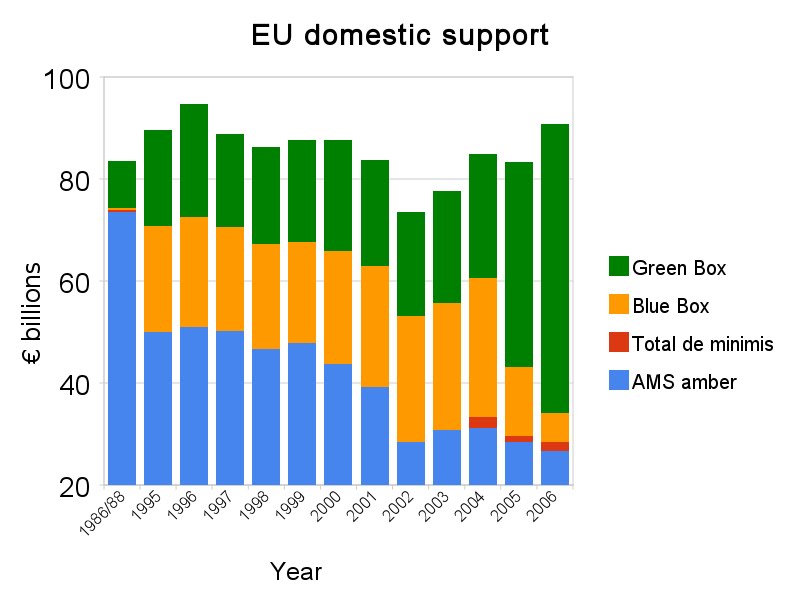
CAP subsidies as reported to the WTO reached a ten-year high of over €90 billion in the 2006/07 marketing year, but conveniently most of them have been parked in the allegedly non trade distorting green box, something that has provoked disquiet in Geneva. The EU notified €90.7 billion of support to the global trade body for 2006/2007 – up from €75.6 billion in 2002, when support was at its lowest in the last fifteen years.
More from ICTSD.
Last Friday, Le Monde, the leading French daily newspaper, devoted a double-page spread on its comment pages to the common agricultural policy. Along with José Bové, Michiel A. Keyzer and Jean-Christophe Bureau I was invited to contribute an article to the debate. You can read it in French on the Le Monde website. I’ve posted an English version below.

Farming should protect Europe’s environmental resources not use them up
In 2009, farm incomes fell across the whole of the EU, not least in France. Dairy farms have been hardest hit with average prices down twenty per cent. This is despite the EU spending 55 billion euro on the common agricultural policy, one of whose aims is to ensure farmers a fair standard of living.
Not long ago the lists of who gets what from farm subsidies were considered ‘state secrets’. No wonder. They reveal that far from supporting small family farms, as the public might suppose, the CAP is lining the pockets of Europe’s biggest landowners and agri-businesses. The data shows that across Europe, 85 per cent of aid goes to the top 17 per cent of recipients.
This is because under the twisted logic of the CAP, the biggest farms with the best land get the most public assistance. Besides helping the rich get richer and big farms to buy out their smaller neighbours, subsidies for land ownership and production rights creates a kind of closed shop. Young farmers must buy their way in and are saddled with heavy debts.
Modern agriculture has brought an abundance of food but it has come at a price that goes beyond the financial costs of the CAP. Over the past quarter century, 40 per cent Europe’s farmland birds have disappeared. Bee colonies, so necessary for pollination of arable crops, are experiencing sudden collapse. Rivers and seas are fouled with fertilizers, pesticides and animal effluent. Each year more ancient natural pasture is put to the plough and more wetlands are drained: once gone, forever lost. The CAP has done little to help. In France, for example, payments for farmland conservation amount to 380 million euro in 2008. They are dwarfed by old-style subsidies of 9.34 billion euro.
Things have improved a little in the past few years and Europe is no longer hurting farmers in developing countries by dumping big surpluses overseas. Farmers are mostly free to farm to market demand rather than to government diktat. Yet these reforms have been opposed at every turn by farm unions and the politicians and civil servants in ministries of agriculture, between whom there are often close ties.
And now, even this modest progress is at risk from a new wind of protectionism blowing across the continent. With a growing world population and a changing climate the question of how humanity will feed itself is back on the political agenda. And rightly so. During the winter of 2007/08, food prices leaped to record levels and the world’s poor faced hunger and even comparatively wealthy Europeans felt the pinch. The response in some quarters has been to adopt a siege mentality and aim for self-sufficiency in food. Why, it is argued, should we put ourselves at the mercy of global markets when there is more we can squeeze out of our own lands?
To base an entire agriculture policy on this logic would be a mistake. Seductive though it may be, the promise of European food self-sufficiency is an illusion as it would come through even greater dependency on on imports of natural gas from Russia for fertilizer and oil from the Middle East to run farm machinery.
Instead of a renewed push for unsustainable agricultural intensification, we should encourage more environmentally-friendly farming. Climate change will increase the risk of drought, flooding and poor harvests and the frightening reality is that any food shortages we may have experienced lately are nothing compared to what we might expect mid-century. We would be wise to safeguard the fertility of our own over-exploited soils, conserve our own precious water, protect the biodiversity we need for the pollination of fruits and vegetables and the ecological resources we will need in an uncertain future. In Europe there is little ‘spare land’ to cultivate and big increases in yields will be hard to find. Increasing global food production can best be achieved by helping farmers in poorer countries whose agricultural productivity lags far behind ours.
Following the election of a new European Parliament and the appointment of a new Commission, the EU will this year embark on a fundamental review of its agriculture policy, which still accounts for 40 per cent of the community’s entire budget. Aside from providing income support to a sector of society that is, more often than not, richer than the average citizen, taxpayers get little for our money. The future must be a common European policy to protect and preserve Europe’s lands, recognising the role played by sustainable farming.
It is certain that such a shift will be fought hard by those who have got used to receiving ‘money for nothing’ but at a time when government budgets are under such strain, we cannot go on like this. In 2009 we discovered where money goes and witnessed the sheer the waste and inequity of a system that in 2008 paid 1,583,120 euro to Prince Hans Adam II of Liechtenstein and 253,987 euro to Prince Albert of Monaco. This year we must start taking action to build a better policy.
Jack Thurston is co-founder of farmsubsidy.org, a network of journalists, researchers and activists pushing for greater transparency in the CAP.
Sugar did not experience the massive price spike in 2007-08 of other commodities, but has been making up for this with a tremendous increase in prices in 2009, driven by poor harvests in Brazil (the world’s largest producer) and strong import demand in India (the world’s largest importer). Raw sugar prices have risen from around 10 USc/lb in May 2008 to over 27 USc/lb currently, and market analysts expect further increases in the coming months.
The increase in world prices means that world prices are now above the (much reduced after the recent sugar reform) EU reference price. Recent price trends are shown in the following figure, reproduced from the SugarTraders website

Despite the very tight global market, EU sugar beet supplies have moved in the opposite direction. The EU expects a bumper sugar beet harvest this year, with beet yields among the best in years. Combined with imports from developing countries which now have free access to the EU market, the EU will have a considerable surplus over its domestic needs. However, exports are limited by a WTO ruling to 1.374 million tonnes, so the EU will be building carry-over stocks at a time of a significant global sugar deficit.
Beet growers in the EU, according to a post on the Agrimoney.com website, have called on the Commission to allow more of the EU’s sugar surplus on to the world market, but the Commission has rejected this call, saying it has to stand by the WTO ceiling. According to a Bloomberg report on 14 December last, the Commission view is that “the carry-over of surplus sugar in the EU is inevitable as it is not possible to export out-of-quota sugar in excess of the WTO limit.”
Whether this is the case or not goes back to the basis for the WTO ruling on the complaint brought by Brazil, Australia and Thailand against the previous EU sugar policy. The WTO ruled that, despite the absence of explicit export refunds for over-quota EU sugar, over-quota sugar was effectively subsidised because it was being sold at less than average cost of production and was cross-subsidised by the higher price of quota sugar.
The Bloomberg report quotes a number of UK agricultural economists who argue that because world prices are now above EU reference prices, then exports can be undertaken without subsidy and the export limits should not apply. The French Miniser for Agriculture has promised his country’s beet growers that he will raise with the Commission ways to avoid carrying over this year’s surplus into the following year.
However, the EU spokesman points out that EU market prices are still above the world price (as is also seen in the diagram above, although EU prices are only published with a 3-month lag). Thus, even without an explicit export subsidy, other exporting countries may still be able to argue that additional EU exports are only possible because of cross-subsidisation.
EU market prices have been falling, and this has consequences for those ACP developing country exporters which still benefit from a price guarantee on the EU market. Whereas ACP exporters were getting €512/tonne and €616/tonne for ACP raw and white sugars respectively in May 2007, these prices had fallen to €448/tonne and €517/tonne by September 2009 (EU sugar prices including ACP prices are reported on the EU Circa website). Some ACP exporters are now arguing that it does not pay in the short-term to export to Europe, so projected imports in the current year may be lower than expected.