Earlier in the month I wrote that Agriculture Commissioner Mariann Fischer Boel was holding the line against protesting dairy farmers and a clutch of national agriculture ministers looking for more aid for their troubled farmers. It looks as though I spoke too soon. At this month’s farm council, Commissioner Fischer Boel found a further 280 million euro from the 2010 budget to give to dairy farmers, in addition to measures announced last month. [...]
The final paragraph of Commissioner Fischer Boel’s valedictory leaflet is revealing and foreshadows the debate that has yet to surface about the future of the CAP after 2013, the end of the current financial perspective. Mrs Fischer Boel makes the case for maintaining a common European agriculture policy among the EU’s 27 member states, presumably funded from the EU budget, as it is now. [...]
The Green-10 grouping of European environmental groups (including big-hitters like Birdlife, WWF and Greenpeace) has produced a dismal scorecard of the outgoing European Commission’s environmental record. The report describes Agriculture Commissioner Fischer Boel has having begun well but quickly reverted to a ‘disappointing business-as-usual approach’ to the common agricultural policy. [...]
Farm commissioner Mariann Fischer Boel has reiterated the EU’s commitment to phase out all export subsidies by 2013, but in the meantime has insisted on their use to defend EU market share. Responding to concerns that the dairy export refunds, reintroduced in January, mean ‘dumping’ cheap produce on developing countries, Fischer Boel said that the EU cannot risk losing its market share to other major exporters. [...]
On a visit to China a few years ago I met an elderly professor who had been sent with his students to the countryside during the Maoist period for ‘re-education’ by the peasants. He struck a deal with the local peasants that allowed them to work on their books two days a week. Now farm commissioner Mariann Fischer Boel, a large-scale farmer with her husband in Denmark, has decided that Commission officials in DG Agri need re-education. She considers that they are too detached from farmers and don’t understand their problems. [...]
The anti-EU agitprop outfit Open Europe has been huffing and puffing over the golden goodbyes that await those European Commissioners who will be put out to pasture when the current Commission’s five year mandate comes to an end later this year. Among their number is thought to be our own Agriculture Commissioner, Mariann Fischer Boel who, after five years of service in Brussels stands to receive approximately 270,000 euros of ‘transition money’ before her 43,000 euro a year pension kicks in.
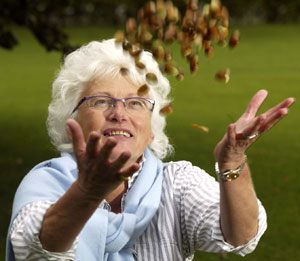
The 66-year old Dane, who sports a trademark shock of snow white hair, has invoked the spirit of Hollywood actress Jennifer Aniston in the L’Oréal commercials, insisting the payout is entirely justifiable “because I’m worth it”. It’s just as well that the Commission scheme is so generous since Fischer Boel, who together with her husband owns several large livestock farms, is too old to qualify for the EU-funded early retirement scheme for farmers, which pays out a maximum of €18,000 a year to farmers who quit before turning 55. The typical ruse is for farmers approaching 55 to “retire” and apply for the early retirement money while passing the legal title of the farm on to a son or daughter who, in all likelihood, will qualify for an EU-funded young farmers startup grant worth up to €40,000. Both continue to work on the farm as before.
It’s no wonder that the Commission suppressed the Court of Auditors report on cross compliance for as long as it could – the report is damning and undermines the Commission’s case for the legitimacy of EU farm subsidies.
Speaking in 2005, Agriculture Commissioner Mariann Fischer Boel explained how she sees cross compliance in relation nearly 40 billion euros of public expenditure on payments to farmers:
“I would emphasise that decoupled payments are not “money for nothing”. To get the cheque in the post, a farmer has to respect a demanding range of standards related to the environment and animal welfare. We call this system “cross-compliance”.”
Today’s report by the Court shows that such a view is at best wishful thinking and at worst deliberately deceitful. Cross compliance does not represent a ‘demanding range of standards’ at all.
It should be stressed that this study is the biggest and most comprehensive to date. The Court says that it “carried out an audit in 2008 of the cross-compliance policy at the Commission and in seven Member States representing the diversity of agriculture across Europe”.
The top line conclusion pulls no punches:
“the objectives of this policy have not been defined in a specific, measurable, relevant, and realistic way, and that at farm level many obligations are still only for form’s sake and therefore have little chance of leading to the expected changes, whether reducing the size of payments or modifying farming practices.”
Senior officials at the Court are reported to be fuming at the suppression of the report until after the CAP health check was concluded. They should rest assured that their work has not been in vain: this report will play a big part in the discussions of the future of the CAP as part of the EU budget review.
Read the press release and the full report (60+ pages).
Mariann Fischer Boel attended the plenary debate on the CAP health check in the European Parliament earlier today. There is little to report from the debate – most of the contributions were bland and reflected the general desire of the European Parliament to water down the Commission’s reform proposals. Neil Parish MEP called for the pace of reform to continue but it was Brian Simpson MEP who made the most powerful dissenting speech, ripping into the Parliament’s draft report, written by Luis Manuel Capoulas Santos MEP. Mr Simpson concluded that
“Your position, Commissioner, on compulsory modulation, is right. Your position on decoupling is right. For once we have a Commission that seriously wants to reform the CAP but faces a Parliament that always fails to deliver on this issue and believes that the challenges that we face can be solved by sticking to the old, discredited system. Hang tough, Commissioner, you are right and sadly, I suspect, this chamber will be wrong.”
It might interest some to see the Commissioner’s short speech.
Surging prices for agricultural commodities means that the EU spends much less on the traditional ‘market measures’ of the CAP such as intervention buying when prices fall below a target price, export subsidies and private storage aid for unsold surpluses. Last year the EU decided to allocate some of this underspend to the Galileo space programme. This year, the proposal is to channel the money to farmers in developing countries who currently suffer from very low productivity. [...]
While many are disappointed by the lack of ambition in the Commission’s health check proposals, there’s no doubt that Commissioner Fischer Boel has been on form when it comes to the pithy soundbites. [...]
The Commission’s widely leaked proposals for the health check of the CAP are now available, together with various supporting documents and impact assessments. Analysis and reaction will follow on this site over the coming days. Watch the press conference live at 16.30 Brussels time on this AV link. [...]
One proposal in the Commission’s health check communication of 20 November 2007 is that the member states which still allocate farm subsidies on the basis of historic entitlements should move to the area average system in which allocations are the same across all hectares in a given geographical region. But it looks as though this change will be optional, according to a speech made by Commissioner Fischer Boel in Ireland on 29 January. Moreover, the flat rate system does nothing to address the striking inequalities between member states, which shows that on average, Dutch farmers get €1299 per hectare, while Portuguese farmers get just €88. [...]
Top Commission officials have confirmed that in the face of opposition from four member states (Czech Republic, Germany, Slovakia and the UK) as well as many farm unions, Mariann Fischer Boel has dropped plans to cut the very largest farm subsidy payments by 45 per cent. The plan, which would have affected an estimated 23,000 farms that receive in excess of €300,000 a year, a list which is dominated by Europe’s wealthiest landowners such as the Duke of Westminster, Prince Albert of Monaco and the Crown Prince of Liechtenstein. [...]
Agriculture Ministers had their first discussion of the Commission’s Health Check proposals at the first Council meeting under the Slovenian Presidency yesterday. It appears that the two issues causing the most fuss are the Commission’s suggestions to introduce a progressive reduction in single farm payments to larger farms (inaccurately referred to as capping) and to increase the rate of compulsory modulation (which again would only affect larger farms), in both cases with the additional funds going to Pillar 2 rural development measures. At the same time, Ministers were clearly taken by the emphasis on risk management and safety nets in the Commission Communication and called for more specific proposals in this area.
[...]
Later today the European Commission will present its proposals for changes to the Common Agricultural Policy – for so long an emblem of bureaucracy, waste and injustice. This will be the first reform since details began to emerge from top secret government files about exactly who gets what from the €55 billion Europe spends each year on farm subsidies. After a landmark FOI case by The Guardian in 2005, revelations about farm subsidies paid to the Queen (£466,667 in 2005), the Duke of Westminster (£526,136) and Sir Richard Sutton (£917,650) hit the headlines across Europe. [...]
Anyone itching to find out what the Commission will be proposing for the CAP health check next Tuesday 20 November need look no further. DG Agri is as leaky as the proverbial sieve and after the jump we have for your reading pleasure the latest version of the consultation document, including a markup of changes made since the AgraFacts leak back in October. [...]
The CAP Health Check has been promoted by the Commission as an exercise focused on tidying up the loose ends of the 2003 Mid Term Review and adapting the CAP to an evolving set of circumstances for the period 2008 – 2013. However, this is only half the equation. The Budget Review is set to open up a much more fundamental debate on the rationale for European expenditure on agriculture, and in doing so will delve into the very heart of the CAP. [...]
Speaking at a meeting of the Parliamentary Agriculture Committee in Nicosia, Cyprus on 29 June, Agriculture Commissioner laid out her current thinking on the future of the CAP, in particular the changes she will be proposing later this year for the CAP Health Check. [...]
It sounds like a Maoist slogan, but farm commissioner Mariann Fischer Boel set out a ‘one vision, two steps’ plan for the reform of the CAP at the recent Agra Europe conference in London. As she has made clear before, the forthcoming Health Check which will address the period up until 2013 is seen largely as a tidying up exercise rather than an opportunity for further fundamental reform. The Commission is currently preparing a Green Paper on the Health Check but this is not expected to be ready until after the summer. [...]
Speaking at the annual conference of the National Farmers’ Union, EU Agriculture Commissioner Mariann Fischer Boel set out her priorities for next year’s CAP ‘health check’. She described her approach as ‘one vision, two steps’, the first step being the health check and the second step being the EU budget review scheduled for 2008/09. It will be very interesting to see how successful she will be in keeping these two steps separate, as the sheer size of the CAP in relation to the rest of the EU budget (in 2005 it was a shade under 50%) makes it impossible to have any meaningful budget discussions without addressing the future of the CAP. [...]
![]()
With her silvery hair, Marks & Spencer outfits and matronly demeanour, EU Agriculture Commissioner Mariann Fischer Boel can give the impression of being rather old fashioned. So it comes as some surprise to discover that she is in fact a techno-geek. [...]