Court of Auditors launches broadside against deficiencies in agri-environment schemes

Alan Matthews | September 24th, 2011 - 9:33 am


Are we as taxpayers getting good value for money from agri-environment payments under the EU’s rural development (RD) policy? This is an important question, given that agri-environment payments will amount to around €22 billion during the 2007-2013 RD programming period, alone accounting for around 23% of all Pillar 2 spending. It becomes more important given that the Commission is flagging that it wants to direct even more funding towards the provision of environmental public goods in the next programming period.
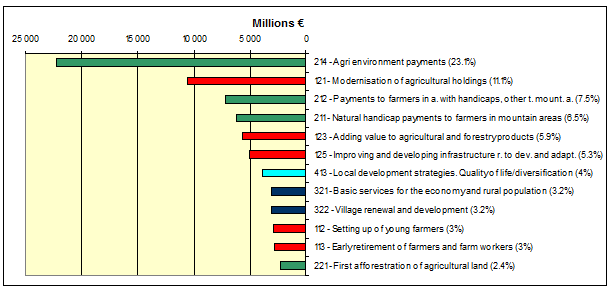
Breakdown EU Rural Development spending 2007-2013Breakdown EU Rural Development spending 2007-2013

A European Court of Auditors report published last Monday (September 19) provides a rather critical response to this question. The Court summarises its findings as follows:

Agri-environment is a key EU policy which aims to respond to society’s increasing demand for environmental services. This report assesses whether this policy is well designed and managed. The Court found that the conditions for assessing whether or not the objectives of the policy have been achieved are not in place. The systems for providing guidance to farmers were generally well implemented. However, considerable problems were identified concerning the aid amounts. Most expenditure was made on basic horizontal schemes without applying selection procedures and without clear decisions about the desirable degree of targeting. Although the audit identified good practices, the weaknesses found by the Court have hampered optimal achievement of the main objectives of agri-environment, namely contributing to EU-level priority areas (biodiversity, water, climate change) and improving the environment and the countryside.

The Court concludes its audit with four recommendations. Two of these relate to improved Commission oversight of the way Member States implement the relevant EU legislation.

Member States are criticised because often their rural development programmes do not contain clear environmental objectives. Where objectives are specified, there is often little linkage made between these objectives and the environmental sub-measures to be funded. Where the linkages are made, there is often little attempt made to monitor the impact of the measure, and little information was available on the environmental benefits of agri-environmental schemes. Aid payments to farmers often do not provide the right incentives, either over-compensating farmers in some cases or not compensating enough in other cases to ensure sufficient participation to really make an environmental difference. All of these issues are addressed in the legislation, and despite some rebuttal of the Court’s criticisms in the Commission’s replies to the audit, clearly there is still some way to go before good practice is routine in the Member States.

Court calls for more targeting of agri-environmental payments

The other two recommendations are more far-reaching because they raise a fundamental policy issue for future agri-environmental schemes. The Court found that, in the 8 regions it examined, the great bulk of agri-environment payments were made through broad, ‘horizontal’ measures available to all farmers in the region, often 80% or more of the total. It also noted that part of this expenditure is for maintaining existing favourable farming practices. It questioned whether in many cases there is an environmental benefit from this expenditure.

One of the more striking statistics in the report is that the Court found no evidence of specific environmental pressures in 39%, almost two-fifths, of the 203 individual environmental contracts it examined. In other words, within a 10 km radius of these farms, there was no evidence of water pollution; no evidence of marginalisation or abandonment of farming; no evidence of threats to exceptional plant diversity; no evidence of soil degradation; no threats to animal populations or animal biodiversity; no threats to plant communities in areas with normal biodiversity; and no evidence of landscape degradation.

The Court’s response to this finding is worth quoting in full:

A rational way to implement agri-environment policy is, on the basis of clearly identified environmental problems, to determine the required targets for impacts and participation levels and on this basis to determine the necessary financial resources. Identifying environmental problems means that there must be an environmental threat justifying why farming practices must be maintained or changed. Failure to apply this logic leads to an insufficient focus on environmental effects. Thus, the audit found that in 39 % of the 203 contracts reviewed, there were no specific environmental pressures in the area where the contract was implemented, or such problems could not be identified by the Member States…

The Court concluded that the large amounts of money spent on entry-level schemes, in contrast to the small amounts spent on higher-level schemes, were insufficiently justified in the rural development programmes concerning their environmental effects.

It favoured, instead, targeting funds to geographical areas, types of farms or farming practices by setting appropriate eligibility criteria. It noted that ensuring that funds are spent according to regional needs and priorities is of key importance for enhancing the environmental effects of agri-environment sub-measures.

The Commission’s defence of the status quo is that ‘the purpose of agri-environment support is not only to address environmental pressures but also to maintain and enhance environmental potentials and opportunities’. Its argument seems to be that it ok to provide agri-environment payments now to farmers without evident environmental problems in order to prevent such problems arising in the future.

The Court was not convinced by this argument. Instead, it recommended that the Commission should consider whether expenditure should be more precisely targeted to specific environmental needs in the next programming period. Specifically, it recommended that:

  • Member States should be required to better justify cases when the objective is to maintain environmentally friendly farming practices;
  • Member States should assess the potential benefits created by improved geographical targeting of agri-environment expenditure versus the increased administrative costs in¬curred;
  • Member States should set quantified targets for participation levels based on the required environmental effects and then determine the level of financial resources needed;
  • Agri-environment payments should be split into simple, generalised agri-environmental actions with a relatively low rate of aid and more demanding actions attracting a higher rate of aid and targeted to EU-level priority areas. Support for organic farming would constitute a third measure.
  • The Commission in its response defended the mix of basic and higher level schemes, noting that basic schemes, if well designed and implemented, can offer significant environmental benefits at relatively low cost. However, it did accept that better targeting of agri-environment payments is necessary and is envisaged in the framework of the CAP post 2013.

    One wonders what the mix between basic and higher level schemes would be if agri-environment payments were managed by Ministries of the Environment rather than Ministries of Agriculture?

    ELO and BirdLife fire the starting gun

    Jack Thurston | January 28th, 2010 - 12:06 pm

    Nothing tells you that a big political debate is hotting up like the emergence of new alliances of odd bedfellows. Yesterday saw a major joint intervention from two of Europe’s biggest, most authoritative and well-connected players in EU agriculture policy.

    Birdlife International is a global partnership of conservation organisations. The Royal Society for the Protection of Birds, its member in the UK, boasts well over a million members. The European Landowners Organization is a federation of farmer and landowner associations. Both Birdlife and ELO have members and affiliates in each of the EU’s 27 member states.

    They have come together in support of new ‘joint position’ for the future of the CAP. It is based around seven core principals. At its heart is a recognition that agriculture policy should be reoriented towards supporting the active land management practices that are needed to protect the landscape, the environment, preserve biodiversity and ensure for the long term Europe’s capacity to continue as a major producer of food.

    The joint position stresses the need for a common European policy backed by money raised at a European level on the grounds that many aspects of land management require a cross border approach, e.g. water basins that span national boundaries, wildlife species that migrate long distances and seas that lap on the shores of more than one country. Moreover, within a the European common market for food, policies that have a bearing on food production should not operate in a way that distorts free competition. Birdlife and ELO also argue that solidarity among European nations of widely different levels of affluence and a shared concern for the future of the unique European tapestry of landscape and rural heritage is justification for a common European policy financed from a common budget.

    The joint position is frank in its admission that despite a measure of evolution since it was founded in the early 1960s and some changing rhetoric, when it comes to how the €55 billion a year of CAP money is actually spent, it is still “a policy tuned to supporting agricultural commodity production”. It goes on to argue that the CAP must leave behind its commodity production past and embrace to a future in which “public expenditure matches, as much as possible, the delivery of public benefits which are vital for achieving both food and environmental security”.

    Birdlife has been a pioneer of the “public money for public goods” mantra that looks certain to dominate at least the semantics of the upcoming CAP reform debate, if not the actual policy content. (Public goods have a very clear definition in economic theory but the term is increasingly thrown around without much precision, even by those who should know better, such as three analysts from the IEEP, who in a recent report, define agricultural public goods so widely as to remove any analytical power from the concept.) That a big, mainstream farm union like the ELO should throw its weight behind the public goods argument, and nail its flag to the Birdlife mast, is a significant achievement for the conservation group. It also suggests that the ELO has made a strategic calculation that the public money for public goods will be the defining logic of the next CAP reform, and it is better to get ahead of the argument than be left behind.

    Making the opposite strategic choice is the UK’s National Farmers Union which is perhaps not surprising since the NFU’s main competition for members comes from the ELO affiliate the Country Land and Business Association (CLA). With Birdlife and the CLA even putting in a cordial joint appearance on the influential BBC Radio 4 Today Programme, the NFU’s Tom Hind reacted angrily to their joint position, dismissing the public goods argument as ‘naive’ and ‘old school’. For the NFU, the recent volatility of food prices means the next CAP reform should see the policy sharpen its focus on boosting commodity production. Some might regard this as a ‘pre-school’ approach.

    Today the NFU issued a further reaction in the form of a press release in which its President Peter Kendall denounces the Birdlife/ELO position and reaffirms the NFU commitment to a CAP aimed squarely at commodity production and cheap food. Over the past few years successive NFU leaders have made the case for remuneration for public goods provided by agriculture (even the NFU’s EU-level partner COPA/COGECA has begun talking in these terms). So this more traditional perspective brings the NFU much closer to the positions taken by continental farm unions like the FNSEA in France.

    hillside

    Putting the UK sideshow to one side, the joint position sets out some of the policy implications of the high level argument for a CAP aimed at long term environmental and food security. It argues that High Nature Value farming, for example extensive grazing livestock farms, is badly neglected by the current CAP and should get a much larger share of taxpayer support, at the expense of more modern, resource-intensive and commercially-viable production systems such as feedlot livestock-rearing and monoculture cereal farms. During the question and answer session of the launch of the joint position in the European Parliament, I put it to Allan Buckwell, policy director of the ELO, that the plan would involve a major redistribution of subsidies and this could be politically toxic. Buckwell was admirably frank in agreeing that the plan would involve significant redistribution of support and made it clear the ELO was not in the business of defending the current allocation of CAP funds.

    For a statement from a leading European farm union, the ‘joint statement’ is remarkable in that its contains the weakest possible defense of the market mechanisms (support prices, intervention buying and export subsidies) and direct aids of the first pillar of the CAP:

    “Pillar 1 has certain strength in its relatively administrative simplicity and in the strong element of certainty and revenue stability it gives farmers.”

    The ‘joint position’ contains no reference to measures to ensure price stability nor does it argue for the continuation the current system of direct income support for farmers. However, it is implicit that paying farmers for the provision of public goods does provide them with a valuable new income stream to supplement what they get from the marketplace. Both Allan Buckwell and RSPB’s Gareth Morgan made this point during the question and answer session.

    Nevertheless, it is striking that first pillar of the CAP, which still takes up well over three quarters of the current budget, is well and truly hung out to dry. The joint position states that the mechanisms and measures of a reformed CAP “are likely to show more characteristics of the current CAP rural development and agri-environment measures than current support measures”. These characteristics are listed as follows: (1) a contractual basis of payments that lists the public goods the recipient of public funds is expected to produce in return for the public money paid, (2) transparency of both the funding and the contractual commitments, (3) targeting of specific outcomes and results that are quantifiable and measurable, (4) monitoring of performance and adaptation of policies in the light of outcomes, (5) accountability of recipients of EU funds and the national and regional authorities responsible for implementing EU policies and spending EU funds.

    It is a sign of changing times that the ELO and Birdlife International are able to see eye-to-eye on the fundamental principals of a new CAP. In my view, they are on the right side of most of the big issues and the ELO has clearly stolen a march on the more traditional farm unions who would prefer to line up in defense of the status quo. My colleague Valentin Zahrnt has argued that BirdLife is makinge a mistake geting into bed with the ELO. I disagree. It’s not possible to achieve radical reform of the CAP without buy-in from the more progressive of Europe’s farmers and land managers.

    Either way, there is no doubt that this will be seen a very important intervention as this year’s debate on the next CAP reform gets going. Read the joint position here

    Does France really want to suspend agri-environmental measures?

    Jean-Christophe Bureau | January 16th, 2010 - 12:37 pm

    The president of the main farmers’ union, the Fedération Nationale des Syndicats d’Exploitants Agricoles (FNSEA) Jean Michel Le Metayer called for “a pause in agri-environmental measures” and the suspension of new measures. For French speaking readers, the (short) video is here.

    The Ministry of agriculture seems sympathetic with this position, even though Nicolas Sarkozy has recently positioned himself as greener than his predecessors, with initiatives under a framework law called the “Grenelle of the environment” and a carbon tax (it turns out that farmers should be exempted from paying this tax, eventually). The French minister Bruno Le Maire apparently said a few days after that, indeed, a revision of the agri-environmental measures (AEM) was necessary and that it should start with an inventory of the provisions adopted throughout the Union according to the newspaper Le Figaro. On January 13 Le Maire unveiled a proposal for a new agricultural law to be discussed by the Parliament with little apparent concern for the protection of the environment.

    sheep3The idea of suspending agri-environmental measures is bizarre, given that they are voluntary measures that are highly appreciated by farmers in some regions, providing often a third or more of the farm incomes in mountainous regions for example. So what did the FNSEA president actually mean? After some inquiry, it seems that he actually used the term “agri-environmental measures” for CAP jargon ignorant journalists. He was not in fact targeting the AEMs, i.e. second pillar measures, but rather the GAECs (Good Agri-Environmental Conditions, i.e. a set of technical constraints that farmers needed to respect in order to receive the Single Farm Payments, under Pillar 1, part of what is sometimes known as cross-compliance), as well as “any element of regulation that imposes environmental constraints such as the Nitrate Directive, or national measures under the new Grenelle law framewok” (FNSEA sources). Le Metayer argued in the interview that because of low prices and low incomes, farmers could not afford the ever growing stream of environmental regulations.

    To FNSEA’s defense, some of the constraints imposed in 2009 turned out to be ill-designed in some regions. For example, farmers had to plant intermediate crops between harvests so as to keep soil covered and reduce nitrate leaching. In some areas, the lack of rain when these crops were planted resulted in extra costs without any environmental benefit. However, the FNSEA position sends an awkward signal regarding farmers’ image in the public opinion, while water pollution with nitrates makes headlines every summer. More worryingly, Le Metayer’s demand shows how much the the anti-environmental stance is widespread among the mainstream French farm lobby (another farmer’s union, the Coordination Rurale runs perhaps an even more anti-environmental program than the FNSEA). The FNSEA is highly representative and about to win again a majority in one of the main instances that co-manage the agricultural sector with the government in France. Only a minority of farmers belonging to the left wing Conféderation Paysanne seems in favour of a greener CAP, but their position regarding market regulation makes them hardly credible in the European debate (they favour a system of generalized quotas and a complex set of coupled payments restricted to small farms). A fringe of enlightened entrepreneurial farmers, the Société des Agriculteurs de France is open to produce public goods as much as wheat if the CAP pays them for that, but this is more a think tank than a powerful union.

    It is hard to make predictions regarding the future behaviour of France as far as the coming debate on the CAP is concerned. With France becoming a net contributor to the CAP, the unholy alliance between the ministry and agriculture and the ministry of finance to defend large CAP budget is about to end. The former minister, Michel Barnier, used Health Check flexibility to reallocate 1.4 billion euro of Single Farm Payments towards the extensive grass-fed livestock sector. This has turned the powerful cereal producers against the government. Given that farm incomes have decreased much more than the EU average in 2009, the Ministry of agriculture can hardly afford more radicalization of the farmers, and his apparent scorn for environmental causes is perhaps tactic. However the historical aversion of the FNSEA for the environment has been particularly effective in the past. France will certainly resist any greening of the CAP in the future.