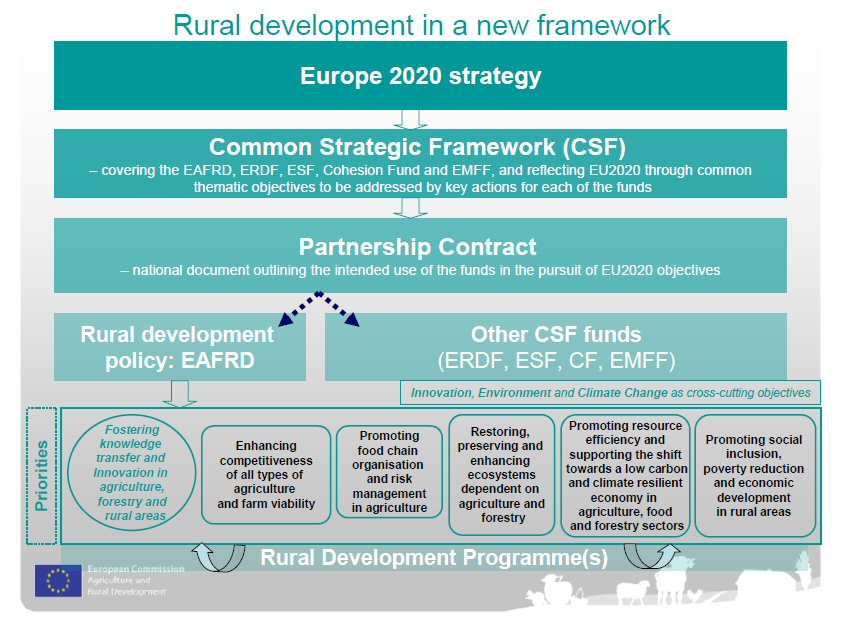
The publication by the Commission of its second Draft Amending Budget (DAB No.2) to the EU’s 2015 budget this week reveals in stark figures the extent of the hiatus in CAP rural development spending caused by the delays in passing the relevant legislation and in approving rural development programmes. I first highlighted how approval of rural development programmes was falling way behind schedule in this post; the Commission’s budget figures now allow us to quantify the extent of the damage.
The delays do not affect only rural development programmes but all programmes under the European Structural and Investment Funds, the Asylum, Migration and Integration Fund and the Internal Security Fund. The Commission reports that 645 programmes need to be approved in total, of which 118 are rural development programmes. It estimates that 252 programmes (39%) were adopted in 2014, 93 (14%) are eligible for adoption on 2014 appropriations carried over to 2015, and for the remaining 300 programmes (47%) the corresponding 2014 appropriations have been left unused.… Read the rest
Agricultural implications of British EU withdrawal for rest of the EU
This Sunday, the Greek general election may decide if Greece will leave the Eurozone, sometimes referred to as Grexit. None of the likely winners of the election, including Syriza, want this, but if there is an unwillingness to address the restructuring of Greek debt, particularly given Syriza’s promises to dramatically increase public spending, this could be the outcome. Whether Greece would then remain a member of the EU if this were to happen is uncertain, with The Economist arguing this week that, in all likelihood, Greece would have to leave the EU as well.
Later this year, on 7 May, the British general election takes place. The outcome of this election will influence the likelihood of Brexit, namely, British withdrawal, not from the Eurozone, but from the EU. David Cameron, the UK Prime Minister, has promised to hold a referendum on UK membership of the EU in 2017 if the Conservatives are returned to power.… Read the rest
Impact of the MFF negotiations on the CAP 2013 reform
The CAP 2013 reform was the first negotiated under the ordinary legislative procedure (co-decision) in which both the Parliament and the Council had equal powers. A project undertaken by the Centre for European Policy Studies in Brussels for the European Parliament’s Policy Department has sought to examine what impact and influence the Parliament had on the CAP 2013 out-turn as a result of co-decision. Did co-decision give the Parliament a greater opportunity to influence the final outcome, who were the key players in shaping the Parliament’s views and what did the Parliament use its influence to achieve?
The final study, when it is published, will throw light on these issues. The team behind the study (of which I was one) also commissioned a series of case studies on specific issues raised in the co-decision process. These case studies are now available on the CEPS website. They include a detailed amendment analysis by Imre Fertð and Attila Kovács of the Council and Parliament amendments to the Commission’s original draft proposals which evaluates the relative effectiveness of the two bodies in carrying their amendments into the final legislation, a detailed study of the role of COMAGRI by Christilla Roederer-Rynning, an analysis of the evolution of the greening debate by Kaley Hart, and an analysis of the European Parliament’s position on market regulation by Alessandro Olper.… Read the rest
Simplification as a top priority in 2015
The heading of this post is taken from the title of the speech delivered by the Commissioner for Agriculture and Rural Development Phil Hogan when addressing the EP COMAGRI on 3 December last. It follows his commitment in his confirmation hearings to a simplification and subsidiarity strategy for the CAP. It seems simplification will be a big buzz word in CAP discussions in 2015. But what can we expect from this initiative, and how important is it likely to be in practice?
Simplification: a Sisyphean task
CAP simplification has been a mantra of all previous Commissioners. For example, shortly after taking up office as Commissioner for Agriculture in 1995, Franz Fischler, in a speech on 28 September 1995, declared:
… Read the restFor my part, I intend to contribute to review existing E.U. legislation, notably in my area of competence, so as to make the C.A.P. easier to understand and to apply. C.A.P. simplification is an overriding objective, not only because our farmers, in particular the smaller ones, seek it and need it, but also because, without it, it will prove exceedingly difficult to implement the C.A.P.