This is a shortened version of a post which was first written for the Institute for International and European Affairs EnvironmentNexus blog
From the perspective of the agricultural environment, there are three elements in the European Council conclusions on the EU’s Multi-annual Financial Framework on 7-8 February which should be noted.
The first element is the general commitment that climate action objectives will represent at least 20% of EU spending in the period 2014-2020 and should be reflected in the appropriate instruments to ensure that they contribute to strengthening energy security and building a low-carbon, resource efficient and climate resilient economy.
As agricultural spending will continue to account for 36% of total MFF spending during this period, it will also have to contribute to this objective. This will require a classification of what spending contributes to climate action objectives. One might speculate, for example, that the Commission is likely to consider the proposed green payment in Pillar 1 as a climate action instrument, in addition to some spending under the Pillar 2 rural development budget.… Read the rest
Court of Auditors launches broadside against deficiencies in agri-environment schemes
Are we as taxpayers getting good value for money from agri-environment payments under the EU’s rural development (RD) policy? This is an important question, given that agri-environment payments will amount to around €22 billion during the 2007-2013 RD programming period, alone accounting for around 23% of all Pillar 2 spending. It becomes more important given that the Commission is flagging that it wants to direct even more funding towards the provision of environmental public goods in the next programming period.
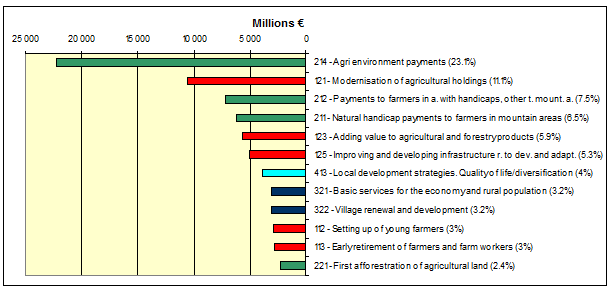 Breakdown EU Rural Development spending 2007-2013
A European Court of Auditors report published last Monday (September 19) provides a rather critical response to this question. The Court summarises its findings as follows:
… Read the restAgri-environment is a key EU policy which aims to respond to society’s increasing demand for environmental services. This report assesses whether this policy is well designed and managed. The Court found that the conditions for assessing whether or not the objectives of the policy have been achieved are not in place.
ELO and BirdLife fire the starting gun
Nothing tells you that a big political debate is hotting up like the emergence of new alliances of odd bedfellows. Yesterday saw a major joint intervention from two of Europe’s biggest, most authoritative and well-connected players in EU agriculture policy.
Birdlife International is a global partnership of conservation organisations. The Royal Society for the Protection of Birds, its member in the UK, boasts well over a million members. The European Landowners Organization is a federation of farmer and landowner associations. Both Birdlife and ELO have members and affiliates in each of the EU’s 27 member states.
They have come together in support of new ‘joint position’ for the future of the CAP. It is based around seven core principals. At its heart is a recognition that agriculture policy should be reoriented towards supporting the active land management practices that are needed to protect the landscape, the environment, preserve biodiversity and ensure for the long term Europe’s capacity to continue as a major producer of food.… Read the rest
Does France really want to suspend agri-environmental measures?
The president of the main farmers’ union, the Fedération Nationale des Syndicats d’Exploitants Agricoles (FNSEA) Jean Michel Le Metayer called for “a pause in agri-environmental measures” and the suspension of new measures. For French speaking readers, the (short) video is here.
The Ministry of agriculture seems sympathetic with this position, even though Nicolas Sarkozy has recently positioned himself as greener than his predecessors, with initiatives under a framework law called the “Grenelle of the environment” and a carbon tax (it turns out that farmers should be exempted from paying this tax, eventually). The French minister Bruno Le Maire apparently said a few days after that, indeed, a revision of the agri-environmental measures (AEM) was necessary and that it should start with an inventory of the provisions adopted throughout the Union according to the newspaper Le Figaro. On January 13 Le Maire unveiled a proposal for a new agricultural law to be discussed by the Parliament with little apparent concern for the protection of the environment.… Read the rest