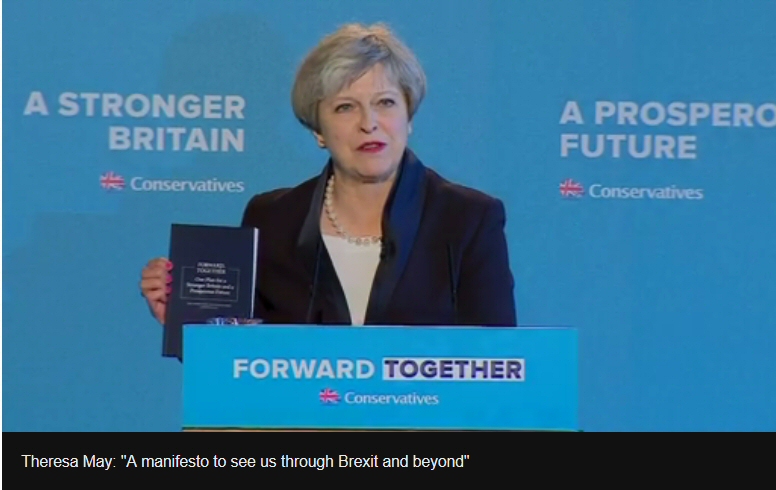
Given that Mrs Theresa May seems certain to be returned as UK Prime Minister with a greatly increased majority after the UK General Election on 8 June next, it is worth paying particular attention to what the Conservative Party manifesto which was launched yesterday has to say on Brexit issues in general and trade, immigration and agricultural issues in particular.
The manifesto actually has little new to say on these topics, with the exception of a new promise to extend agricultural support at current levels to the end of the next parliament, i.e. 2022 compared to the current commitment to maintain support at current levels to 2020. Given that EU agricultural spending may well be reduced in the next Multiannual Financial Framework period, we could end up with the paradoxical outcome that farmers in the UK, supposedly the greatest critic of the CAP, will receive higher payments following Brexit than if the UK were to remain a member of the EU, at least for a period (though of course direct payments are only one factor in farm incomes, and changes in trade access, tariff protection and exchange rates would also need to be factored in).… Read the rest
Latest EU AMS notification confirms declining trend in WTO amber box support
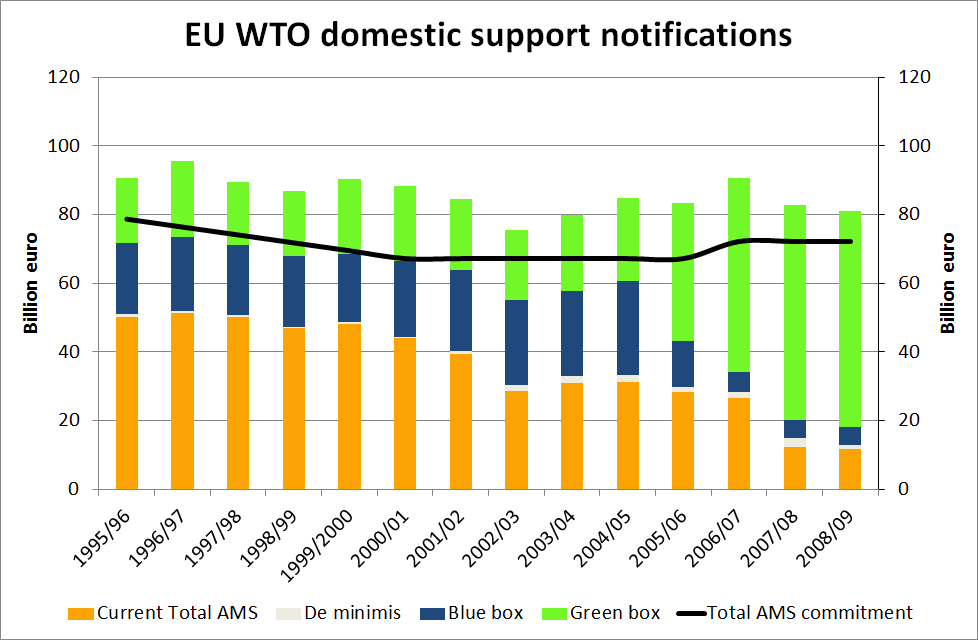
The EU has just submitted its domestic support notification to the WTO for the year 2008/09 (hat tip to LB) and this year there are no surprises. Total support (using the WTO definition) was a shade over €80 billion, but the value of its trade-distorting support (the so-called ‘amber box’, given by its current total Aggregate Measure of Support) fell to its lowest level ever, at just under €12 billion.
In that year, the EU used just over 16% of its Total AMS commitment (its bound ceiling) of €72.2 billion. In other words, the EU could have reduced its AMS commitment by over 80% in that year and would still have fulfilled its WTO amber box obligation.
The AMS includes three main categories of support: direct payments that do not fall under the green or blue boxes as non-exempt direct payments; market price support for products for which an administered price exists; and an equivalent measure of support for those products where the domestic market is supported but where no obvious administered price exists.… Read the rest
The changing landscape of agricultural support
Discussions on reducing agricultural support in the Uruguay Round and, especially, the WTO Doha Round have been framed increasingly in North-South terms. Developing countries have sought reductions in OECD country agricultural support while developed countries have sought increased access to their manufacturing and services markets in exchange.
However, the landscape of agricultural support is changing. While levels of agricultural support and protection have been falling in OECD countries (helped by high world market prices), agricultural support in a number of (but not all) emerging economies has been increasing (despite the increase in world market prices).
These changes in the global distribution of agricultural support have two main consequences. First, the pattern of global agricultural trade is increasingly influenced by agricultural policy interventions in non-OECD countries, even if OECD countries still have a predominant weight in global agricultural production and trade.
For example, world cotton prices which are a concern for the West African C-4 countries in the WTO are now more distorted by subsidies in China and Turkey than by subsidies in the US and the EU.… Read the rest