Recent trends in EU WTO domestic support notifications

The EU submitted its latest domestic support notification to the WTO for the 2015/16 marketing year on 23 August last. This notification is interesting because it covers the first full year of operation of the new CAP in 2015, as the new direct payments architecture was first implemented in that year. This post examines the trends in domestic support in this and recent notifications, and speculates on how the figures might be affected by the Commission’s legislative proposals for the CAP announced on 1 June last.

Trend in overall domestic support

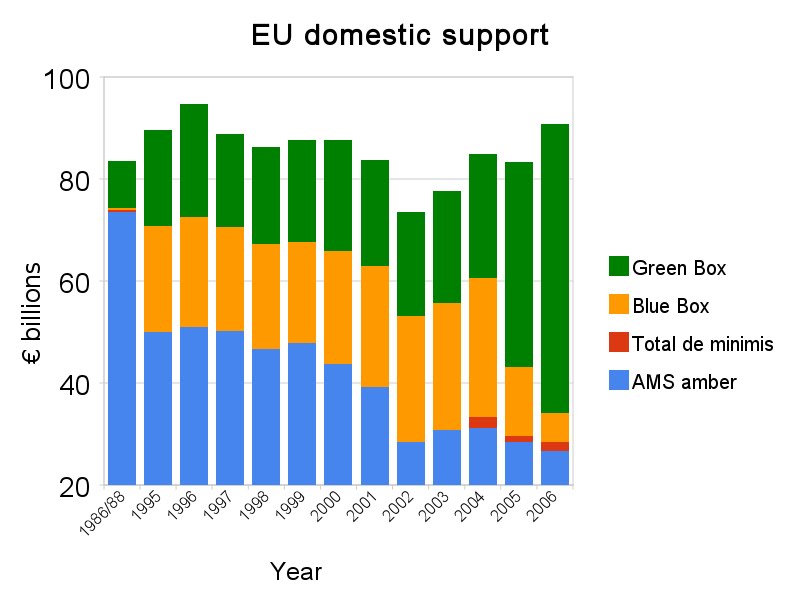
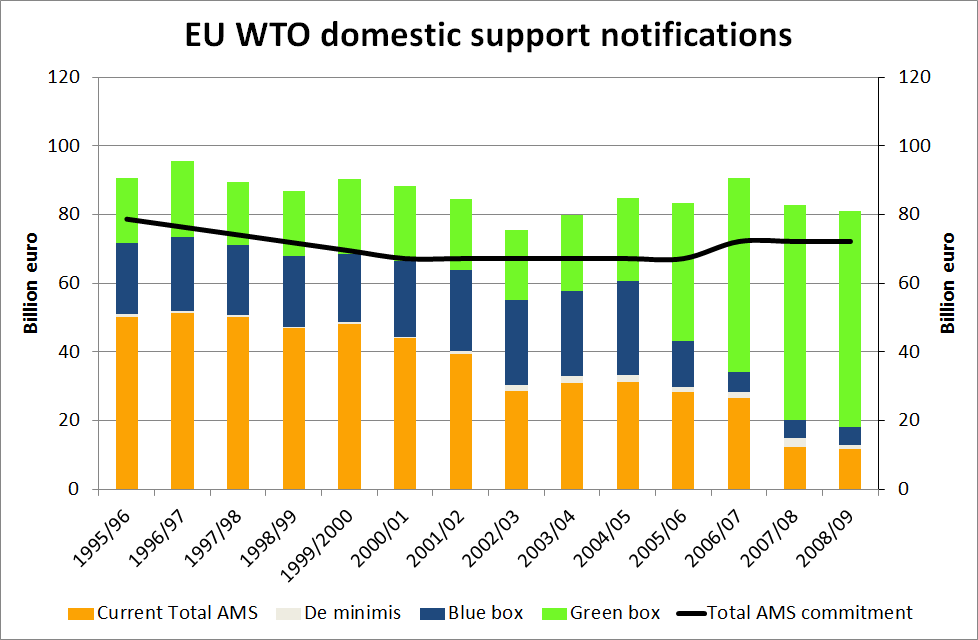
The broad trends in domestic support provided to EU agriculture according to the WTO classification is shown in the Figure below. Domestic support under the WTO Agreement on Agriculture is the sum of (a) expenditure on general services that provide benefits or services to agriculture and the rural community, (b) support (expressed in monetary terms) provided for agricultural products that benefit agricultural producers, as well as (c) non-product-specific support provided in favour of agricultural producers in general.… Read the rest
Establishing the UK’s non-exempt limit on agricultural support after Brexit

One of the issues the UK must address in establishing its WTO schedule of commitments post-Brexit is the limit it will have on certain types of domestic support it can provide to its farmers. This limit will, in turn, have implications for the way in which the UK and its devolved administrations can design their post-Brexit agricultural policies, assuming that they might wish to continue to provide some support to their farmers.

Domestic support in the WTO is measured as an Aggregate Measurement of Support, or AMS. Countries which provided non-exempt domestic support in the base period (1986-88) for commitments under the Uruguay Round Agreement on Agriculture (AoA) entered a Total AMS commitment in Part IV of their WTO schedules of commitments (their Bound Total AMS or BTAMS). This sets the maximum limit on their allowed non-exempt support (often referred to as the Amber Box or, inaccurately, as trade-distorting support).

Where no Total AMS commitment exists in Part IV of a Member’s Schedule, a WTO Member is not allowed to provide support to agricultural producers in excess of the relevant de minimis levels (Art 7, AoA).… Read the rest

Latest EU AMS notification confirms declining trend in WTO amber box support

The EU has just submitted its domestic support notification to the WTO for the year 2008/09 (hat tip to LB) and this year there are no surprises. Total support (using the WTO definition) was a shade over €80 billion, but the value of its trade-distorting support (the so-called ‘amber box’, given by its current total Aggregate Measure of Support) fell to its lowest level ever, at just under €12 billion.

In that year, the EU used just over 16% of its Total AMS commitment (its bound ceiling) of €72.2 billion. In other words, the EU could have reduced its AMS commitment by over 80% in that year and would still have fulfilled its WTO amber box obligation.

The AMS includes three main categories of support: direct payments that do not fall under the green or blue boxes as non-exempt direct payments; market price support for products for which an administered price exists; and an equivalent measure of support for those products where the domestic market is supported but where no obvious administered price exists.… Read the rest

The changing landscape of agricultural support

Discussions on reducing agricultural support in the Uruguay Round and, especially, the WTO Doha Round have been framed increasingly in North-South terms. Developing countries have sought reductions in OECD country agricultural support while developed countries have sought increased access to their manufacturing and services markets in exchange.

However, the landscape of agricultural support is changing. While levels of agricultural support and protection have been falling in OECD countries (helped by high world market prices), agricultural support in a number of (but not all) emerging economies has been increasing (despite the increase in world market prices).

These changes in the global distribution of agricultural support have two main consequences. First, the pattern of global agricultural trade is increasingly influenced by agricultural policy interventions in non-OECD countries, even if OECD countries still have a predominant weight in global agricultural production and trade.

For example, world cotton prices which are a concern for the West African C-4 countries in the WTO are now more distorted by subsidies in China and Turkey than by subsidies in the US and the EU.… Read the rest

Doha round agreement would leave EU farm subsidies untouched

According to the EU’s recent notification of farm subsidies to the WTO for the marketing year 2007/08, the EU’s trade distorting farm subsidies fell to a record low of 12.3 billion euros.

As the ICTSD reports,

“For the first time ever, the recent figures would put the EU’s overall trade-distorting support below the proposed new ceiling of 22 billion euros that would be established by a Doha Round accord under the terms currently being considered at the WTO. The Doha deal would create a new subsidy cap that limits the total amount of amber, blue and de minimis support that countries are allowed to provide.”

In other words, on the basis of the notification for 2007/08 (the most up to date that the EU has made), a Doha deal would not require the EU to change any of its farm subsidy policies. This comes as little surprise since the EU wave the magic wand of decoupling and ensured that most of the money it pays farmers is theoretically ‘non trade distorting’ and therefore unaffected by WTO disciplines.*… Read the rest

CAP support levels reach new high

CAP subsidies as reported to the WTO reached a ten-year high of over €90 billion in the 2006/07 marketing year, but conveniently most of them have been parked in the allegedly non trade distorting green box, something that has provoked disquiet in Geneva. The EU notified €90.7 billion of support to the global trade body for 2006/2007 – up from €75.6 billion in 2002, when support was at its lowest in the last fifteen years.

More from ICTSD.… Read the rest