The budgetary context for the CAP after 2020
Last week I attended the XVth Congress of the European Association of Agricultural Economists which was held in Parma, Italy. With almost 600 contributed papers, poster papers, organised sessions and panels, it was a feast both of stimulating ideas and great food. Over the next few weeks, I hope to highlight a few of the papers which were of interest to me. In this post, I take the opportunity to refer to my own contribution to an organised session on the economics and politics of the CAP after 2020.
This panel discussion also included contributions from Tassos Haniotis (DG AGRI), Jean-Christophe Bureau (AgriParisTech) and Johan Swinnen (University of Leuven). My contribution dealt with the state of play and the process of shaping the CAP post 2020, Haniotis and Bureau discussed some of the substantive issues under discussion, while Swinnen discussed the political economy of a reform agenda, drawing on analytical insights from previous CAP reforms.… Read the rest

Impact of Brexit on the EU budget

In a post last month, I made some estimates of the likely impact of Brexit on the CAP budget and which member states would have to stump up if overall CAP spending were to be maintained following a UK exit from the EU. These estimates were based on particular assumptions about how to calculate member states’ notional contributions to the CAP budget and how to calculate the CAP share of the overall UK rebate.

Of course, Brexit would have budgetary consequences not only for the CAP but for the UK net balance of contributions to all EU policies and for the overall EU budget. There has been controversy in the UK over the exact size of the UK’s net contribution to the EU budget (which, conversely, also represents the budget gap to be filled by the remaining member states if the level of EU spending in the remaining EU-27 countries and outside is to be maintained after Brexit).… Read the rest

Impact of Brexit on CAP budget net balances for remaining Member States

Much of the recent discussion on agricultural matters in the fall-out from the UK referendum vote on Brexit in June has focused on the implications for UK agriculture. What agricultural policy will the UK pursue after Brexit? What type of trade relationship will it have with the EU and with other countries? What arrangements might be put in place for seasonal migrant workers who play an important role in the production of certain UK crops?

However, Brexit will also have implications for the agricultural policy of the EU. I previously explored these implications in general terms in this Eurochoices article. In this post, I look more closely at the effect that Brexit will have for the net budget balances (gains and losses) of the remaining EU Member States. This can have an important bearing on the positions individual Member States take when discussing a future CAP reform (see my previous discussion on the role of net budget balances in the CAP).… Read the rest

The 2016 mid-term review of the Multi-annual Financial Framework

Imagine a scenario where UK voters go to the polls later this year to vote on whether to remain in or leave the EU, while at the same time in Brussels a debate is in full swing over whether to increase the ceilings for the 2014-2020 Multi-annnual Financial Framework (MFF), and thus the UK contribution to the EU budget. This seems to be the nightmare scenario behind the story carried by Euractiv earlier this week based on the views of an anonymous EU official and which declared that “the major event in the calendar of the Juncker Commission, the midterm review of the European Union’s 7 year budget, has been effectively cancelled”.

The report goes on to explain:

EU officials are too scared to come up with policy recommendations to recalibrate the €960 billion EU budget until 2020 by mid-summer, as such proposals would most likely coincide with the Brexit referendum expected in June.

Read the rest

Gainers and losers from the CAP budget

In thinking about the prospects for a future CAP reform, one of the relevant factors is the political economy of member states’ negotiating positions, which in turn is heavily influenced by their net position as a contributor to or a beneficiary from CAP expenditure. Countries are more likely to defend a high level of CAP expenditure if they are likely to benefit from it. The net transfers arising from the CAP budget are thus an important predictor of a country’s stance on CAP reform.

These net transfer positions are not routinely published, although DG Budget provides the raw data in its annual calculation of the ‘operating budgetary balances’ of member states. A member state’s operating budgetary balance is the difference between allocated operating expenditure (excluding administration) and its ‘national contribution’ to the EU budget.

A member state’s ‘national contribution’ represents its contribution to the EU budget’s ‘own resources’ apart from the traditional own resources of customs duties and sugar levies.… Read the rest

€500 million farm aid package announced

The farm aid package announced by the Commission (in the form of Vice-President Jyrki Katainen in the absence of Commissioner Hogan due to illness) at the extraordinary Agriculture Council yesterday exceeded the expectations raised by the Presidency background paper in a number of respects (the elements of which related to dairying I discussed in this post), but fell short of what some Ministers had sought and what the farm organisations deemed satisfactory. The Council’s conclusions can be accessed here.
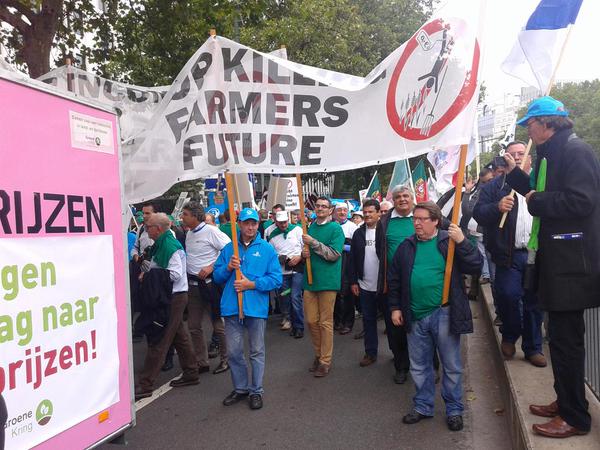
In my view, the package is a measured response to the difficulties in some specific farm sectors and, indeed, the Commissioner has held his nerve in the face of demonstrations and protests. However, further discussions will continue at the end of this week and at the informal Agricultural Council next week (14-15 September) which otherwise will focus on agriculture and climate. These are intended to address some of the practical implementation questions raised by the Commission’s proposals but the issue of raising the intervention price for dairy products may still not be finally settled.… Read the rest

Status update on Rural Development Programmes

DG AGRI was able to announce in this past week that it had approved a further 5 Rural Development Programmes (RDPs) for the period 2014-2020. This means that 78 of the 118 RDPs have now been adopted covering 76.6% of the envisaged funding. The state of play (as of the end of August) is shown in the graphic below. Note that one-third of RDPs still remain to be adopted at this point, even if they account for less than 25% of the envisaged expenditure.
Source: DG AGRI
Reasons for delays need to be examined

When the approval exercise is completed, we will need an investigation into the reasons for these unacceptable delays and some allocation of responsibility between possible contributing factors. Lessons need to be learned for the next programming period. The factors which might have contributed to the delays in approval fall under four headings:
• The delayed approval by the Council and Parliament of the basic legislation which in turn delayed the adoption by the Commission of the relevant delegated and implementing acts interpreting how the legislation should be implemented.… Read the rest

Impact of the MFF negotiations on the CAP 2013 reform

The CAP 2013 reform was the first negotiated under the ordinary legislative procedure (co-decision) in which both the Parliament and the Council had equal powers. A project undertaken by the Centre for European Policy Studies in Brussels for the European Parliament’s Policy Department has sought to examine what impact and influence the Parliament had on the CAP 2013 out-turn as a result of co-decision. Did co-decision give the Parliament a greater opportunity to influence the final outcome, who were the key players in shaping the Parliament’s views and what did the Parliament use its influence to achieve?
The final study, when it is published, will throw light on these issues. The team behind the study (of which I was one) also commissioned a series of case studies on specific issues raised in the co-decision process. These case studies are now available on the CEPS website. They include a detailed amendment analysis by Imre Fertð and Attila Kovács of the Council and Parliament amendments to the Commission’s original draft proposals which evaluates the relative effectiveness of the two bodies in carrying their amendments into the final legislation, a detailed study of the role of COMAGRI by Christilla Roederer-Rynning, an analysis of the evolution of the greening debate by Kaley Hart, and an analysis of the European Parliament’s position on market regulation by Alessandro Olper.… Read the rest

The 2015 EU budget and agricultural spending

A provisional agreement has now been reached on the 2015 EU budget between the Council and Parliament following their inability to reach an agreement on the Commission’s first draft budget proposal in November (read here the reactions to the deal of the Commission, of the Council and of the Parliament). In terms of the headline figures for overall EU spending, the agreement is closer to the Council’s position, particularly in terms of payment appropriations, an outcome which was predicted as a consequence of the Lisbon Treaty changes in a series of papers by Giacomo Benedetto of the University of London.
The Parliament’s main demand was not so much adjustments to the 2015 figures but rather addressing the increasing backlog of unpaid bills (the result of a rising gap between commitment and payment appropriations in recent budgets). The amount of unpaid bills rose from €5 billion in 2010 to €23.4 billion at the start of 2014 and without an increase in 2014 payment appropriations would have risen further in 2015.… Read the rest

Farmers may have to pay for Russian crisis aid

One of the successes of outgoing Agriculture Commissioner Dacian Ciolos in the 2013 CAP reform was to maintain the size of the CAP budget in the 2014-2020 multi-annual financial framework (MFF), at least in nominal terms (and even in real terms in the Commission’s original proposal). This was no mean achievement given the extent of the financial crisis in Europe, the pressures on public spending and the competing demands for spending at EU level.
His success was due to persuading his fellow Commissioners that a larger share of the CAP budget would be devoted to paying for public goods, particularly environment and climate actions. However, in the subsequent negotiations on the details of the CAP reform, these commitments were greatly weakened, much to the frustration of the other Commissioners. It now appears that the other Commissioners have had enough and are fighting back, using the first amending letter to the 2015 EU budget as their instrument.… Read the rest