
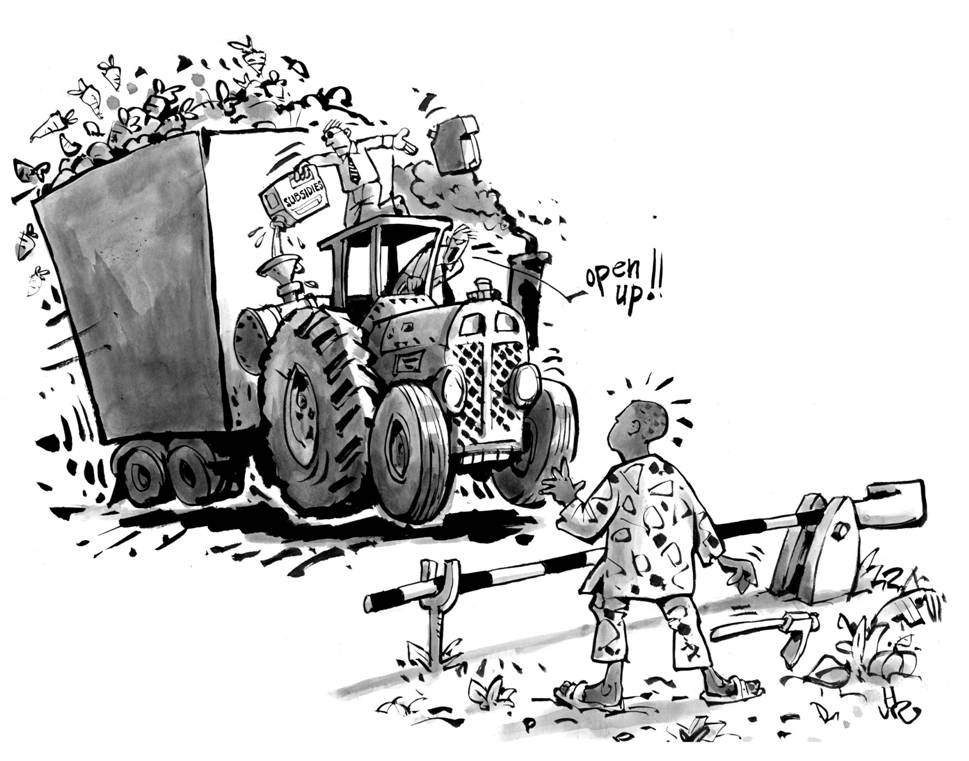
The EU has finally agreed to eliminate export subsidies…three cheers!

As long as I have been commenting on the CAP, its most criticized feature has been its use of export subsidies, also called export refunds. In the late 1980s and early 1990s, the EU was spending €10 billion a year on export subsidies, almost one-third of the CAP budget, in order to allow traders to get rid of the EU’s growing export surpluses by paying the difference between the EU’s high internal prices and lower world market prices.

Export subsidies allowed EU exporters to grab market share in import markets from competing exporters, put downward pressure on the level of world market prices, and competed unfairly with local producers in many developing countries. The damages caused were brilliantly highlighted and analyzed in a series of powerful reports and pamphlets by development NGOs such as Oxfam (Stop the Dumping! How EU Agricultural Subsidies are Damaging Livelihoods in the Developing World, 2002; Dumping on the World: How EU Sugar Policies Hurt Poor Countries, 2004); Aprodev (No More Chicken, Please, 2007; Preventing Unfair ‘Dumping’ of EU Subsidized Food, 2011); ActionAid (Milking the Poor; How EU Subsidies Hurt Dairy Producers in Bangladesh, 2011) and Brot für die Welt (Milk Dumping in Cameroon: Milk powder from the EU is affecting sales and endangering the livelihoods of dairy farmers in Cameroon, 2009).… Read the rest

Forum for the Future of Agriculture 2015 – Remarks on EU agricultural trade policy

The 8th Forum for the Future of Agriculture (FFA2015) was held yesterday in Brussels. This annual meeting, organised jointly by the European Landowners’ Association and Syngenta, attracts around 1400 participants and has established itself as one of the principal fora for debate on the future of agricultural policy. What makes the event interesting is that it attracts a good number of participants from among farmers and the agri-business sector while also being open to environmental NGOs and others critical of current agricultural practices.
The theme for yesterday’s meeting was the UN Sustainable Development Goals and possible implications for EU agriculture, with contributions from both Commissioners Hogan (Agriculture) and Vella (Environment, Maritime Affairs and Fisheries). Sessions explored issues ranging from global food security (do we really need to produce more food?), developing a sustainable agriculture (is organic the only legitimate solution?), implications of the circular economy concept for jobs and growth (is there more to this concept than simply pricing in the value of externalities?)… Read the rest

The Doha Round is back on track

On Thursday 27 November 2014 last, the WTO General Council approved three decisions related to public stockholding for food security purposes, the Trade Facilitation Agreement and the post-Bali work programme. With these agreements the hiatus in the WTO’s post-Bali work caused by India’s position on the 2013 Bali Ministerial Council decisions has been unblocked. India had demanded a commitment to faster progress on finding a permanent solution to the treatment of official procurement prices for food security stocks under domestic support disciplines, as well as the copper-fastening of the terms of the interim peace clause, in return for its willingness to approve the Protocol of Amendment to allow the Trade Facilitation Agreement to come into effect.
The drama leading up to these decisions and their significance is well described in this Bridges article. Addressing the General Council , the WTO Director-General Robert Azevêdo said:

By agreeing these three decisions we have put ourselves back in the game.

Read the rest

WTO failure on trade facilitation agreement puts question mark over Doha timeline

On Thursday this week, the WTO Director-General Robert Azevêdo admitted to failure in concluding the negotiations to adopt the Protocol of Amendment on the Trade Facilitation Agreement (TFA) by 31 July as had been agreed by Ministers at the WTO Ministerial Conference in Bali last December. The Protocol of Amendment was intended to start the process to formally insert the trade facilitation deal into the overall WTO Agreement.
The TFA was part of a carefully-balanced package at Bali designed to get substantive negotiations on the Doha Round again underway. In addition to a series of decisions and declarations on trade facilitation, agriculture, cotton, development and least developed country (LDC) issues, the Ministerial Conference had set a deadline of the end of 2014 for the Trade Negotiations Committee to develop a clearly-defined work programme on the remaining Doha Round issues. Work in Geneva had begun to focus on developing this work programme, but as Director-General Azevêdo admitted to the meeting of the WTO General Council on 25 July last, the talks were still at an early stage.… Read the rest

Life after Bali for the WTO Doha Round

Some weeks ago I discussed the prospects for a Doha Round mini-package at the next WTO Ministerial Council meeting in Bali in December, and I explained the proposals making up the agricultural elements of that mini-package. A recent paper produced jointly by the Geneva-based International Centre for Trade and Sustainable Development (ICTSD) and the Food and Agriculture Organization (FAO) also provides a useful introduction to the agricultural issues at stake in the Bali talks.
Since then, the Chair of the agricultural negotiations has provided a status update on the progress towards agreement on this mini-package. It makes for tortuous reading as the negotiators get into mind-numbing detail on aspects of the proposals. At the same time, the new WTO Director-General, Roberto Azevêdo, has warned that the count-down to Bali has begun and, despite his determined optimism in his report to the informal meeting of the WTO Trade Negotiations Committee (which oversees the negotiations) earlier this month it is clear there is still some way to go if concrete results are to be achieved at this meeting.… Read the rest

The Doha Round Bali ‘mini-package’ in agriculture

In the previous post, I discussed the process leading up to the forthcoming Bali Ministerial Conference of the WTO and the prospects for progress on a Doha Round ‘mini-package’. This ‘mini-package’ is planned to consist of three components: trade facilitation, some development/LDC issues and some agricultural elements (with the possibility of including other elements such as the dispute settlement review and the Information Technology Agreement if progress allows). In this post I discuss the issues being negotiated as part of the agricultural strand of this package.
The agricultural consultations have focused around three proposals tabled so far:
• a G-20 non paper which proposes an understanding on tariff rate quota (TRQ) administration provisions. This proposal envisages tighter disciplines for administering tariff-rate quotas, and how to deal with the possibility that the methods used might impede trade.
• a G-33 proposal on some elements of the draft modalities text on agriculture for early agreement to address food security issues.… Read the rest

Prospects for a Doha Round mini-package at Bali this year

With Brussels and national capitals closed for the month of August so little happening on the CAP front, it is timely for a stock-taking of the state of play in the multilateral trade negotiations.
In December later this year, the WTO at its 9th WTO Ministerial Conference in Bali, Indonesia will make yet another effort to salvage some concrete deliverables from the tortuous Doha Round negotiations. The negotiations have proceeded in fits and starts, but with more fits than starts, since the cancellation of what should have been the 7th Ministerial Conference (MC) in Geneva in December 2008 following the failure to agree on revised modalities documents.
The Doha Round negotiations were revitalised in early 2011 following strong political guidance by the leaders of the G20 at the Seoul Summit in November 2010. The objective was to reach outlines of a comprehensive package by the summer, and to finalise the agreement by the end of the year.… Read the rest

New Commission study on impacts of Doha Round

The G20 Cannes Summit, despite being side-tracked by the continuing eurozone crisis, did address other issues of importance to the global economy. In the section of its final communiqué on trade, the heads of state reaffirmed their ritualistic commitment to the Doha Round mandate. However, they went on to note that “It is clear that we will not complete the [Doha Development Agenda] if we continue to conduct negotiations as we have in the past.” Instead, they called for “fresh, credible approaches to furthering negotiations, including the issues of concern for Least Developed Countries and, where they can bear fruit, the remaining elements of the DDA mandate” to be pursued in 2012.

However, as the preparations for the forthcoming WTO Ministerial Council on 15-17 December rachet up in Geneva, there is little evidence that the same countries are ready to reach agreement on a common approach to the next steps to rescue the Doha Round.… Read the rest