
Macron's views on the Common Agricultural Policy
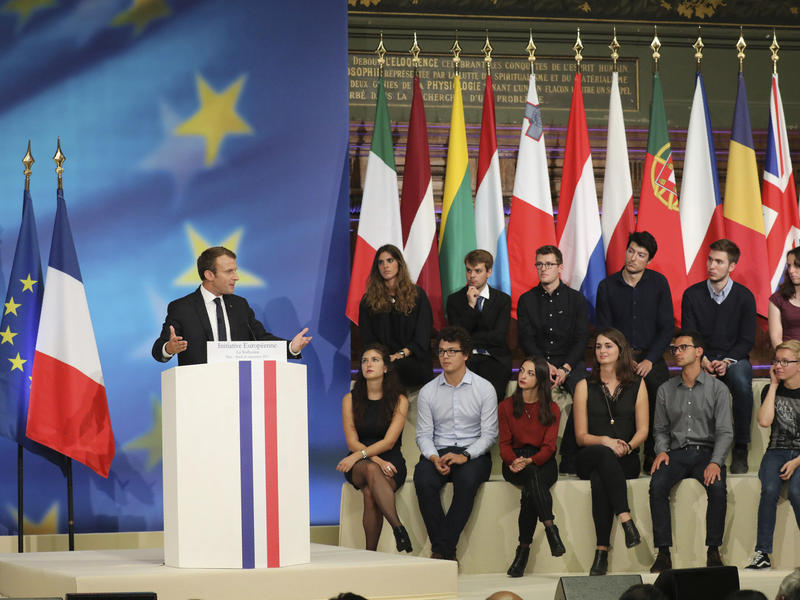
President Emmanuel Macron laid out his vision for Europe in a major speech at the Sorbonne yesterday. This speech was billed as an Initiative for Europe and set out the President’s ambitions in a range of areas – defence, counter-intelligence, asylum and migration policy, an external policy focused on Africa and the Mediterranean, a sustainable development agenda (including ideas for a more flexible CAP), addressing the challenges of the digital economy, reforms of the eurozone, and institutional reform. He proposed that each Member State that signs up to this agenda (recognising that not all will want to) should organise a citizen’s dialogue in the coming months with a view to feeding into a new “group for overhauling Europe” which would be tasked to produce a report by Summer 2018 on measures to implement these ambitions.
The full speech (in French) is here, with the official English summary here.
There is much to get to grips with in this speech. In this post I concentrate solely on what President Macron said about the CAP. In the English summary, this is reported as

[Europe] needs to ensure its food sovereignty, by reforming the Common Agricultural Policy (CAP) and establishing a common inspection force to guarantee food safety for Europeans.

The full version of his comments, in French, on food and agricultural policy are as follows. Below, I have reproduced my rough translation (suggested improvements welcome!).

Une Europe qui garantit notre vision exigeante du développement durable, c’est aussi une Europe de la sécurité et de la souveraineté alimentaires et c’est à dessein que je place ici cette ambition. Nous devons sans tabou nous poser les bonnes questions : est-ce que notre Politique agricole commune protège bien nos agriculteurs et nos consommateurs ? Je regarde les dernières années, je n’en ai pas totalement le sentiment et nous sommes arrivés à cette forme de paradoxe où la PAC est devenue un tabou français alors que nos agriculteurs ne cessent d’en dénoncer le fonctionnement.
La politique agricole ne doit pas être une politique de suradministration de tous les territoires de l’Union européenne, de toutes les filières et, bien souvent, une politique de revenus accompagnant approximativement les transitions, produisant parfois des schémas complexes que nous avons bien du mal à expliquer à nos peuples.
La politique agricole européenne doit permettre de faire vivre dignement les agriculteurs de leurs revenus en les protégeant face aux aléas du marché et aux grandes crises, elle doit les aider à évoluer pour construire une agriculture plus responsable. Il y aura toujours en Europe plusieurs modèles agricoles et je souhaite que chaque pays puisse accompagner cette transformation selon ses ambitions et ses préférences. Et cette nouvelle politique agricole commune, pour ne pas être bureaucratique et injuste, doit être l’instrument de la transition agricole, de notre souveraineté face aux grands défis de la mondialisation. Elle doit redonner une vitalité, une ambition à nos territoires ruraux.
En d’autres termes, je souhaite que nous puissions ouvrir de manière décomplexée et inédite une Politique agricole commune qui se pense d’abord avec deux objectifs : nous protéger face à ces grands aléas, à la volatilité des marchés mondiaux qui pourrait mettre en péril la souveraineté alimentaire de l’Europe ; favoriser la grande transition agricole européenne et laisser plus de flexibilité au niveau des pays pour organiser la vie des territoires et des filières, mettre moins de bureaucratie, laisser au niveau régional, accompagner de manière plus souple les filières partout où des choix qui restent des choix collectifs de terrains sont nécessaires.
L’exigence des Européens, c’est d’avoir confiance dans les aliments et les produits qu’ils utilisent au quotidien et cela participe de cette sécurité alimentaire que j’évoquais. Et on voit là aussi que l’échelle européenne est incontournable. Nous l’avons vécu l’été dernier avec ce qu’il convient d’appeler désormais la crise des œufs. Nous avons vu que les dysfonctionnements à un endroit de l’Europe, parce que nous sommes un marché intégré, ont des conséquences partout en Europe qui peuvent jeter le doute sur notre sécurité alimentaire, avec une demande parfaitement légitime de nos concitoyens qui est d’avoir la vérité en temps réel sur tous ces sujets.
Il nous faut donc établir une force européenne d’enquête et de contrôle pour lutter contre les fraudes, garantir la sécurité alimentaire, assurer le respect des standards de qualité partout en Europe. Cette transformation, nous devons aussi la conduire. Et à cet égard, je soutiens le choix du président JUNCKER de mettre fin partout en Europe au double standard alimentaire et de faire que cette force puisse être le garant de cette convergence légitime.
L’exigence des Européens, c’est d’avoir aussi confiance dans les experts qui nous éclairent. Nos récents débats sur le glyphosate, les perturbateurs endocriniens montrent la nécessité d’évaluation scientifique européenne plus transparente, plus indépendante, d’une recherche mieux financée qui permet d’identifier les risques et de proposer des alternatives. C’est indispensable. Nous avons aujourd’hui des débats politiques qui, parfois, cherchent à se substituer au débat scientifique. C’est la science qui doit éclairer la dangerosité mais qui doit ensuite, de manière indépendante, transparente, indiquer les alternatives possibles scientifiquement démontrées. En aucun cas cette science ne doit s’effacer au profit d’engagements politiques qui deviennent à ce moment des paroles de sachants ou des paroles d’autorité ni a fortiori ne doivent accepter de laisser la place à une parole publique qui est celle de lobbies, d’intérêts industriels et qui construisent l’opacité sur des décisions collectives qu’attendent nos concitoyens.

Unofficial English translation

A Europe that guarantees our demanding vision of sustainable development is also a Europe of food security and sovereignty, and I deliberately set this ambition here. Without being afraid to break taboos, we must ask ourselves the right questions: does our Common Agricultural Policy protect our farmers and our consumers? I look at the last few years, and I do not totally have this feeling. We have arrived in the paradoxical situation where the CAP has become a French taboo while our farmers are constantly denouncing its functioning.
Agricultural policy must not be a policy of over-administration of all European Union territories, of all sectors and, in many cases, of an incomes policy that loosely supports the transitions, sometimes resulting in complex schemes which we have a hard time to explain to our peoples.
The European agricultural policy must enable farmers to live decently on their incomes and protect them from the vagaries of the market and major crises, and must help them to evolve in order to build a more responsible agriculture. There will always be several agricultural models in Europe and I hope that each country can pursue this transformation according to its ambitions and preferences. And this new common agricultural policy, not to be bureaucratic and unjust, must be the instrument of agricultural transition, of our sovereignty in the face of the great challenges of globalization. It must restore vitality and ambition to our rural territories.
In other words, I hope that we can open up in an uninhibited and unprecedented way a Common Agricultural Policy which first thinks of two objectives: to protect ourselves against these great risks, against the volatility of world markets which could jeopardize the food sovereignty of Europe; and to promote the great European agricultural transition, allowing more flexibility at the country level to organize the life of the regions and sectors, to reduce bureaucracy, to leave to the regional level, to support in a more flexible way all sectors where choices that remain collective land choices are necessary.
The Europeans’ need is to have confidence in the food and products they use on a daily basis and this is part of the food security that I mentioned. And we see here that the European scale is unavoidable. We experienced this last summer with what we should now call the egg crisis. We have seen that dysfunctions in one part of Europe, because we are an integrated market, have consequences throughout Europe that can cast doubt on our food security, with a perfectly legitimate demand from our fellow citizens, to have the truth in real time on all these subjects.
We must therefore establish a European investigation and control force to combat fraud, ensure food safety and ensure that quality standards are respected throughout Europe. We must also lead this transformation. And in this regard, I support President JUNCKER’s choice to end the dual food standard in Europe and to ensure that this force can be the guarantor of this legitimate convergence.
The demand of Europeans is also to have confidence in the experts who enlighten us. Our recent debates on glyphosate and endocrine disruptors show the need for a more transparent, independent, European scientific assessment of better funded research that identifies risks and proposes alternatives. This is essential. Today we have political debates that sometimes seek to take the place of scientific debate. It is science that must shed light on dangers, but then, independently and transparently, indicate the scientifically demonstrated alternatives. In no case must this science step aside in favour of political commitments which at that moment become words of knowledge or words of authority. Nor, even more emphatically, should science agree to give way to a public discourse which is that of lobbies and industrial interests and which build opacity around the collective decisions that our fellow citizens expect.

Evaluation

In general, these comments reflect themes rather than policies (with the exception of the specific proposal for a European investigation and control force on food safety issues). Because they are themes, they represent pegs around which a debate on policies might be organised, but they are in themselves devoid of policy content.
I identify four main themes in this section of his speech.
We should be willing to debate (and reform) the CAP. The reference to breaking taboos suggests that previous French positions on the EU’s CAP might be reviewed. However, no specific examples are provided where revision of the French position might be warranted, so this is a rhetorical statement rather than a pointer to policy. Notably, given the current debate on the future of the EU finances, there is no mention of budgetary and financing issues in the speech.
Two objectives are prioritised for the CAP, risk management (especially from imported price volatility) and promoting a transition to more sustainable agricultural production. Again, the discussion on these issues remains at a rhetorical level and the sentences could have been lifted from election speeches to farm groups. We should recall that Macron’s government has launched a major citizen dialogue initiative in France, des États généraux de l’alimentation, which will in time help to define the French position on these issues.
Greater flexibility to determine agricultural policy should be given to individual Member States and regions. This comes in the context of criticism of the over-bureaucracy of the CAP and the complexity of schemes which are hard to explain to farmers. To the extent that the future CAP should focus more on incentivising changes in the way farmers produce and manage their land, this makes a lot of sense. The challenges of environmental land management are place-specific and cannot be properly addressed through general, uniform prescriptions. However, the challenge in managing flexibility is performance and ensuring that Member States do not abuse flexibility as an excuse for doing nothing.
The role of experts in deciding on food regulations. We can again define this as a theme rather than a policy although there is a concrete proposal in the speech for more funding for research in support of food regulations. It is clearly an important issue and President Macron is right to focus on it. In his speech, he tries to steer a middle course through the public controversies which have surrounded recent discussions in Europe of crop protection chemicals (glyphosate and neonicotinoids), biotechnology and other regulatory issues. On the one hand, he makes a strong case for listening to science rather than groups with a political agenda when it comes to assessing potential dangers of particular products. On the other hand, he acknowledges the risk that debates may be unduly influenced by business interests and calls for greater transparency in decision-making.
This post was written by Alan Matthews

Photo credit: WVIK

Food safety in the US-EU TTIP negotiations

There is widespread concern that the ongoing negotiations on a transatlantic free trade area between the US and the EU, known as the Transatlantic Trade and Investment Partnership (TTIP), may result in a watering-down of EU food safety standards under US pressure to remove measures which are perceived as barriers to trade.
According to a report from the US-based NGO the Centre for Food Safety, “many analysts believe that a central aim of the negotiations is to dismantle many food safety regulations that corporations view as impediments to trade and profitmaking.”
Less dramatically, the European Consumer Organisation BEUC notes in its position paper that: “[…] the EU food legislative framework guarantees consumers a high level of protection and information. BEUC believes the TTIP should not lead to a downward harmonisation and that the EU should remain free to maintain, strengthen and enforce the rules it deems necessary to preserve the interests of consumers in areas such as food safety, GMOs, the use of growth promoters in livestock production or cloning.” (bolding in the original).
Does the EU have higher food safety standards?

Behind these concerns lies the assumption, often made explicit, that the EU food safety system guarantees a higher level of consumer protection than the US one. For some observers, this comes down to the fact that the EU gives greater weight to the precautionary principle in its food risk assessment, whereas the US approach is based more on a cost-benefit approach when reviewing food safety standards.
For others, the difference lies in the fact that the US tends to focus on achieving its food safety objectives by regulating the end product, while the EU has the tendency to regulate the whole production process.
Yet another difference is that the US regulatory authorities rely mainly on scientific risk assessment; in the EU risk assessment is science-based and centralised in the European Food Safety Agency EFSA, but EU risk management has allowed a wider range of factors, including social, economic, tradition, ethics and environmental factors, to be taken into account.
This perception that the EU has the more stringent food safety regulations is relatively recent, and dates mainly from the 1990s. As David Vogel, a professor of political science at Berkeley, California has observed in his book The Politics of Precaution, prior to then food safety regulation in the US was more risk-averse and precautionary than in the EU.
A good example was the Delaney Clause which established a policy of zero tolerance for any residue of carcinogenic pesticides or additives in processed food, no matter how small the risk or how tenuous the relationship between the results of the animal tests establishing carcinogenity and human exposure, at a time when no EU country had addressed this issue.
Vogel notes a number of the high-profile regulations introduced by the EU since around 1990 which are more stringent than in the US. They include: beef hormones – banned in the EU in 1985 but still permitted in the US; ractopamine, widely used as a feed additive in the US but banned in the EU in 1996; the milk hormone BST – approved for use in the US in 1993, but permanently banned in the EU in 1999; the introduction of GM plants, food and animal feed – permitted in the US since 1986, but restricted in the EU beginning in 1990; and antibiotics in animal feed – significantly restricted in the EU in 1998 and banned for non-medical use in 2006. The reasons for this role reversal are discussed in his book and summarised in this post.
Despite these high-profile differences (and others could be added, such as attitudes to pathogen reduction treatments for meat and poultry products), food safety regulation in both the US and the EU has similar objectives. The EU General Food Law (Regulation EC/178/2002) and the recent sweeping revision of US food law in the Food Safety Modernization Act 2011 (FSMA) share a basic mandate and contain many similarities in approach, such as the food industry’s primary responsibility for ensuring food safety, process-based regulation aimed at the whole supply chain, and linking international standards.
However, within these broad shared principles the differences in regulatory approaches noted above continue. They are summarised in the BEUC position paper in the following table. For example, under current FDA practices, food manufacturers can self-determine whether their products are safe and should be granted ‘Generally recognised as safe’ (GRAS) status and can just notify the Food and Drug Administration (FDA) about it. The FDA has no obligation to review manufacturers’ assessment.

Despite differences in regulatory practices, what matters at the end of the day are the outcomes. While there are a range of food-borne hazards to health, including pathogens, toxins, pesticides, chemicals and other contaminants, the most common food-borne illnesses are due to harmful bacteria, such as campylobacter found in raw milk or undercooked poultry; salmonella from raw chicken, eggs, or green onions; listeria bacteria from soft cheeses and lunch meats; or E. coli in undercooked hamburger or bacteria-laden lettuce.
Does the US have higher rates of food-borne illnesses (food poisoning) than the EU? Not according to figures put together by Jennifer McEntire of the Acheson Group, which is a food risk consulting group, based on data from EFSA in the EU and the Centers for Disease Control and Prevention in the US for 2012.

There are, of course, numerous problems in comparing data from two jurisdictions collected under very different circumstances, which are discussed in detail in this follow-up post by Jennifer McEntire. Nonetheless, there is no clear evidence from these data that the EU food safety system is far and away superior to the US one.
Regulatory convergence as a TTIP objective

Food safety regulations are just one example of the broader range of non-tariff or ‘behind-the-border’ measures. Where different regulations apply in the US and the EU, the need for firms to demonstrate compliance with both sets of regulations raises the cost of entering the other market and reduces the amount of competition to the detriment of consumers.
On the other hand, common for these non-tariff measures, whether they address food safety, health, environment, business conduct or labelling requirements, is that they are put in place in order to protect or benefit consumers. Such regulations are adopted after extensive debate and consultation, and there is a justifiable concern that such regulations should not be altered simply as part of a trade agreement.
The US-EU High Level Working Group on Jobs and Growth, whose recommendations in 2013 led to the launch of the TTIP negotiations, saw enhancing the compatibility of regulations and standards as well as the elimination, reduction or prevention of unnecessary ‘behind-the-border’ non-tariff measures as a significant opportunity to increase transatlantic trade and investment. Their final report foresaw five basic components of TTIP provisions tackling regulatory issues:
1. an SPS plus chapter which would build upon the key principles of the WTO Sanitary and Phytosanitary Agreement, and provide for improved dialogue and cooperation on addressing bilateral SPS issues;
2. a TBT plus component which would build upon the principles enumerated by the WTO Technical Barriers to Trade as regards to technical regulations, conformity assessment and standards;
3. cross-cutting disciplines on regulatory coherence and transparency for the development and implementation of efficient, cost-effective, and more compatible regulations for goods and services, including early consultations on significant regulations, use of impact assessments, periodic review of existing measures and application of good regulatory practices;
4. sectoral annexes containing commitments for specific goods and services sectors;
5. a framework for identifying opportunities for and guiding future regulatory cooperation, including provisions that provide an institutional basis for future progress.
The negotiations so far appear to have been closely followed this structure. A possible horizontal chapter laying down the principles for future regulatory cooperation apparently foresees a Regulatory Cooperation Council (RCC) and a more or less permanent dialogue between regulatory agencies on both sides of the Atlantic.
While TTIP will not alter the regulatory decision-making process in either the US or the EU (joint decision-making is not foreseen), the way in which sectoral agreements reached under the RCC process will be incorporated into EU law and what sanctions or enforcement mechanism might apply to ensure this remain to be decided.
SPS negotiations in TTIP

The EU position on food safety issues in the TTIP negotiations is set out in the SPS (Sanitary and Phytosanitary) paragraphs of its June 2013 negotiating mandate and a later paper on the EU initial negotiating position on SPS issues published by DG Trade. While the mandate remains a restricted document, it is widely available on the internet or in documents such as the annex to this Notre Europe report.
The EU’s aim is to negotiate an agreement which builds on but goes beyond existing WTO disciplines in this area through a so-called ‘SPS-plus’ chapter. As in other regulatory areas, it seeks a greater degree of regulatory convergence while underlining that there are some red line issues.
The mandate can be summarised in three elements:
• Minimise the negative effect of existing SPS measures on trade
• Without prejudice to the right of both parties to adopt and enforce measures to pursue legitimate public policy goals such as public health and safety
• While strengthening cooperation between regulators when drawing up future standards and increasing their cooperation in standard setting at the international level.
Under the first heading, the negotiating position envisages that existing SPS measures should be revisited with the aim to remove unnecessary barriers. The EU proposes to ensure predictability and transparency in the approval and authorisation process applicable to imported products, including risk assessments, timelines and technical consultations where necessary. Also under this heading, the EU seeks more recognition of equivalence where standards may be different but lead to equivalent levels of food safety, so that firms certified to sell in one market will also be able to sell in the other.
Under the second heading, the EU insists that the agreement should recognise the right of both parties to appraise and manage risk in accordance with the level of protection that each side deems appropriate, in particular, when relevant scientific evidence is insufficient (a nod to the precautionary principle). As the DG Trade issues paper puts it: “Regulatory convergence shall be without prejudice to the right to regulate in accordance with the level of health, safety, consumer and environmental protection that either Party deems appropriate, or to otherwise meet legitimate regulatory objectives.”
The third element recognises that TTIP cannot resolve all SPS issues ex ante and references the idea that this will be a ‘living agreement’ based on extensive future cooperation between the respective regulatory agencies. Behind this idea is the hope that, if the US and the EU can agree on common standards, there is a good prospect that these standards will then be adopted, either de facto or de jure, by other trading countries.
Is TTIP a threat to EU food safety regulation?

The concern of the critics is that this process of regulatory convergence in the SPS area will erode existing regulatory rules in the EU. Even if the rules themselves are not changed, the critics fear that the mutual equivalence principle would allow US food exports produced to different standards to be sold on the EU market.
Future standards or modifications to existing standards will need to take greater account of US concerns, although we should be wary of assuming that the US will always seek a lower standard of consumer protection than the EU. Also, in many areas food trade is now governed by more demanding private standards which firms on both sides of the Atlantic must meet, regardless of the level of public standards that are agreed.
The Commission has repeatedly stated that EU food safety laws will not be changed as a result of a TTIP agreement. That goes for genetically modified food and hormone-treated beef as much as for other products, according to Trade Commissioner Karel de Gucht. This is a large carve-out from an agreement focused on regulatory convergence.
The US position, as spelled out by the Business Coalition for Transatlantic Trade, is to seek the elimination of “illegitimate” SPS barriers and to eliminate the use of the precautionary principle in favour of “science-based decision making” in setting both current and future SPS standards. Obligations that go beyond the WTO should be subject to TTIP enforcement mechanisms. These positions are echoed in the US Trade Representative’s (USTR) negotiating objectives in the SPS area where the aim is “eliminate or reduce non-tariff barriers […] such as unwarranted sanitary and phytosanitary (SPS) restrictions that are not based on science…”
In principle, it makes good sense to identify ways to reduce costs associated with regulatory differences by promoting greater compatibility between regulatory systems in the US and the EU. But, in the case of food, it seems likely that the cultural, political and institutional differences between the two jurisdictions will continue to result in different perceptions of risk, and thus different regulatory outcomes.
As noted in this IPC report, both the US and the EU have signed up to the same set of principles in the WTO SPS Agreement, but nonetheless most of the agriculture-related disputes between the two jurisdictions have concerned SPS measures. According to reported remarks of US Agriculture Secretary Tom Vilsack in April this year, SPS issues are proving “very, very difficult” in the TTIP negotiations.
There are commitments that the EU can make to address US SPS concerns without altering its existing food safety rules. In the case of GMOs, for example, adhering to its own deadlines for the approval process for new GM events would be a major change from current practice.
With respect to decontamination treatments, the EU has already accepted beef sprayed with lactic acid to clean animal carcases. While it continues to resist poultry imports washed with chlorinated water, permission to use a peroxyacetic acid (PAA) solution during processing to reduce pathogens on poultry carcasses and meat is currently going through the EFSA approval process. In neither case is there anything harmful in the use of these treatments; the EU opposition is based on the belief that, with proper hygiene and handling throughout the total food chain, there is no need for these pathogen reduction treatments.
Whether small movements on these specific issues would be sufficient to persuade US agriculture to support a deal may depend on what is agreed about the way SPS regulations are made in the future. The objective on both sides is to reach agreement on an SPS-plus chapter, that is, on provisions that go beyond those agreed in the WTO SPS Agreement and that are enforceable under the TTIP dispute settlement process.
But exactly what might be agreed as part of this ‘Plus’ package, whether and how this would impinge on the EU decision-making process for food safety standards, and what rights would be given to the US to challenge the outcomes of this process in the future remains unclear at this stage of the negotiations.
If the negotiators do come to an agreement on a draft proposal, there must be sufficient time for all concerned to consider its implications. Trade is a legitimate interest to take into account in setting food safety standards, but it cannot be the determining factor.
Photo credit: Wikipedia, used under a Creative Commons licence.
This post was written by Alan Matthews

Food safety – the Irish pork dioxin crisis revisited

An Irish Parliamentary Committee has just published the results of its investigation into the pork dioxin crisis in Ireland last December, which led to the slaughter of pigs on a number of farms which had been fed contaminated feed and the recall of all Irish pork products produced since 1 September from the home and export markets. In an earlier post, I provided some background to the crisis. I argued that the contamination incident raised three questions: how was it that the praised EU hygiene controls broke down in this instance? What will be the overall cost to the sector and to the economy of the dioxin contamination and the product recall?  And who will be asked to bear this cost? The Parliamentary Committee report makes some interesting findings on the first of these questions. Continue reading “Food safety – the Irish pork dioxin crisis revisited”

Prospects for GMO products in the EU

After the forceful and successful management of the agricultural dossier by the French Presidency in the second half of 2008, it was inevitable that the agenda for the Czech Presidency would be a light one, and this is also reflected in the activity level for this blog since the beginning of this year.

Nonetheless, even in a context where most attention is focused on dealing with the financial crisis and the strengthening recession hitting Europe, Europe’s agricultural and food industries continue to be required to address regulatory issues affecting the governance of the sector. One of these issues concerns the regulatory environment for genetically modified products (GMPs), and I am indebted to EurActiv for drawing my attention to the outcome of a meeting of the Environmental Council in early December which gave a series of political directions to the Commission on this issue.
Continue reading “Prospects for GMO products in the EU”

More on Irish pigmeat compensation

The European Council at its last meeting under the French Presidency on 11-12 December had a weighty agenda, discussing the EU energy and climate change package, the European economic recovery plan and agreeing with the Irish government an approach which might allow the Lisbon Treaty to enter into force before the end of 2009. The Council also welcomed the political agreement on the CAP Health Check and, in a move surely made with one eye on the upcoming second referendum in Ireland on the Lisbon Treaty, it “expressed its support for Ireland’s effort to deal with the situation relating to pigmeat and its prompt precautionary action. It invites the Commission to support farmers and slaughterhouses in Ireland by way of co-financed measures to remove relevant animals and products from the market.”

Continue reading “More on Irish pigmeat compensation”

Food safety rules as protection or protectionism?

SPS (sanitary and phytosanitary standards) barriers figured prominently in the final Agricultural Council of 2008 under the French Presidency. Agricultural Ministers agreed Council Conclusions on the safety of imported agricultural and agri-food products and compliance with Community rules. At the same meeting, EU Farm Ministers rejected a Commission proposal to allow the use of antimicrobial substances to treat poultry carcasses, which would have re-opened the Community market to US imports. Is there a danger that food safety protection becomes an excuse for protectionism?

Continue reading “Food safety rules as protection or protectionism?”

Questions from Irish pigmeat contamination crisis

Europe’s lastest food safety incident stems from the confirmation of elevated levels of dioxins in Irish pigmeat last Saturday. As a result, all Irish pork and bacon products from pigs slaughtered in Ireland since 1st September 2008 have been recalled. Consumers have been advised, as a precautionary measure, not to consume Irish pork and bacon products at this time and to dispose of any purchased since the 1st of September 2008. The discovery of this contamination – which has been sourced back to a small feed mill recycling bakery and confectionery waste for animal feed – is a calamity for the Irish pig sector and could yet have major adverse consequences for the Irish food processing sector as a whole. There is a good account of the background to the incident on Wikipedia. I have given my own initial reaction to the events in an Irish Independent article today. Here I want to explore three questions which the crisis has thrown up.

Continue reading “Questions from Irish pigmeat contamination crisis”