Import dependence for nitrogen supply

Nitrogen is a critical input to agricultural production. In the EU, approximately half of this nutrient is supplied from organic livestock-derived sources while the other half comes from mineral nitrogen (specifically in 2023, organic nitrogen supplied amounted to 8.3 million tonnes and mineral nitrogen 8.7 million tonnes across the EU27, UK, Switzerland and Norway, source Fertilizers Europe 2024).

A significant share of this mineral nitrogen (either directly or in the form of ammonia which is the main feedstock) is imported, which can be a significant source of vulnerability. In this post we examine the extent of this vulnerability in terms of the dependence on nitrogen imports and the main sources of import supply.

Nitrogen use and import dependency

The introduction of the Nitrates Directive in 1991, of the national action programmes for designated nitrate vulnerable zones and the CAP reforms decoupling payments from production levels, all led to steep declines in the use of nitrogenous fertilisers in the 1990s and early 2000s (DG AGRI, 2019) shown in the first figure below.… Read the rest
Europe’s future of food – articulating food security, sovereignty and sustainability

I was pleased to be invited to give a talk at the EIT Food conference on the future of food last Thursday where the organisers had given me the very ambitious title at the head of this post. I reproduce below the talk as I presented it, with one small modification. The great advantage of attending a conference of this kind is that one is alerted to new perspectives and new angles and, in the light of listening to some of the other excellent contributions to the conference, I slightly nuanced one of my conclusions below (I note the specific change at the end of this post).

My key message is that there are inevitable trade-offs in the transition to a sustainable food system, but that the discourse around a threat to food security is not helpful or correct and masks other trade-offs which policymakers should address more directly. I have included the slides in this blog post, but the presentation can also be downloaded directly if anyone is interested.… Read the rest

Conversation with a chatbot on the Common Agricultural Policy

Artificial intelligence (AI) has been described as the fourth industrial revolution, following the invention of the steam engine, electric power, and the internet. AI tools can rapidly synthesize large amounts of data and detect patterns. AI tools are increasingly used in business but also in the provision of public services in activities such as risk profiling, the delivery of medical care, and traffic management.

There is growing interest in the interface between AI and public policy. This is a relationship that works both ways. On the one hand, there are concerns about how best to regulate the use of AI in society. AI is not a risk-free option. Its algorithms—the engines that generate intelligence out of raw data—can reinforce existing discriminatory practices. And its tools, such as facial recognition, can violate privacy protections. On the other hand, there is interest in making use of AI capabilities to improve public policy, for example, through data-driven policy making.… Read the rest

Macron's views on the Common Agricultural Policy

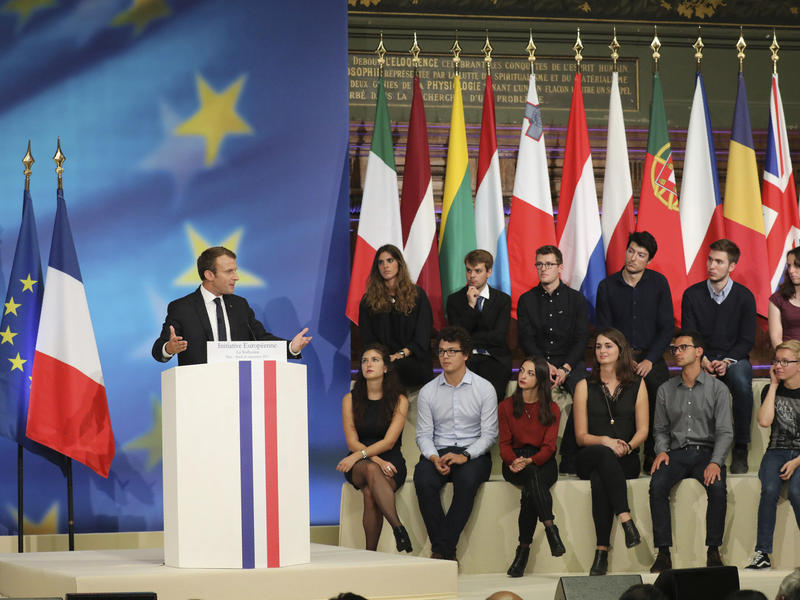
President Emmanuel Macron laid out his vision for Europe in a major speech at the Sorbonne yesterday. This speech was billed as an Initiative for Europe and set out the President’s ambitions in a range of areas – defence, counter-intelligence, asylum and migration policy, an external policy focused on Africa and the Mediterranean, a sustainable development agenda (including ideas for a more flexible CAP), addressing the challenges of the digital economy, reforms of the eurozone, and institutional reform. He proposed that each Member State that signs up to this agenda (recognising that not all will want to) should organise a citizen’s dialogue in the coming months with a view to feeding into a new “group for overhauling Europe” which would be tasked to produce a report by Summer 2018 on measures to implement these ambitions.
The full speech (in French) is here, with the official English summary here.
There is much to get to grips with in this speech.… Read the rest

Why further reform of the CAP is needed now

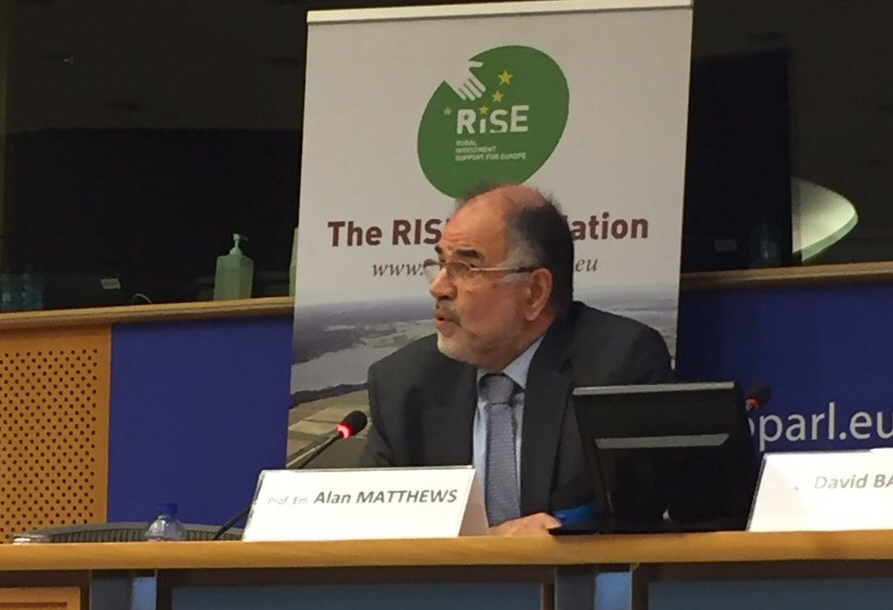
Yesterday I took part in a meeting at the European Parliament under the heading “CAP – Out of the box thinking‘ jointly organised by the RISE Foundation and the European Landowners’ Association. The event was part of the preparation for a report by the RISE Foundation under the leadership of Professor Allan Buckwell aiming to provide ideas for the CAP post 2020. My contribution was to argue that further reform of the CAP is needed now. Below is a slightly edited transcript of my remarks.

Reform of the Common Agricultural Policy has been ongoing since the seminal McSharry reforms in 1992. They have covered both the common market organisations, which have become more market-oriented, as well as rural development programming.
Direct payments were originally introduced to compensate for the reduction in market intervention prices in the MacSharry and later reforms, but were subsequently extended to farmers in new Member States where this rationale did not apply.

Read the rest

Why the poor EU response to higher grain prices?

Since 2007/08, the world has lived with substantially higher, if fluctuating, prices for grains following the global food price spike that began in 2007. Economists would predict that higher prices would lead to a global supply response. Indeed, global cereals production has increased by over 500 million tonnes in 2013 compared to 2006 production of just over 2 billion tonnes (FAOSTAT statistics are used throughout this post, and cereals production is measured inclusive of the volume of milled rice). This corresponds to an increase of 25% over this period, or a compound annual growth rate of 3.3% per annum which is impressive.
What is also of interest is where this supply response has taken place. Immediately after the food price shock it seemed that most of the supply response was taking place in developed countries, with only a limited supply response in developing countries. Various reasons were suggested for this. It was argued that there was limited transmission of the international price increases to domestic markets in developing countries, either because of high transactions costs (inefficient transport systems, expensive customs procedures) or because of deliberate government policies (reducing import tariffs or imposing export restrictions in order to limit the extent of price increases on domestic markets).… Read the rest

Trends in EU agricultural self-sufficiency

Worries and concerns about food security, real or imagined, have figured prominently in the debate on EU agricultural policy since the Commission launched its consultation document on the recent CAP reform in 2010, stimulated by the price spike on global food markets in the years 2007-08. This week, at the informal Farm Council in Milan on Tuesday 30 September under the Italian Presidency, agricultural ministers will discuss how EU agriculture can contribute to the food security challenge.

One of the issues that constantly pops up in this debate is the importance of food self-sufficiency as a guarantor of food security. Food self-sufficiency is defined as the proportion of domestic consumption met from domestic production. In my view, identifying food security with food self-sufficiency is misleading and, indeed, potentially dangerous if it diverts attention away from more real threats to food security, but that argument is for another day. Nonetheless, to debate this issue requires, at least, good information on the underlying figures and trends.… Read the rest

WTO failure on trade facilitation agreement puts question mark over Doha timeline

On Thursday this week, the WTO Director-General Robert Azevêdo admitted to failure in concluding the negotiations to adopt the Protocol of Amendment on the Trade Facilitation Agreement (TFA) by 31 July as had been agreed by Ministers at the WTO Ministerial Conference in Bali last December. The Protocol of Amendment was intended to start the process to formally insert the trade facilitation deal into the overall WTO Agreement.
The TFA was part of a carefully-balanced package at Bali designed to get substantive negotiations on the Doha Round again underway. In addition to a series of decisions and declarations on trade facilitation, agriculture, cotton, development and least developed country (LDC) issues, the Ministerial Conference had set a deadline of the end of 2014 for the Trade Negotiations Committee to develop a clearly-defined work programme on the remaining Doha Round issues. Work in Geneva had begun to focus on developing this work programme, but as Director-General Azevêdo admitted to the meeting of the WTO General Council on 25 July last, the talks were still at an early stage.… Read the rest

Eurobarometer food security survey

What are we to make of the findings in the latest Eurobarometer survey of EU public opinion on Europeans’ attitudes to their own food security? (The survey also covered attitudes to global food security, food quality and the countryside).

On the one hand, only two out of five (43%) respondents are concerned about food security in their own country, while more than half (56%) are either not very concerned or not at all concerned. Only two out of five (40%) respondents are concerned about food security at EU level, while more than half (57%) are either not very concerned or not at all concerned. On the other hand, in all Member States a large majority of respondents supported the view that the EU should produce more food to reduce its dependence on imports. Levels of agreement exceeded the EU average of 81% in 17 of 27 Member States.

Responses to survey questions are in part determined by the way the question is asked.… Read the rest

DG Agri study: Don’t be afraid of liberalization

Farm interests routinely threaten that any reduction in support will provoke a slump in production, endangering EU food security, and threatening massive land abandonment to the detriment of rural life and biodiversity. The findings of the Scenar 2020-II – Update of scenario study on agriculture and the rural world, commissioned by DG Agri, strongly contradict such panicmongering about the looming end of EU agriculture.

The study looks at three scenarios. The reference case assumes a 20% (nominal) CAP budget reduction, reduced intervention stocks, full decoupling, a 30% direct payment reduction, a 105% increase for the second pillar, and a moderate Doha agreement (based on the Falconer paper, including the elimination of export subsidies). The conservative scenario presumes that the Health Check results are largely maintained, direct payments reduced by only 15% and second pillar payments raised by 45%. The liberal scenario is very liberal indeed, with a 55% CAP budget reduction, no intervention stocks, no direct payments, a 100% increase for the second pillar and no tariffs.… Read the rest