

2025 was a record year for farm income, though not for all

As the tractors arrived in Brussels yesterday, it is important to keep a sense of perspective. European farm incomes broke a new record high in 2025 – also in real terms – although not all farmers participated in this. But amid all the doom and gloom spread about an industry on its knees (a narrative with an explicitly political objective), and despite the evident challenges, it is even more important to keep an eye on the underlying facts.

The record farm income is reported in Eurostat’s first estimate of the economic accounts for agriculture earlier this week. This gives a snapshot of the economic health of the agricultural sector, summarised in what Eurostat calls Indicator A.

Indicator A represents an index of the real factor income per annual work unit (AWU) in agriculture. It measures the remuneration of all factors of production (land, capital, labour) by the equivalent of each full-time worker in the agricultural industry, presented in real terms (adjusted for inflation) and expressed as an index.… Read the rest
Who feeds Europe, and how much do they earn?

One of the demands in the ongoing farmer protests is for fair prices and a fair income. But how many farmers are there and what do individual farmers earn? In my previous post, I examined income trends at an aggregate level, both for the EU and for France as a Member State case study. In this post, I want to dig more behind the aggregate numbers to look at how incomes are distributed within the farming sector.

There are 9 million farms (holdings) in the EU. This figure comes from the latest Agricultural Census taken in 2020 (with figures in the inter-census years derived from the Farm Structure Surveys usually taken every three years or so). The requirements for a holding to be included in the Agricultural Census that year were set out in  Regulation (EU) 2018/1091. Previously, there had been a specific requirement to cover all agricultural holdings above 1 ha in size.… Read the rest

Rising Agricultural Incomes in Europe

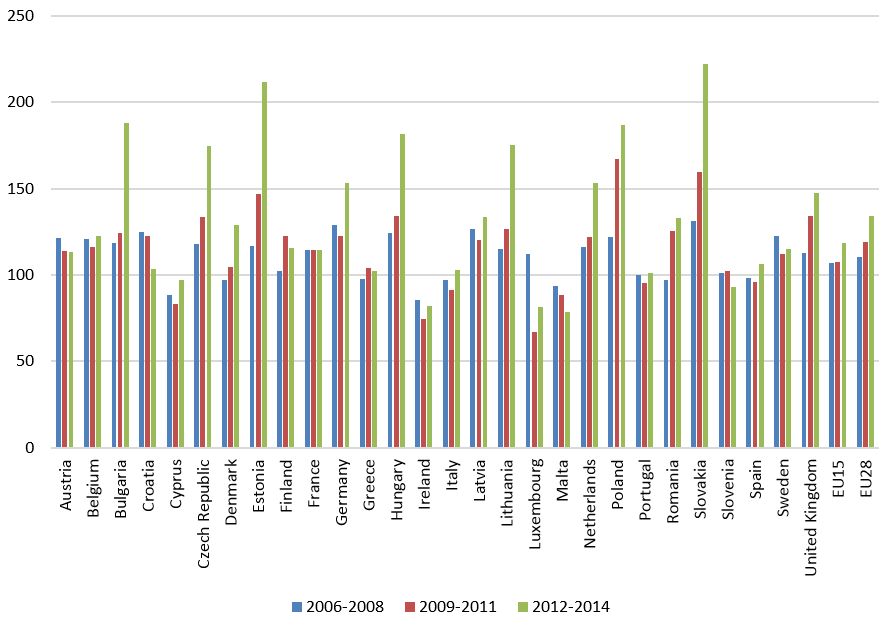
The index of the real income of factors in agriculture per annual work unit (better known as index of agricultural income or Indicator A) has increased by 18% in EU15 countries and 35% in EU28 countries from 2005 to 2014 as evident from Eurostat statistics. It is clear from the figure below that compared to 2005, agricultural incomes more than doubled in Estonia and Slovakia in 2012-2014, while it was just decreasing in Cyprus, Ireland, Luxembourg, Malta and Slovenia.

Agricultural income in the European Union by member state, 2005-2014 (2005=100)

Source: Own composition based on Eurostat 2015 data.

Without going very much into detail, it is apparent that agricultural income has been increasing in each period in the majority of the cases. Even in 2009-2011 when the economic crisis definitely had the biggest impact, agricultural real income per worker was just lower on 2005 basis in seven EU members. It is also evident from the figure above that due to increasing support, income of the New Member States (NMS) were increasing at a higher pace than that of EU15.… Read the rest