
Measuring changing farm structure in the EU

A particular type of farm structure is not an explicit policy objective of the EU’s Common Agricultural Policy (CAP). However, facilitating structural change is an objective of the CAP, set out in Article 39 of the Treaty on the Functioning of the European Union, as a way of ensuring a fair standard of living for the agricultural community and increasing the individual earnings of persons engaged in agriculture (the Treaty language speaks of “ensuring the rational development of agricultural production and the optimum utilisation of the factors of production, in particular labour”).

However, there is a widely-shared view that it is desirable to maintain the family farm model of European agriculture. There also seems to be broad political support for the view that assistance should be targeted on smaller family farms. There is keen interest in the evolution of agricultural structures, with many regretting the decline in the number of smaller farms and criticising the emergence of larger, ‘industrial’ holdings.

One way to track changes in farm structure is to examine trends in the average size of holding, or average herd size in the case of livestock farms. However, this measure can seriously underestimate the pace of change where much of the growth (in area farmed, or in livestock numbers) takes place on the larger holdings. The persistence of many small holdings, even though the share of the land or livestock that they control is small and may be falling, tends to mask the extent of structural change as measured by averages.

The midpoint size

An alternative farm structure metric that can be used to track changes in farm structure which takes account of this phenomenon is the midpoint farm size or herd size. The midpoint size (sometimes called the hectare-weighted median when discussing farm size) is defined as the size that marks the middle of the distribution of the variable of interest, whether farm area or livestock. Taking farm area as an example, the midpoint size divides the distribution into two parts; 50% of the total agricultural area is operated by farms of a larger size and the other 50% by farms of a smaller size than the midpoint size.

This measure better captures the extent of farmland or livestock concentration than average (mean) size. Another advantage is that it facilitates a more accurate comparison of farm structure across countries. Countries often differ in the minimum size threshold they use to define the farm population (some countries might use a minimum threshold of 1 ha, others 5 ha, and yet others a threshold based on the value of sales). These different thresholds can mean big differences in the number of very small farms included in the farm population, which can greatly affect the calculated average farm size, but has a much smaller impact on the midpoint farm size.

A 2016 OECD paper by Bokusheva and Kimura examines cross-county differences in farm size distributions and explains the strengths and weaknesses of this and other farm structure statistics. That paper also presents results using various metrics for selected farm enterprises for some EU and non-EU countries based on the work of the OECD Network for Farm-Level Analysis. The results, which include changes in midpoint sizes, are presented for five-yearly intervals from 1995 to 2010 though the 1995 data are often missing for the included EU countries.

The following two graphs (click on all graphs to enlarge) show a comparison of changes in the mean and midpoint size for cropland area and dairy herds in the US (the cropland chart is taken from this USDA report while the dairy herd chart comes from this USDA publication). The cropland chart is interesting because it shows almost no change in the average size of arable area on farms (because the largest and smallest crop farms grew in number while farms in the middle declined). At the same time, the midpoint size doubled, from around 600 acres to 1,200 acres over the same period.


The disparity in the trends is even more marked in the case of dairy herd size. While the size of the average dairy herd has more than doubled over a 20-year period, the midpoint size has increased nine times. Half of all US milk production is now coming from herds with more than 900 cows, assuming similar yields in herds of different sizes.


European comparisons for dairy herds

I thought it would be interesting to derive a similar chart for EU dairy herd size. Average herd size is easily available, but the midpoint size is not. I do not have access to the raw survey data which would be necessary to derive the midpoint size, but one can make a reasonable guess using the published herd structure data by size class. Invariably, the midpoint size falls within a herd size class (say, for example, 20-29 cows).

To derive an estimate of the midpoint size, we assume that dairy herds are evenly distributed within a size class, i.e. there are the same number of total cows in herds of size 20, 21, 22, etc. With this assumption, it is possible to calculate the herd size which precisely divides the number of cows into two equal halves. The assumption is likely to give a slight upward bias to my midpoint size estimates, as for the relevant size classes it is probable that cows are bunched in the smaller herd sizes within a class.

In the EU, farm structure statistics are published by Eurostat as part of the regular Farm Structures Survey (FSS). This is a sample survey undertaken by Member States every two or three years which is currently mandated by Regulation (EC) No 1166/2008. In addition, a full agricultural census is conducted every ten years in order to provide a register of farm holdings and the other information required for the stratification of the sample surveys. For the EU15 with the exception of Germany (so EU14), the FSS data go back to 1990. For the EU12 (excluding Croatia), the data begin in 2003. The 2008 Regulation specified that surveys would be carried out in 2010, 2013 and 2016. As the data from the 2016 FSS will not become available until later this year (Eurostat promises an update of its farm structures page in September), the latest data on farm structure trends relates to the year 2013.

The EU14 chart is shown below. It is striking in various ways. Average herd sizes are smaller in the EU than in the US. In 1992 (1990 in the EU), the US average herd size was 61 and the EU average herd size was 16. By 2012 (2013 in the EU), these averages had increased to 144 in the US and 45 in the EU. If anything, average herd sizes increased at a faster rate in the EU than in the US in these two decades (though note that the EU time period is slightly longer by three years). A reasonable conclusion to draw would be that structural change was proceeding at roughly the same rate in the two regions.

However, the midpoint sizes tell a very different story. More and more milk production in the US is coming from the relatively larger herds. As noted, the midpoint size increased from 101 to 900. This is not the case in the EU. While the average herd size more than doubled (from 18 to 45 cows between 1990 and 2013), the midpoint size increased at a slower rate (from 39 to 84 cows). In the EU, growth in cow numbers was slightly faster in the smaller herd sizes, at least in the older Member States.

An obvious question is to ask is why do we observe this difference with the US? The quota regime in the EU likely slowed down the rate of structural change as in many countries quota transfers were regulated and smaller herds were given priority. Other factors, such as the higher cost of land in the EU, planning regulations for larger dairies, and difficulty in accessing labour, may also be part of the explanation. To the extent that the quota regime played a role, with the abolition of quotas there may be a greater tendency to shift to a ‘US’ model of structural change in the future.

The pattern of change in the EU12 is shown in the next chart. The time period is much shorter and, perhaps not surprisingly given the very small average size of herds, growth in production is growing faster in the larger herds. The fact that 50% of milk production still comes from herds of less than 18 cows highlights the very different production structures in the new Member States.

The final chart shows structural change in a single Member State, where I have chosen Ireland. The pattern of structural change in Ireland mirrors that for the older Member States as a whole, where growth of production has been faster on the smaller farms.

Conclusions

The contrast between the patterns of structural change in the US and EU dairy herd structure is striking. I tentatively suggest that the existence of the quota regime during the observation period in the EU is the main explanation. With the elimination of dairy quotas, one would expect future structural changes in EU dairy farms to follow more closely the ‘US’ model. It will be important to be able to monitor whether this is the case or not.

Where inequality in farm size distributions is increasing, data on the increase in average farm or herd sizes will underestimate the extent of structural change in agriculture. For this reason, the midpoint size is a more meaningful measure of structural change. The EU statistical authorities (Eurostat and DG AGRI) do not currently make use of this measure in presenting farm structures data. I would recommend that this should become routine. In particular, when presenting the results of the 2016 FFS later this year, Eurostat should be encouraged to present the midpoint sizes for various distributions and how these have changed over time.

A related observation is that the size class data used for the public presentation of FSS results should be updated to take account of the growing concentration of production assets on larger holdings. For example, the upper class size for dairy herds is 100 cows and above, but in 2013 50% of all dairy cows in the Netherlands were in this size class, and 50% in the other six size classes. By 2016 well over half of all cows could be in this single size class. Subject to confidentiality requirements, it would be desirable to provide a further breakdown of farm and herd sizes in the very largest size groups.

This post was written by Alan Matthews

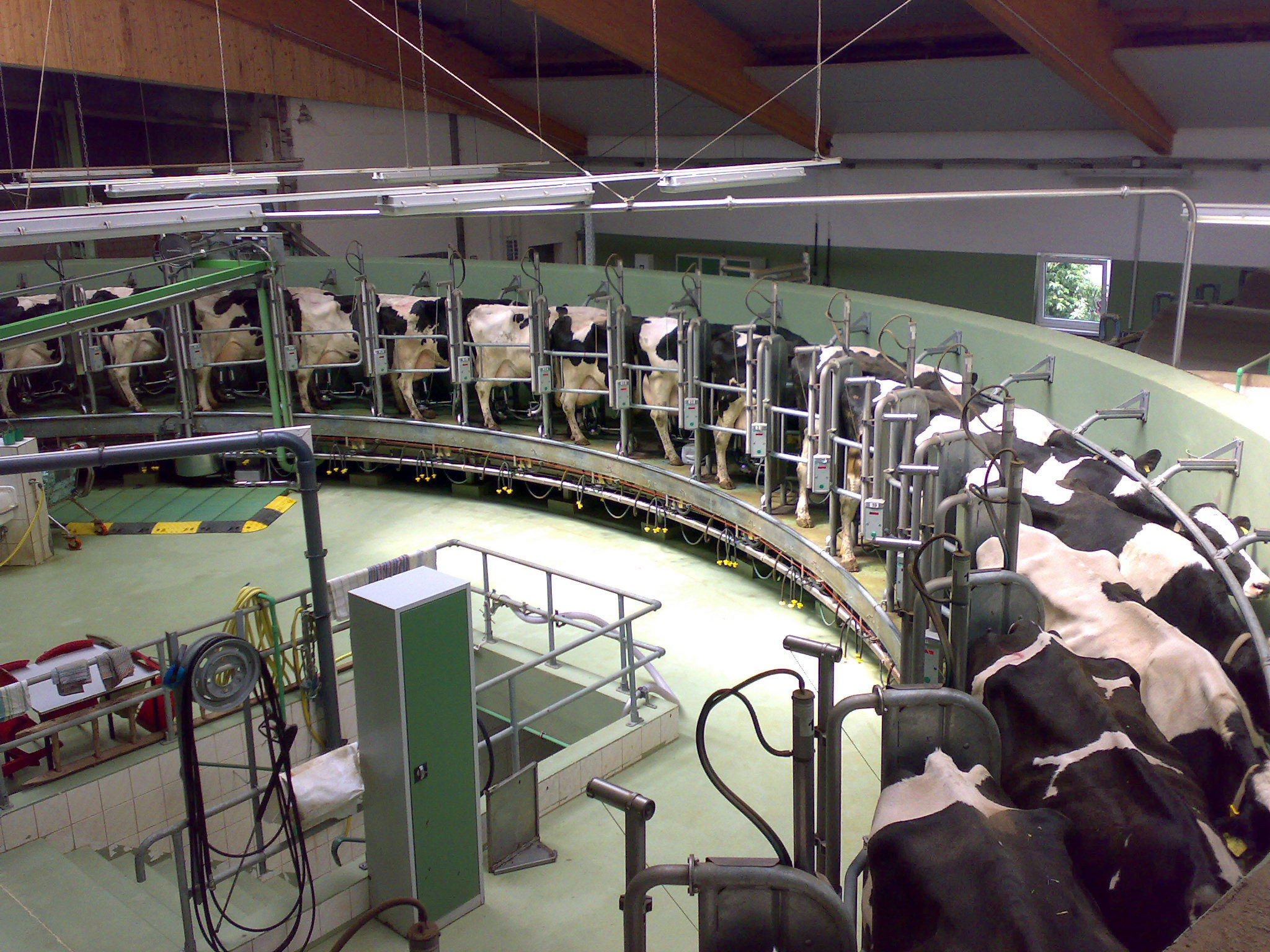
Photo credit: Wikipedia, under a Creative Commons licence

Is the removal of quotas responsible for the increase in EU milk production in 2015?

The plight of milk producers supplying the dairy cooperative Arla in Denmark and Sweden was the lead article in my Danish newspaper yesterday morning. Interviews with a number of farmers supplying Arla highlighted their loss-making situation at current milk prices. The journalist writing the story highlighted that a number of factors were responsible for the current low milk prices: the Russian import ban on EU dairy products, lower import demand in China but also increased production in the EU which he attributed to the removal of milk quotas in April of this year.
That EU milk production has increased is clear, as shown in the figure below. Production has increased from 135.2 mt in 2008 to a forecast 149.4 mt in 2015 and an estimated 150.8 mt in 2016. More recent data from the Milk Market Observatory (MMO) Dashboard for 23 December 2015 even suggests that the expected increase in 2015 will be significantly higher at 1.8% rather than the 1.1% shown in the December 2015 short-term outlook. The pace of increase has been uneven. Production grew by 2% or more annually in 2010 and 2011, and by a bumper 4.7% in 2014, with relatively modest increases in other years.

This increase in production was associated with a gradual loosening of milk quotas. Following the Commission Communication on the Health Check and in anticipation of the final Health Check decisions, there was strong pressure in the Agriculture Council to increase production possibilities. As a result quotas were increased by 2% in April 2008. To ensure a ‘soft landing’ and to gradually erode the value of quotas to close to zero by 1 April 2015 when quotas were due to expire, quotas were increased by 1% each year from 2009/10 until 2013/14, with an additional measure (fat correction reduction) which further increased production potential.
However, the journalist’s comment set me thinking about how important quota removal has been to the increase in EU milk production over the past 12 months relative to other factors. There was no increase in quotas in 2014/15 compared to 2013/14 until quotas were removed on 1 April 2015 (although some countries could increase their quota for milk deliveries by switching quota from direct sales). At the same time, milk prices reached record-high levels in 2014 (see figure below), despite the steady expansion of quotas since 2008. Any price-depressing effect from increased EU production was more than compensated by the positive price signals coming from a rapid growth in world market demand.

Milk prices are an important incentive to alter production. After very buoyant milk prices in 2008, prices collapsed to around 25c/l in the middle of 2009 but recovered to a level between 34-35c/l from August 2011 to July 2013. Prices then soared to reach a peak of over 40c/l in the four months from November 2013 to February 2014, before dropping again to their current level of around 30c/l.
In looking at the incentive to increase milk production, milk prices are only part of the picture. What really counts is the evolution of the milk margin which also takes into account trends in input costs. I previously looked at changes in milk margins in the EU using MMO data in this post, emphasising the great variability across farms in the EU around the EU average. The next graphic shows that, indeed, input costs grew in line with the increase in milk prices between 2009 and 2013 for the EU as a whole but input prices fell in 2014. Thus, the incentives at the beginning of 2014 to increase milk production were boosted by the fall in input costs in that year.

The trend in incentives is even clearer in the next graphic. This shows the quarterly evolution of average milk prices, operating costs and milk gross margin in the EU from Q3 in 2013 to Q3 in 2015. Input costs turned down about three Quarters before milk prices did, so during those three Quarters, covering in particular the peak production period in the first half of 2014, the incentive to produce additional milk was even greater than indicated by the milk price alone. It should thus be no surprise that milk production soared by an estimated 4.7% in 2014.

The question is whether it is possible to disentangle the respective contributions of quota removal and the carryover effect of the high 2014 milk prices and margins to the expected 1.8% increase in milk deliveries in 2015.
Distinguishing developments in countries constrained and not constrained by quotas
One way to answer this question is to make use of the fact that quotas were not binding in all member states, and to examine separately the evolution of milk production in countries that were constrained and those that were not constrained by quotas. I would expect production to be more sensitive to changes in milk prices/margins in the non-constrained countries during the quota period, but what I am really interested in is whether there is evidence that milk production has increased faster in the quota-constrained countries in the seven months for which data exists since quotas were eliminated.
To perform this test, we need to divide member states into the two groups of quota-constrained and non-constrained countries. Two issues arise in doing this. The first is that the countries where quotas were binding have changed over time. For example, in the last quota year 2014/15 twelve countries were constrained by their quotas, whereas in 2012/13 only five member states were constrained (where constrained is defined as production equal to or greater than a country’s quota ceiling). I decided arbitrarily to assume that countries which exceeded their quotas in three of the last four quota years belonged to the ‘quota-constrained’ group where you might expect to see a greater potential for expansion compared to countries in the non-constrained group. Eight countries fell into this group: Denmark, Germany, Ireland, Cyprus, Luxembourg, Netherlands, Austria and Poland. Four other countries – Belgium, Estonia, Italy and Spain – were above quota in the final year but not before.
The second caveat is the assumption that countries that did not exceed their national quotas were not quota-constrained. In some cases, such as Belgium, it may be that they did not exceed their quota because of careful management by farmers to remain within their quota ceilings. However, most countries below quota were well below quota. For example, in the final quota year, there were 16 member states under quota, and 10 of these were more than 10% below their quota for deliveries. Also, even in those countries where the national quota was not exceeded, it is possible that individual farms were constrained by their farm-level quota, depending on the national arrangements for the transfer of quotas and for offsetting over-quota milk with under-quota deliveries between individual farms. Again the fact that the majority of countries where the quota was not binding were well below their quota ceilings suggests that this should not be a major concern.
The result of this comparison is shown in the following diagram. Each month shows the 12-month milk deliveries for the 12 months ending in that month. Thus, the two data points for 2012M12 show total milk production in the calendar year 2012 for both groups of countries.

Between 2012M12 and 2015M03, annual milk production (measured on the rolling 12-month basis) increased by almost exactly the same percentages in the two groups of countries (by 5.7% in the constrained countries and by 5.6% in the non-constrained countries) although with greater variability in the non-constrained group.
However, in the seven months for which data are available since quotas were lifted, annual production in the constrained countries has grown by a further 3.1% while production in the previously non-constrained countries has grown by only 0.6%.
The results are even more clear-cut if we limit ourselves to comparing milk deliveries in the seven months since quota elimination in the two groups of countries with milk deliveries in the same seven months in 2014. Milk deliveries are up by 1.0% in the non-constrained countries, whereas they have jumped by 5.1% in the previously quota-constrained countries. Incidentally, the results are not qualitatively different if we enlarge the group of constrained countries to include, in addition, the four countries that were quota-constrained only in the final quota year, although the differences between the two groups are narrowed somewhat.
As with all results based on correlation analysis, we need to keep in mind that the true effect between quota elimination and production change may be masked by differences in other factors between the two groups which are not controlled for. For example, there is considerable heterogeneity in milk prices, production costs and their evolution across member states. It could be that milk deliveries have increased more in the non-constrained countries because they benefited on average from a more favourable trend in their milk margins. Nonetheless, the exercise does provide some indirect evidence that quota elimination has contributed to the rise in EU milk deliveries experienced in 2015.
Conclusions

A number of factors have come together to result in the collapse of the EU milk producer price from 40c/l in the early months of 2014 to 30c/l today. The main factors are external to the EU, such as the Russian import ban, slow growth in Chinese import demand and increased production in significant producers such as the US. But milk production has also grown in the EU in 2015, by 1.8% according to the latest MMO estimate.
It is plausible to point to the elimination of milk quotas in April of this year as the reason for the growth in EU milk production in 2015. Indeed, we find some evidence that production has increased much more significantly in the seven months since quotas were eliminated in those countries that were previously constrained by their quota ceilings compared to those countries where quotas were no longer binding.
However, we should also remember that quota elimination in 2015 followed a year of record prices and even more record margins in 2014 which led to the single largest year-on-year increase in EU milk deliveries even when quotas were still in place. During 2014 (comparing annual production in calendar year 2014 with calendar year 2013), milk deliveries increased by 5.8% in the non-constrained countries compared to 3.8% in the quota-constrained countries. The size of the increase in constrained countries is particularly noteworthy given that quotas themselves did not increase in 2014/15 compared to the previous year. As we know, many producers decided to build up their production capacity risking the record-breaking superlevy fines that year in anticipation of the end of quotas in April 2015.
The separate effects of quota elimination and the carryover effect of high prices and margins in 2014 on EU milk production growth in 2015 thus cannot be disentangled. It is safe to conclude that the impact of either one on milk production growth in 2015 would not have been anywhere near as large without the other.
This post was written by Alan Matthews.
Photo credit: Wikipedia