What does the Commission’s proposed 2040 climate target mean for agriculture?

On 6 February last, the Commission published its Communication Securing our future:  Europe’s 2040 climate target and path to climate neutrality by 2050 building a sustainable, just and prosperous society. The Communication proposes a Union-wide, economy-wide 2040 target reaching 90% net GHG emissions reduction compared to 1990 levelsthat will put the EU on an effective, cost-efficient, and just trajectory towards climate neutrality by 2050, as called for under the European Climate Law”.

In fact, what the Climate Law calls for is ambiguous. In recital (30), the Commission should propose a Union intermediate climate target for 2040, as appropriate, at the latest within six months of the first global stocktake carried out under the Paris Agreement and which was concluded at COP28 in Dubai in December 2023. But in the text of the Law, Article 4(3) states that the Commission “at the latest within six months of the first global stocktake … , the Commission shall make a legislative proposal, as appropriate, based on a detailed impact assessment, to amend this Regulation to include the Union 2040 climate target, ..’.… Read the rest

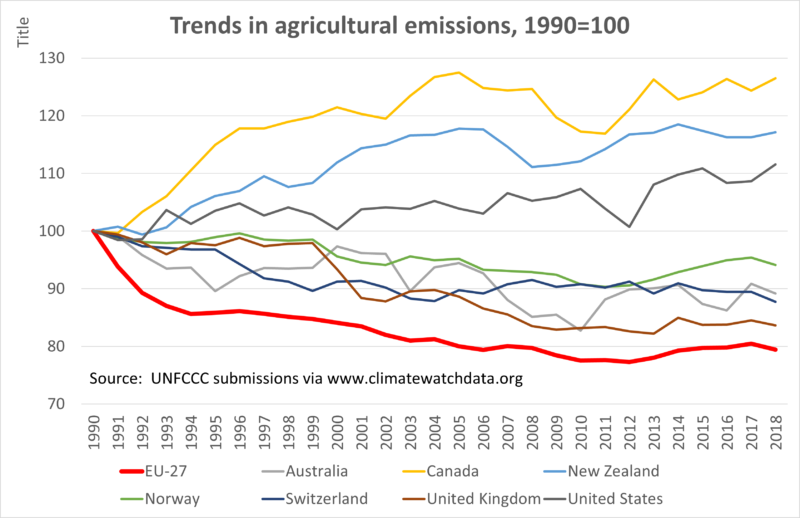
EU agricultural emissions trends in comparative perspective

The EU sees itself as a global leader in climate action. The UN Framework Convention on Climate Change (UNFCCC) was agreed in 1992. Since then, the EU has had quantitative emissions reduction targets for the period 2008-2012 under the Kyoto Protocol (a reduction of 8% compared to 1990 levels) and for the period 2013-2020 (under both the Kyoto Protocol and the 20-20-20 by 2020 Climate and Energy Package) which committed to a reduction of 20% in greenhouse gas (GHG) emissions by 2020 relative to 1990.

How have agricultural emissions trended during this period in the EU compared to other Annex 1 parties (developed countries) to the UNFCCC? The first chart below compares the trends in agricultural emissions (defined as mostly the non-CO2 gases emitted by agricultural production and soils) included in the national inventories submitted to the UNFCCC by selected Annex 1 countries.

Based on this evidence, agricultural emissions in the EU-27 have fallen by more over the period since 1990 than in the other Annex 1 countries shown.… Read the rest

Climate measures in Irish agriculture

Today, I made an online presentation to a virtual workshop jointly organised by MAREI, the Marine and Renewable Energy Ireland centre at University College Cork and the Economic and Social Research Institute, Dublin on climate and energy policy research. The talk discussed measures in agriculture to reduce Irish agriculture’s greenhouse gas footprint in the context of the country’s policy goals for climate stabilisation. Below is a transcript of the talk.

Agriculture is the single largest contributor to Ireland’s greenhouse gas emissions, accounting for 34% of total national emissions in 2018, but 46% of the emissions that are limited by the EU Effort Sharing Decision. If we are to reduce emissions in line with our national targets for 2030 and 2050, agricultural emissions must clearly be reduced. Yet they have been increasing in recent years.

Reducing absolute emissions is more difficult in agriculture because of the absence of obvious technical solutions such as exist for energy generation, transport and the built environment.… Read the rest

Mitigation potential in EU agriculture

In my previous post on this blog, I noted that the Commission’s impact assessment (IA) accompanying its presentation of the new Effort Sharing Regulation (ESR) proposal concluded that very little additional agricultural mitigation is expected in the period 2021-2030, over and above what is projected to occur under current policies.

Two possible conclusions might be drawn from this finding. One is that the agricultural sector lobby organisations have used their political clout to ensure that the sector is required to do as little as possible to contribute to the EU’s 2030 climate targets. This reaction was advanced by some NGO activists in response to the post.

The other explanation is that it is difficult (and expensive) to achieve additional agricultural mitigation above and beyond the business as usual scenario. This was the view of the European Council in October 2014 when, in agreeing the EU’s 2030 climate targets, it noted the lower mitigation potential of the agriculture and land use sectors.… Read the rest

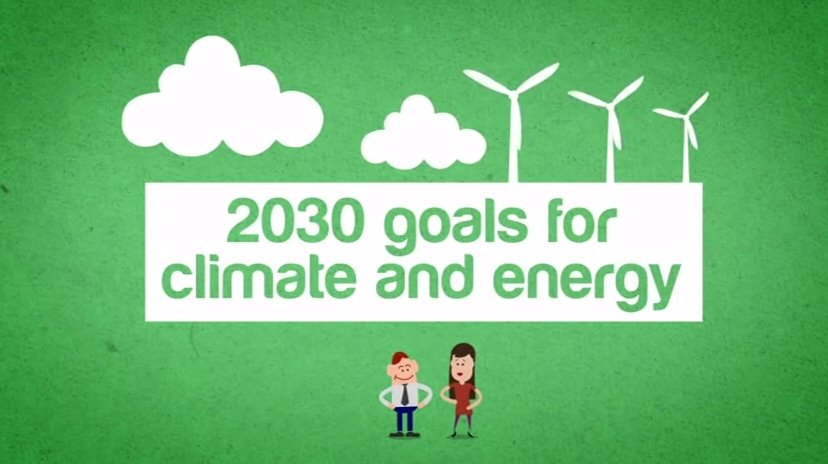
Is agriculture off the hook in the EU’s 2030 climate policy?

In October 2014, the European Council agreed the 2030 policy framework for climate and energy policy. The framework sets out the European Union (EU)’s commitment to a binding target of at least a 40% domestic reduction in economy-wide greenhouse gas (GHG) emissions by 2030 compared to 1990, with the reductions in the Emission Trading System (ETS) and non-ETS sectors (NETS) amounting to 43% and 30% respectively by 2030 compared to 2005. The European Council also set an EU target of at least 27% for the share of renewable energy consumed in the EU in 2030, and an indicative target at the EU level of at least 27% for improving energy efficiency in 2030 compared to projections of future energy consumption based on current trends. This will be reviewed by 2020, having in mind an EU level of 30%.

In a previous post, I examined the likely treatment of agriculture in this 2030 Climate and Energy Framework in the run-up to the European Council meeting which agreed the 2030 targets.… Read the rest