Capping direct payments – a modest proposal

DG AGRI has published its latest breakdown of the distribution of direct payments in financial year (FY) 2017, which refers to payments made to farmers in the claim year (CY) 2016. The report itself has less text than usual, but lots of graphs showing the distributions of payments and recipients for the EU28 and by country. The detailed tables showing the numbers behind these graphs are given in the statistical annex.

A couple of points are worth remarking. The tables distinguish between the distribution of decoupled payments, other direct payments and total direct payments. The decoupled payments include the basic payment, greening payment, redistributive payment, young farmers’ payment, and the payment to areas facing natural constraints in Pillar 1. The other direct payments are mainly the small farmer scheme and coupled payments under the Voluntary Coupled Support Scheme, the cotton payment and POSEI payments.

Decoupled direct payments amounted to €35.37 billion and were paid to 4.25 million beneficiaries in 2017.… Read the rest
The redistributive payment is more effective at redistribution

Capping of direct payments is not the only instrument proposed by the Commission to allocate more support to small and medium-sized farms. In addition to a mandatory ‘basic income support for sustainability’, the Commission CAP proposal would also require Member States to introduce a ‘complementary redistributive income support for sustainability’. This redistributive payment is currently voluntary under the 2014-2020 CAP.

Under the current CAP, the redistributive payment is applied by 9 Member States: BE-Wallonia, BG, DE, FR, HR, LT, PL, RO and UK-Wales. The financial allocation to the scheme takes up from 0.5% to 15% of the Member States national ceiling for direct payments. The payment aims at achieving a more effective income support for smaller farmers by granting an extra payment per hectare for the first hectares below a certain threshold.

All farmers eligible for BPS/SAPS receive the redistributive payment. However, they only receive this payment up to a certain number of hectares per holding.… Read the rest

How Member States are implementing the new CAP

All the focus last week was on the publication of the Commission Communication on the Future of Food and Farming. This document has been greeted with both curiosity (concerning the potential of the proposed new mode of delivery and governance to deliver both simplification of the CAP as well as improved targeting and results on the ground) and criticism (from farm groups worried that it eliminates the ‘common’ in the Common Agricultural Policy and environmental groups worried that it could facilitate the continued transfer of a large chunk of the EU budget to farmers with no questions asked). It will take some time to tease out its full implications, and this is something I will return to on this blog in the future.
Last month DG AGRI also published without fanfare on its website a very useful summary report on the implementation of the 2013 CAP reform in the 2015 claim year, the first year of implementation of the new CAP.… Read the rest

Implications of the new redistributive payment

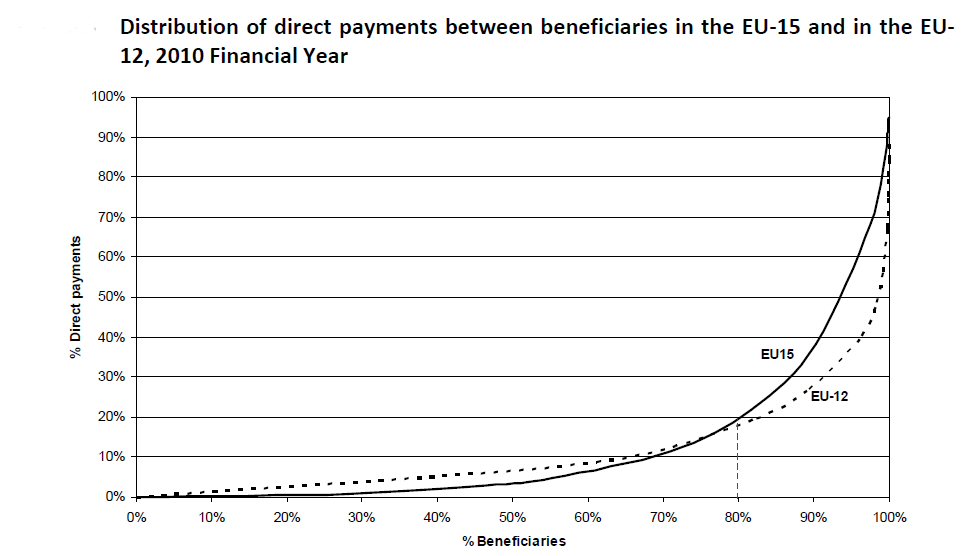
Ever since direct payments were introduced into the CAP, their unequal distribution has attracted unfavourable attention. The Commission’s 1991 paper The Development and Future of the CAP criticised the distribution of price support, noting that “80% of the support provided by FEOGA is devoted to 20% of farms which account also for the greater part of the land used in agriculture”. Yet the proportions remain exactly the same in both the EU-15 and EU-12 today, according to the Commission’s latest figures for the claim year 2009 (financial year 2010) (see diagram).

Even for those who argue that the specific nature of farming justifies a permanent system of direct payments support, the unequal distribution of support is hard to justify. The Commission has regularly made proposals to reduce payments to larger farms through either progressive modulation and/or capping. But these proposals equally regularly were either watered down or rejected by the member states.… Read the rest