
Greater transparency needed in national aids to agriculture

On 2 May 2024, the European Commission adopted an amendment to the State aid Temporary Crisis and Transition Framework (TCTF) to allow Member States to continue to provide aid to farmers affected by persistent market disturbances up to €250,000 to end-December 2024. This followed the European Council’s endorsement in its conclusions following its meeting 17-18 April 2024 of “the proposed extension of the temporary framework on State aid and the possibility to increase the ceiling on de minimis aid for agriculture.”

Following on the European Council’s conclusions, Germany on behalf of 16 Member States informed the last AGRIFISH Council meeting in April 2024 that it was seeking an increase in the de minimis aid amounts for farmers from a total of €20,000 over three years (€25,000 in certain circumstances) to an amount of €50,000. This would become the relevant ceiling once the TCTF derogation expires at the end of the year. The Commission announced in parallel with its adoption of the TCTF amendment that it will launch a revision of the agricultural de minimis regulation “in light of the inflationary pressure in recent years and the current context with, amongst others, high commodity prices affecting the agricultural sector.

These decisions put the focus on how much additional aid farmers receive from Member States in addition to the funds transferred through the CAP. This is an extremely murky area as, despite the obligations on Member States to report State aid and other aid to farmers, there is no central registry which keeps track of these amounts. But that the amounts have been significant is beyond doubt. Back in May 2023, Commissioner Wojciechowski tweeted that more than €7.6 billion in State aid under the TCTF had been approved between March 2022 and May 2023 (though I have been unable to track down the document copied in the tweet).


A little earlier, in November 2022, Farm Europe estimated that Member States received approval for around €4.6 billion in aid to farmers in 2022 both under the Temporary Crisis Framework (TCF, which preceded the TCTF) and the Covid-19 Temporary Framework (TF). Its analysis included a table which compared the crisis support approved with the direct payment transfers to each Member State. Its estimates showed that in Italy, Poland and Bulgaria the crisis aid approved amounted to between 27% and 33% of the direct payments envelope in 2022. 

A more recent analysis by Euractiv journalists Maria Simon Arboleas and Sofia Sanchez Manzanaro examined aid to agriculture and the food sector under both the TCF and the TCTF between March 2022 and March 2024. They estimated that Member States had approved over €11 billion in State aid over those two years, with Poland (€3.9 billion) and Italy (€2.3 billion) the clear leaders.

These estimates underline that Member State transfers to farmers outside the CAP have been very significant in recent years, but there is still huge uncertainty about the figures. For one thing, the amounts approved for State aid are not necessarily disbursed in full, so the figures above exaggerate the actual transfers that farmers received. On the other hand, these figures only cover crisis State aid, while Member States also transfer significant amounts to farmers through regular non-crisis State aid and de minimis amounts (the latter are not considered State aid under EU law) in addition to the funding allocated in the CAP Strategic Plans.  

In this post, I first discuss the different ways Member States can transfer national funds to farmers. I then examine available information on the amounts transferred in recent years, highlighting the lack of consistent robust data. Because there is a risk that national aids can distort the level playing field within the single EU market, I conclude by calling for a single central repository of data (building on but extending the State Aid Scoreboard maintained by DG Competition) to allow full transparency around this largely invisible flow of funds to EU farmers.

The EU State aid architecture for agriculture

EU State aid rules play a critical role in ensuring fair competition and the efficient allocation of resources within the internal market. The basic principles are set out in Articles 107-109 of the Treaty on the Functioning of the European Union (TFEU). Article 107 begins by prohibiting aid by a Member State that distorts or threatens to distort competition insofar as it affects trade between Member States in the single market. It then goes on to identify certain categories of aid that are deemed to be compatible with the internal market, and further categories of aid that can be deemed to be compatible. The Commission has developed a set of horizontal rules to clarify its position on particular categories of aid, including general guidelines, block exemptions, and de minimis provisions.

However, these general rules derived from the Treaty Article 107 are not automatically applicable to agriculture. The EU legislator has decided, on the basis of TFEU Article 42, that State aid rules do not apply to support financed under the CAP in relation to production and trade in agricultural products listed in Annex 1 of the TFEU (Articles 145-146 of the CAP Strategic Plans Regulation and Articles 211-212 of the Single CMO Regulation). Thus, national co-financing of rural development spending relevant to Annex 1 products in CAP Strategic Plans, including additional national co-financing, is not considered State aid.  However, for the following expenditures normal State aid rules apply:

  • National spending related to producers of Annex 1 agricultural products financed solely by national resources (i.e. without any EU element). This includes all subsidies, tax advantages, and grants that exceed specified thresholds or do not fall within exempted categories.
  • Measures in CAP Strategic Plans that fall outside the scope of Article 42, for example, forestry measures and support for tourism or small businesses in rural areas.

Normal State aid rules mean that Member States must first notify their intention to provide assistance and then wait until the Commission has given the go-ahead after checking its impact on competition in the internal market before they can implement the measure.

The Commission has developed a set of horizontal rules to clarify its position on State aids to agriculture and forestry:

  • The Agricultural Block Exemption Regulation (ABER) allows Member States to implement certain types of aid to SMEs in the agricultural sector without prior notification to the Commission, provided the aid meets specific criteria and conditions outlined in the regulation. This includes support for investments in physical assets, environmental and climate action, research and development, and risk management in agriculture. A revised ABER entered into force on 1 January 2023 which included a significant extension of the scope of block-exempted measures. The Commission anticipates that the new rules will block-exempt up to 50% of cases which before were subject to notification.
  • The Agricultural Guidelines on State Aid provide the framework for assessing the compatibility of State aid with the internal market and stipulate various conditions under which aid may be considered permissible. These guidelines emphasise the need for aid to support genuine public policy objectives such as environmental protection, animal welfare, and the promotion of rural development, without unduly distorting competition.
  • The agricultural de minimis Regulation sets a ceiling below which aid measures are not seen as State aid and do not have to be notified to the Commission. After the last revision to this Regulation in 2019, the de minimis ceiling was raised to €20,000 for a single undertaking over a period of three years subject to a national cap of 1.25% of national output (these amounts can be raised to €25,000 per undertaking and 1.5% of national output provided certain conditions limiting the amount of aid to a specific sector and establishing a central register for such aid are observed). Member States are obliged to report such aid to ensure transparency and adherence to cumulative limits.

These non-crisis State aid rules have been supplemented in recent years by several crisis measures. In March 2020 the EU introduced the Covid-19 Temporary Framework (TF) which permitted additional aid to farmers up to €100,000 in 2020, provided that the aid was not fixed on the basis of the price or quantity of the products put on the market. Successive amendments extended the period of validity to June 2022 and in November 2021 the maximum ceiling on aid to farmers was increased to €290,000. This aid could be paid in addition to de minimis aid.

Following the Russian invasion of Ukraine in February 2022, the EU introduced the Temporary Crisis Framework (TCF) in response to market disturbances. For farmers, Member States were allowed to provide up to €35,000 per undertaking in the form of direct grants, tax advantages, or guarantees and loans up to end December 2022. In July 2022 the maximum ceiling on aid to farmers was increased to €62,000. In October 2022 all measures were extended until end December 2023 and the maximum ceiling for aid to farmers was increased to €250,000 per farm. The TCF was replaced by the Temporary Crisis and Transition Framework (TCTF) in March 2023 which also set the permitted maximum level of aid to an individual farm at €250,000 to be paid before the end of December 2023. The period of validity was later extended to June 2024 and, as noted in the introduction to this post, has now been extended to December 2024 for farmers alone.

Finally, we should note that farmers have also benefitted from the call up of the agricultural reserve in both 2022 and 2023. In 2022 this was worth €500 million and Member States were permitted to add double this amount (200%) from their own resources (in practice, national top-ups amounted to €575 million giving a total budget of £1.1 billion). The total amount was allocated between Member States according to their net ceilings for direct payments, and farmers were eligible provided that they engaged in activities pursuing one or more of these goals: circular economy, nutrient management, efficient use of resources, and environmental and climate friendly production methods.

Expenditure of the 2023 agricultural reserve was more piecemeal and not without controversy. The EU 2023 budget included an amount of €450 million for the agricultural reserve and five measures, totalling €530.5 million, were adopted. These included two tranches of support for front-line states bordering Ukraine worth €56.3 million and €100 million respectively. This led several other Member States, annoyed by the unilateral restrictions on imports from Ukraine imposed by several of the beneficiaries, to question the criteria used to allocate this funding, a criticism repeated by MEPs in November 2023. Subsequently, the Commission proposed a general support package of €330 million for all Member States, again with the possibility for Member States to add double this support from their own resources, with Member States again criticising the lack of transparency.  Smaller amounts were also made available for the eggs and poultry sectors in Poland and Italy. According to the EAGF Early Warning System, some of this expenditure (€134.5 million) was paid from the 2023 EAGF budget and the remainder (€315.5 million) was carried forward to the 2024 budget.

The agricultural crisis reserve itself is part of the CAP budget and does not represent additional resources transferred to farmers. However, the possibility for Member States to add double these amounts from national resources does represent additional State aid which would represent an increase in transfers over and above the channels considered so far. The Commission is obliged to report every three years on the use of crisis measures adopted on the basis of Articles 219 to 222 of the Single CMO Regulation including the use of the agricultural reserve, its first such report was published in January 2024. But this report only covers expenditure from the EU budget and does not cover complementary national aid.

How much national aid have farmers received?

State aid approvals under crisis measures

In this section, we want to estimate how much additional funds have been transferred to farmers under national aid measures in recent years. One way to get a handle on this amount is to examine the Commission decisions on Member State notifications under the various emergency aid packages (COVID TF, TCF and TCTF). This is the approach taken by Farm Europe and Euractiv in the analyses previously summarised. It aggregates the maximum ceilings for State aid approved by the Commission. Although there has been a specific interest in aid approved under the various crisis measures, the approach can be extended to all State aid notifications. One (major) drawback is that actual State aid provided under these approvals may turn out to be much less than the amounts approved (discussed further below). Other issues are that the schemes identified in this approach are those that specifically target agricultural producers. In practice, other beneficiaries such as aquaculture producers and forestry may also be included in these schemes. More important, several countries introduced umbrella schemes which, for example, reduced energy costs across the economy under which agricultural producers can also benefit but are not identified as a distinct group.

To illustrate this approach, I have estimated the total State aid approved primarily for the agriculture sector under the Temporary Crisis Framework introduced in March 2022 and approved during 2022. The main source used was the Commission Staff Working Paper accompanying the 2022 Annual Competition Report. Relevant schemes were identifying using keywords such as ‘agriculture’, ‘livestock’ or other specific commodities. Schemes specifically targeting the food processing sector were excluded. The list of schemes derived from this source was compared with the list of Member State measures adopted under the TCF and TCTF published by the Commission in May 2024 and some additional schemes not in the original list were added. The final list of schemes is available in this spreadsheet. Total approvals in 2022 under the TCF amounted to €4.93 billion, with Italy accounting for €2.23 billion of this total, Poland for €836 million, and France for a further €559 million (note that these figures are considerably higher than the €3.8 billion estimated by Farm Europe for the same scheme in the same year). These figures are compared with actual expenditure under the TCF in 2022 on agriculture, forestry and rural areas later in this post.  

EEA support amounts

To assess the actual level of disbursements a first place to start is to examine the Economic Accounts for Agriculture (EEA) compiled by Eurostat. The EEA captures budget transfers to farmers under two headings:  subsidies on products (e.g. coupled payments) and other subsidies on production (e.g. direct payments, agri-environment payments). Table 1 shows the trend in these subsidies in recent years. As well as giving the data for the EU as a whole, I also include Poland which is identified as a country that has made great use of the crisis emergency measures.

Table 1. Public transfers to farmers, € million
Source:  Eurostat, Economic Accounts for Agriculture domain [aact_eea_01]. Total CAP payments to Member States (excluding the UK for 2019 and 2020) from DG BUDGET, EU spending and revenue – Data 2000-2022. CAP spending by the Commission is excluded. Note that not all EAGF and EAFRD payments are made to individual farmers.

The most striking message from Table 1 is how little the crisis State aids in 2020-2023 show up in the table, either for the EU or for Poland. For the EU, we control for changes in CAP payments by looking at the total receipts of Member States from the two CAP funds EAGF and EAFRD. Not all of these payments are received by individual farmers and therefore would show up in the EEA figures, but it is the overall trend that is significant. In 2020, the year of the Covid-19 TCF, total subsidies actually fell compared to 2019 despite an increase in CAP payments.  In 2021 there was a small increase in total subsidies compared to 2019 but still much less than what can be explained by a greater increase in CAP payments. Only in 2022 do we see evidence of an increase in total subsidies greater than the increase in CAP payments compared to 2019 but still only amounting to €1.4 billion. While we do not yet have data on CAP payments to Member States for 2023, assuming that they are similar to 2022 payments suggests that they would account for all of the increase in total subsidies relative to 2019. The situation for Poland is even starker as there has been no increase in the reported amounts of subsidies in recent years, despite the significant use Poland has made of the temporary crisis measures. In other words, it seems that the crisis payments to farmers have gone missing in action.

In the EEA, agricultural output is valued at both producer prices and at basic prices (the difference here is what allows us to calculate subsidies on products). However, inputs are always valued only at basic prices, i.e. the prices that farmers actually pay (excluding VAT). A feature of much of the crisis aid to farmers is that it was used to lower input prices, i.e. subsidies on energy costs, on fertiliser, on fodder and on interest rates, or to provide tax exemptions or reductions in social security contributions. By definition, these subsidies would not be picked up in the EEA. However, the input cost subsidies would still be captured in the income arising in agriculture because the value of inputs would be reduced by the amount of these subsidies. This is a major limitation of using the Economic Accounts for Agriculture to track the impact of national State aids.

State aid Scoreboard

Another source to use in tracking State aids is the State aid Scoreboard repository maintained by DG Competition. It is a requirement for the EU Commission to publish annually a State aid synopsis based on expenditure reports provided by Member States covering all aid expenditure that falls under the scope of TFEU Article 107(1). In principle, this covers notified State aid to agriculture and forestry, aid exempted from notification under the block exemption regulation, and State aid expenditure on the crisis measures.  Importantly, the Scoreboard data do not include de minimis aid because it is not subject to the Commission’s investigative powers under the State aid rules nor deemed to be State aid. The Scoreboard covers all Member State expenditure for which the Commission has either adopted a formal decision following notification or received a summary information sheet from Member States for measures qualifying under the agricultural block exemption ABER.

There are other methodological issues which need to be kept in mind when using the Scoreboard. First, the data represent actual State aid expenditure by Member States and not the ceilings that have been approved. There is usually a large discrepancy. For example, the State Aid Scoreboard 2023 reported that in the period between the adoption of the COVID-19 Temporary Framework in March 2020 and December 2022, out of nearly €3.05 trillion of aid approved, only around one third (34% or €1.03 trillion) of it was actually spent. For the TCF which was adopted in March 2022, only 9.6% of the aid approved in nominal terms had been spent by December 2022.

Second, the data distinguish between the nominal value of State aid granted by Member States and the aid element, which is the economic value granted to the recipient. For grants, the aid element normally corresponds to the budget expenditure but for other aid instruments there can be a difference. For example, when the State provides a loan guarantee there is an economic advantage to the recipient but not necessarily budgetary expenditure by the State unless the loan is called in. The 2023 Scoreboard notes that in nominal terms State aid expenditure under the Covid TF was €1.03 trillion, but the aid element of this expenditure amounted to only €472 billion.

Table 2 shows the data for State aid to agriculture forestry and rural areas distinguishing between notified aid (including the crisis aid measures Covid TF and TCF in force in those years) and aid for which notification is not necessary as it is granted under the ABER block exemption regulation. Member States provide their reports by June 30 of the following year, and the latest Scoreboard data refer to 2022. The first point to note is that no COVID TF State aid measures have been reported in the Scoreboard, which seems to be a fatal omission. It is not clear whether these COVID TF measures are included under Notifications but not reported separately under the COVID TF heading, or whether they are simply omitted entirely from the Scoreboard.

Aid expenditures under the TCF have been reported by nine Member States in 2022.  However, three Member States, Poland, France and Bulgaria account for the great majority of this actual expenditure (the State aid notifications to which these larger expenditures refer are listed in Annex 1 of the State Aid Scoreboard 2023). The difference between the aid expenditure reported under the TCF in 2022 and that approved (€4.9 billion, see above) is striking. The discrepancy is particularly severe for Italy, where the Commission approved national aids of €2.3 billion in 2022 but only €45.5 million was actually paid out to farmers.

Figure 2. State aid for the objective ‘Agriculture forestry and rural areas’ in the State Aid Scoreboard repository.
Notes:  Figures refer to the aid element of State aids.

Overall, the Scoreboard figures show an increase in State aid expenditure on agriculture and related areas of around €3 billion in 2022 compared to 2019. €1 billion of this is due to higher expenditure on ABER aids, just over €1 billion due to the TCF in 2022, and the remaining €1 billion due to other notified State aids (which may include measures approved under the COVID TF). The fact that expenditure under ABER has increased shows that Member States have been willing to use conventional non-crisis State aids also to make additional transfers to farmers during the crisis period.

Even leaving aside the uncertainty around COVID State aid, these figures are an underestimate of total national State aids to agriculture as the Scoreboard figures do not take account of Member State co-financing of agricultural reserve crisis spending nor de minimis aid. For example, the Commission reports that Member State aid in 2022 (on top of the agricultural reserve spending of €500 million) amounted to a further €575 million.  

Conclusions

The current moves to change the rules to make it easier for Member States to provide national State aid to their farmers raises the question, what do we know about the amounts of aid that EU farmers receive and which Member States make most of this channel. The question is even more relevant given the very significant sums of money transferred through the various crisis aid schemes in recent years, the Covid Temporary Framework (TF), the Brexit Adjustment Reserve, the Temporary Crisis Framework (TCF) and currently the Temporary Crisis and Transition Framework (TCTF). There is a real concern that some Member States are in a better position to provide national aid to their farmers than others, and that the flexibilities provided under these various instruments may distort the level playing field in the single internal market.

Previous attempts to address this question have relied on State aid notifications and the amounts of aid that Member States have sought approval for. These amounts are indeed eye-wateringly large. But they exaggerate the amounts of aid finally disbursed which are usually well below the total amounts of aid for which approval is sought. DG Competition does provide figures, based on returns from Member States, of actual aid disbursed in its annual Scoreboard of State aid, but this only covers formal notifications and money disbursed under the Agricultural Block Exemption Regulation (ABER). It ignores national crisis aid authorised under the Single CMO Regulation as well as de minimis aid. Furthermore, there is a question mark over the actual figures reported in the Scoreboard as aid under the Covid TF for the Agriculture, Forestry and Areas objective is not shown separately, so it is not clear to me if it is included or not. The Commission publishes a regular report on the use of crisis aid under the Single CMO Regulation, but this only covers expenditure from the EU budget and does not include complementary national aid. Although Member States are required to report on their de minimis aid to the Commission, there does not appear to be any way of finding out and tracking the sums provided under this channel.

Still, my estimate in this post is that national State aids amounted to an additional transfer of over €9 billion to farmers (€8.6 billion in notified State aids plus aid under ABER, see Table 2, plus a further €0.57 billion in complementary national support for the agricultural reserve) in 2022. This compares to total CAP receipts by Member States in 2022 under both the EAGF and EAFRD funds of €54 billion (see Table 1). These national aids are a largely invisible additional transfer to EU farmers that should become more transparent.

Farming will continue to be affected by adverse shocks arising either from natural disasters, including those due to increasingly frequent weather extremes caused by climate change, or market disruptions due to geopolitical events. In this context, the agricultural crisis reserve, in place since the introduction of the latest CAP on 1 January 2023 with a yearly allocation of at least €450 million, is established to finance exceptional measures. But a reserve of this size is not able to sufficiently address the scale of crises, and hence the Commission has resorted to permitting additional national State aids.

Various calls have been made to re-examine the budget for crisis support. Commissioner Wojciechowski in November 2023 when visiting the scenes of flooding in Slovenia called for a special EU fund as a third pillar of the CAP to be used specifically for crisis support, a call echoed by the Italian farm organisation Confagricoltura during the farm protests in February earlier this year.  But it is hard to see how to introduce the possibility of sufficient flexibility in the CAP budget within the budgetary rules governing the Multi-annual Financial Framework. It is likely that relying on Member States to provide national aids will continue to be a feature of future crises.

For this reason, the Commission should commit to preparing a single centralised annual report which would allow easy tracking of all national State aids to agriculture. This could build on the DG Competition Scoreboard but should be extended to also include the other channels whereby farmers receive national aids that are not formally considered as State aid. This post makes clear that such information is not readily available at the present time.

This post was written by Alan Matthews.

Photo credit: Pattys-photos, used under a CC licence.

Financing emergency aid to address market disruption due to COVID-19

There has been strong pressure on Commissioner Wojciechowski to get the Commission to do more to protect farmers and agricultural markets from the adverse effects of the lock-down responses to the coronavirus pandemic.

The Commissioner has argued that there is no funding available for these measures in the EU budget. In this post, I assess the funding that may be available to the Commissioner. I conclude that available funding is limited but not exhausted. It now seems time to make use of the crisis reserve that was put in place for exactly this eventuality as well as unused margins under the European Agricultural Guarantee Fund (EAGF) in the EU budget.

The EU budget is a very complex entity, and it is not easy for an outsider to have a complete understanding of how it works. There may well be errors in the following account, and if so, I would be grateful to have them pointed out. The exercise is still valuable as context for any future debate on crisis management in the CAP as part of the ongoing negotiations on the future CAP framework post 2020.

Growing demand for EU intervention

Copa-Cogeca has highlighted the market breakdown for livestock producers in the dairy, beef, sheep and goat sectors and called for additional targeted market measures for the livestock sector, including exceptional measures, financed outside the CAP budget. Specifically, it has called for the activation of private storage measures for dairy products and the different meats, as well as more targeted management of Tariff Rate Quotas for imports.

Copa-Cogeca has also highlighted problems in the ornamental sector and for some fruits and vegetables. Also the wine market, where exports had already been hit by US tariffs of 25% imposed as part of US retaliation against Airbus subsidies, has been further affected by the loss of sales of higher-quality wines as restaurants remain shuttered.

The European Milk Board has called for a voluntary supply reduction programme in the dairy sector covering a few months in which producers would be compensated, similar to that introduced at the time of the last milk price crisis in 2016. The French dairy sector representative group CNIEL has already introduced a €10 million solidarity fund under EU rules to compensate suppliers who agree to reduce production.

According to Euractiv, MEPs in the European Parliament’s Agriculture Committee have also written to the Commissioner calling on the Commission to use the emergency instruments in the common market organisation (CMO) “as soon as possible”. The Committee is looking for intervention measures as well as opening private storage. In addition, it supports the activation of the crisis reserve which has been financed by withholding a proportion of the direct payments paid to farmers at the end of 2019 and which if left unused would be returned to them as part of their direct payment paid out at the end of this year. Some MEPs have called for a compulsory volume reduction in the dairy sector to avoid milk storage or destruction as the spring peak in milk production approaches.

Ministers of Agriculture have also supported these calls. In a letter initiated by Ireland and sent to the Commissioner on 16 April, all EU agriculture ministers, while welcoming the measures taken in the European response to date, called for urgent additional measures to be taken under the CAP, including aid for private storage to support those sectors where significant price impacts have been identified, as well as exceptional aid to farmers in the most affected sectors.

Commissioner Wojciechowski, when addressing the Parliament’s AGRI Committee on 15 April, accepted that requests for market intervention measures were legitimate but pointed to the absence of money in the EU budget to finance such measures. “These are legitimate expectations and if the Commission had a sackful of money it would dip into it straight away”, the Commissioner is reported as telling MEPs. However, he added that there is no such sack in the current financial framework, as there was no reason to do so when adopting the budget last year.

The Commission has announced two sets of measures so far to help the agri-food sector in its response to the pandemic. On 25 March, DG AGRI announced an extension of the deadline for submitting CAP payment applications, as well as details of additional flexibilities for Member States to provide aid to farmers and food processing companies under the newly adopted Temporary Framework for State Aid (especially paragraph 23 in that Framework).

A further set of measures were announced by DG AGRI on 2 April. These included the possibility to reallocate unused funds within Rural Development Programmes to finance relevant actions to face the crisis, an increase in the advance payment of direct payments farmers will receive after mid-October and rural development payments, plus a reduction in the number of physical on-the-spot checks to ensure eligibility conditions are met.

Whether market intervention measures are justified or not is always a judgement. Agricultural market prices are anyway volatile, and normal market risk is something that should be left to producers and processors to manage. However, some agricultural sub-sectors have experienced an exceptional drop in demand where taxpayer assistance can be justified. Market intervention can also be justified to provide some market stability when there is a sudden and temporary drop in prices.

State aid measures will remain the most important response

Following the changes made in the 2013 CAP reform to the crisis management measures available under the Common Market Organisation (CMO) Regulation, the CAP has the policy flexibility to respond to market disruption but not necessarily the budget. This reflects the relatively inflexible structure of the EU budget more than any ceiling on available funds per se.

The EU cannot borrow to finance a sudden increase in the demand for resources such as can result from an agricultural market crisis. Especially for an EU-wide crisis that affects all agricultural sectors, the EU budget will never be able to cope on its own. It is also relevant to recall that, under the Treaties, agriculture is a shared competence between the Union and the Member States. It is thus reasonable to expect Member State initiatives to play a role, perhaps even the major role, in providing income assistance to farmers where this is justified.

This is the rationale behind the Temporary Framework for State Aid Measures introduced in response to the COVID-19 outbreak in March. As the Commission noted when bringing forward this measure: “Given the limited size of the EU budget, the main response will come from Member States’ national budgets”. Under the Temporary Framework, Member States have the possibility to provide up to €100,000 per farm in state aid following rapid approval by the Commission, provided the aid is not fixed on the basis of the price or quantity of products put on the market. In addition, Member States can top up this amount by de minimis aid with a ceiling of €20,000 per farm which does not require Commission approval.

To get a sense of the potential scale of this assistance, if we multiply €120,000 per farm by the approximately 6.5 million beneficiaries of EU direct payments, then the theoretical total pot of money available in the EU for farm income support is €780 billion if Member States decide there is a need to activate it. Clearly, we will never come anywhere near this theoretical maximum but it is helpful to be reminded of the firepower that is available.

Member States have already begun to use this option. DG COMP, the Competition Policy Directorate-General, maintains a webpage with a weekly e-News update which gives details of all decisions approving state aid. Most decisions refer to economy-wide support and it would require further work to identify to what extent farmers will benefit from the assistance provided. But it is up to national governments to decide on those sectors they deem to be in greatest need of support.

EU budget financing for market measures

Member States, however, cannot undertake market intervention which is reserved to the Union. Thus it is also important to assess the Commissioner’s claim that there is no money in the kitty to finance such measures.  There are four potential sources of EU revenue:

  • The crisis reserve
  • Appropriations-in-aid
  • Margin below the ceiling in Heading 2 of the MFF
  • Special flexibility instruments.

We now look closer at each of these options.

The crisis reserve. The EU budget no longer contains specific amounts for crisis spending for export refunds or intervention. Instead, there is a crisis reserve made up by withholding a portion of direct payments (€478 million withheld from 2019 payments that should be reimbursed to farmers after October 2020). The Commissioner has argued against using this because it is farmers’ own money that they rely on during the crisis. As we have seen, the EP’s COMAGRI believes it should be used.

There are three arguments in favour of the Committee’s position. The first is that using the money now means it can aid farmers in the next few months when it is needed, rather than waiting until after the middle of October to disburse these cheques. Second, using the reserve as it was intended to provide crisis assistance would allow the money to be targeted to those sectors in greatest need. Not all agricultural sectors have experienced an adverse shock to the same extent, for example, pigmeat prices are up 40% on a year earlier because of the impact of African swine fever on Chinese herds. Third, reimbursing the crisis reserve to farmers in October is a form of income support, whereas the crisis reserve can also be used for market intervention which, by managing supply to prevent prices from falling further, could have a multiplier effect on income.

Appropriations-in-aid. During the financial year, there are often exceptional and unexpected appropriations-in-aid that provide additional resources to the CAP budget over and above what is appropriated through the budget process. Commissioner Hogan was able to use significant revenue from milk superlevy fines to support the milk market in the 2016 price crisis. It is too early in the financial year to know whether there will be an unexpected surge in such receipts this year, but it is hard to see why this might occur. On this front, Commissioner Wojciechowski will not be so lucky as Commissioner Hogan.

MFF margins. The ceilings established in the Multi-annual Financial Framework (MFF) for specific headings and sub-headings represent the maximum level of authorised commitment appropriations under these headings as well as overall annual payments. The annual budgets rarely use all of these ceilings, and the difference represents a margin of unused expenditure.

The second Draft Amending Budget to the 2020 General Budget providing emergency support to Member States to respond to the COVID-19 outbreak proposed by the Commission on 2 April gives an updated table of current margins under commitment appropriations by MFF Heading. The unused margin for Heading 2 Sustainable Growth: Natural Resources (which includes the CAP) is shown as €514 million whlie the margin for the EAGF sub-heading (covering direct payments and market expenditure) is shown as €477 million – almost exactly the same figure as in the crisis reserve. It only requires the agreement of the budgetary authority (the Council and Parliament) to make use of this margin, no revision of the MFF ceilings (which would require unanimity in the Council) is required.

There is also a flexibility instrument in the budget called the Global Margin for Commitments (GMC). This allows the Commission to propose the re-deployment of margins left available in precedent years to subsequent years. Originally, these funds could only be used to finance actions related with growth and employment. In 2016, this was extended to migration and security issues. The Commission has now proposed an amendment to the MFF regulation so eliminate all scope restrictions to the use of the GMC in the current financial year. However, at the same time, it has proposed to deploy all of this funding (around €2 billion) to finance the Emergency Support Instrument intended to help Member States address the COVID-19 outbreak. Therefore, no funds are available under this instrument for agricultural market price support.

Special flexibility instruments. The need to increase the EU’s ability to respond to unforeseen events at the time when the MFF was agreed has led over time to the creation of a number of special flexibility tools that allow the financing of specified expenditure that cannot be financed within the limits of the ceilings available for one or more MFF headings (this briefing from Magdalena Sapala of the European Parliamentary Research Service gives an excellent overview).

The Flexibility Instrument specifically provides funding for clearly defined expenditure that cannot be covered by the EU budget without exceeding the maximum annual amount of expenditure set out in the MFF. However, its funding in 2020 has been fully exhausted to support measures to manage the migration, refugee and security crisis. Thus, there is no possibility of recourse here to fund unanticipated agricultural market expenditure.

Relaxing environmental measures is not an appropriate response

This review of the options available to support those farmers who have been particularly badly hit by the economic fall-out from the coronavirus pandemic highlights, first, the crucial role of national measures. The Commission has indicated its willingness to approve very substantial amounts of State aid if Member States request it. This is up to individual member states. There will be significant differences both in the ability of individual countries to fund such assistance packages as well as differences in the relative severity to which different economic sectors have been affected (for example, the tourism and hospitality sectors have borne the brunt of employment losses in many countries).

At the same time, it appears there may still be some funding available in the EU budget, consisting of the crisis reserve as well as the unused margin under the EAGF sub-heading in the MFF, that could be used to provide some targeted market support. However, the total amount is limited to around €950 million, with half of this made up of the crisis reserve that farmers would expect to receive after October in any case. The Commissioner’s declaration that his hands are tied by a lack of EU budget resources is thus partly justified, although there are some steps that can be taken.

At the same time, we are hearing calls from various groups (for example, the EPP group in the European Parliament or the Farm Europe think tank) calling for the postponement of planned initiatives necessary to address increased climate ambition and to promote more sustainable farming that are expected to be announced in the Farm to Fork Strategy as part of the European Green Deal, now delayed to the end of the summer. Indeed, there are worrying indications that some national administrations may be willing to relax existing conditionalities that farmers should observe to be eligible for payments, for example, with respect to Ecological Focus Area requirements.

Following this advice would both be a false economy as well as result in shifting the costs of responding to the crisis to the environment just at the time when we are realising more and more the value of environmental services to society. Improving soil health, restoring biodiversity habitats, protecting water quality, tackling water depletion, addressing air quality and reducing greenhouse gas emissions were all urgent environmental challenges before the coronavirus pandemic and they are no less urgent after it.

As thirteen environment and climate ministers from around Europe wrote in a joint letter emphasising that the European Green Deal must be central to a resilient recovery from the COVID-19 outbreak: “The lesson from the Covid-19 crisis is that early action is essential. Therefore, we need to maintain ambition in order to mitigate the risks and costs of inaction from climate change and biodiversity losses”.

Update 22 April 2020: The day following the publication of this post, DG AGRI announced a third package to assist the agricultural sector including measures for private storage aid (PSA) in the dairy and meat sectors, the authorisation of self-organisation market measures by operators in hard hit sectors and flexibility in fruits and vegetables, wine and some other market support programmes. The details of their financing are not yet available but it seems some additional funding has been found within the CAP budget.

This post was written by Alan Matthews

Photo credit: Downloaded from pxhere.com, used under CC0.

State aid rules and the CAP 2020 legislation

State aid rules play an important role in the management of the single market. State aid is defined as any advantage granted by public authorities through state resources on a selective basis to any organisations that could potentially distort competition and trade in the EU. Unless otherwise permitted, State aid is viewed as incompatible with the single market and is prohibited. However, the Treaty leaves room for the granting of State aid in respect of several policy objectives, considering the possibility of market failures and the need for a well-functioning and equitable economy. For example, of relevance to the agricultural sector and forestry, the Treaty considers aid to make good the damage caused by natural disasters or exceptional occurrences as compatible with the single market. It may also consider State aid to promote the economic development of the agricultural and forestry sectors and of rural areas compatible with the single market, provided that it does not adversely affect trading conditions.

Furthermore, due to the specificities of the agricultural sector, Article 42 of the Treaty on the Functioning of the European Union (TFEU) provides that the rules on competition apply to production of and trade in agricultural products only to the extent determined by the European Parliament and the Council. Because of the importance of this Article to what follows, it is worth quoting in full. Note that the agricultural products covered by this Article are set out in Annex 1 TFEU and are referred to as Annex 1 products.

“The provisions of the Chapter relating to rules on competition shall apply to production of and trade in agricultural products only to the extent determined by the European Parliament and the Council within the framework of Article 43(2) and in accordance with the procedure laid down therein, account being taken of the objectives set out in Article 39.
The Council, on a proposal from the Commission, may authorise the granting of aid:
(a) for the protection of enterprises handicapped by structural or natural conditions;
(b) within the framework of economic development programmes.”

The CAP and State aid rules

Under the CAP, the Union provides financial support to the agricultural and forestry sectors and to rural areas. As the economic effects of State aid do not change depending on whether it is (even partly) financed by the Union, or whether it is financed by a Member State alone, the Commission considers that there should in principle be consistency and coherence between its policy in respect of the control of State aid and the support which is granted under the CAP. Thus, the first paragraph of the Article on State aid (Article 81 in Regulation (EU) 1305/2018 on rural development and Article 131 of the proposed CAP Strategic Plan Regulation) lays down that, save as otherwise provided, the Treaty’s competition rules including those governing State aid apply to support provided under the CAP.

However, based on Article 42 TFEU, large chunks of this support are then excluded from State aid disciplines. Here, we focus on support for rural development interventions. Member State support for rural development interventions can be divided into three categories:

• Payments made by Member States to co-finance rural development interventions as part of their Rural Development Programmes (RDPs) within the scope of Article 42;
• Additional national financing provided by Member States for rural development interventions for which Union support is granted at any time during the programming period, provided it is included in the Rural Development Programme and falls within the scope of Article 42.
• Payments by Member States that are financed exclusively from national funds (i.e. without any EAFRD co-financing, so-called ‘pure’ State aid) for measures which are designed largely in accordance with the conditions of a given rural development measure (‘rural development-like measure’).

Payments in the first two categories within the scope of Article 42 TFEU are exempted from State aid disciplines. When the Commission approves RDPs, it implicitly accepts that the benefits with respect to EU objectives in the agricultural and rural sectors are greater than any potential distortion to trade within the single market. However, payments to enterprises that are not covered by Article 42 TFEU (e.g. forestry, small businesses producing non-Annex 1 products) even when made pursuant to a Rural Development Programme are not exempted. Payments in the third category above (pure State aid for RD-like measures) are similarly not exempted. If a Member State wishes to provide these supports, it must seek State aid approval from the Commission.

In passing, we can note that Pillar 1 direct payments under the CAP are not considered as State aid (and thus do not need to be exempted), because Member States do not exercise any discretion regarding direct payments because European Union law predetermines the eligibility criteria (see the entry under ‘State aid’ in the DG AGRI Glossary). Similar exemptions from State aid disciplines as for rural development interventions apply to specific supports under the Single CMO Regulation due to the application of Article 42 TFEU.

Notifying State aid and Commission approval

For State aids that are not automatically exempted as part of a Rural Development Programme, a Member State has to inform the Commission of its intention in advance (‘notification’) and wait for an authorisation by way of a Commission Decision before putting the proposed measure into effect (‘standstill obligation’). This can be a time-consuming process while the Commission checks on the details provided by the Member State. Three initiatives have been introduced to simplify the process.

The first is the block exemption. Under the Agricultural Block Exemption Regulation (EU) No 702/2014 (ABER), State aids which meet general and specific criteria set out in the Regulation are processed under a ‘fast track’ procedure. Member States are not required to seek prior authorisation of the Commission, but are merely required to inform the Commission which then publishes that information. This fast-track procedure usually takes around 10 days compared to half a year or more for the authorisation procedure. One restriction in using ABER is that it only applies to aids to SMEs. Although this covers nearly all primary producers in the EU, the fast-track procedure cannot be used, for example, where a Member State wants to pay compensation to larger companies for a disease outbreak or for forestry measures.

The second simplification measure is that the Commission has codified the criteria it will use to assess a notified State aid measure in a set of agricultural Guidelines (GL) for State aid in the agricultural and forestry sectors and in rural areas. These agricultural GL lay down the conditions under which the Commission will consider that an individual aid or an aid scheme is compatible with the internal market and can therefore be authorised. Aid notified under the GL can be paid to both large and small enterprises.

The third simplification measure is the Agricultural de minimis Regulation which sets out the maximum amounts of aid that can be granted to a single undertaking over a given time period deemed not to fall within the definition of State aid and which therefore is not subject to the notification procedure.

These agricultural State aid instruments are not only important for rural development measures not exempted by Article 42 TFEU or pure State aid for RD-like interventions. Even where Member States can provide support in their Rural Development Programmes, they sometimes prefer to make use of the ABER fast track procedure or even to seek Commission approval through the authorisation process under the agricultural GL. For example, many Member States prefer to keep their support for insurance schemes outside the RDP framework. In some cases, the criteria for ABER fast-track notification are wider and more flexible than the RDP provisions, which encourages Member States to make use of this alternative.

The CAP post 2020 proposal and State aid

Article 131 State aid of the draft CAP Strategic Plan Regulation incorporates the existing provisions whereby Member State co-financing of CAP interventions, or additional national financing, is exempted from the requirement to notify as State aid, provided these interventions fall under the scope of Article 42 TFEU. There are a few changes worth noting.

One is an additional clarification that, in the case of support for operations which are partly covered by Article 42 and partly not, then the exemption does not apply. I am not sure what exactly the Commission has in mind here. One example might be support for a rural business that produces both Annex 1 and non-Annex 1 products, for example, a small abattoir that slaughters cattle and sells both meat but also meat sandwiches in a small shop.

Specifically for support for investment in non-agricultural products, there is another potentially significant change in the proposed legislation. In the 2014-2020 Rural Development Programmes, Member States can provide support for investments in the creation and development of non-agricultural activities, provided they are micro- or small enterprises in rural areas or managed by farmers or members of a farm household. Because this is support for a non-Annex 1 activity, it is not exempt from State aid discipline under Article 42 TFEU but it could be notified under the ABER fast-track procedure.

The equivalent Article 69 in the proposed legislation is both more general but also includes a small but crucial distinction. Member States would be allowed to grant support to help “business start-ups of non-agricultural activities in rural areas being part of local development strategies”. The first thing to notice is that only start-ups but not the development of existing businesses can be supported. The second thing to notice that that there is no longer any limitation to micro- and small businesses; it will be up to Member States to set whatever limits they deem necessary. The third change, of relevance to this post, is that the support must be provided as part of a local development strategy.

The reason why this is important goes back to Article 42 TFEU which was quoted earlier. In addition to exempting support for agriculture from State aid rules to the extent decided by the Council and Parliament, it also exempts aid granted “within the framework of economic development programmes”. I assume that the intention is that, in future, aid given to non-agricultural business start-ups in rural areas will be exempt from State aid disciplines provided it is part of a local development strategy.

Finally, there is a new Article 133 on national fiscal measures. Farmers are increasingly facing risks of income volatility. One measure to mitigate these risks is to encourage farmers to make savings in good years to cope with bad years. It is proposed that national tax measures whereby the income tax base applied to farmers is calculated based on a multiannual period should be exempted from the application of the State aid rules.

The need for amended State aid legislation

Without any intervention from the Commission, the current agricultural GL and ABER will expire at the end of 2020. The Commission has commissioned an evaluation of the changes made in 2014 in the agricultural State aid instruments which is planned for completion next January. According to the Roadmap for this evaluation, “The results from the evaluation will be used for the review of the State aid rules, to be carried out in 2020 with the view to establishing a new State aid framework for the agricultural and forestry sectors and for rural areas for the period 2021 to 2028”.

The problem is that the current ABER and agricultural Guidelines are very prescriptive. In this, they closely follow the detailed guidelines set out in the Rural Development Regulation (EU) No 1305/2018. In the proposed CAP Strategic Plan Regulation, nearly all these detailed rules and prescriptions are abolished. It will now be up to Member States to establish detailed rules in their CAP Strategic Plans. So what will happen to the ABER and agricultural Guidelines?

One option is to maintain the detailed rules in the ABER and agricultural GL. However, there is no longer any list of detailed rules in the CAP legislation to which these could be benchmarked. Maintaining these prescriptive rules in ABER and the agricultural GL would also run counter to the Commission’s desire to give Member States flexibility in the way they want to meet their CAP specific objectives. ‘Pure’ State aid for RD-like measures should be redefined as ‘pure’ State aid for the CAP specific objectives. But if the criteria for the approval of State aid measures is left fuzzy and unclear, on what basis could Member States notify these ‘pure’ State aids to make use of the fast-track procedure in the absence of legal certainty as to what the Commission is prepared to accept as ‘legitimate’ State aid in pursuit of CAP objectives? A similar question arises for aids for forestry and other non-Annex 1 activities. For Member State administrations, the absence of legal certainty is a nightmare scenario.

There is clearly a need for a wide-ranging debate on how to adapt the Agricultural Block Exemption Regulation and the agricultural Guidelines to the performance-oriented model of the CAP proposed by the Commission post 2020. But this debate has not even begun. There was no mention of the revision of these instruments in the Commission’s Annual Work Programme for 2019 presented to the European Parliament earlier this week. This is in line with the timeline previously expressed by the Commission that these revisions would take place in 2020.

Perhaps one year might be enough for revision if only minor amendments were foreseen, but even this is uncertain. On the last occasion, the Commission published its Roadmap for the revision of these instruments in December 2012, the draft rules were made available for comment in February 2014 and the legislation and Guidelines came into force in July 2014.

More important, Member States are supposed to have finalised drawing up their CAP Strategic Plans by the end of 2019. The lack of clarity regarding how some of the interventions they might wish to propose might be treated in the State aid framework will be a major source of uncertainty and, I would have thought, a major obstacle to finalising these Plans. To minimise this uncertainty, it would seem important that the Commission should clarify its intentions with regard to the revision of the agricultural State aid instruments at the earliest opportunity.

This post was written by Alan Matthews

Photo credit: Agri.eu Social Network of European Farmers

Update on market crisis measures

There were two occasions last week which provided an opportunity for an update on the market crisis measures taken by the Commission and member states. On Monday 11 April, the AGRIFISH Council was briefed by the Commissioner for Agriculture and Rural Development Phil Hogan on progress in implementation of the market support measures for those sectors that were agreed at its meeting on 14 March. The following day, Tuesday 12 April, the Commissioner addressed the plenary session of the European Parliament on the measures to alleviate the crisis in the European agricultural sector.

The measures taken at the March 2016 AGRIFISH Council were intended to be market-oriented and budget-neutral. They focused amongst others on: a voluntary and temporary regulation of milk production, under articles 222 and 219 of the CMO Regulation; the full use and improvement of existing market measures including a temporary doubling of the quantitative ceilings set out for the public intervention of skimmed milk powder and butter and private storage aid for pig meat; and more flexible state aid support.

This was the second round of crisis measures coming on top of those adopted at the AGRIFISH Council in September last year which led to agreement on a €500 million package of measures designed to help farmers to overcome the crisis (which in turn was additional to those measures that had already been in place in response to the Russian ban).

The September 2015 measures included a targeted aid fund of €420 million allocated to member states in national envelopes, with the option of a 100% top-up using national funds, an enhanced private storage aid scheme for skimmed milk powder, a further private storage aid scheme for cheese, increased rates of advanced payments under the direct payment scheme and rural development programmes and increased funds for food promotion programmes. It was also agreed that efforts to tackle non-trade barriers in third countries and to further develop third country markets should be intensified. A task force on agricultural markets was also established which is expected to present its report in autumn of this year.

In this post, I examine the follow-up actions taken to date with respect to two of the measures proposed at the March 2016 AGRIFISH Council, namely, voluntary supply management in the dairy sector and greater flexibility in the use of state aids.

Application of voluntary supply management (article 222) in the dairy sector

Under this heading the Commission agreed to activate, for a limited period of time, the possibility to enable producer organisations (POs), their associations and interbranch organisations (IBOs) in the dairy sector to establish voluntary agreements on their production and supply. This is permitted under Article 222 of the Common Market Organisation (CMO) in case of severe imbalance in the market and provided specific conditions are met. The necessary legislation was published in the Official Journal last Tuesday and comes into force immediately. A second piece of legislation extended the authorisation for agreements to reduce milk supplies to cooperatives on the grounds that these are entities “established by milk producers”. Note that, while the measures are voluntary for these market actors in the sector, any agreement to limit supply by POs, coops and/or IBOs would likely have to be mandatory for their participating members if the limitations were to be effective.

An NFU Online blog post reports on the discussion at the CMO Livestock Management Committee on the draft texts of this legislation. The Commission calculated that recognised POs and IBOs control only 12% of total EU milk production, hence the need to extend the measure to other bodies in order to have a meaningful impact on the dairy market. Including cooperatives brings in a further 64% of milk production. According to the post, “the Commission were realistic about the likely take-up of the Article 222 measure by the industry”.

The legislation is extremely brief. Apart from authorising voluntary agreements on planning the volume of milk to be produced during a period of six months starting from the date of entry into force of the regulation, and requiring member states to ensure that the agreements do not undermine the proper functioning of the internal market and strictly aim to stabilise the milk sector, it sets out minimal notification requirements. Those behind an agreement must notify the estimated production volume covered and the expected time period of implementation to the member state authority with the highest share of the covered milk production.

There is no obligation to notify the details of the supply constraint (is it the intention to merely stabilise production or to reduce it? Compared to what period? At the end of the six months period, member states must provide an overview of the agreements implemented during the period. These reports will presumably also include information on the size of any financial incentive provided to those POs, coops or IBOs which voluntarily agree to restrict production, if any, and the mechanisms used to implement the supply restrictions.

Strictly, it is entirely up to producer groups and coops to decide if they wish to make use of this exemption from EU competition policy. It is not for the member states to decide whether they wish to participate in this voluntary supply management tool, as Commissioner Hogan has stressed. However, the free-rider problem will militate against any PO or coop or IBO implementing a supply reduction in the hope of influencing the market price without some financial incentive.

It is thus highly likely that member states would need to be involved in providing a financial incentive for a PO, coop or IBO to engage in supply reductions. This means that implementing legislation may also be required at national level where there is a political will to make use of this option. In Germany, according to the dairy spokesperson for the German Farmers’ Union DBV, this could take until June. Even then, he was sceptical that the measure would be implemented in Germany. In France, which was the main proponent of the measure, an initial meeting between the French Ministry of Agriculture and the milk sector was held on 22 March with another scheduled for the beginning of April. However, as I write this, there does not appear to be any further information on what concrete steps might be taken in France.

In summary, although the necessary legislation to allow voluntary management of milk supplies by POs, coops or IBOs is now in place at EU level, there are likely to be few POs, IBOs or coops which believe they have sufficient market power to move milk prices in their favour simply by restricting supply and which would get the agreement of their members to a mandatory reduction in production to allow this to happen.

The availability of a financial incentive from a member state government could, of course, encourage a more positive response. Again, however, it is hard to see why a member state would opt to use its limited financial envelope to assist its farmers in this way. The free-rider problem would mean that one or two member states could end up paying to support the milk price across the EU as a whole. In any case, even if there are member states willing to provide a financial incentive for a voluntary scheme, it seems it will take another couple of months to implement the necessary national rules. If the intention was to have a measure in place prior to the main flush of EU milk production this spring, this is unlikely to happen.

Flexibility in the use of state aids

The focus of much of the crisis package has been to enlarge the possibilities for member states to provide aid to their farmers using national funds (state aids). State aids are rightly disciplined in order to prevent distortions in the internal market and to ensure a level playing field for farmers competing against producers in other member states. However, state aids are permitted in certain limited circumstances set down in the Treaty and interpreted in various Commission regulations and guidelines.

The key derogations in the Treaty from the prohibition on state aids are:

(i) in accordance with Article 107(2)(b) of the Treaty, aid to make good the damage caused by natural disasters or exceptional occurrences is deemed compatible with the internal market;

(ii) on the basis of Articles 107(3)(c) of the Treaty, the Commission may consider compatible with the internal market State aid to promote the economic development of the agricultural and forestry sectors and of rural areas, provided that it does not adversely affect trading conditions.

(iii) In accordance with Article 42 of the Treaty, in the case of products covered by the CAP the rules on State aid apply only to the extent determined by the European Parliament and the Council. Specifically, the CMO Regulation (Article 211) excludes measures financed wholly or partly from the EU budget under that regulation (including crisis measures in relation to a market disturbance) from state aid rules.

These derogations, in turn, are defined more fully in a series of Commission guidelines and regulations. The main ones are:

• 2014 Guidelines for State aid in the agricultural and forestry sectors and in rural areas 2014 to 2020
• 2014 Agricultural Block Exemption Regulation (ABER)
• 2013 Regulation on de minimis aid in the agricultural sector
• 2014 Guidelines on rescuing and restructuring non-financial enterprises in difficulty

The 2014 Guidelines for State aid set out the conditions and criteria under which aid for the agricultural and forestry sectors and for rural areas is considered to be compatible with the conditions of Articles 107(2) and 107(3) of the Treaty. These aids must still be notified to and authorised by the Commission. The ABER identifies a sub-set of these aids where notification is not necessary. The aids covered in the Guidelines are largely rural development as well as risk and crisis management measures, but there is a catch-all paragraph 30 which permits the Commission to assess any aid measure not covered by the Guidelines directly on the basis on Article 107(3). The intention is that the Commission would approve these measures only “if the positive contribution to the development of the sector clearly outweighs the risks of distorting competition in the internal market and affecting trade between Member States”.

The de minimis regulation allows member states to pay up to €15,000 per farm over a three-year period subject to a national cap of 1% of the value of agricultural output. De minimis aid can be paid for almost any purpose and, provided the criteria in the regulation are observed, does not count as state aid. The Guidelines on aid for enterprises in difficulty (which also apply to farms in difficulty) set out the conditions for permitted aid to such enterprises.

There are thus three state aid elements under discussion in the crisis package measures in September 2015 and March 2016:

(i) State aid justified under the CMO Regulation. The September 2015 package included €420 million from the EU budget for exceptional aid to livestock farmers, justified under Article 219 of the CMO Regulation. The envelope was divided among member states according to a distribution key which took account of the size of national milk quotas and national pig populations, the extent of the decrease in the farmgate milk and pig prices, the degree of dependence on the Russian market and the impact of the summer drought on feed prices. The Commissioner has stated that this financial assistance can be used by member states to fund voluntary supply reductions in the milk sector. Importantly, member states were allowed to double this aid from their own national resources, which would constitute state aid justified on the basis of Article 211 of the CMO Regulation. According to the Commissioner, only fourteen member states have so far drawn down €162 million of the money, although others are likely to do so before the 30 June deadline. No information seems to be available on whether any of the fourteen member states decided to add to the EU funding from their own national resources.

(ii) De minimis aid. The March 2016 AGRIFISH Council called on the Commission to review the de minimis ceiling, with a view to raising it from €15,000 to €30,000. The Commission stalled on this measure, stating its preference for the following option, arguing that this could be done immediately and much more quickly than an increase in de minimis ceilings.

(iii) Additional measures accepted as eligible for state aid approval. The March 2016 AGRIFISH Council also called on the Commission to consider the possibility for member states to grant temporary support of up to €15,000 per farmer per year in line with paragraph 30 of the Guidelines on State Aid (see above), including the possibility for the member states to give temporary liquidity support. In response, the Commission undertook to give its full consideration to a temporary acceptance of state aid that would allow member states to provide to a maximum of €15,000 per farmer per year and no national ceiling would apply.

What this means in practice is set out in the Presidency’s background note on the market situation and support measures of 7 April where the Commission is reported as informing a meeting of the Special Committee on Agriculture about the different options available to member states:

– access to temporary finance schemes assessed directly on the basis of Article 107(3)(c) TFEU, and entailing freezing or reducing production,
– access to temporary finance schemes assessed directly on the basis of Article 107(3)(c) TFEU, and entailing the bridging of a liquidity gap, and
– other state aid possibilities such as rescue and restructuring aid for undertakings in difficulty or state aid for closing production capacity.

Financing the freezing or reducing of production is not currently envisaged under the Guidelines for state aid in the agricultural sector, so this represents a new clarification that the Commission will use its discretion under paragraph 30 of the Guidelines for State aids to approve such aids. Liquidity assistance and aid to close capacity is foreseen under the Guidelines on rescuing and restructuring enterprises in difficulty, although generally in the context of a restructuring plan.

More detail is given in the indicative timetable for follow-up action attached to the Presidency note. Here the potential measures are specified more fully as follows:

– State aid scheme for farmers voluntarily freezing or reducing production (compared to a reference period) for up to €15.000 per farm per year (without national ceiling) in the form of a grant, loan or guarantee (for the dairy, pig meat and fruit and vegetable sectors, on the basis of a notification according to 107(3)(c) TFEU).
– State aid scheme for access to finance to bridge a liquidity gap in the form of loans or guarantees (for the dairy, pig meat and fruit and vegetable sectors, on the basis of a notification according to 107(3)(c) TFEU.)
– Rescue and restructuring support (under the horizontal State aid Guidelines)
– State aid for closing of production capacity

These steps are implemented immediately but subject to deadlines inherent in state aid notification procedures. The Commission is working on standard criteria and a template that member states could use to make the case for additional national support of up to E15,000 per farmer per year. This would help to fast-track any applications under the normal state aid notification process. Until we see these criteria, it is hard to evaluate how much of a relaxation of state aid conditions this initiative will be, particularly as all member states can currently give a once-off payment (within a three-year period) of €15,000 to dairy and pig farmers as de minimis aid without any hassle of referring to Brussels.

Conclusions

The Commission response to the current market imbalances in the dairy, pigmeat and fruits and vegetables sectors shows both continuity with the measures adopted in the 2009 milk crisis as well as considerable policy innovation. As in 2009, while using market measures such as public intervention and private storage aid, there has been a strong focus on income support. This has included, as in 2009, both direct aid from the EU budget as well as encouragement to member states to provide additional income support through state aid (see this post for a comparison of the measures adopted in September 2015 with those adopted in 2009).

This time round, there has also been policy innovation. The Commission has, for the first time, triggered Article 222 of the CMO Regulation which allows the temporary suspension of normal competition rules to allow POs, cooperatives and IBOs to work together to limit production in order to raise market prices. It has permitted member states to provide a financial incentive to POs, coops and IBOs which agree to limit production, and has extended the categories of measures which are exempt from state aid rules to include financial incentives which meet the indicated criteria. It has also proposed to exempt state aid schemes for access to finance to bridge a liquidity gap through loans or guarantees from state aid rules.

Recourse to state aids always raises the spectre that some member states may support their farmers to a greater extent than other member states, so diluting the ‘common’ agricultural policy. In this context, we should be mindful that the definition of state aid can also be extended to the tax and social welfare system. For example, the French government announced in February that it would defer €500m in farm tax and social insurance bills for this year. It is worth noting that the decision to exempt member state financial incentives to restrict milk production up to a certain amount from state aid disciplines is actually likely to benefit farmers in other member states rather than tilt the playing field against them.

Agriculture Ministers have promised to return to the market situation at the June AGRIFISH Council, when it may be clearer how much use member states have made of these opportunities to provide additional support to their farmers.

This post was written by Alan Matthews

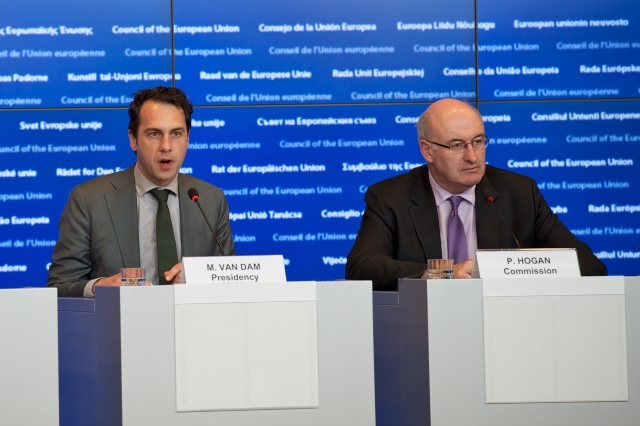
Photo credit: Mr Martijn VAN DAM, Dutch Minister for Agriculture and Mr Phil HOGAN, Commissioner for Agriculture and Rural Development, European Union Audiovisual Service.