What has changed in the published Commission communication?

The formal Commission communication on the future of the CAP published today, and which Jack Thurston has summarised below in his own inimical way, had become available some weeks ago in a leaked version when it went into inter-service consultation. It is an interesting exercise to deduce, from a comparison of the two versions, what changes were made as a result of this process and what implications they might have.

At the outset, we can state that the two documents are substantially the same, with only very minor adjustments. Thus, all of the criticisms made of the earlier document remain valid. The Commission stresses that this is still a consultation document. It does provide some shape to the discourse around the future CAP, sometimes in a positive direction (placing more emphasis on targeted payments for public goods and highlighting the importance of innovation) but sometimes in a negative direction (raising misleading concerns about relative farm –nonfarm income levels and food security).… Read the rest
Commission blueprint for future of the CAP

The European Commission’s blueprint for the future of the CAP has been published. While the communication sets all the reasons why the Commission thinks the EU needs to keep on supporting its farmers, it puts off all the really big decisions for another day.

According to the Commission, the main objective of the CAP is “a territorially and environmentally balanced EU agriculture”. What this boils down to is that the Commission believes the EU should supplement any money farmers earn themselves with money from EU taxpayers. A considerable number of justifications are provided, among them:

– the EU should pay farmers because farm incomes are subject to greater variability and are, on average, lower than incomes in the rest of society. The Commission provides no evidence for this highly contested assertion.

– the EU should pay farmers to farm in places where it is too cold, to dry or too mountainous for farming to be economically viable, because it’s important that there is farming activity in every part of the European continent.… Read the rest

What 'common' agricultural policy?

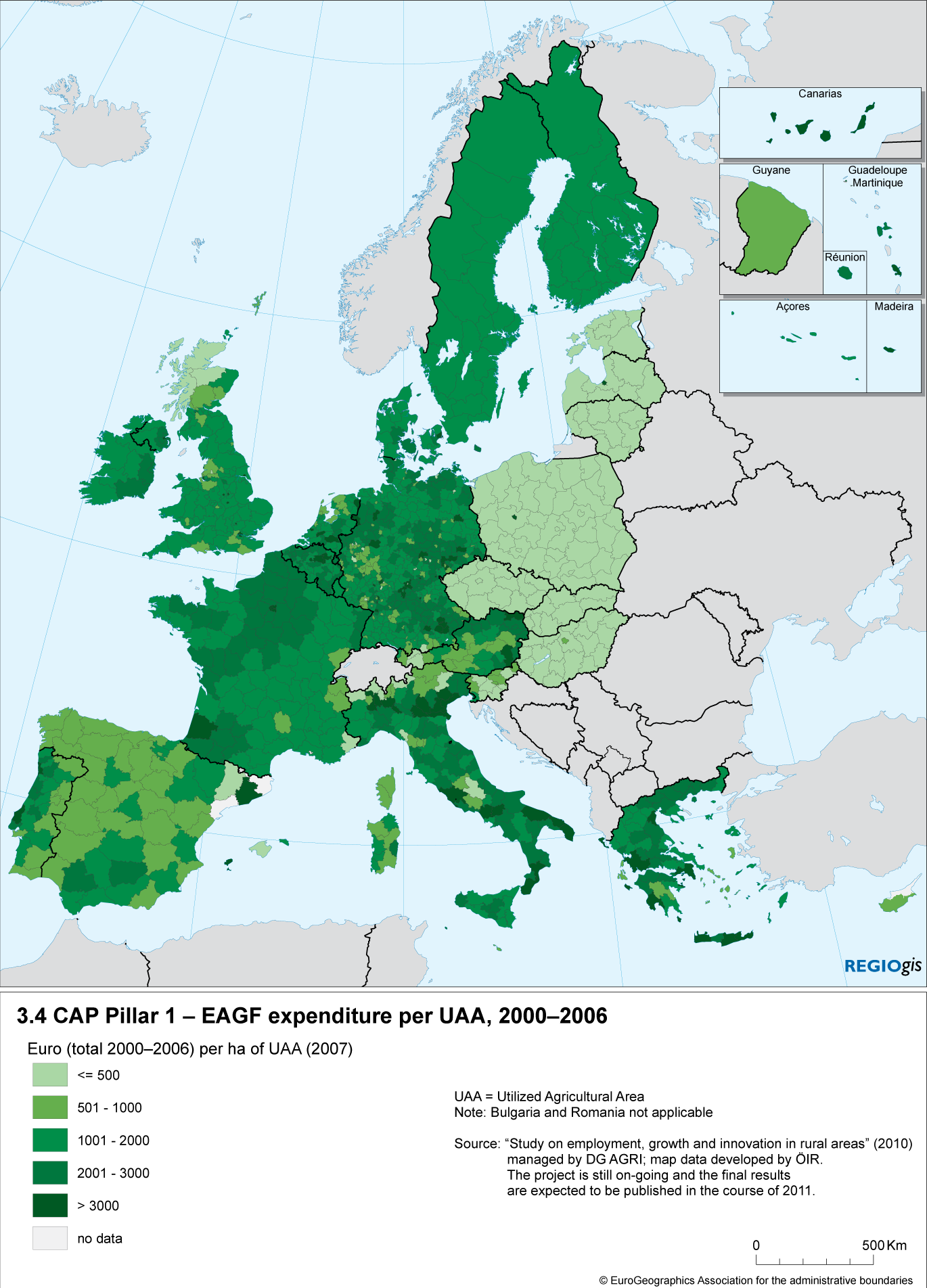
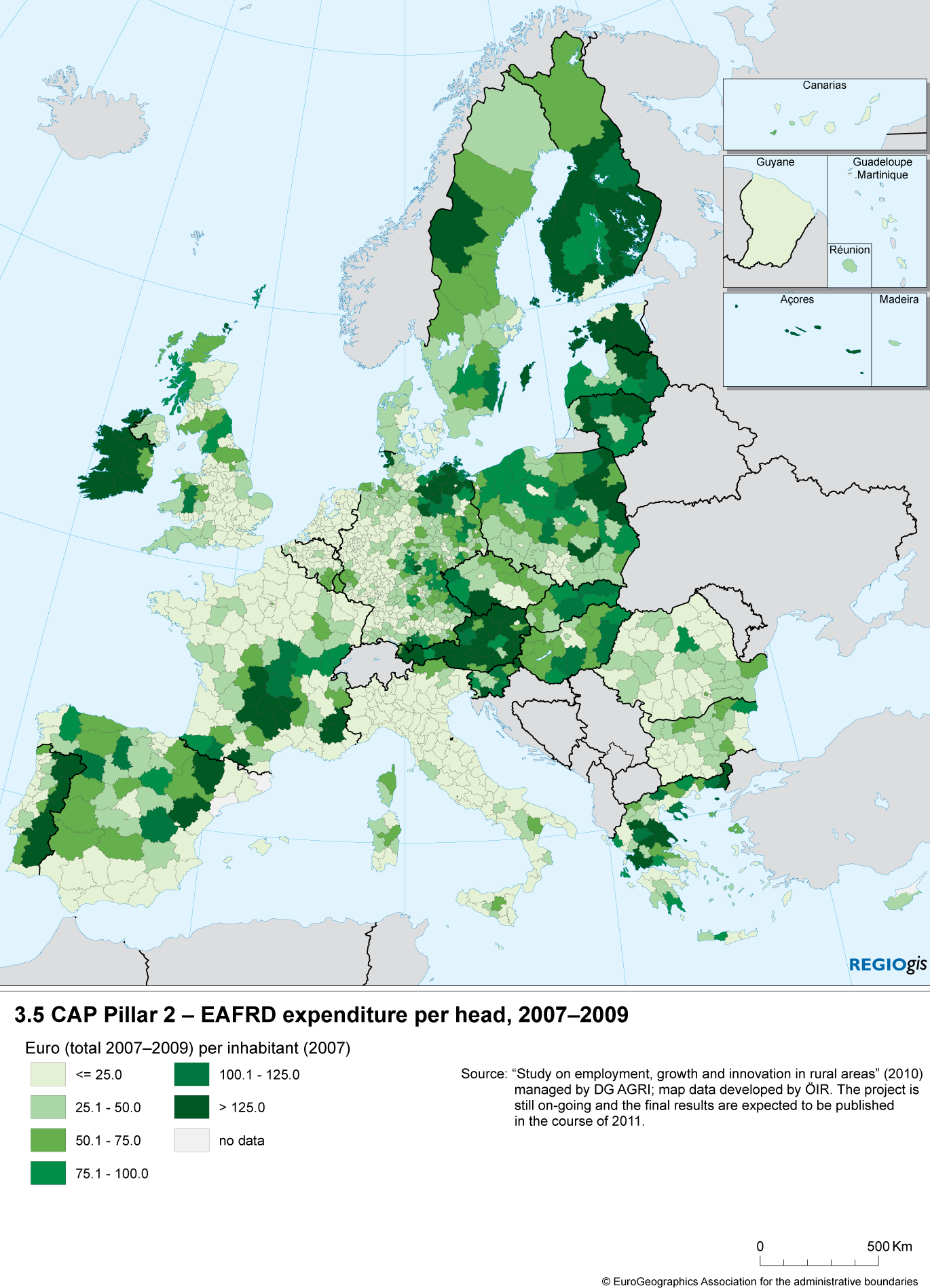
DG Regio’s compendious Fifth Report on Economic, Social and Territorial Cohesion contains a pair of maps looking at CAP expenditure by region.
The first shows the level of Pillar 1 spending per hectare of farmland in in each EU NUTS-3 region over the period 2000-2006.


The second shows the level of Pillar 2 spending per inhabitant in each region between 2007 and 2009.


What do the maps tell us? The first map shows the uneven distribution of direct aids among EU regions of the EU-15. Spain seems to do relatively badly on this score and there is a striking east-west divide in Portugal. Italy resembles a green patchwork quilt, indicating that payments vary considerably among regions. Since the map shows spending from 2000 to 2006, it doesn’t tell us much about the CAP in the new member states, which only joined the EU in 2004.
The second map shows that Austria gets a large amount of EU rural development funding per inhabitant, reflecting a funding formula that takes into account previous national commitments to farmland conservation measures.… Read the rest

What ‘common’ agricultural policy?

DG Regio’s compendious Fifth Report on Economic, Social and Territorial Cohesion contains a pair of maps looking at CAP expenditure by region.

The first shows the level of Pillar 1 spending per hectare of farmland in in each EU NUTS-3 region over the period 2000-2006.


The second shows the level of Pillar 2 spending per inhabitant in each region between 2007 and 2009.


What do the maps tell us? The first map shows the uneven distribution of direct aids among EU regions of the EU-15. Spain seems to do relatively badly on this score and there is a striking east-west divide in Portugal. Italy resembles a green patchwork quilt, indicating that payments vary considerably among regions. Since the map shows spending from 2000 to 2006, it doesn’t tell us much about the CAP in the new member states, which only joined the EU in 2004.

The second map shows that Austria gets a large amount of EU rural development funding per inhabitant, reflecting a funding formula that takes into account previous national commitments to farmland conservation measures.… Read the rest

French government fighting itself

France has always played a pivotal role in the CAP. As a founder member of the EU, Europe’s largest agricultural economy and the biggest single beneficiary of CAP monies, it has a lot at stake. It is therefore fascinating to witness a violent power struggle within Nicolas Sarkozy’s government over the future of the policy.

On 18 October, French Environment Minister Jean-Louis Borloo and Sustainable Development Minister Chantal Jouanno put their names to a 16-page reform proposal that would see France’s current annual €10 billion a year in CAP payments be divided between basic income payments with environmental compliance (€3 billion), farmland conservation contracts (€6 billion) and food chain and price safety nets (€1 billion). This would be a radical redistribution. Currently 90 per cent of CAP spending in France is in the form of direct aids and market measures, with only ten per cent spent on farmland conservation and rural development.… Read the rest

The surge in sugar prices

In the past few years commentators have emphasised the growing integration between food and energy markets. Food prices were always influenced by energy prices on the cost side, but with the growth of markets for biofuels made from agricultural feedstocks, prices are also linked on the demand side. If oil prices rose, this would tend to pull up food prices as grains, sugarcane and vegetable oils were diverted to fuel production, and if oil prices fell, feedstocks would move back again to the food market also pushing down prices there. The crucial lever here was seen as the Brazilian sugar-ethanol complex and Brazil’s fleet of flex-fuel vehicles, which facilitated easy substitution between the two markets.

But agricultural markets are subject to their own shocks independent of the energy market, and the price integration is far from perfect as shown by a comparison of sugar and oil prices over the past twelve months.… Read the rest

Court of Auditors criticises sugar reform

The European Court of Auditors today released a report reviewing the outcome of the 2006 sugar regime reform. The Court makes some criticisms of the design of the 2006 reform, but more important are its findings and recommendations which are likely to feed into the debate on the shape of the CAP post-2013. Here the report manages to give ammunition to both CAP reformers and diehards, and if early reactions in my own Irish media are any guide it is the more reactionary views which are getting the media spin.

The Court notes that one objective of the reform was to contribute to a more competitive sugar industry, and that this was to be achieved by concentrating quota reductions in the least competitive areas. The audit criticises the Commission for the absence of data on the productivity of individual factories and for the fact that data on the overall competitiveness of sugar production in different Member States was somewhat dated.… Read the rest

French environment ministry coming out in favour of a green CAP

In a smart move, the Ministry proposes to keep the current €10 billion CAP budget for France – thus making the proposals more appealing to its domestic audience – and it uses the budget issue as a stick/carrot: a large budget can only be justified for a green CAP.

The money is allocated to several instruments (doing away with the traditional two-pillar structure):

* €3 billion for direct income support, available to all farmers in the EU at an equal level, without any historic base. National governments could have the possibility to top up these payments. A flexible component could be introduced to soften fluctuation in prices and regional yields. The eco-conditionality (respect of good agricultural and environmental conditions) shall be tightened.
* €4 billion for environmental services, notably the protection of the climate, biodiversity and water. One part of these payments is available to all preferable farming systems (organic, high nature value, leguminous plants, foraging, low input).… Read the rest

Battle heats up on indirect land use change effects of biofuels

The EU renewables target of 10% of transport fuel by 2020 to be met mainly by biofuels has been heavily criticised for its potential impact on diverting land from food to fuel production and thus putting upward pressure on food prices. Another source of criticism is whether it does actually contribute to reducing overall greenhouse gas (GHG) emissions. The Commission sought to deflect this latter criticism by requiring that biofuels which count against the renewables target must show a direct GHG saving of 35% compared to the fossil fuel that they displace. This saving requirement is gradually increased to 50% and 60% for fuels produced by installations that start production after 2017 and 2018, respectively.

However, these GHG reduction requirements do not take into account the possible indirect effects of converting cropland to biofuel production, which will encourage indirect land use change (ILUC) by conversion of pasture or forest to produce the food crops displaced by biofuels.… Read the rest

The CAP and semi-subsistence farmers

One result of the last two enlargements in 2004 and 2007 was to bring millions of small farms into the EU, most of which are either subsistence farms (SFs) or semi-subsistence farms (SSFs). Various definitions of what is a subsistence or semi-subsistence farm exist (see the background paper on this topic by Sophia Davidova and colleagues for the recent seminar in Sibiu, Romania on semi-subsistence farming) including physical area (e.g. less than 5 ha), size of farm business (below a certain ESU threshold) or market orientation (share of production going to own consumption).

According to Eurostat FSS, in 2007 there were 11.1 million small farms (below 8 ESU) within the EU-27. Of these, 6.4 million were below 1 ESU, therefore considered SFs and the remaining 4.7 million were SSFs. The total number of holdings in 2007 in the EU-27 was 13.7 million, so the share of SFs and SSFs was equal to 46.6% and 34.5% of the total number, making them the dominant farm type in Europe.… Read the rest