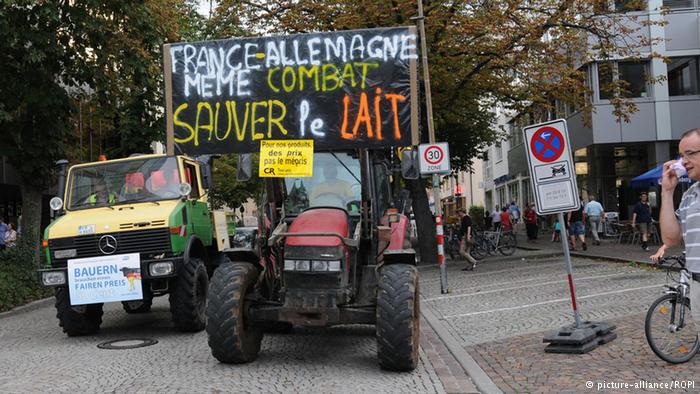
Farm interests routinely threaten that any reduction in support will provoke a slump in production, endangering EU food security, and threatening massive land abandonment to the detriment of rural life and biodiversity. The findings of the Scenar 2020-II – Update of scenario study on agriculture and the rural world, commissioned by DG Agri, strongly contradict such panicmongering about the looming end of EU agriculture.
The study looks at three scenarios. The reference case assumes a 20% (nominal) CAP budget reduction, reduced intervention stocks, full decoupling, a 30% direct payment reduction, a 105% increase for the second pillar, and a moderate Doha agreement (based on the Falconer paper, including the elimination of export subsidies). The conservative scenario presumes that the Health Check results are largely maintained, direct payments reduced by only 15% and second pillar payments raised by 45%. The liberal scenario is very liberal indeed, with a 55% CAP budget reduction, no intervention stocks, no direct payments, a 100% increase for the second pillar and no tariffs.
Among the most interesting results is that the volume of crop production will grow slowly in all scenarios (around 0.25% per year). Even the vulnerable livestock sector loses only 4% in the liberal scenario over the entire 2007-2020 period. Agricultural land use remains roughly unchanged in the reference and conservative scenarios, and declines by a mere 6% in the liberal scenario (due to the decline in the EU-15, driven mostly by the abolition of the Single Farm Payment).
More significant differences arise when it comes to land prices. These remain largely unchanged in the reference and conservative cases, but decrease by 30% in the liberal scenario. This is nothing the public need worry about – but it explains the heavy lobbying of landowners for the preservation of a ‘strong’ CAP.
The study also analyzes the situation of rural regions. It concludes that strong rurality is not synonymous with negative economic or demographic trends. 422 regions have a negative and 435 regions a positive demographic trend (with negative developments in the eastern Member States and at the southern and northern borders of the EU). The study also finds that ‘There is no evidence that the EU-27 regions with an above average agricultural employment are generally showing negative reactions. Hence, it shall be emphasised that rurality and agricultural vocation are not a sign of weak development perspectives.’ This further undermines the rural development approach of the CAP that spreads money to all rural regions, often in positive correlation with their agricultural production.
A last point to consider: surveys of life satisfaction and happiness give very similar results for urban and rural areas. Since ‘happiness’ is in vogue (and heads of states from Bhutan to France argue for happiness accounting to complement GDP figures), why worry if rural regions have a lower GDP per capita, so long as people there are equally satisfied?
The EU dairy market is now recovering from the severe drop in milk prices in 2009. Perhaps the clearest sign of this recovery is the setting of export refunds on dairy products to zero since mid-November, as world market prices for dairy products have strengthened in recent months.
It is thus an opportune time to evaluate the EU’s response to the crisis, and to see what lessons might be drawn for how the Union can address similar problems in other farm sectors in the future. My view is that there is a lot to be learned from the dairy crisis, and that the outgoing Commissioner deserves credit for the way she handled it.
EU milk prices improving
Let us first review the evidence that the milk market is improving. The trends in the EU market prices (proxied by the German price and represented by the blue line) and the EU intervention price (the red line) for butter and skim milk powder (SMP) have been graphed by CLAL.it and are reproduced below.


The German butter price is now back to the level of 2002 before the cuts in intervention prices. The recovery in SMP prices has not been as strong, but even so these are now comfortably above intervention levels. EU dairy farmers also benefit from an additional €5 billion per year in the form of direct payments (3.5c/kg milk) to compensate for the reductions in intervention prices.
Farm prices are responding to the better prices for dairy products, although with some lag. The average EU price for standardised 4.2% fat milk, according to the LTO, has risen to €27.06/100kg in October 2009 from its lowest point of €23.74/100kg in April. It is now back at the levels of Spring 2007, before the big run-up in prices in 2008.
The recent USDA market outlook for dairy products in 2010 foresees continued strong prices into 2010 as economic growth recovers particularly in developing countries. While the large stocks of SMP in particular overhanging the market are seen as a negative factor, it observes that in the US most of these stocks are committed for domestic food programmes and that the EU is unlikely to release its stocks on to the market soon for fear of the political fallout from producers.
The Commission’s response to the dairy crisis
Assuming that prices continue to strengthen throughout 2010, it is useful to review what lessons were learned for crisis management when faced with a substantial fall in the price of a farm commodity. The Union’s responses to the collapse in domestic milk prices in 2009 can be divided into market management measures and income support measures.
Among the market management measures were
In total, the Commission expects to spend up to €600 million on market measures this year.
Among the income support measures were:
Reflections on the Union’s response to the dairy crisis
A first observation to make is that, while the Commission did resort to market management measures such as intervention and export subsidies, much more emphasis on this occasion was put on income support measures.
It was noticeable that the Commissioner firmly set her face against any increase, even temporarily, in intervention prices and against a reduction in quotas, arguing that both would be against the spirit of the Health Check intended to move the CAP in a more market-oriented direction.
Although the future of export refunds after 2013 is uncertain (the EU has committed to their elimination but only in the context of a successful outcome of the Doha Round in which similar disciplines applied to other forms of export support), it is likely that the greater emphasis on direct income support measures in response to crisis is here to stay. While the loud voices calling for stronger support measures as part of a food security policy for Europe would doubtless like to see stronger market management measures, these are effectively beggar-my-neighbour responses unless undertaken as part of a global framework (e.g. a global stocks policy).
A second observation is that the income support measures included both a relaxation of state aid restrictions (allowing Member States to fund payments to producers) and a Community scheme. While the national state aids were permitted only in the context of a measure taken as part of a wider response to the economic crisis, they do flag a possible direction for future responses to agricultural market crises. When the figures come in, it will be interesting to assess how much use the individual Member States make of this opportunity.
A third observation is that the payments will be made to producers only with a lag (the exception is the speeding up of the disbursement of the standard Single Farm Payment). This means that payments will reach farmers after the crisis has passed and when incomes are already recovering. Clearly, payments should reach farmers at the time when they are most needed, and hopefully the decision to allow the Commission to respond to future dairy market crises on its own initiative may facilitate this in future.
A fourth observation is that there is now little headroom in the EU budget up to 2013 to fund unexpected crisis management measures. The outgoing Commissioner has made clear that funding the €300m emergency aid from the 2010 budget has utilised any remaining headroom and, apart from the use of the safety margin, any further call on the agricultural budget would trigger the financial discipline mechanism requiring a cut in direct payments.
Price volatility on agricultural markets is expected to increase in future (though whether this is a reasonable presumption to make deserves further analysis, and the outcome depends on the interaction between production shocks and their distribution where climate change is expected to increase volatility, trade policies and their implications for price transmission from world to national markets, and government behaviour particularly with reference to stocks).
Presumably these lessons will be analysed by the High Level Experts’ Group on Milk which is looking into the medium and long-term future of the dairy sector and which will deliver its final report by the end of June 2010. A very useful input is the report on price volatility in the dairy sector commissioned by the European Dairy Association and written by my Irish colleagues Michael Keane and Declan O’Connor.
The 2009 EU dairy market crisis was handled well by the outgoing Commissioner. There was no back-tracking in the direction of CAP reform, and a number of innovative new instruments to address income volatility in a particular sector are being tested. The lessons learned from this experience will be an important input into the discussions on the shape of the CAP post-2013.
Update 5 January 2010: When writing this post, I had not seen that the French have made use of the national state aid provision to provide up to €700 million to farmers affected by the crisis. Aid under this new scheme can be granted until 31 December 2010 and will take the form of direct grants, interest rate subsidies, subsidised loans as well as aid towards the payment of social security contributions. See http://europa.eu/rapid/pressReleasesAction.do?reference=IP/09/1866&format=HTML&aged=0&language=EN&guiLanguage=en,
The current high prices for arable crops mean that farmers in the US and Europe are reconsidering whether putting their land into government-financed conservation schemes is such a good idea financially. The EU is well on the way to releasing all its set aside land back into production, and in the US Congress is considering whether to allow farmers to leave long term conservation contracts without facing any penalties. [...]
Another study forecasting higher real food prices for the next decade has recently been published by three authors associated with the Humboldt University in Berlin led by Professor Harald von Witzke. The working paper provides a useful qualitative survey of the reasons why agricultural supply will have difficulty in keeping up with the demand for food and other products of agriculture (including bioenergy). For the more technically minded, it uses a partial equilibrium multi-market model (descended from the venerable SWOPSIM model once supported by the US Department of Agriculture) to provide quantitative estimates of price levels for the key grains and oilseeds which are the focus of the study.
[...]
The Republic of Ireland will hold a referendum on ratification of the EU’s Lisbon Treaty on 12 June 2008. The Irish Farmers Association is urging a No vote, on the grounds that the EU’s push towards more open world markets in agriculture could expose them to competition from overseas, notably from Latin America.
Ireland gets way more than it’s fair share of EU farm handouts. And this fact will not be lost to other member states if Ireland votes to derail the Lisbon Treaty. The EU is currently engaged in a fundamental, ‘once in generation’ review of its budget. The main target for cuts appears to be the agriculture budget, which accounts for around 45% of all EU spending.

Here are some facts that might be of interest: [...]
The cost of agricultural holdings across the EU has risen to record levels. However, this is not entirely good news for farmers. It makes it even harder for those who do not inherit to enter the industry, while only farmers wanting to retire can cash in. Tenant farmers face higher prices making life more difficult for them. [...]
World Bank President Robert Zoellick has warned that high food prices are threatening to undo seven years of progress in global poverty reduction. Zoellick has encouraged donor countries to take immediate action to increase funding to the UN World Food Programme and coordinate a ‘New Deal on World Food Policy’. The World Bank has released a new analysis which points the finger squarely at biofuels as the prime cause of the recent surge in global commodity prices. [...]
Fears of unrest are increasing in developing countries as shortages develop of staple foods or prices increase substantially. Governments have cut import tariffs to cope with the problem, but hoarding to take advantage of future price rises has exacerbated the difficulties being encountered. [...]
Roger Waite is a long-standing member of the Brussels agricultural press pack and he will be giving a podcast round-up of the monthly Agriculture Council meetings, when farm ministers from all 27 EU member states met to decide the future of EU agriculture and rural development policy. In this month’s meeting, EU farm ministers debated the Commission’s ideas for the health check, the latest position of the WTO Doha Round negotiations and the impact of rising feed prices on European pig farmers.
As well as being the founding editor of the AgraFacts news subscription service, Roger is a Journalism Fellow of the German Marshall Fund of the United States.
Earlier this week, BBC Radio 4 broadcast Churchill Confidential, a dramatisation of British cabinet meetings chaired by Prime Minister Winston Churchill, records of which have only recently been released into the public domain. In this week’s episode, looking at Churchill’s second term of office (1951-55), we get an overview of the pressing issues of state at that time: the impending conflict with Egypt over the Suez Canal, the development of the British atom bomb, balancing Britain’s relationships with its European neighbours and the United States of America, immigration and race relations, the coronation of Queen Elizabeth II, the devaluation of the pound and, somewhat incongruously… a decision on whether to reduce the meat ration. Why is this relevant to the CAP? Find out after the jump… [...]
In Chicago wheat and rice prices for delivery in March 2008 have jumped to an all-time high, soyabean prices are at a 34-year high and corn prices at a 11-year peak. The agricultural commodities price rises are the result of high demand, poor harvests and low stockpiles of food. [...]