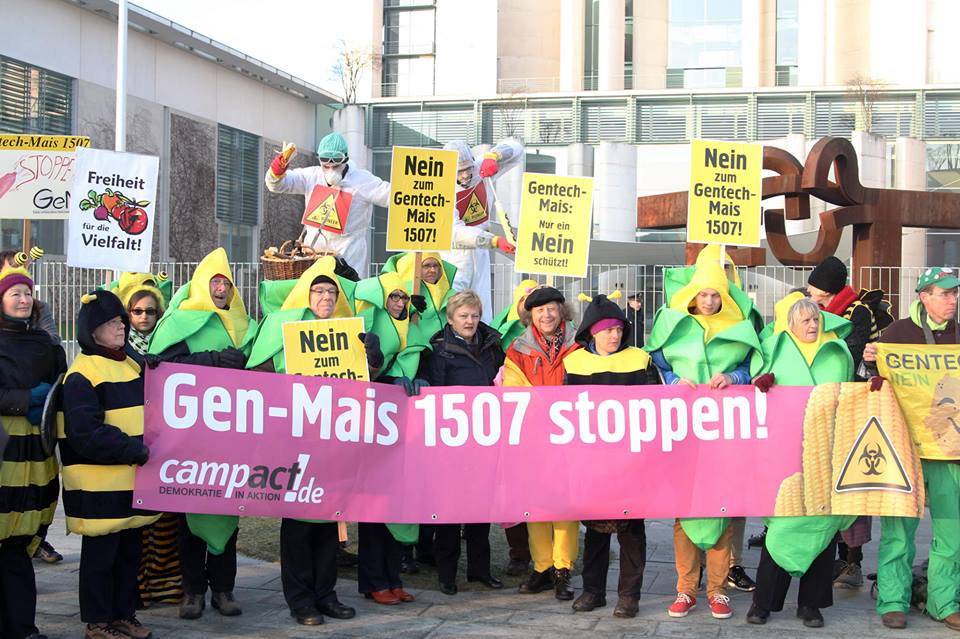
EU policy on genetically-modified organisms (GMOs) for use in food and agriculture has been deadlocked for a number of years as member states, industry stakeholders and non-governmental organisations remain conflicted about the use of agricultural biotechnology. Three examples of the policy differences and contradictions that characterise this dossier include the following.
How to interpret cross-compliance
Tomás García Azcárate, who maintains a very useful blog on the CAP with links to his university course notes and a series of CAP capsules, recently paid me the compliment of discussing a comment I made in an article on CAP greening on the function of cross-compliance. My comment was that “… the strong political support for the view that direct payments are, in part, recognition of the costs that the society asks farmers to bear through cross compliance implicitly undermines the “polluter pays principle. If farmers who do not receive direct payments are not expected to observe cross compliance standards, then these do not form the environmental baseline”.
Tomás disagreed with this statement arguing that cross compliance does not oblige farmers to respect new rules. I put my hand up immediately to admit that the extract could have been clearer. It is well-known that cross compliance consists of respect for Statutory Management Requirements (SMRs) (provisions drawn from the application of relevant articles of legislation now listed in Annex II of the new horizontal Regulation (EU) No 1306/2013) as well as standards of good agricultural and environmental condition (GAEC) of land.… Read the rest

Incentivising soil carbon sequestration
Soil contains a huge amount of carbon, twice as much as in the atmosphere in the 0-30 cm layer alone. However, continuous cultivation over a long period has reduced stocks of soil organic carbon (SOC, which I will abbreviate here to soil carbon), often to dangerously low levels. The EU’s Joint Research Centre estimates that some 45% of the soils of Europe have a low or very low organic matter content (0-2% organic carbon). The main mechanism for soil carbon loss is associated with ploughing, due to increased decomposition of SOC due to soil aeration and soil aggregate destruction, increased aggregate turnover and a reduction in aggregate formation.
Reversing this process to build up soil carbon stocks has thus the technical potential to sequester a lot of carbon. The practices to do this are now well known: they include the use of winter cover and catch crops; crop rotation; adding legumes or N-fixing crops; reduced or zero tillage; and incorporating crop residues and other organic matter.… Read the rest