While the Commission’s Communication on the future of the CAP after 2013 is less remarkable for what it says than what it leaves out, one of the accompanying documents is a fascinating read, and reveals much about how the Commission regards the future of the EU’s €55 billion-a-year farm policy.
Despite its unpromising title, the Consultation Document for Impact Assessment shows there are at least some people in the DG Agri bunker who are engaging their brains on the future of the CAP. What’s more, the document hints we might expect something altogether more radical and ambitious when the Commission’s legislative proposals are made later this year.
Most striking about the document are the home truths told about the state of EU agriculture – admissions that one would rarely, if ever, hear uttered in public by a Commissioner or a senior DG Agri official.
First, European farming is in a parlous economic state and ‘the current policy has a strong focus on income support’.… Read the rest
Commission’s home truths on the CAP
While the Commission’s Communication on the future of the CAP after 2013 is less remarkable for what it says than what it leaves out, one of the accompanying documents is a fascinating read, and reveals much about how the Commission regards the future of the EU’s €55 billion-a-year farm policy.
Despite its unpromising title, the Consultation Document for Impact Assessment shows there are at least some people in the DG Agri bunker who are engaging their brains on the future of the CAP. What’s more, the document hints we might expect something altogether more radical and ambitious when the Commission’s legislative proposals are made later this year.
Most striking about the document are the home truths told about the state of EU agriculture – admissions that one would rarely, if ever, hear uttered in public by a Commissioner or a senior DG Agri official.
First, European farming is in a parlous economic state and ‘the current policy has a strong focus on income support’.… Read the rest
Commission blueprint for future of the CAP
The European Commission’s blueprint for the future of the CAP has been published. While the communication sets all the reasons why the Commission thinks the EU needs to keep on supporting its farmers, it puts off all the really big decisions for another day.
According to the Commission, the main objective of the CAP is “a territorially and environmentally balanced EU agriculture”. What this boils down to is that the Commission believes the EU should supplement any money farmers earn themselves with money from EU taxpayers. A considerable number of justifications are provided, among them:
– the EU should pay farmers because farm incomes are subject to greater variability and are, on average, lower than incomes in the rest of society. The Commission provides no evidence for this highly contested assertion.
– the EU should pay farmers to farm in places where it is too cold, to dry or too mountainous for farming to be economically viable, because it’s important that there is farming activity in every part of the European continent.… Read the rest
What 'common' agricultural policy?
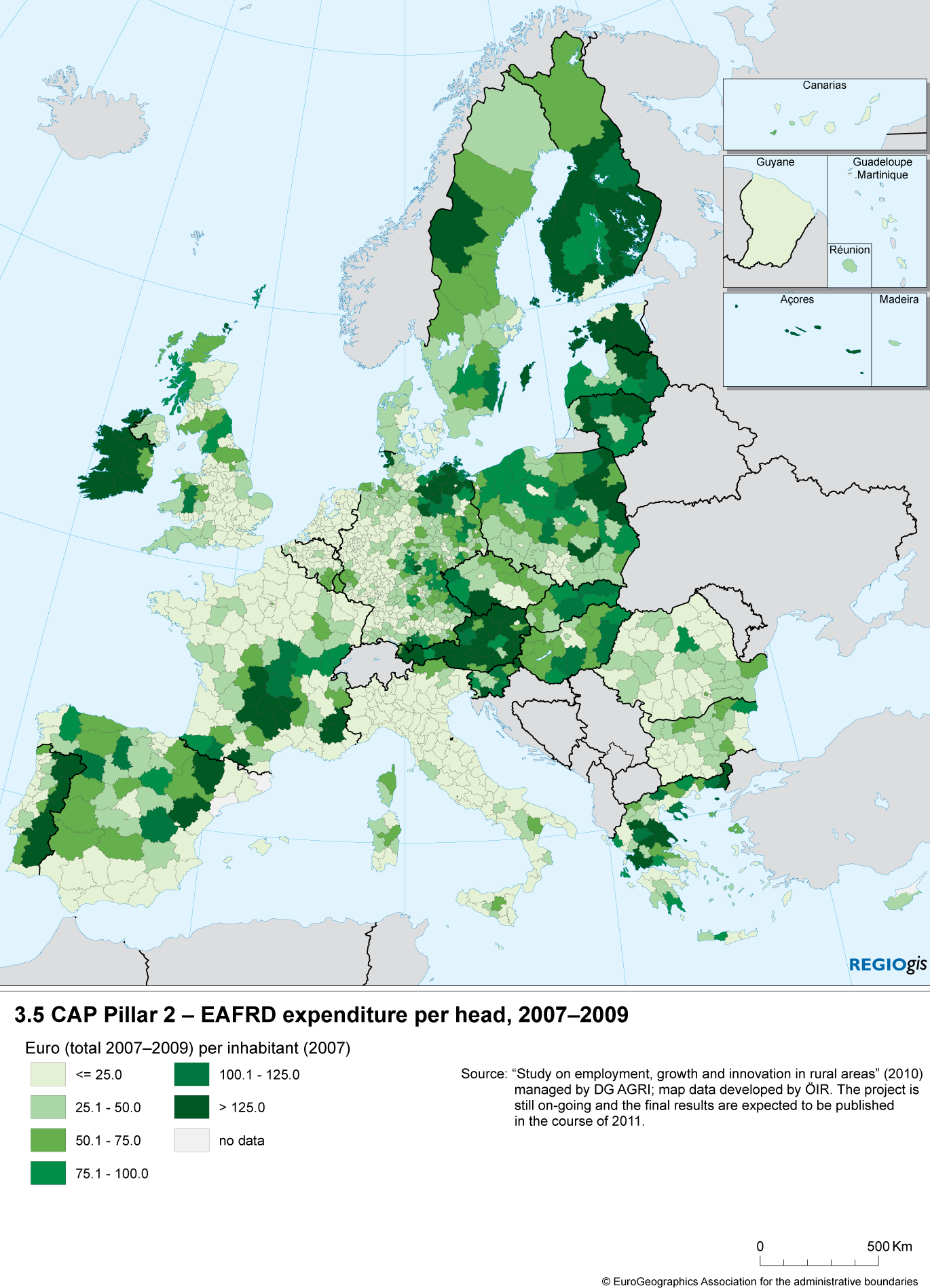
DG Regio’s compendious Fifth Report on Economic, Social and Territorial Cohesion contains a pair of maps looking at CAP expenditure by region.
The first shows the level of Pillar 1 spending per hectare of farmland in in each EU NUTS-3 region over the period 2000-2006.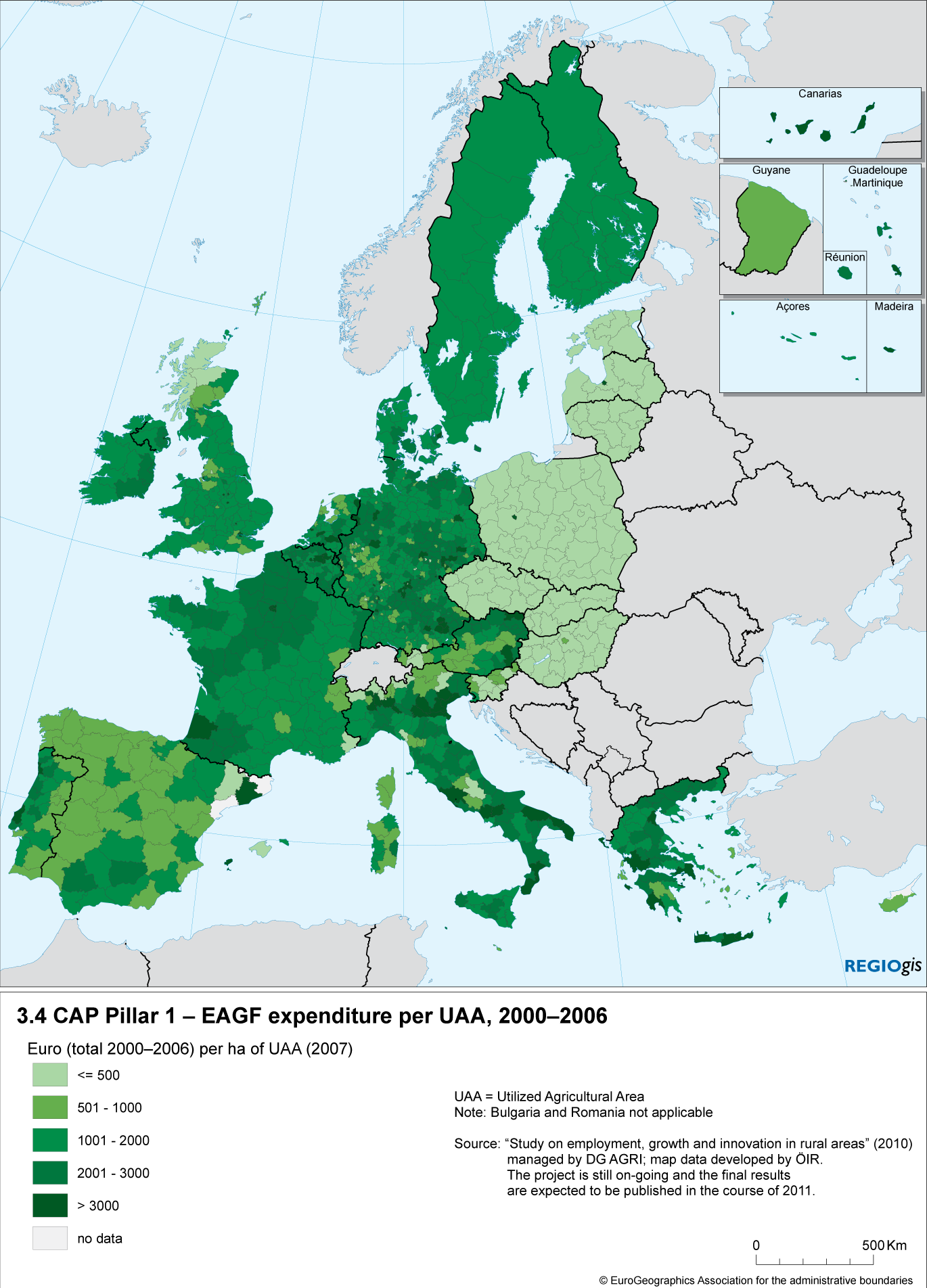
The second shows the level of Pillar 2 spending per inhabitant in each region between 2007 and 2009.
What do the maps tell us? The first map shows the uneven distribution of direct aids among EU regions of the EU-15. Spain seems to do relatively badly on this score and there is a striking east-west divide in Portugal. Italy resembles a green patchwork quilt, indicating that payments vary considerably among regions. Since the map shows spending from 2000 to 2006, it doesn’t tell us much about the CAP in the new member states, which only joined the EU in 2004.
The second map shows that Austria gets a large amount of EU rural development funding per inhabitant, reflecting a funding formula that takes into account previous national commitments to farmland conservation measures.… Read the rest
What ‘common’ agricultural policy?
DG Regio’s compendious Fifth Report on Economic, Social and Territorial Cohesion contains a pair of maps looking at CAP expenditure by region.
The first shows the level of Pillar 1 spending per hectare of farmland in in each EU NUTS-3 region over the period 2000-2006.
The second shows the level of Pillar 2 spending per inhabitant in each region between 2007 and 2009.
What do the maps tell us? The first map shows the uneven distribution of direct aids among EU regions of the EU-15. Spain seems to do relatively badly on this score and there is a striking east-west divide in Portugal. Italy resembles a green patchwork quilt, indicating that payments vary considerably among regions. Since the map shows spending from 2000 to 2006, it doesn’t tell us much about the CAP in the new member states, which only joined the EU in 2004.
The second map shows that Austria gets a large amount of EU rural development funding per inhabitant, reflecting a funding formula that takes into account previous national commitments to farmland conservation measures.… Read the rest
French government fighting itself
France has always played a pivotal role in the CAP. As a founder member of the EU, Europe’s largest agricultural economy and the biggest single beneficiary of CAP monies, it has a lot at stake. It is therefore fascinating to witness a violent power struggle within Nicolas Sarkozy’s government over the future of the policy.
On 18 October, French Environment Minister Jean-Louis Borloo and Sustainable Development Minister Chantal Jouanno put their names to a 16-page reform proposal that would see France’s current annual €10 billion a year in CAP payments be divided between basic income payments with environmental compliance (€3 billion), farmland conservation contracts (€6 billion) and food chain and price safety nets (€1 billion). This would be a radical redistribution. Currently 90 per cent of CAP spending in France is in the form of direct aids and market measures, with only ten per cent spent on farmland conservation and rural development.… Read the rest
The Commission communication leak in full
PDF to download. Main text (without footnotes and annex):
EUROPEAN COMMISSION
Brussels, 2910912010
COM(2010) version finale
COMMUNICATION FROM THE COMMISSION TO THE COUNCIL, THE EUROPEAN PARLIAMENT, THE EUROPEAN ECONOMIC AND SOCIAL COMMITTEE AND THE COMMITTEE OF THE REGIONS
The CAP towards 2020: Meeting the food, natural resources and territorial challenges of the future
1. INTRODUCTION
The Common Agricultural Policy (CAP) is confronted with a set of challenges, some unique in nature, and most unforeseen, that invite the EU to make a strategic choice for the longterm future of its agriculture and rural areas.
In preparation for this Communication, the Commission organised an extensive public debate earlier in 2010 that concluded with a conference in July 20101¥ The Council discussed during four successive Presidencies the reform, the European Parliament (EP) adopted an own initiative report on the post-2013 CAP, and its link with the Europe 2020 Strategy and both the Economic and Social Committee and the Committee of the Regions (CoR) have come forward with position papers.… Read the rest
Franco-German position on future of the CAP
 This week the governments of France and Germany have published a short document setting out their common position on the future of the common agricultural policy. It makes for fairly light reading though the following points are worth remarking on:
– The common position endorses further moves towards greater market orientation in the CAP but suggests countervailing measures are needed “to buffer devastating effects of growing price volatility and market crises”.
– There is nothing concrete on the future budget of the CAP and it is stressed that “a final decision on all questions relating to finances will be made when decisions are made on all policies and the entire EU financial framework”. In other words, there is not going to be another stitch-up like the Chirac-Schroeder deal of 2002 which effectively fixed the CAP budget for the next 11 years, short-circuiting the normal EU budget-setting processes.
– The two pillar structure of the CAP should be maintained, and no national co-financing should be required of pillar one expenditure (i.e.… Read the rest
Public goods in the spotlight
What’s in a word? Or, to be more specific, two words? Where CAP and the term ‘public good’ is concerned, quite a lot. A new briefing note from the Institute for European Environment Policy takes a look at how the slogan ‘public money for public goods’ has come to define the political debate over the future shape of the CAP.
The briefing looks at the evolution of the idea of environmental public goods as a justification for future public expenditure on agriculture. It also sounds a note of caution, that’s worth repeating here:
… Read the restThe increasing visibility of the public goods concept however, has resulted in the concept being interpreted in different ways. It appears that there has been recognition of this agenda as one with real gravity and legitimacy, and therefore for political reasons some interests are trying to justify various aspects of current policy as conducive to, or essential for outcomes that they have presented as ‘public goods’.
Budget rumbles in Brussels
The summer break has come and gone and with the European Parliament back in session, Commissioners back from their yachts and their fonctionnaires back at their desks, the future of the EU budget is back in the spotlight.
 As part of the December 2005 heads of government agreement on the 2007-2013 financial perspective it was agreed that there would be a midterm ‘budget review’ in 2008-09 which would look at all areas of the EU budget. including the two hottest political potatoes – the large share of funds going to the CAP and the British budget rebate. The review began with a big public consultation led by the then Budget Commissioner Dalia Grybauskaite, who pulled no punches in describing the budget as largely out of tune with Europe’s current and future challenges. However, she left the Commission early to become President of Lithuania and with delays to the Lisbon Treaty ratification the review process slowed to a standstill.… Read the rest