The USDA Foreign Agricultural Service carries a useful report of the meeting in Warsaw on 3 February last attended by the agricultural ministers from the new Member States which concluded with a declaration on the future of the CAP after 2013. Its a fairly uncompromising defence of a large agricultural budget after 2013. The USDA notes that not only are the NMS sore about the unequal distribution of direct payments, but they are rapidly losing ground in the production of primary agricultural commodities. Poland, for example, now imports more pork than it exports, while meat and dairy exports from West to East have surged. The declaration was signed by ten Member States, including Estonia which is sometimes seen as part of the CAP reform camp. Only the Czech Republic attended as an observer but did not sign. The USDA FAS report contains the translation of the agreed declaration which can also be downloaded from the Polish Ministry of Agriculture website here.… Read the rest
CAP support levels reach new high
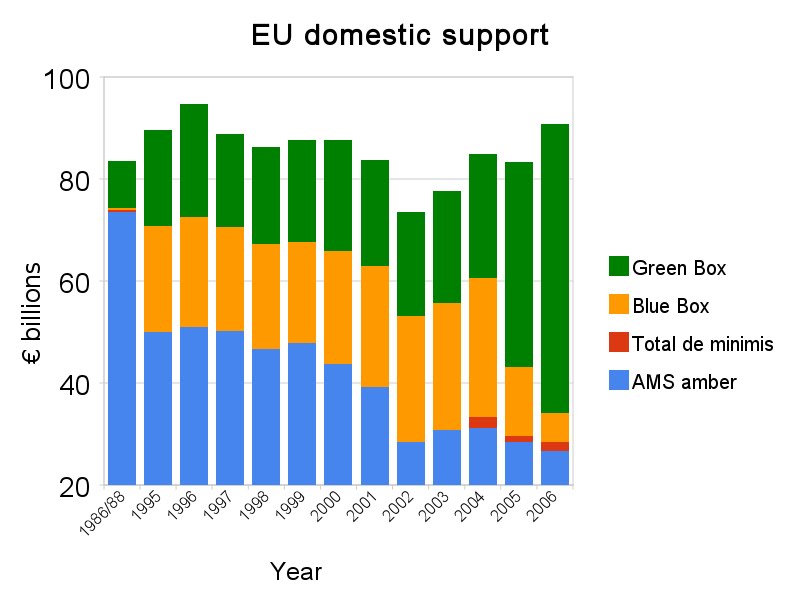
CAP subsidies as reported to the WTO reached a ten-year high of over €90 billion in the 2006/07 marketing year, but conveniently most of them have been parked in the allegedly non trade distorting green box, something that has provoked disquiet in Geneva. The EU notified €90.7 billion of support to the global trade body for 2006/2007 – up from €75.6 billion in 2002, when support was at its lowest in the last fifteen years.
More from ICTSD.… Read the rest
Another day, another declaration
Hot on the heels of the joint declaration by Birdlife International and the European Landowners Association and the declaration of 23 European agricultural economists comes the European Food Declaration (PDF).
The European Food Declaration diagnoses the problems of Europe’s food and farming system in the following way:
– dependence on under-priced fossil fuels
– failure to recognise the limitations of water and land resources
– promotion of unhealthy diets high in calories, fat and salt, and low in fruit, vegetables and
grains
– domination by transnational corporations and the World Trade Organisation (WTO)
The declaration argues that:
“All people should have access to healthy, safe, and nutritious food. The ways in which we grow, distribute, prepare and eat food should celebrate Europe’s cultural diversity, providing sustenance equitably and sustainably.”
The declaration sets out 12 principles, among them Principle 3 makes the curiously contradictory case for healthier eating and less consumption of meat and dairy products “while
respecting the regional cultural dietary habits and traditions”.… Read the rest
Does the CAP fit?
The biggest driver for further reform of the CAP is budgetary. At a time when most governments are struggling with vast budget deficits, public expenditure is under pressure as never before. Policy-makers are looking for ways to trim budgets, to get better value for public money and to ensure that budgets are aligned with their most pressing policy priorities. Several years ago the commission initiated a ‘fundamental’ review of the EU budget and it is expected that this will set the scene for the debate over the EU’s finances from 2014 onwards. The views of member states are critical, as they hold the EU’s purse strings. James Clasper and I have this week published a new analysis of the views of member states on the EU budget and the CAP, based in part on their responses to the budget review consultation. As part of the analysis we created a typology of member states, with five categories: Gold Diggers, happy to reap the benefits of integration and let others pick up the tab; Misers, fans of budget discipline and a smaller CAP, but keen to claim compensation for their net balance deficits; Big Spenders, who want an ambitious budget but are prepared to pay for it; Modernisers, who want to keep the budget under control but also to simplify its structure and Fence-Sitters, quick to pay lip service to the idea of budgetary discipline, but still keen to maintain CAP spending levels.… Read the rest
Le Monde debates the CAP
Last Friday, Le Monde, the leading French daily newspaper, devoted a double-page spread on its comment pages to the common agricultural policy. Along with José Bové, Michiel A. Keyzer and Jean-Christophe Bureau I was invited to contribute an article to the debate. You can read it in French on the Le Monde website. I’ve posted an English version below.
Farming should protect Europe’s environmental resources not use them up
In 2009, farm incomes fell across the whole of the EU, not least in France. Dairy farms have been hardest hit with average prices down twenty per cent. This is despite the EU spending 55 billion euro on the common agricultural policy, one of whose aims is to ensure farmers a fair standard of living.
Not long ago the lists of who gets what from farm subsidies were considered ‘state secrets’. No wonder. They reveal that far from supporting small family farms, as the public might suppose, the CAP is lining the pockets of Europe’s biggest landowners and agri-businesses.… Read the rest
German call for reform of CAP payments
The German Council for Sustainable Development has just published a report highlighting the environmental damage caused by intensive agriculture and calling for a reform of the CAP direct payments system. It proposes a three-fold structure of payments: an environmental basic payment, a series of targeted agri-environmental payments for farmers who accept higher obligations, and a series of payments for high nature-value areas where the continuation of agricultural production is desirable but threatened on economic grounds.
For the environmental basic payment, it suggests that eligibility would be conditional on farmers turning over at least 10% of their area to environmentally-friendly husbandry with a view to maintaining a high level of biodiversity in the agricultural landscape throughout the EU.
The Council explicitly argues against the idea that farmers should be remunerated for fulfilling their statutory obligations with respect to the environment, animal welfare and food safety (cross compliance). It also justifies full EU financing of most of the payments “so long as these are directed to fulfilling EU objectives”, thus apparently advocating that some of the existing co-financed agri-environmental payments in Pillar 2 might be moved to Pillar 1 at least as far as financing modalities are concerned.… Read the rest
ELO and BirdLife fire the starting gun
Nothing tells you that a big political debate is hotting up like the emergence of new alliances of odd bedfellows. Yesterday saw a major joint intervention from two of Europe’s biggest, most authoritative and well-connected players in EU agriculture policy.
Birdlife International is a global partnership of conservation organisations. The Royal Society for the Protection of Birds, its member in the UK, boasts well over a million members. The European Landowners Organization is a federation of farmer and landowner associations. Both Birdlife and ELO have members and affiliates in each of the EU’s 27 member states.
They have come together in support of new ‘joint position’ for the future of the CAP. It is based around seven core principals. At its heart is a recognition that agriculture policy should be reoriented towards supporting the active land management practices that are needed to protect the landscape, the environment, preserve biodiversity and ensure for the long term Europe’s capacity to continue as a major producer of food.… Read the rest
The BirdLife-ELO escapade
I am a great fan of BirdLife’s work on the CAP, but in their joint position paper with the European Landowners’ Organization (ELO), presented on 27 January 2010, BirdLife has taken a step in the wrong direction. What’s more, it has announced that this is only the beginning of their cooperation with the ELO.… Read the rest
Ciolos confirmation hearing poor reflection on the Parliament
It is now over a week since the confirmation hearing of Commissioner-designate for Agriculture and Rural Development Dacian Ciolos before the European Parliament, but it was only this weekend that I had the opportunity to listen to the EP’s video of the hearing itself. Commentary elsewhere on Mr Ciolos’ performance has been rather negative (my colleague Jack Thurston described it as a lack-lustre performance both in style and substance) and I would not disagree with this assessment – his responses on co-financing and on the legitimacy of equal per hectare payments across all EU Member States were just two examples of woolly and obfuscatory replies.
But I think we may need to take into account the context of this confirmation hearing, which was solely before members of the EP’s Committee on Agriculture. Thus, Mr Ciolos was faced with a totally one-sided perspective on agricultural policy by agrarian representatives. Committee members sought his views on the reintroduction of price supports, higher barriers against third country imports and more support for their special interest groups.… Read the rest
What does co-decision have in store?
When the Lisbon Treaty came into force on 1 December 2009, one of the big winners was the European Parliament which gained equal status with the Council of Ministers in most EU decision-making, including for the first time agricultural policy-making (although with some ambiguity about its role in setting prices and aid levels to which Wyn Grant has drawn attention). There is considerable interest in whether these new powers will be used to promote or block CAP reform. The pessimistic view is that the EP will become the focus of intense sectoral lobbying which will be used to block reform.
 Some light may be thrown on the way the EP will exercise its new legislative role by looking at trade policy, another area where the Parliament gained new powers under the Lisbon Treaty. Currently, the EU-South Korean Free Trade Agreement, which was negotiated under the old Nice Treaty rules, is up for ratification under the new Lisbon rules.… Read the rest