Milk market on track for soft landing following quota removal

The Commission has just forwarded the first of two required reports on the milk market situation and the prospects for a smooth phasing-out of the milk quota system. The next one is due at the end of 2012. The report concludes that a “soft landing” is on track in an overwhelming majority of Member States.

Milk quota prices have a very low value, already at zero in some Member States, and decreasing in most of the others with a view to reach zero in 2015. Milk quotas have ceased to work as a production limit in most Member States, especially in the new Member States, and market orientation is already the leading principle in a number of them. It concludes that under these circumstances there is no reason to revisit the Health Check decisions with regard to the gradual increase in quotas and the end of the quota regime on 1 April 2015.

The report will be welcome news for dairy farmers. It also pulls the rug from under those dairy farmers grouped in the European Milk Board who have been arguing that the continuation of supply controls in order to flexibly adjust milk volumes to demand is the basic requirement for cost-covering milk prices (of course, reducing milk quotas even below the pre-Health Check limits would push up domestic EU prices to some extent, but their fear that removing quotas would lead to a sharp fall in milk prices now appears groundless).

Mind you, these fears were based on sound economic analysis commissioned by DG Agri, which showed that the removal of quotas would lead to both increased production and decreased prices. It now appears this is unlikely to happen. Two factors have overturned these predictions. The first is the growing linkage between EU and world market prices in recent years, making EU market management tools redundant. The second is the disappearance of quota rents in most Member States.

The graph below shows recent developments in EU milk prices in relation to global prices, measured as the world milk equivalent price. The steep climb to record prices at the end of 2007, driven by world market prices, is evident, as is the equally steep fall in prices through 2008 and into early 2009. EU prices began to recover since then, again driven by world market developments. EU market management instruments, including export subsidies (set at zero since the end of 2009) and tariffs, are now ineffecctive in influencing the  milk price EU dairy farmers receive.
EU milk prices

However, more important is that milk quotas are gradually becoming less relevant, as milk production falls short of quota in an increasing number of Member States. While surplus levy had to be paid by 6 Member States in quota year 2008/09, only 3 are on course to pay one in quota year 2009/10. According to official notifications by Member States, the 2009/10 quota year is estimated to have ended with EU milk deliveries approximately 7% under quota.

All of the previous economic analyses of the removal of milk quotas assumed that quotas constrained production at farm level, indicating that marginal costs of production of the quota volume were much less than the producer price received. The difference between the price under quota (higher than market price when quotas are binding) and marginal costs of production is defined as the quota rent.

Because the existence of quota rents shows that marginal costs of production are below the producer price, the removal of the quota was assumed both to lead to lower prices but also increased production. The economic analysis is shown in the diagram below. The left panel shows how producers, limited by the operation of the quota, will take advantage of its removal to increase production. Indeed, because the quota leads to rigidities in production by creating additional costs for the expansion of efficient producers, its removal would also be expected to lead to farm restructuring, and thus a downward shift in the supply curve, thus giving a further boost to production and an even lower price (shown in the right-hand panel).

Graphical analysis of milk quotas

The Commission report shows that quota rents are now being eroded, so a surge in production leading to a fall in prices when quotas are abolished in 2015 does not appear likely.
Erosion of milk quota rents

The Commission’s report may be too optimistic. Dairy farmers in 2009/10 may still have been overly influenced by their bad experiences in 2008/09 to bet on a future in dairying. Nor does the disappearance of quota rents necessarily mean that dairy farmer incomes are satisfactory. Quota rents could be zero because of high input costs or because of poor expectations for future milk prices. However, the evidence suggests that the EU milk market is now close to a market equilibrium, and this can only be good news for those working in the industry.

Beef hormones dispute with the US

The US Congressional Research Service has just updated its review of the US-EU beef hormone dispute, one of the longest-running trade disputes under GATT/WTO dating back to the 1980s. The briefing sets out the milestones in the dispute, discusses the basis for the differing positions of the EU and the US on the scientific evidence regarding the health risks of consuming hormone-treated beef, and outlines the Memorandum of Understanding signed between the two sides in 2009 which provides the basis for a potential settlement of this dispute.

The MOU provides that the EU should open an increased tariff rate quota for non-hormone-treated US beef at a reduced tariff rate, while the US agreed to delay its implementation of increased duties on particular EU imports, while retaining its existing duties which are sanctioned under the WTO dispute settlement procedure. Ultimately, there is provision for the US to drop is retaliatory duties altogether in return for a further increase in the TRQ for non-hormone-treated beef.

What seems to have encouraged the US to agree to this MOU was the outcome of the EU complaint to the WTO in 2005 claiming that the US should remove its retaliatory measures as the EU had now brought itself into compliance with its WTO obligations by conducting a risk assessment on the health effects of the disputed hormones. The Appellate Body issueed a mixed judgement in October 2008 which allowed for continued imposition of trade sanctions on the EU by the United States and Canada, but also allowed the EU to continue its ban on imports of hormone-treated beef.

The US share of EU beef imports is tiny although it has been increasing, so the cost to the EU of complying with MOU is minimal.

A wider issue of some concern is the apparent tendency to settle WTO disputes by compensating the complaining party (through an increased TRQ in the hormone case, or through financial compensation in the US cotton case taken by Brazil).  These bilateral deals may satisfy the complaining party, but they undermine the MFN and non-discriminatory principle of WTO rules because other trading parties are excluded and cannot benefit.

Whether this represents a reasonable price to pay for resolving seemingly intractable disputes or represents a further weakening of the WTO dispute settlement system is a matter for debate.

The future of direct payments: a Scottish view

The Commission’s November 2010 communication on the future of the CAP post-2013 envisaged that Pillar 1 direct payments might, in future, consist of three elements: a basic income support payment; a green payment; and a natural handicap payment. Another theme of the communication is that greater flexibility should be given to Member States in how they distribute their Pillar 1 envelope. The Scottish Government recently released the Pack Report of an inquiry into future support for agriculture in Scotland. Although it appeared before the Commission communication did, some of its ideas reflect what is in the communication while other ideas suggest ways in which Member States might make use of any flexibility they were given. Continue reading “The future of direct payments: a Scottish view”

What has changed in the published Commission communication?

The formal Commission communication on the future of the CAP published today, and which Jack Thurston has summarised below in his own inimical way, had become available some weeks ago in a leaked version when it went into inter-service consultation. It is an interesting exercise to deduce, from a comparison of the two versions, what changes were made as a result of this process and what implications they might have.

At the outset, we can state that the two documents are substantially the same, with only very minor adjustments. Thus, all of the criticisms made of the earlier document remain valid. The Commission stresses that this is still a consultation document. It does provide some shape to the discourse around the future CAP, sometimes in a positive direction (placing more emphasis on targeted payments for public goods and highlighting the importance of innovation) but sometimes in a negative direction (raising misleading concerns about relative farm –nonfarm income levels and food security).

However, it also remains at a very high level of generality. Key parameters which will determine the impact of the package, such as the balance between basic income support and green payments in Pillar 1, and the distribution keys or even potential criteria which might determine the distribution of both Pillar 1 and Pillar 2 payments between Member States, are not enumerated or discussed.

The changes made to the leaked draft before its final publication today are of two kinds: (i) editorial points, and (ii) more substantive issues. The latter of course are more interesting, and there are three that are worth highlighting.

LFA payments to remain in Pillar 2

The first substantive change is the Commission’s backtracking on moving Less Favoured Area payments from Pillar 2 to Pillar 1. Traditionally, the distinction between the two pillars was that Pillar 1 was concerned with the economics of agricultural production – market and income support – while Pillar 2 focused on improving structural and environmental performance and supporting local development.

The Commission’s leaked draft proposed an alternative distinction between the two Pillars, namely

The future design of the CAP should be based on a two pillar structure….The first pillar should contain the support paid to all farmers on a yearly basis, whereas the 2nd pillar is the support tool for community objectives giving the member states sufficient flexibility to respond their specificities [sic]

While this is about as clear as mud, it was followed up by the specific proposal

that direct payments in Pillar 1 should be used to promote the sustainable development of agriculture in areas with natural handicap by providing an additional income support to farmers in such areas in the form of an area-based payment with optional top-ups on a voluntary basis. The existing support for LFAs granted in the 2nd pillar would come to an end. [my italics]

This has now been replaced by the following paragraph.

Promotion of the sustainable development of agriculture in areas with specific natural constraints by providing an additional income support to all farmers in such areas in the form of an area-based payment as a complement to the support given under the 2nd pillar.

This seems to mean that there will now be payments to LFA areas as well as other areas with specific natural constraints both in Pillar 1 and Pillar 2. At the same time, the possibility of national top-ups has been removed. This would mirror the proposal that farmers will receive agri-environment payments both in Pillar 1 and in Pillar 2.

Despite this, the proposed principles for the overall architecture of the CAP is retained in the document, albeit slightly elaborated.

The instruments of the future CAP should continue to be structured around two pillars…The first pillar would contain the support paid to all farmers on a yearly basis, whereas the 2nd pillar would remain the support tool for community objectives giving the Member States sufficient flexibility to respond to their specificities on a multi-annual, programming and contractual basis. In any case, the separation between the two pillars should bring about clarity, each pillar being complementary to the other without overlapping and focussing on efficiency.

How these proposals would ensure that each pillar is complementary to the other without overlapping is a mystery to me. What seems to have been behind the original idea was a version of ‘modulation’. Instead of attempting to shift more of the overall CAP budget from Pillar 1 to Pillar 2, the Commission was proposing to shift some of the payment objectives of Pillar 2 into Pillar 1 which would have the same effect of enlarging the budget for traditional ‘rural development’ objectives. Significant lobbying by Ireland among others seems to have stymied this plan for the moment, at least as far as the LFA payments are concerned.

A new small farm scheme

A second small but potentially significant clarification concerns the small farm scheme. The last enlargements brought millions of subsistence and semi-subsistence farms into the Union. The leaked document proposed a minimum level of payment to these small farmers, which would have reversed the trend of introducing a minimum size of payment in an attempt to end the situation where the transactions costs of making the payment often exceeded the value of the payment itself. In the published document, this is now revised to a potentially more sensible proposal, though again specific details are lacking.

A simple and specific support scheme for small farmers should replace the current regime in order to enhance the competitiveness and the contribution to the vitality of rural areas and to cut the red tape.

The radical Option 3 presented more neutrally

The final change to highlight concerns the reformulation of the three broad options which the Impact Assessment will be asked to consider. The first option was labeled as the continuation of the status quo apart from a correction to the distribution of direct payments across member states. The second option which is widely seen as the Commission’s preferred option contains the proposals for some greater targeting of the Pillar 1 payments plus an extension of the menu of Pillar 2 measures to include, for example, climate change mitigation and risk management instruments.

The third option was presented in the leaked document in a very negative way.

Those requesting a more radical reform of the CAP advocate moving away from income support and most market measures, and focusing entirely on environmental and climate change objectives. This alternative could have the advantage that it would allow a clear focus of the policy. However, this would lead to a significant reduction in production levels, farm income and number of farmers for the most vulnerable sectors and areas, as well as cause land abandonment in some areas and intensification of production in other areas, with serious potential environmental and social consequences. This option would thus imply a loss of synergies between the economic, environmental and social dimensions of the CAP.

One can almost sense the Commission holding its nose as it proposed this third option, it is clearly not something that it really wanted to contemplate.

In the published document, this option is now presented on an equal standing with the other two. The text reads

Another option would be a more far reaching reform of the CAP with a strong focus on environmental and climate change objectives, while moving away gradually from income support and most market measures. Providing a clear financial focus on environmental and climate change issues through the Rural Development policy framework would encourage the creation of regional strategies in order to assure the implementation of EU objectives.

The negative impact assessment has been eliminated, and it will now indeed be interested to see if the proper Impact Assessment to follow will provide a methodologically well-founded analysis of this option free of the prejudices which clearly characterized the earlier draft version.

Commission blueprint for future of the CAP

The European Commission’s blueprint for the future of the CAP has been published. While the communication sets all the reasons why the Commission thinks the EU needs to keep on supporting its farmers, it puts off all the really big decisions for another day.

According to the Commission, the main objective of the CAP is “a territorially and environmentally balanced EU agriculture”. What this boils down to is that the Commission believes the EU should supplement any money farmers earn themselves with money from EU taxpayers. A considerable number of justifications are provided, among them:

– the EU should pay farmers because farm incomes are subject to greater variability and are, on average, lower than incomes in the rest of society. The Commission provides no evidence for this highly contested assertion.

– the EU should pay farmers to farm in places where it is too cold, to dry or too mountainous for farming to be economically viable, because it’s important that there is farming activity in every part of the European continent.

– the EU should pay farmers because they face higher costs due to EU regulations on pollution, the environment, food safety and animal welfare. In this sense, farming is a ‘special case’ for the Commission does not advocate paying anything to non-agricultural businesses that face higher costs due to European labour, environmental and health and safety regulations.

– the EU should pay farmers to keep the countryside looking good.

– the EU should pay farmers to stop decimating Europe’s wildlife and polluting its rivers and seas.

– the EU should pay farmers to help them adapt to climate change and to reduce their greenhouse gas emissions.

– the EU should pay farmers to help them start side businesses that are not directly related to farming (diversification).

– the EU should pay farmers to ensure that European agriculture maintains a variety of farm sizes and diverse farming methods that ‘contribute to the attractiveness and identity of rural areas’.

– the EU should pay farmers because they employ people in rural areas and farming is ‘the social fabric of rural areas’.

Having established beyond all doubt why it’s vitally important that the EU pay farmers, the Commission goes on to outline the ways it would like to pay farmers.

First, a scheme to provide ‘basic income payments’ to all farmers. These will be broadly related to the size of farm, though an upper limit for very large payments “should be considered”. The Commission suggests that some of the inequalities of the current distribution of aids to farmers be addressed, though it rejects the radically egalitarian idea that every EU farmer should receive the same amount per hectare. The recipe for “Ciolos fudge” is as follows:

“the question is how to reach an equitable distribution that reflects, in a pragmatic, economically and politically feasible manner, the declared objectives of this support, while avoiding major disruptive changes which could have far reaching economic and social consequences in some regions and/or production systems. A possible route could be a system that limits the gains and losses of Member States by guaranteeing that farmers in all Member States receive on average a minimum share of the EU-wide average level of direct payments.”

If you are able to understand the meaning of that, then I advise you to apply for a job as a Brussels bureaucrat, at once.

Second, a scheme to pay farmers for ‘environmental measures’ such as maintaining permanent pasture and practicing crop rotation including leaving fields fallow for ecological reasons. Any farmer who cared remotely about the future of his or her land would be doing this kind of thing anyway but, as the saying goes, one should never look a gift horse in the mouth.

Third, a scheme to pay farmers in areas where farming is economically unviable because it is too cold, to high or to dry.

Fourth, a scheme to pay certain farmers for producing certain crops or raising certain animals, where there is a risk that if the government were not paying them to do so, they they might chose not to.

Fifth, a scheme to pay small farmers.

The Commission also proposes a plethora of ‘rural development’ payment measures aimed at helping improve the profitability of farm businesses and paying farmers to improve the landscape and protect wild species of plants, insects and animals and ‘risk management toolkit’ to pay farmers when their incomes go down due to the variability of commodity prices.

The Commission introduces an important new caveat: only ‘active farmers’ should be paid by the EU. Presumably this rules out all the farm subsidy payments the EU has previously made to airlines, railway companies, golf clubs, prisons, accordion societies, dead people and children. Perhaps more controversially, it may also rule out payments to ‘sofa farmers’ – large landowners who rent out their land to farmers but keep the subsidies for themselves. Nothing is said about how to decide who is an ‘active farmer’ but I like to imagine that DG Agri is already working with the Court of Auditors on a ‘fingernail test’. This is likely to go down very badly with the Duchess of Alba and Prince Hans Adam II of Liechtenstein, both of whom receive seven-figure CAP payments each year and like to keep their hands soil free while handling such substantial amounts of public money.

In addition to payments to farmers, the Commission would like to reserve its right to buy up commodities to keep them in storage or send them overseas, as a way of keeping prices at levels that it regards as ‘fair’.

The Commission’s blueprint doesn’t include a price tag, or any indication of how the CAP budget should be divided among the various schemes and measures, nor how much each member state will get as a result. These questions are thought to be somewhat controversial and the Commission has decided the less said the better.

What 'common' agricultural policy?

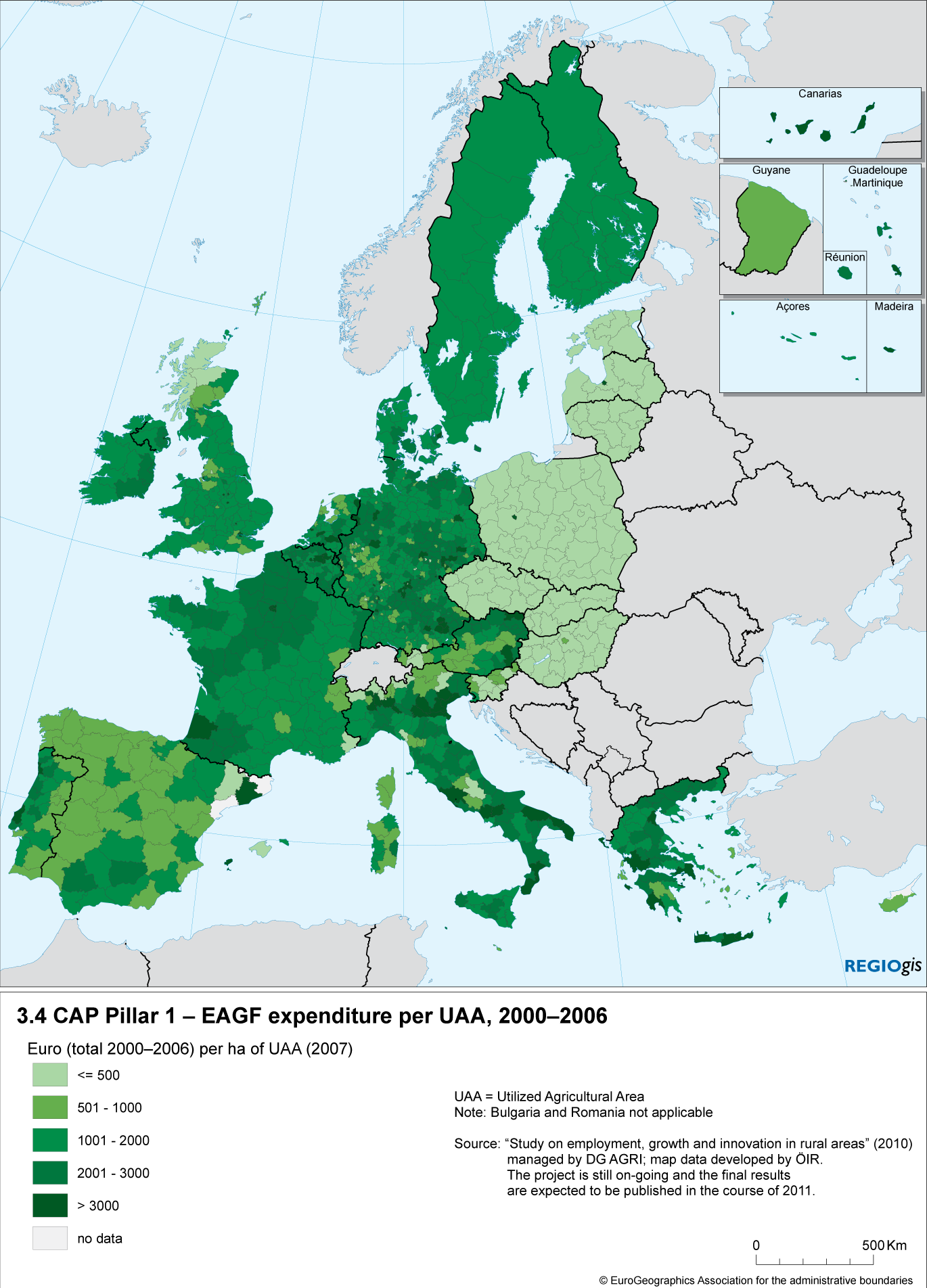
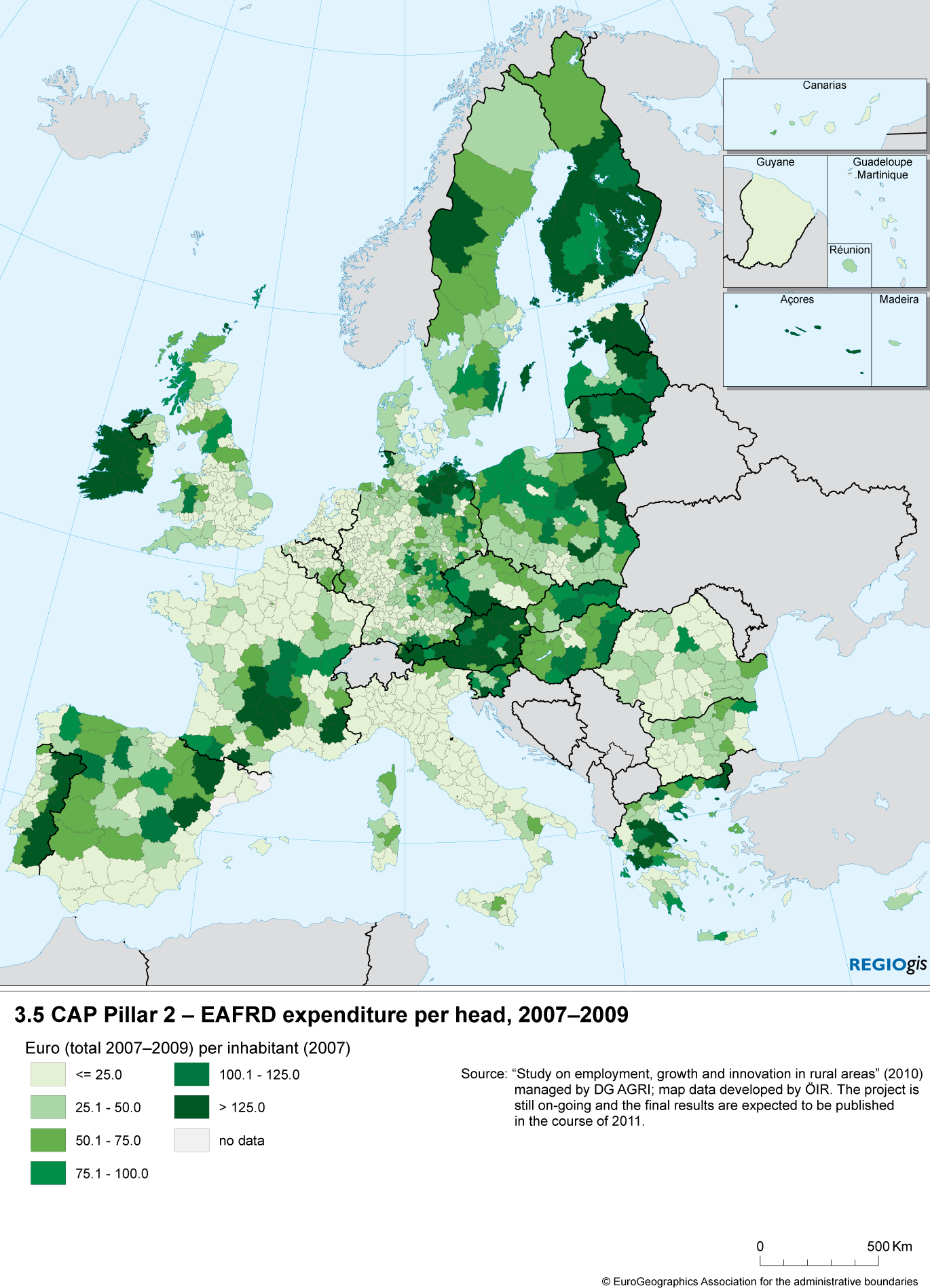
DG Regio’s compendious Fifth Report on Economic, Social and Territorial Cohesion contains a pair of maps looking at CAP expenditure by region.
The first shows the level of Pillar 1 spending per hectare of farmland in in each EU NUTS-3 region over the period 2000-2006.


The second shows the level of Pillar 2 spending per inhabitant in each region between 2007 and 2009.


What do the maps tell us? The first map shows the uneven distribution of direct aids among EU regions of the EU-15. Spain seems to do relatively badly on this score and there is a striking east-west divide in Portugal. Italy resembles a green patchwork quilt, indicating that payments vary considerably among regions. Since the map shows spending from 2000 to 2006, it doesn’t tell us much about the CAP in the new member states, which only joined the EU in 2004.
The second map shows that Austria gets a large amount of EU rural development funding per inhabitant, reflecting a funding formula that takes into account previous national commitments to farmland conservation measures. Ireland also gets a healthy share, as does the regions of the Massif Central in France. German rural development spending is concentrated in the former German Democratic Republic and eastern Poland and the Baltic states and Finland can be seen to do relatively well. Romania and Bulgaria, which have perhaps the greatest need, do relatively badly, it seems. Measuring spending per inhabitant can perhaps be questioned – why not spending per ‘rural inhabitant’, seeing as this is a policy targeted at rural areas?
While the maps are interesting in themselves, Commissionologists will find it significant that DG Regio is wading into a policy area that is nominally run by another DG. I’ve said it before, but this must be welcomed: the CAP is too large and too important a policy to be left to ministries of agriculture.

What ‘common’ agricultural policy?

DG Regio’s compendious Fifth Report on Economic, Social and Territorial Cohesion contains a pair of maps looking at CAP expenditure by region.

The first shows the level of Pillar 1 spending per hectare of farmland in in each EU NUTS-3 region over the period 2000-2006.


The second shows the level of Pillar 2 spending per inhabitant in each region between 2007 and 2009.


What do the maps tell us? The first map shows the uneven distribution of direct aids among EU regions of the EU-15. Spain seems to do relatively badly on this score and there is a striking east-west divide in Portugal. Italy resembles a green patchwork quilt, indicating that payments vary considerably among regions. Since the map shows spending from 2000 to 2006, it doesn’t tell us much about the CAP in the new member states, which only joined the EU in 2004.

The second map shows that Austria gets a large amount of EU rural development funding per inhabitant, reflecting a funding formula that takes into account previous national commitments to farmland conservation measures. Ireland also gets a healthy share, as does the regions of the Massif Central in France. German rural development spending is concentrated in the former German Democratic Republic and eastern Poland and the Baltic states and Finland can be seen to do relatively well. Romania and Bulgaria, which have perhaps the greatest need, do relatively badly, it seems. Measuring spending per inhabitant can perhaps be questioned – why not spending per ‘rural inhabitant’, seeing as this is a policy targeted at rural areas?

While the maps are interesting in themselves, Commissionologists will find it significant that DG Regio is wading into a policy area that is nominally run by another DG. I’ve said it before, but this must be welcomed: the CAP is too large and too important a policy to be left to ministries of agriculture.

French government fighting itself

France has always played a pivotal role in the CAP. As a founder member of the EU, Europe’s largest agricultural economy and the biggest single beneficiary of CAP monies, it has a lot at stake. It is therefore fascinating to witness a violent power struggle within Nicolas Sarkozy’s government over the future of the policy.

On 18 October, French Environment Minister Jean-Louis Borloo and Sustainable Development Minister Chantal Jouanno put their names to a 16-page reform proposal that would see France’s current annual €10 billion a year in CAP payments be divided between basic income payments with environmental compliance (€3 billion), farmland conservation contracts (€6 billion) and food chain and price safety nets (€1 billion). This would be a radical redistribution. Currently 90 per cent of CAP spending in France is in the form of direct aids and market measures, with only ten per cent spent on farmland conservation and rural development.

For more detail on the proposals see Valentin’s earlier blog post.

Naturally, the publication of such a radical proposal was met with howls of dismay from the Ministry of Agriculture and its sponsors, the mainstream farm unions. Barely a month previously, the Agriculture Ministry had put its name to an altogether different, more conservative joint position with the German Agriculture Ministry. In the struggle that ensued, the environment ministers were forced to back-pedal and remove the offending document, even though it was warmly received by other stakeholders.

Nothing on the internet can ever be erased and the document is still available on the links below. It remains to be seen just which version of the French government position will prevail as we head into the next stage of the negotiations. French President Nicolas Sarkozy is said to have joked that France has two commissioners in the current college: Dacian Ciolos (agriculture) and Michel Barnier (single market). With a government so divided, perhaps he’ll need them.

Hat Tip: www.pouruneautrepac.fr

Downloads:

Proposal

Accompanying letter from Environment Minister Jean-Louis Borloo

The surge in sugar prices

In the past few years commentators have emphasised the growing integration between food and energy markets. Food prices were always influenced by energy prices on the cost side, but with the growth of markets for biofuels made from agricultural feedstocks, prices are also linked on the demand side. If oil prices rose, this would tend to pull up food prices as grains, sugarcane and vegetable oils were diverted to fuel production, and if oil prices fell, feedstocks would move back again to the food market also pushing down prices there. The crucial lever here was seen as the Brazilian sugar-ethanol complex and Brazil’s fleet of flex-fuel vehicles, which facilitated easy substitution between the two markets.

But agricultural markets are subject to their own shocks independent of the energy market, and the price integration is far from perfect as shown by a comparison of sugar and oil prices over the past twelve months. Sugar prices have risen on the back of low stocks, lower-than-expected harvests in key producers and India’s delay in authorising sugar exports until next spring.

null

What is curious is why the Brazilian ‘arbitrage’ mechanism has not worked. Why is Brazil not taking advantage of the high sugar prices relative to oil to move more of its cane harvest into the sugar market? I don’t know the answer, but possible candidates might include the following. Ethanol prices in Brazil are well below gasoline prices, so the incentive to switch may not yet exist. There may also be mandates in Brazil which prevent the switch. Brazil itself has reduced cane supplies in this harvest, although in itself that does not explain why it does not subsitute now-cheaper oil for ethanol in its cars. Perhaps it simply takes longer than three months for this arbitrage process to work – for the ethanol plants to close down and blend ratios to be reduced. Explanations would be welcomed in the comments section.

Court of Auditors criticises sugar reform

The European Court of Auditors today released a report reviewing the outcome of the 2006 sugar regime reform. The Court makes some criticisms of the design of the 2006 reform, but more important are its findings and recommendations which are likely to feed into the debate on the shape of the CAP post-2013. Here the report manages to give ammunition to both CAP reformers and diehards, and if early reactions in my own Irish media are any guide it is the more reactionary views which are getting the media spin.

The Court notes that one objective of the reform was to contribute to a more competitive sugar industry, and that this was to be achieved by concentrating quota reductions in the least competitive areas. The audit criticises the Commission for the absence of data on the productivity of individual factories and for the fact that data on the overall competitiveness of sugar production in different Member States was somewhat dated. It concludes that particularly the measures introduced in the third year of the reform were “not sufficiently targeted to achieve the desired objective”.

The Commission responds that an explicit targeting approach would neither have been feasible nor politically acceptable. The reform was based on a voluntary restructuring approach where the decision to abandon or remain in production was made by each individual sugar company in the light of the substantially lower institutional prices for sugar beet. It defends its approach by pointing that out that Member States with high profitability in beet production now account for 78% of EU quota (compared to 68% before the reform) where Member States with low profitability now hold 5% of the EU quota (compared to 12% before the reform).

However, the Court makes the point that a significant portion of quotas that were abandoned were not in the least competitive regions. This, of course, reflects the fact that sugar beet production is still limited by quota in all Member States. The Court has previously criticised the rigidities linked to the quota system pointing out that it creates barriers to entry for new sugar beet growers. It is worth quoting in full its analysis and recommendation:

50. In terms of sugar industry processing efficiency, the maintenance of rigidities and constraints incorporated into the current quota system, i.e. such as the establishment of quantitative quotas per individual grower in certain Member States, the absence of tradability of quotas and the limited possibilities for their transferability, results in undue rigidity of production capacity and reduces scope for both growers and producers to increase efficiency. The audit confirmed that in some of the audited Member States, quota restrictions hamper the entry of possible new growers and delivery rights of existing growers may not be changed without their consent. This entails significant constraints in the sugar production market.

51. While certain producers attempted to mitigate this constraint through private initiatives, overall these constraints are a limiting factor in the application of the principle of economic sustainability which the impact assessment considered should be improved by ‘moving away from the principle of the apportionment of the production capacity, currently built into the sugar quota regime, towards a more competitive, more market-orientated sector’.

Recommendation 2. In view of the importance of sugar production in the agricultural economy, the Court recommends that the Commission proposes measures to remove the rigidities and constraints in the current quota system which affect adversely the competitiveness of growers and producers.

In its response, the Commission notes that, in the preparation of its proposal for the rules governing sugar after the marketing years 2014/15, it will examine a “whole series of options”. With the ending of dairy quotas, the continuation of sugar quotas after that date will become an even more glaring anomaly. Recent high world market sugar prices may have taken the pressure off the Commission to propose a radical reform of the sugar regime. On the other hand, it is during such periods when reform is likely to be easier to implement.

More disconcertingly, the Court raises a red herring by pointing out that production quotas currently limit EU production to a level approximately 85% of EU consumption “for what is a strategic product for the agri-food and chemical industries, thus increasing the EU dependence on imports, while world market supplies are dominated by a limited number of exporting countries”. It recommends that future decisions which impact on EU sugar production “take into account the level of internal sugar production which is considered necessary given the Treaty objective of assuring availability of supply”.

The Commission in its response, quite rightly, points out that the Treaty does not stipulate that the EU should be self-sufficient in every product. The reason for quotas is precisely because the EU market is attractive for third country exporters, so there is no likelihood of sugar shortages in the near future. That the Court calls sugar, the ‘empty calorie’, a ‘strategic product’ says more about the sweet tooth of the auditors than their analytical abilities.