NMS farm ministers flex their muscles

The USDA Foreign Agricultural Service carries a useful report of the meeting in Warsaw on 3 February last attended by the agricultural ministers from the new Member States which concluded with a declaration on the future of the CAP after 2013. Its a fairly uncompromising defence of a large agricultural budget after 2013. The USDA notes that not only are the NMS sore about the unequal distribution of direct payments, but they are rapidly losing ground in the production of primary agricultural commodities. Poland, for example, now imports more pork than it exports, while meat and dairy exports from West to East have surged. The declaration was signed by ten Member States, including Estonia which is sometimes seen as part of the CAP reform camp. Only the Czech Republic attended as an observer but did not sign. The USDA FAS report contains the translation of the agreed declaration which can also be downloaded from the Polish Ministry of Agriculture website here.

CAP support levels reach new high

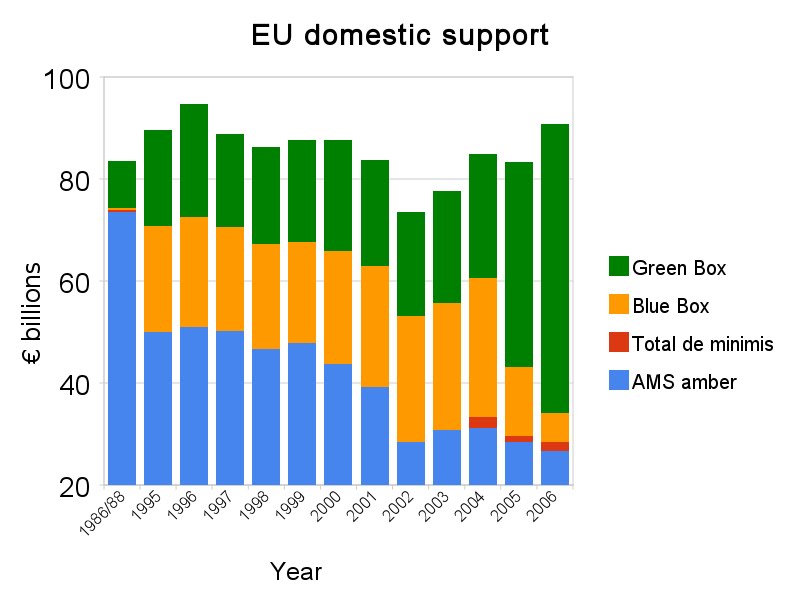
CAP subsidies as reported to the WTO reached a ten-year high of over €90 billion in the 2006/07 marketing year, but conveniently most of them have been parked in the allegedly non trade distorting green box, something that has provoked disquiet in Geneva. The EU notified €90.7 billion of support to the global trade body for 2006/2007 – up from €75.6 billion in 2002, when support was at its lowest in the last fifteen years.

More from ICTSD.

Another day, another declaration

Hot on the heels of the joint declaration by Birdlife International and the European Landowners Association and the declaration of 23 European agricultural economists comes the European Food Declaration (PDF).

The European Food Declaration diagnoses the problems of Europe’s food and farming system in the following way:

– dependence on under-priced fossil fuels
– failure to recognise the limitations of water and land resources
– promotion of unhealthy diets high in calories, fat and salt, and low in fruit, vegetables and
grains
– domination by transnational corporations and the World Trade Organisation (WTO)

The declaration argues that:

“All people should have access to healthy, safe, and nutritious food. The ways in which we grow, distribute, prepare and eat food should celebrate Europe’s cultural diversity, providing sustenance equitably and sustainably.”

The declaration sets out 12 principles, among them Principle 3 makes the curiously contradictory case for healthier eating and less consumption of meat and dairy products “while
respecting the regional cultural dietary habits and traditions”. So cassoulet, bratwurst and zampone are all safe. Principle 4 calls for an agriculture “that involves numerous farmers”, presumably a call for more support to keep smaller farms in business, or to cut support for larger farms. Principle 4 also calls for “fair and secure farm prices”, i.e. a return to production controls and price-setting of the CAP of the 1970s and 1980s. Principle 7 argues that Europe should be GMO-free and Principle 8 says biofuels should be discouraged and transport minimised. Most of the other principles are of the ‘motherhood and apple pie’ variety – very sound but lacking real substance on how they’ll be achieved.

The declaration is the work of a platform of NGOs includingVia Campesina (International Peasant Movement), whose colourful José Bové is a former French presidential candidate and currently vice-chairman of the European Parliament’s agriculture committee, Friends of the Earth and Attac Austria. The organisers will open the declaration to public signatories later this month.

You can read the declaration in full below:

Does the CAP fit?

The biggest driver for further reform of the CAP is budgetary. At a time when most governments are struggling with vast budget deficits, public expenditure is under pressure as never before. Policy-makers are looking for ways to trim budgets, to get better value for public money and to ensure that budgets are aligned with their most pressing policy priorities. Several years ago the commission initiated a ‘fundamental’ review of the EU budget and it is expected that this will set the scene for the debate over the EU’s finances from 2014 onwards. The views of member states are critical, as they hold the EU’s purse strings. James Clasper and I have this week published a new analysis of the views of member states on the EU budget and the CAP, based in part on their responses to the budget review consultation. As part of the analysis we created a typology of member states, with five categories: Gold Diggers, happy to reap the benefits of integration and let others pick up the tab; Misers, fans of budget discipline and a smaller CAP, but keen to claim compensation for their net balance deficits; Big Spenders, who want an ambitious budget but are prepared to pay for it; Modernisers, who want to keep the budget under control but also to simplify its structure and Fence-Sitters, quick to pay lip service to the idea of budgetary discipline, but still keen to maintain CAP spending levels.

You can read a summary of the report at European Voice, or download the report in full over at followthemoney.eu.

Le Monde debates the CAP

Last Friday, Le Monde, the leading French daily newspaper, devoted a double-page spread on its comment pages to the common agricultural policy. Along with José Bové, Michiel A. Keyzer and Jean-Christophe Bureau I was invited to contribute an article to the debate. You can read it in French on the Le Monde website. I’ve posted an English version below.

Farming should protect Europe’s environmental resources not use them up

In 2009, farm incomes fell across the whole of the EU, not least in France. Dairy farms have been hardest hit with average prices down twenty per cent. This is despite the EU spending 55 billion euro on the common agricultural policy, one of whose aims is to ensure farmers a fair standard of living.

Not long ago the lists of who gets what from farm subsidies were considered ‘state secrets’. No wonder. They reveal that far from supporting small family farms, as the public might suppose, the CAP is lining the pockets of Europe’s biggest landowners and agri-businesses. The data shows that across Europe, 85 per cent of aid goes to the top 17 per cent of recipients.

This is because under the twisted logic of the CAP, the biggest farms with the best land get the most public assistance. Besides helping the rich get richer and big farms to buy out their smaller neighbours, subsidies for land ownership and production rights creates a kind of closed shop. Young farmers must buy their way in and are saddled with heavy debts.

Modern agriculture has brought an abundance of food but it has come at a price that goes beyond the financial costs of the CAP. Over the past quarter century, 40 per cent Europe’s farmland birds have disappeared. Bee colonies, so necessary for pollination of arable crops, are experiencing sudden collapse. Rivers and seas are fouled with fertilizers, pesticides and animal effluent. Each year more ancient natural pasture is put to the plough and more wetlands are drained: once gone, forever lost. The CAP has done little to help. In France, for example, payments for farmland conservation amount to 380 million euro in 2008. They are dwarfed by old-style subsidies of 9.34 billion euro.

Things have improved a little in the past few years and Europe is no longer hurting farmers in developing countries by dumping big surpluses overseas. Farmers are mostly free to farm to market demand rather than to government diktat. Yet these reforms have been opposed at every turn by farm unions and the politicians and civil servants in ministries of agriculture, between whom there are often close ties.

And now, even this modest progress is at risk from a new wind of protectionism blowing across the continent. With a growing world population and a changing climate the question of how humanity will feed itself is back on the political agenda. And rightly so. During the winter of 2007/08, food prices leaped to record levels and the world’s poor faced hunger and even comparatively wealthy Europeans felt the pinch. The response in some quarters has been to adopt a siege mentality and aim for self-sufficiency in food. Why, it is argued, should we put ourselves at the mercy of global markets when there is more we can squeeze out of our own lands?

To base an entire agriculture policy on this logic would be a mistake. Seductive though it may be, the promise of European food self-sufficiency is an illusion as it would come through even greater dependency on on imports of natural gas from Russia for fertilizer and oil from the Middle East to run farm machinery.

Instead of a renewed push for unsustainable agricultural intensification, we should encourage more environmentally-friendly farming. Climate change will increase the risk of drought, flooding and poor harvests and the frightening reality is that any food shortages we may have experienced lately are nothing compared to what we might expect mid-century. We would be wise to safeguard the fertility of our own over-exploited soils, conserve our own precious water, protect the biodiversity we need for the pollination of fruits and vegetables and the ecological resources we will need in an uncertain future. In Europe there is little ‘spare land’ to cultivate and big increases in yields will be hard to find. Increasing global food production can best be achieved by helping farmers in poorer countries whose agricultural productivity lags far behind ours.

Following the election of a new European Parliament and the appointment of a new Commission, the EU will this year embark on a fundamental review of its agriculture policy, which still accounts for 40 per cent of the community’s entire budget. Aside from providing income support to a sector of society that is, more often than not, richer than the average citizen, taxpayers get little for our money. The future must be a common European policy to protect and preserve Europe’s lands, recognising the role played by sustainable farming.

It is certain that such a shift will be fought hard by those who have got used to receiving ‘money for nothing’ but at a time when government budgets are under such strain, we cannot go on like this. In 2009 we discovered where money goes and witnessed the sheer the waste and inequity of a system that in 2008 paid 1,583,120 euro to Prince Hans Adam II of Liechtenstein and 253,987 euro to Prince Albert of Monaco. This year we must start taking action to build a better policy.

Jack Thurston is co-founder of farmsubsidy.org, a network of journalists, researchers and activists pushing for greater transparency in the CAP.

German call for reform of CAP payments

The German Council for Sustainable Development has just published a report highlighting the environmental damage caused by intensive agriculture and calling for a reform of the CAP direct payments system. It proposes a three-fold structure of payments: an environmental basic payment, a series of targeted agri-environmental payments for farmers who accept higher obligations, and a series of payments for high nature-value areas where the continuation of agricultural production is desirable but threatened on economic grounds.

For the environmental basic payment, it suggests that eligibility would be conditional on farmers turning over at least 10% of their area to environmentally-friendly husbandry with a view to maintaining a high level of biodiversity in the agricultural landscape throughout the EU.

The Council explicitly argues against the idea that farmers should be remunerated for fulfilling their statutory obligations with respect to the environment, animal welfare and food safety (cross compliance). It also justifies full EU financing of most of the payments “so long as these are directed to fulfilling EU objectives”, thus apparently advocating that some of the existing co-financed agri-environmental payments in Pillar 2 might be moved to Pillar 1 at least as far as financing modalities are concerned.

The report provides an excellent summary of the state of the debate on the environmental implications of agricultural policy (in German only, at least for the moment).

Read it here. Google Translate renders a passable English version of the press release for non-German speakers here.

ELO and BirdLife fire the starting gun

Nothing tells you that a big political debate is hotting up like the emergence of new alliances of odd bedfellows. Yesterday saw a major joint intervention from two of Europe’s biggest, most authoritative and well-connected players in EU agriculture policy.

Birdlife International is a global partnership of conservation organisations. The Royal Society for the Protection of Birds, its member in the UK, boasts well over a million members. The European Landowners Organization is a federation of farmer and landowner associations. Both Birdlife and ELO have members and affiliates in each of the EU’s 27 member states.

They have come together in support of new ‘joint position’ for the future of the CAP. It is based around seven core principals. At its heart is a recognition that agriculture policy should be reoriented towards supporting the active land management practices that are needed to protect the landscape, the environment, preserve biodiversity and ensure for the long term Europe’s capacity to continue as a major producer of food.

The joint position stresses the need for a common European policy backed by money raised at a European level on the grounds that many aspects of land management require a cross border approach, e.g. water basins that span national boundaries, wildlife species that migrate long distances and seas that lap on the shores of more than one country. Moreover, within a the European common market for food, policies that have a bearing on food production should not operate in a way that distorts free competition. Birdlife and ELO also argue that solidarity among European nations of widely different levels of affluence and a shared concern for the future of the unique European tapestry of landscape and rural heritage is justification for a common European policy financed from a common budget.

The joint position is frank in its admission that despite a measure of evolution since it was founded in the early 1960s and some changing rhetoric, when it comes to how the €55 billion a year of CAP money is actually spent, it is still “a policy tuned to supporting agricultural commodity production”. It goes on to argue that the CAP must leave behind its commodity production past and embrace to a future in which “public expenditure matches, as much as possible, the delivery of public benefits which are vital for achieving both food and environmental security”.

Birdlife has been a pioneer of the “public money for public goods” mantra that looks certain to dominate at least the semantics of the upcoming CAP reform debate, if not the actual policy content. (Public goods have a very clear definition in economic theory but the term is increasingly thrown around without much precision, even by those who should know better, such as three analysts from the IEEP, who in a recent report, define agricultural public goods so widely as to remove any analytical power from the concept.) That a big, mainstream farm union like the ELO should throw its weight behind the public goods argument, and nail its flag to the Birdlife mast, is a significant achievement for the conservation group. It also suggests that the ELO has made a strategic calculation that the public money for public goods will be the defining logic of the next CAP reform, and it is better to get ahead of the argument than be left behind.

Making the opposite strategic choice is the UK’s National Farmers Union which is perhaps not surprising since the NFU’s main competition for members comes from the ELO affiliate the Country Land and Business Association (CLA). With Birdlife and the CLA even putting in a cordial joint appearance on the influential BBC Radio 4 Today Programme, the NFU’s Tom Hind reacted angrily to their joint position, dismissing the public goods argument as ‘naive’ and ‘old school’. For the NFU, the recent volatility of food prices means the next CAP reform should see the policy sharpen its focus on boosting commodity production. Some might regard this as a ‘pre-school’ approach.

Today the NFU issued a further reaction in the form of a press release in which its President Peter Kendall denounces the Birdlife/ELO position and reaffirms the NFU commitment to a CAP aimed squarely at commodity production and cheap food. Over the past few years successive NFU leaders have made the case for remuneration for public goods provided by agriculture (even the NFU’s EU-level partner COPA/COGECA has begun talking in these terms). So this more traditional perspective brings the NFU much closer to the positions taken by continental farm unions like the FNSEA in France.

hillside

Putting the UK sideshow to one side, the joint position sets out some of the policy implications of the high level argument for a CAP aimed at long term environmental and food security. It argues that High Nature Value farming, for example extensive grazing livestock farms, is badly neglected by the current CAP and should get a much larger share of taxpayer support, at the expense of more modern, resource-intensive and commercially-viable production systems such as feedlot livestock-rearing and monoculture cereal farms. During the question and answer session of the launch of the joint position in the European Parliament, I put it to Allan Buckwell, policy director of the ELO, that the plan would involve a major redistribution of subsidies and this could be politically toxic. Buckwell was admirably frank in agreeing that the plan would involve significant redistribution of support and made it clear the ELO was not in the business of defending the current allocation of CAP funds.

For a statement from a leading European farm union, the ‘joint statement’ is remarkable in that its contains the weakest possible defense of the market mechanisms (support prices, intervention buying and export subsidies) and direct aids of the first pillar of the CAP:

“Pillar 1 has certain strength in its relatively administrative simplicity and in the strong element of certainty and revenue stability it gives farmers.”

The ‘joint position’ contains no reference to measures to ensure price stability nor does it argue for the continuation the current system of direct income support for farmers. However, it is implicit that paying farmers for the provision of public goods does provide them with a valuable new income stream to supplement what they get from the marketplace. Both Allan Buckwell and RSPB’s Gareth Morgan made this point during the question and answer session.

Nevertheless, it is striking that first pillar of the CAP, which still takes up well over three quarters of the current budget, is well and truly hung out to dry. The joint position states that the mechanisms and measures of a reformed CAP “are likely to show more characteristics of the current CAP rural development and agri-environment measures than current support measures”. These characteristics are listed as follows: (1) a contractual basis of payments that lists the public goods the recipient of public funds is expected to produce in return for the public money paid, (2) transparency of both the funding and the contractual commitments, (3) targeting of specific outcomes and results that are quantifiable and measurable, (4) monitoring of performance and adaptation of policies in the light of outcomes, (5) accountability of recipients of EU funds and the national and regional authorities responsible for implementing EU policies and spending EU funds.

It is a sign of changing times that the ELO and Birdlife International are able to see eye-to-eye on the fundamental principals of a new CAP. In my view, they are on the right side of most of the big issues and the ELO has clearly stolen a march on the more traditional farm unions who would prefer to line up in defense of the status quo. My colleague Valentin Zahrnt has argued that BirdLife is makinge a mistake geting into bed with the ELO. I disagree. It’s not possible to achieve radical reform of the CAP without buy-in from the more progressive of Europe’s farmers and land managers.

Either way, there is no doubt that this will be seen a very important intervention as this year’s debate on the next CAP reform gets going. Read the joint position here

Ciolos confirmation hearing poor reflection on the Parliament

It is now over a week since the confirmation hearing of Commissioner-designate for Agriculture and Rural Development Dacian Ciolos before the European Parliament, but it was only this weekend that I had the opportunity to listen to the EP’s video of the hearing itself. Commentary elsewhere on Mr Ciolos’ performance has been rather negative (my colleague Jack Thurston described it as a lack-lustre performance both in style and substance) and I would not disagree with this assessment – his responses on co-financing and on the legitimacy of equal per hectare payments across all EU Member States were just two examples of woolly and obfuscatory replies.

But I think we may need to take into account the context of this confirmation hearing, which was solely before members of the EP’s Committee on Agriculture. Thus, Mr Ciolos was faced with a totally one-sided perspective on agricultural policy by agrarian representatives. Committee members sought his views on the reintroduction of price supports, higher barriers against third country imports and more support for their special interest groups. While in a democratic parliament farmers have every right to have their views and concerns raised, why were there no representatives from the Committee on Development? From the Environment Committee? From the Health Committee? From the Committee on Budgets and from Consumers? All of these groups have a legitimate interest in agricultural policy. This was a disgraceful decision by the Parliament, which in the case of other Commissioner-designates associated members of other Committees with the questioning of the nominee.

Given this loaded confrontation, I thought Ciolos actually made a reasonable fist of his replies, in that he avoided giving hostages to fortune while showing a suitable deferential attitude to the Committee which had the power to influence his nomination. He described himself as a reformer, although he clarified that this meant adapting the CAP to the realities of 27 Member States and to new situations, and did not mean reducing financial support to agriculture or giving up existing instruments. But he was firm in making clear that there could be no return to the market support instruments of the past, while leaving open the need for new instruments to address questions of price and income volatility. He also seemed to be prepared to think creatively about the second pillar, and his defence of the current level of the agricultural budget was not a defence of the Pillar 1 budget alone. I would not be prepared to write off prospects for CAP reform yet during the period of Mr Ciolos’ tenure.

There is a useful summary of the hearing exchanges prepared by the Parliament here, but as yet no full script of the hearing. The written answers to questions posed by EP AGRI to Mr Ciolos are available here.

What does co-decision have in store?

When the Lisbon Treaty came into force on 1 December 2009, one of the big winners was the European Parliament which gained equal status with the Council of Ministers in most EU decision-making, including for the first time agricultural policy-making (although with some ambiguity about its role in setting prices and aid levels to which Wyn Grant has drawn attention). There is considerable interest in whether these new powers will be used to promote or block CAP reform. The pessimistic view is that the EP will become the focus of intense sectoral lobbying which will be used to block reform.

Parliament2Some light may be thrown on the way the EP will exercise its new legislative role by looking at trade policy, another area where the Parliament gained new powers under the Lisbon Treaty. Currently, the EU-South Korean Free Trade Agreement, which was negotiated under the old Nice Treaty rules, is up for ratification under the new Lisbon rules. According to a report in EUObserver, there is a possibility that the EP could reject the agreement, in large part because of lobbying by European small car manufacturers.

The EUObserver report notes that a debate in the Parliament next week will throw light on the stance of the European legislature, with observers predicting support or opposition is likely to fall along national rather than political lines. One MEP, Christofer Fjellner, a member of the parliament’s trade committee and a supporter of the agreement is quoted: “It would be very disturbing if the first thing the European Parliament does with its new powers is to take special interests to heart and increasingly act in a protectionist way.”

A signpost of things to come in agricultural policy ?