Changes in GM feedstuffs rules on the way?

There now seems to be momentum building up to change EU rules on GM feedstuffs in order to assist the future of the pig and poultry industries in Europe, with the Commissioner Mariann Fischer Boel waxing eloquent on this issue on her blog last week after she raised the issue at the monthly Agricultural Council. According to a Reuters report, the Commissioner has indicated that a proposal on a maximum level for GMO residues in imports should be ready before the end of the year.

The problem arises for two reasons. The first is that the EU has tended to lag behind other countries in the approval of new GM varieties for use in animal feedstuffs. The EU is hugely dependent on the import of feeds, particularly soya, and as the main soya exporters, the US, Brazil and Argentina, increasingly turn to GM varieties, it is becoming increasingly difficult to source non-GM feedstuffs. This is adding to the cost of feed supplies for EU pig and poultry producers. The Commissioner is calling for a more rapid political response once the EFSA safety assessment has been made.

The second issue is that, as long as a GM variety is unapproved, no amount of this unapproved variety is allowed to enter the EU. This has resulted in a number of shipments of soybeans from the US being refused permission to offload because of the presence of minute amounts of a non-approved GM maize variety in the shipments – presumably from a previous load that the ship carried. Such uncertainty could, in the limit, mean that US exporters cease soya shipments to the EU. The obvious solution would be to raise the threshold for adventitious contamination from the current zero level to a minute level, say 0.1%, where the health risks would still be negligible.

In the absence of a solution to this problem, Europe risks losing a large part of its pig and poultry industries, to be replaced by imports of pigmeat and poultrymeat from third countries – fed on the very GM varieties that the EU has refused to authorise even when the EFSA has given the thumbs up. However, the Reuters report concludes that, given the disagreements among Member States on this issue, a solution will not be found until the new Commission takes office next year.

Informal meeting Agricultural Ministers in Sweden 14-15 September to discuss agriculture and climate change

The Swedes have chosen to highlight agriculture and climate change at the informal agricultural council meeting next week. The discussion will be built around three questions:

1. Climate change is of great concern for the future competitiveness of EU agriculture and this challenge is being dealt with at all levels. While the framework is set at EU level, implementation will need to be carried out at farm level.

What should be the role of the EU regarding mitigation and adaptation in agriculture, and, in particular, what should be the key areas of cooperation?

2. An instrument in handling climate change in the agricultural sector is rural development programmes. While climate change is already one of the Community priorities for the current programming period, additional funds were provided that can be targeted to climate relevant actions.

How are these opportunities best utilised and are there any early lessons to be learned?

3. One of many consequences of the changing climate is the increased presence of pathogens and diseases. This is likely to be a main concern for crop, livestock and, at worst, human health. The economic consequences for the sector may be substantial.

How could we further develop our common policy and strategies to best meet the challenges of a changed pattern of dissemination of pathogens and diseases?

What recommendations would readers make to the assembled Ministers?

Is EU agriculture carbon-efficient?

A relatively new argument being used to justify support for agricultural production in the EU is that reductions in EU food production would be made up by increases elsewhere where less efficient production systems exist and thus would result in a heavier carbon footprint. This raises the question whether this statement is factually correct and what do we know about the relative carbon efficiency of production systems in different parts of the world? Continue reading “Is EU agriculture carbon-efficient?”

EU farmers drive Ukraine's agricultural revolution

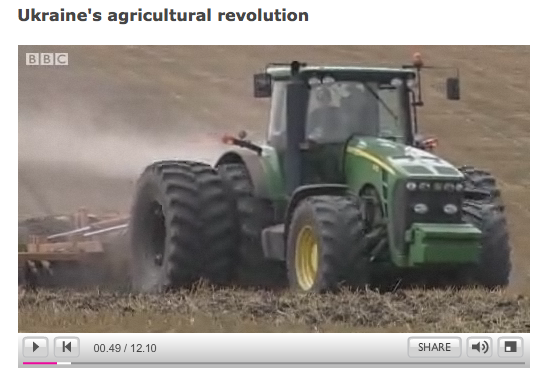
Earlier this week BBC’s Newsnight aired an extended feature on how overseas farmers are bringing the investment that’s transforming Ukraine’s agriculture into vast arable mega-farms. There is no doubt that Ukraine, with its vast expanses of fertile land, has the potential to make a valuable contribution to the global supply of food. Let’s hope they avoid the mistakes made in industrial monoculture farming elsewhere in the world. And that some of the profits that are being made end up in the hands of ordinary Ukrainians.
View the feature here
picture-15

EU farmers drive Ukraine’s agricultural revolution

Earlier this week BBC’s Newsnight aired an extended feature on how overseas farmers are bringing the investment that’s transforming Ukraine’s agriculture into vast arable mega-farms. There is no doubt that Ukraine, with its vast expanses of fertile land, has the potential to make a valuable contribution to the global supply of food. Let’s hope they avoid the mistakes made in industrial monoculture farming elsewhere in the world. And that some of the profits that are being made end up in the hands of ordinary Ukrainians.

View the feature here

picture-15

Tackling the new (old) productivism

This afternoon I did a pre-recorded interview with BBC Radio 4’s Farming Today programme. The subject was the House of Lords report on the 2010 EU budget, which says too much money is being spent on agriculture. The first question I was asked by the presenter shows how deeply the new (old) productivism has taken root over the past year. I was asked something along the lines of “Given the fears about food security, don’t we need a well-funded agriculture sector?”. Continue reading “Tackling the new (old) productivism”