
The annual budget is an important statement of any organisation’s strategic priorities. The EU budget is no exception, but its sheer size and complexity makes it difficult for the interested lay person to interpret and to understand.
The Commission proposed a draft budget (DB) for 2015 in June, and the figures are now under negotiation between the two legislative institutions. Since the Lisbon Treaty, the annual budget is agreed by co-decision between the Council and the Parliament, although the outcome must observe the ceilings agreed in the 2014-2020 multiannual financial framework (MFF).
Once the draft budget is proposed, the Council first adopts its position and forwards it to the European Parliament (EP). The Council’s position on the DB 2015 was agreed by its Permanent Representatives’ Committee on 15 July last. This is its mandate for the negotiations with the EP under the Italian Presidency in September.
The Parliament, meanwhile, is in the process of drawing up its own position.… Read the rest
More on Pillar 2 allocations by member state

In a previous post I commented that a noteworthy aspect of the Ciolos CAP reform was that, unlike previous reforms, it explicitly proposed to redistribute CAP resources between the member states and between farmers within member states. In writing this I was thinking primarily of Pillar 1 payments. Pillar 2 allocations between member states have been more variable, although still largely influenced by historical amounts (Zahrnt discusses the evolution of Pillar 2 shares in this European Parliament paper).
Also on this occasion, the Commission proposed (in its MFF budget proposals) that the distribution of Pillar 2 rural development support should be based on objective criteria linked to the policy objectives taking into account the current distribution. However, the final allocation was once again largely determined by political bargaining, with some evidence that countries losing heavily from the proposed Pillar 1 redistribution were partially compensated through extra ‘sweeteners’ received in the Pillar 2 budget (see this post for a discussion of the Pillar 2 outcome).… Read the rest
Does national spending on agriculture follow a different path to the CAP?
In evaluating the pattern of budget transfers to agriculture, most of the focus is on the transfers through the EU budget. The negotiations on the Multi-annual Financial Framework (MFF) were closely followed because of their importance for the size of the CAP budget in the overall EU budget in the coming programming period.
However, in addition to EU transfers farmers also receive significant transfers from member state budgets. These take two forms: member state co-financing of CAP Pillar 2 expenditures (plus some allowed top-ups of Pillar 1 payments), and state aids paid by member states to their farmers. A proportion, but not all, of agricultural state aid represents member state spending on measures equivalent to rural development measures which would be eligible for funding under Pillar 2 if the national allocations were bigger, but which are funded instead by national exchequers.
The political economy of budget support to farmers is different at the EU and member state levels.… Read the rest
CAP budget share rises as budget deadlock finally resolved
My previous post on EU budget decision-making in mid-October described the complex inter-relationships between agreement on the EU’s long term budget the Multi-annual Financial Framework, the conciliation procedure with respect to the 2014 budget and the divisions between the Council and Parliament on the Commission’s draft amending budgets to the 2013 budget seeking additional funds to avoid pushing more expenditure further into the coming year.
At the end of the post, I described an optimistic scenario in which the Lithuanian Presidency got the Council’s agreement to pay the amending budgets for 2013 and the conciliation process between Council and Parliament on the 2014 budget was successful, thus paving the way for formal approval of the political agreement already reached on the MFF. In the end, it took a marathon session of the conciliation committee (comprising all 28 member state budget ministers and an equal number of parliamentarians) lasting 16 hours on Monday last 11 November to reach the necessary compromises on the 2013 and 2014 budgets.… Read the rest
The 2014 CAP transition year
The Council announced last Wednesday (October 23) that a political agreement had been reached with the Parliament on the transition measures for agriculture in 2014. This follows the publication of the Commission proposal in April and the adoption of the COMAGRI position in September (the relevant documents are available here in the European Parliament Legislative Observatory)
For direct payments and rural development, the new CAP rules will start to apply as from 1 January 2015. Council and Parliament agreed in June to postpone the implementation of the new rules on direct payments until 1 January 2015, but this seems to be the first time that the institutions have agreed that the start of rural development programmes should be pushed back to 1 January 2015. However, the transitional regulation provides for a number of elements of the CAP reform package to apply already as from 1 January 2014.
A draft of the agreed regulation has not yet been released, so it not possible yet to see the details.… Read the rest
The distribution of CAP payments by member state
The Scottish Government is currently waging a campaign for a higher share of the UK national envelopes for Pillar 1 and Pillar 2 of the CAP. It claims that Scotland is almost certain to find itself at the bottom of the EU per hectare league table in terms of both Pillar 1 and Pillar 2 support by the end of the next CAP period because, as a region, it could not directly benefit from the ‘external convergence’ formula used to increase payments in those countries with currently low payments per hectare.
As part of its campaign, the Scottish Government has prepared two tables showing the levels of payment per hectare for both Pillar 1 and Pillar 2 in each member state currently and on average over the 2014-2020 MFF period to bolster its case. As the tables will be of more general interest, I reproduce them below.
Pillar 1 direct payments
The comparison of Pillar 1 payments per hectare is shown in Table 1.… Read the rest
Budget impasse creates uncertainty over December farm payments
All eyes have been focused on the US government shutdown from October 1 through 17 after Congress failed to enact appropriations for the fiscal year 2014, and the simultaneous threat of a US default due to the inability to get a political majority to raise the debt ceiling until Congress finally agreed at the last moment yesterday. Less attention has been paid to the warning given by Financial Programming and Budget Commissioner Lewandowski some weeks ago, and repeated by the Director-General of that Directorate at the European Parliament Budget Committee yesterday, that the EU Commission will find itself unable to pay its bills by the middle of November unless additional appropriations are made available to fund the 2013 budget. The inability of the Commission to pay its bills (mainly reimbursements to member states) has of course a much smaller economic impact than the US case, but it is symptomatic of a different type of political gridlock.… Read the rest
Does the CAP cap agricultural spending in the EU?
Every so often the debate about how far and how fast powers should be transferred from member states to the Union level within the EU and vice versa gains momentum. This debate about the optimal degree of centralisation or decentralisation in policy-making is known as the debate about subsidiarity in EU terminology.
The principle of subsidiarity is now part of the Lisbon Treaty but there are many observers who feel that this does not work very well. The optimal degree of policy centralisation is part of the debate on the response to the Eurozone crisis as well as a key element in David Cameron’s demand in his London speech in January 2013 for the repatriation of powers from the Union to member states.
Subsidiarity and agricultural policy
Economists take a very functional approach to subsidiarity. Drawing on the economics of federalism or multi-tier government, economists see the allocation of powers as a balance between taking decisions as close to voters as possible to maximise the chances that voters’ preferences are realised, while recognising the realities of interdependence which can justify the centralisation of powers.… Read the rest
Cyprus Presidency proposes CAP budget cut in next MFF
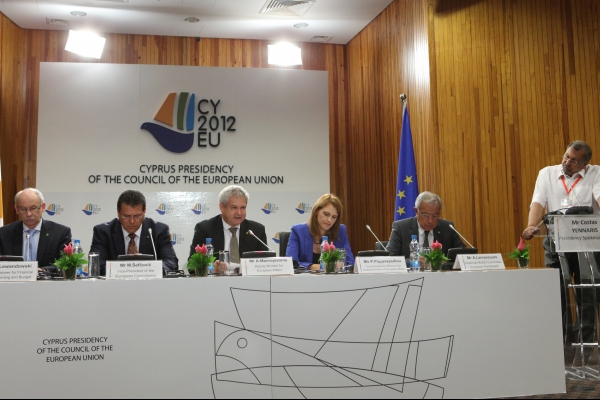
The first initiative in what member states hope might be the final push to get agreement on the next Multi-annnual Financial Framework by the end of this year under the Cyprus Presidency took place yesterday (30 August) when the Cypriots hosted an informal meeting of the General Affairs Council in Nicosia.
During July, the Cypriots held a series of bilateral meetings (‘confessionals’) with the 27 member states and Croatia. Based on these discussions an Issues Paper was prepared for the meeting. This paper reported briefly on the outcome of the bilateral consultations, presented the Presidency´s proposed orientations for reflection by the delegations, and included a brief reference to the next steps.
The Issues Paper
The summary of the bilateral consultations is a daunting list of areas of disagreement, ranging from the overall size and composition of the next MFF, the sources and make-up of revenue sources, to more specific concerns on cohesion policy, the CAP, and other expenditure headings (this earlier post discusses the state of play on some of these issues at the beginning of the summer).… Read the rest
COMAGRI Chair calls for maintenance of CAP budget in real terms

Paolo De Castro, Chair of the European Parliament’s Committee on Agriculture and Rural Development (COMAGRI), is also the rapporteur for the COMAGRI opinion on the Commission’s proposal for a new MFF regulation. His draft report circulated last month is a trenchant call for additional money for farmers and greater flexibility in how it can be spent.
While the rapporteur’s draft has yet to be discussed by COMAGRI, it is likely to be approved as it builds on previous Parliament reports and resolutions. The COMAGRI opinion is a set of suggestions to the Budget Committee which has the ultimate responsibility for drafting the Parliament’s view on whether to consent to the Council’s (and, ultimately, the European Council’s) decision on the MFF ceilings in the 2014-2020 period. It provides an interesting insight into COMAGRI’s thinking on the role of the budget in a time of economic crisis.
The De Castro recommendations
The starting point for De Castro’s draft report is the Commission’s level of CAP spending in its MFF proposal.… Read the rest