The CAP Communication was published by the Commission on 29 November last. In a previous post, I commented on an early leaked draft of this Communication. A number of changes in emphasis were added in the final version but the basic structure of the proposal has not changed. It is nonetheless worth to revisit the document and the Commission’s suggested vision for the direction of the CAP after 2020.
Much of the initial reaction both in the meeting of the European Parliament’s AGRI Committee to which Commissioner Hogan presented the Communication on the day of its publication (the video can be watched here) and at the December meeting of the AGRIFISH Council where Agriculture Ministers had their first chance to discuss the document (the discussion was held in private session but Vice President Katainen’s speaking notes are available and the subsequent press conference can be viewed here) focused on the proposed new delivery model for the CAP.… Read the rest
How Member States are implementing the new CAP
All the focus last week was on the publication of the Commission Communication on the Future of Food and Farming. This document has been greeted with both curiosity (concerning the potential of the proposed new mode of delivery and governance to deliver both simplification of the CAP as well as improved targeting and results on the ground) and criticism (from farm groups worried that it eliminates the ‘common’ in the Common Agricultural Policy and environmental groups worried that it could facilitate the continued transfer of a large chunk of the EU budget to farmers with no questions asked). It will take some time to tease out its full implications, and this is something I will return to on this blog in the future.
Last month DG AGRI also published without fanfare on its website a very useful summary report on the implementation of the 2013 CAP reform in the 2015 claim year, the first year of implementation of the new CAP.… Read the rest
Leaked draft of the Commission Communication on Future of the CAP
Brussels has been buzzing in the past week since copies of the draft Commission Communication on the Future of the CAP which is set to be launched on 29 November next were leaked – you can read it and download a copy from the ARC2020 website. The status of this document is not clear – my guess is that this is the version that has been prepared by DG AGRI for the Inter-Service Consultation process which normally takes two to three weeks. This is where DG AGRI would get the formal opinion of the other DGs on its proposal, which it would then take into account in its final Communication. So there is still the possibility that the final Communication could differ from the leaked version, although one assumes that DG AGRI have been in close touch with their colleagues in the process of drafting, so I would not expect substantial changes at this stage.… Read the rest
Does the WTO discipline really constrain the design of CAP payments?
This post is contributed by Jean-Christophe Bureau who is professor of of economics at AgroParisTech, Université of Paris-Saclay, and heads the joint research team in public economics of INRA, the National Institute for Agricultural Reseach in France.
The idea that the definition of CAP instruments has been (and still is) heavily constrained by World Trade Organisation rules is widespread. In debates on the post 2020 CAP, the issue of compatibility with WTO disciplines is raised each time coupled payments, countercyclical payments, support to production in less favoured areas, risk management or income stabilization schemes are discussed. An issue of particular interest (which this post focuses on) is environmental payments.
It is often stressed that WTO discipline imposes strict limitations in this area; in particular, that payments to farmers for environmental services need be limited to compensation of the additional costs experienced. This has important consequences for the design of the future CAP.… Read the rest
Macron's views on the Common Agricultural Policy
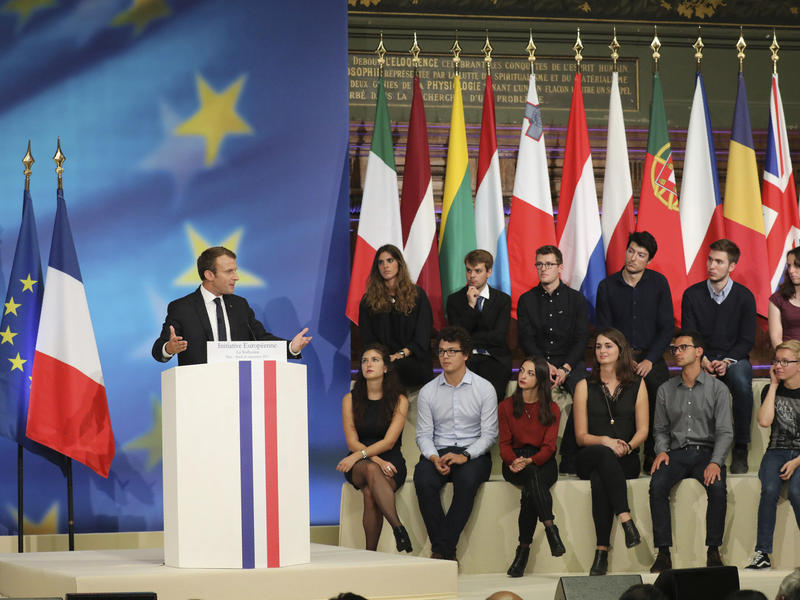
President Emmanuel Macron laid out his vision for Europe in a major speech at the Sorbonne yesterday. This speech was billed as an Initiative for Europe and set out the President’s ambitions in a range of areas – defence, counter-intelligence, asylum and migration policy, an external policy focused on Africa and the Mediterranean, a sustainable development agenda (including ideas for a more flexible CAP), addressing the challenges of the digital economy, reforms of the eurozone, and institutional reform. He proposed that each Member State that signs up to this agenda (recognising that not all will want to) should organise a citizen’s dialogue in the coming months with a view to feeding into a new “group for overhauling Europe” which would be tasked to produce a report by Summer 2018 on measures to implement these ambitions.
The full speech (in French) is here, with the official English summary here.
There is much to get to grips with in this speech.… Read the rest
The budgetary context for the CAP after 2020
Last week I attended the XVth Congress of the European Association of Agricultural Economists which was held in Parma, Italy. With almost 600 contributed papers, poster papers, organised sessions and panels, it was a feast both of stimulating ideas and great food. Over the next few weeks, I hope to highlight a few of the papers which were of interest to me. In this post, I take the opportunity to refer to my own contribution to an organised session on the economics and politics of the CAP after 2020.
This panel discussion also included contributions from Tassos Haniotis (DG AGRI), Jean-Christophe Bureau (AgriParisTech) and Johan Swinnen (University of Leuven). My contribution dealt with the state of play and the process of shaping the CAP post 2020, Haniotis and Bureau discussed some of the substantive issues under discussion, while Swinnen discussed the political economy of a reform agenda, drawing on analytical insights from previous CAP reforms.… Read the rest
Merkel's stance on agricultural policy
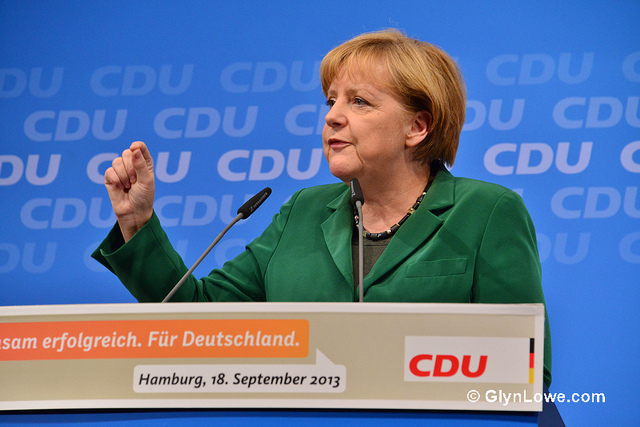
Given the pivotal importance of Germany in shaping the future CAP, it is worth paying attention to what the CDU/CSU coalition have to say about agriculture in its just announced programme for government for the German elections in September. Not least because opinion polls currently suggest that Merkel will succeed in her bid for re-election. Among other issues, there are commitments to maintain direct payments after 2020 (though no commitment to seek any particular size of the CAP budget), to maintain the two-pillar structure of the CAP, to improve the crisis instruments at the disposal of the Commission and a preference to compensate for biodiversity loss arising from agricultural production through financial compensation rather than land set-aside (though how this might work in practice is not spelled out). Below is my rough translation of the agricultural section of the CDU/CSU programme for government.
… Read the restAgriculture has a future
Agriculture, forestry and the food industry in Germany contribute greatly to economic activity, but also to the quality of life, culture and landscape management.
CAP – out of the box thinking
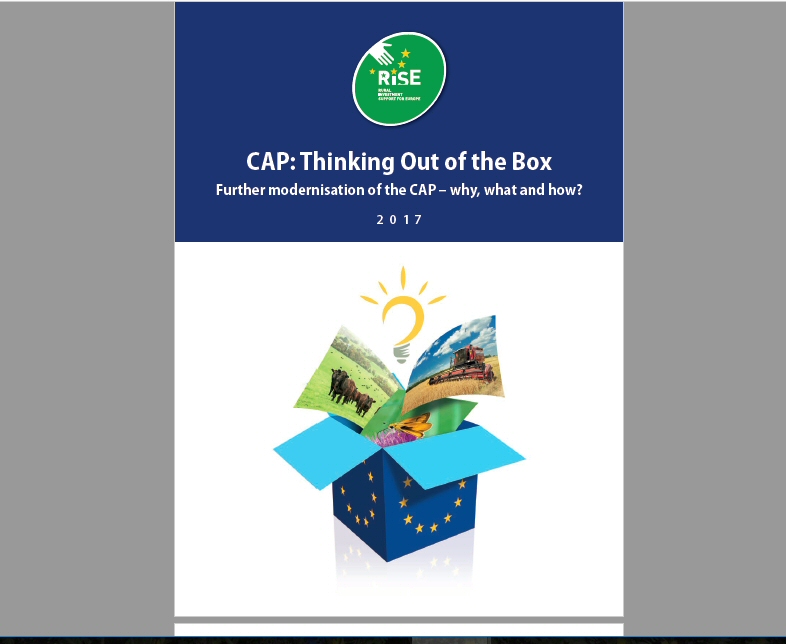
Last Monday saw the launch of a report “CAP – thinking out of the box” by the Rural Investment Support for Europe (RISE) Foundation. The report director was Allan Buckwell and the other contributors to the report are Erik Mathjis, David Baldock and myself. The report is a response to the public consultation on the modernisation and simplification of the CAP launched by Commissioner Phil Hogan in February.
Below, I reproduce a short summary of the key messages of the report.
… Read the restFurther adaptation of the CAP is necessary to help EU farming become a well-structured industry which is economically viable and environmentally sustainable. The next 15 years will see a generational turnover amongst farmers as millions of farmers already over 60 retire. The new generation have before them the exciting challenge of embracing the wealth of new technology based on precision, digitisation, big data and even robotics which when applied to plant and animal genetics and nutrition can raise their productivity, and thus incomes, and equip them to combine Europe’s high quality food production with high and rising environmental performance as they steward our natural resources.
COMAGRI co-rapporteur proposes Omnibus Regulation amendments
We are pleased to bring you this guest post by Paolo de Castro MEP who is a co-rapporteur for the European Parliament’s AGRI Committee on the so-called Omnibus Regulation which proposes to amend the CAP basic acts with a view to their simplification. Mr de Castro introduced his draft report at the AGRI Committee last Monday 13 March, and it is now open for amendment by other AGRI Committee members until March 21st. The following is an edited version of his remarks.
The Omnibus proposal represents, despite its significant management and administrative complexity, an important opportunity to improve and solve the major issues that our farmers have been facing over the first three years of application of the new CAP. We welcome such initiative from the European Commission, but I believe the Parliament has the duty to make the Commission’s proposals more ambitious, while complying with the two main objectives of the overall text, which are procedural simplification and red tape cutting.… Read the rest
AGRIFISH Council meeting underlines pressures to reverse CAP reform
Agricultural Ministers had a round table discussion on the future of the CAP at yesterday’s AGRIFISH Council meeting in Brussels. This was based on an orientation paper prepared by the Maltese Presidency.
The orientation paper identified six CAP priorities. These included the three previously identified by the Commissioner – building resilience, responding to environmental challenges, and generational renewal – and three others – investing in rural viability and vitality, maintaining a market orientation and strengthening farmers’ position in the food chain. Ministers were invited to answer the following questions:
In your view, what would be most effective way to address the CAP priorities?
Without prejudice to the overall financing of the CAP, do you think that a rebalancing exercise should take place between the first and the second pillar of the CAP in order to deliver on these priorities?
The round table was held in closed session, and little information was provided at the subsequent press conference on the range of views expressed by individual Ministers.… Read the rest