What does the outcome of the European Parliament elections mean for EU agrifood policy?

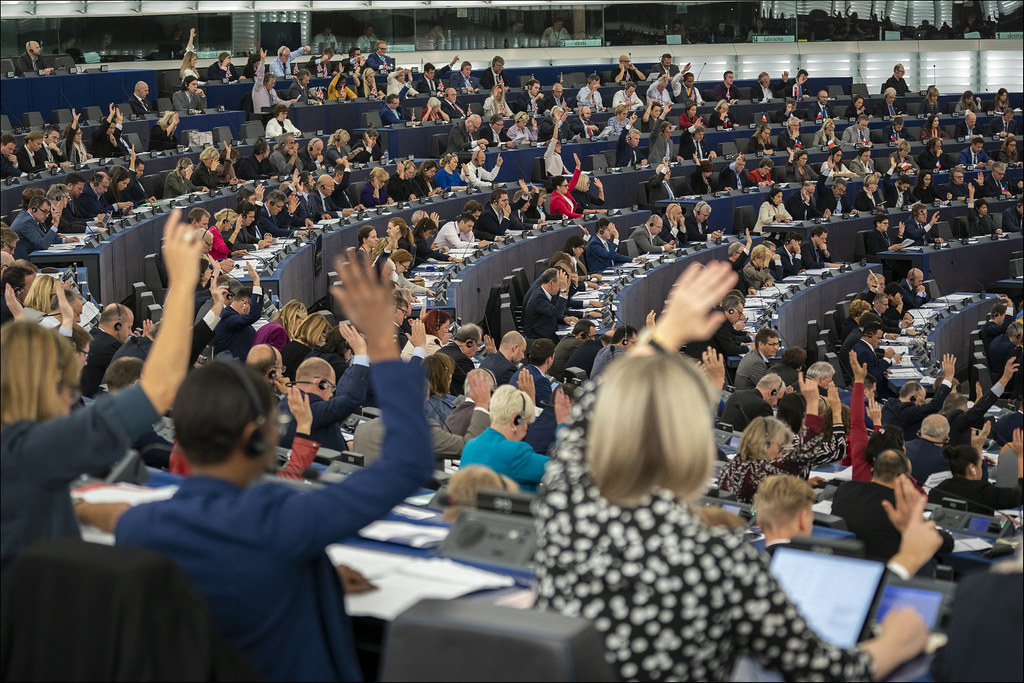
The confirmation of Ursula von der Leyen’s nomination as Commission President by the European Parliament today may give the appearance of business as usual in the European Union for the coming political cycle 2024-2029. But this would underestimate the pressures for change under the apparent veneer of stability. The political priorities set out by von der Leyen as she sought support for her nomination on this occasion are subtly different to the Green Deal platform on which she sought support in 2019. This also applies in the area of agrifood policy, an area which has been marked by protests and policy reversals in the last year of her previous mandate.

Changing priorities are a response to changes in context and circumstance. These include the wake-up call due to Russia’s brutal invasion of Ukraine which highlighted inter alia an unhealthy dependence on Russia for energy supplies, geo-political tensions including the need to address China’s growing role in frontier technologies, conflicts in the Middle East and Africa which contribute to migration pressures, as well as the increasingly obvious need to adapt to climate change while also pursuing ambitious mitigation goals,  

Changing priorities also reflect changed political circumstances arising from the June 2024 election to the European Parliament.… Read the rest

European Parliament polling reaches tipping point for right-of-centre majority

Latest polling results from the three institutions that provide regular updates on seat projections for the European Parliament elections in June 2024 now point for the first time to the possibility that the three right-of-centre political groups – the EPP, ID and ECR – may have a majority of seats on their own in the next Parliament.

My previous synthesis of the seat projections in May 2023 (see my blog post here) showed that the left-of-centre groups – S&D, Greens and the Left – together with Renew were still slightly ahead of the right-of-centre groups though they would have required support from the independent MEPs – the so-called Non-Inscrits – to create an overall majority. This is no longer the case.

In the following table, I present the seat projections by the three institutions – Europe Elects, Politico Poll of Polls, and Der (europäische) Föderalist – as a percentage of the overall number of seats (note, this is not a projection of the share of total votes received by the national political parties affiliated with these political groups).… Read the rest

How might the political composition of the European Parliament change in the 2024 elections?

This post first appeared on LinkedIn on June 11, 2023 and is reproduced here without amendment. Since that date there have been national parliamentary elections in Greece and Spain which in many respects confirm the analysis presented here. Furthermore, it is now agreed to increase the number of seats in the European Parliament by 15, with additional seats going to France, Spain and the Netherlands (2 each) and 1 additional seat to Austria, Belgium, Poland, Slovenia, Slovakia, Finland, Latvia, Ireland and Denmark.

A couple of weeks ago the Council of the EU confirmed that the next elections to the European Parliament (EP) will take place from 6 to 9 June 2024. So in exactly one year’s time we will know the outcome of the election and the political composition of the next Parliament.

It seems as if political change is on the way. Right-wing parties have kept power or made gains in recent elections in Greece, Finland, the Netherlands, Hungary, Sweden, and Italy.… Read the rest

Agriculture Commissioner-designate Wojciechowski stumbles at hearing

One piece of advice given to everyone who goes for a job interview is that you need to prepare. Commissioner-designate for Agriculture Janusz Wojciechowski seemed to have done limited preparation for his hearing in front of COMAGRI (with COMENVI as an associated committee) in the European Parliament earlier this week and failed to impress. As a result, he has been asked to respond to a fresh set of questions submitted by the Committee before it decides if it is willing to support his candidacy.

Wojciechowski has a legal background and rose to become a senior judge in Poland.… Read the rest

What will the European Parliament elections mean for CAP reform?

The European Parliament (EP)’s agricultural committee adopted its Opinions on the three CAP-related legal proposals earlier this month. However, lack of time during this Parliamentary session before elections take place to the EP at the end of May means that the Parliament itself will not vote on these Opinions until after the new Parliament reconvenes in July.

While the outgoing committee would like to see the new Parliament use its Opinions as the starting point for its plenary voting, there is no guarantee that this will be the case. The composition of the political groups in the new Parliament may be very different to what has existed in the current Parliament. In this post, I look at projections of EP election results in May and what this might mean for the outcome for the CAP reform legal proposals.

Political groups and political parties

There is an important distinction between political groups in the EP and European political parties.… Read the rest

COMAGRI lacks full transparency in crucial votes

Th AGRI Committee voted its Opinion on amendments to the CMO Regulation on Monday 1 April, its Opinion on the Strategic Plan Regulation on 2 April and will vote its Opinion on the Horizontal Regulation on financing, management and monitoring of the CAP today 8 April. I plan to comment on the substantive outcome of these votes in the coming days. In this post I want to comment on a procedural aspect of these votes that I find does not live up to the norms of acceptable practice and which makes it impossible for anyone not in the inner circle to follow the voting on these Opinions. My complaint concerns the unavailability of the compromise amendments and the voting lists without which the public proceedings of the Committee on these days was incomprehensible.

The compromise amendments play a key role in shaping the Committee’s opinion. To see their importance, we can quote from the News Highlights on the Committee’s home page accessed on 7 April (this is a dynamic page so this link will not work after a week or two).… Read the rest

Impact of the MFF negotiations on the CAP 2013 reform

The CAP 2013 reform was the first negotiated under the ordinary legislative procedure (co-decision) in which both the Parliament and the Council had equal powers. A project undertaken by the Centre for European Policy Studies in Brussels for the European Parliament’s Policy Department has sought to examine what impact and influence the Parliament had on the CAP 2013 out-turn as a result of co-decision. Did co-decision give the Parliament a greater opportunity to influence the final outcome, who were the key players in shaping the Parliament’s views and what did the Parliament use its influence to achieve?
The final study, when it is published, will throw light on these issues. The team behind the study (of which I was one) also commissioned a series of case studies on specific issues raised in the co-decision process. These case studies are now available on the CEPS website. They include a detailed amendment analysis by Imre Fertð and Attila Kovács of the Council and Parliament amendments to the Commission’s original draft proposals which evaluates the relative effectiveness of the two bodies in carrying their amendments into the final legislation, a detailed study of the role of COMAGRI by Christilla Roederer-Rynning, an analysis of the evolution of the greening debate by Kaley Hart, and an analysis of the European Parliament’s position on market regulation by Alessandro Olper.… Read the rest

The Reform of the CAP: One Year After

Almost exactly a year ago the legislative bodies of the European Union accepted 4 new key Regulations that will determine the next period’s CAP. The Commission presented this reform, utilizing the label ‘Greening’, as a shift of paradigm and an introduction of certain other important changes in both the goals and the instruments of European agricultural policy. The essence of the new reform was to find a new justification for and mechanisms of agricultural policy. The reform, which took place in times of economic crisis, was accepted after the Lisbon treaty; as such it was characterized by a new form of legislation which equalized the roles of the European Parliament and Council as key legislators. A year has passed and it is time to try to assess our achievements from a distance, taking into account the future of the CAP.

CAP reform – The new and the old

It is my assessment that with the latest CAP reform there has been much change at the level of policy objectives, but less in the field of CAP instruments.… Read the rest

How MEPs voted on CAP reform

The website VoteWatch Europe monitors the voting of MEPs on each resolution and piece of legislation. It published the following commentary on the CAP reform voting earlier this month (thanks to Xavier Pavard @xpavard on Twitter for drawing attention to this source) which I reproduce here.
(Note: Right click on the images below and select Show picture to get clearer view of the graphics)

Centre-right wins battle over CAP reform; net contributor country MEPs outvoted

MEPs voted on a package of four legislative proposals that make up the reform of the Common Agricultural Policy (CAP). The subject was hotly debated, as CAP currently accounts for close to 40% of the EU budget. CAP is to be reformed with effect from 1 January 2014. To ensure better targeting of aid, the proposal gives Member States the responsibility for defining what constitutes an “active farmer”.
Other provisions are that no Member State’s farmers should receive less than 65% of the EU average, that young farmers should get a 25% top-up payment for a maximum of 100 ha and that direct payments to any one farm should be capped at €300,000.

Read the rest

The legislative timeline for CAP reform

The publication of the Commission’s legislative package for CAP reform is merely the starting gun for the EU’s legislative procedure to debate the regulations before they can take effect. The regulations now enter the co-decision procedure involving the Council of Ministers and the European Parliament (EP).

In an article this week in the Irish farming press, Mairead McGuinness set out the timeline as seen from the Parliament’s perspective. Mairead McGuiness is the EPP Group shadow rapporteur for the direct payments report contained within the legislative package, and thus centrally involved in formulating the EP’s position.

According to McGuinness, the current timeline envisages that draft reports will be prepared for consideration by the Agriculture Committee by April next, with a vote in Committee taking place in September on the changes proposed by MEPs.

However, she warns that given the complexity of the reforms proposed this timetable is by no means certain and that divergent views may delay the work programme.… Read the rest