
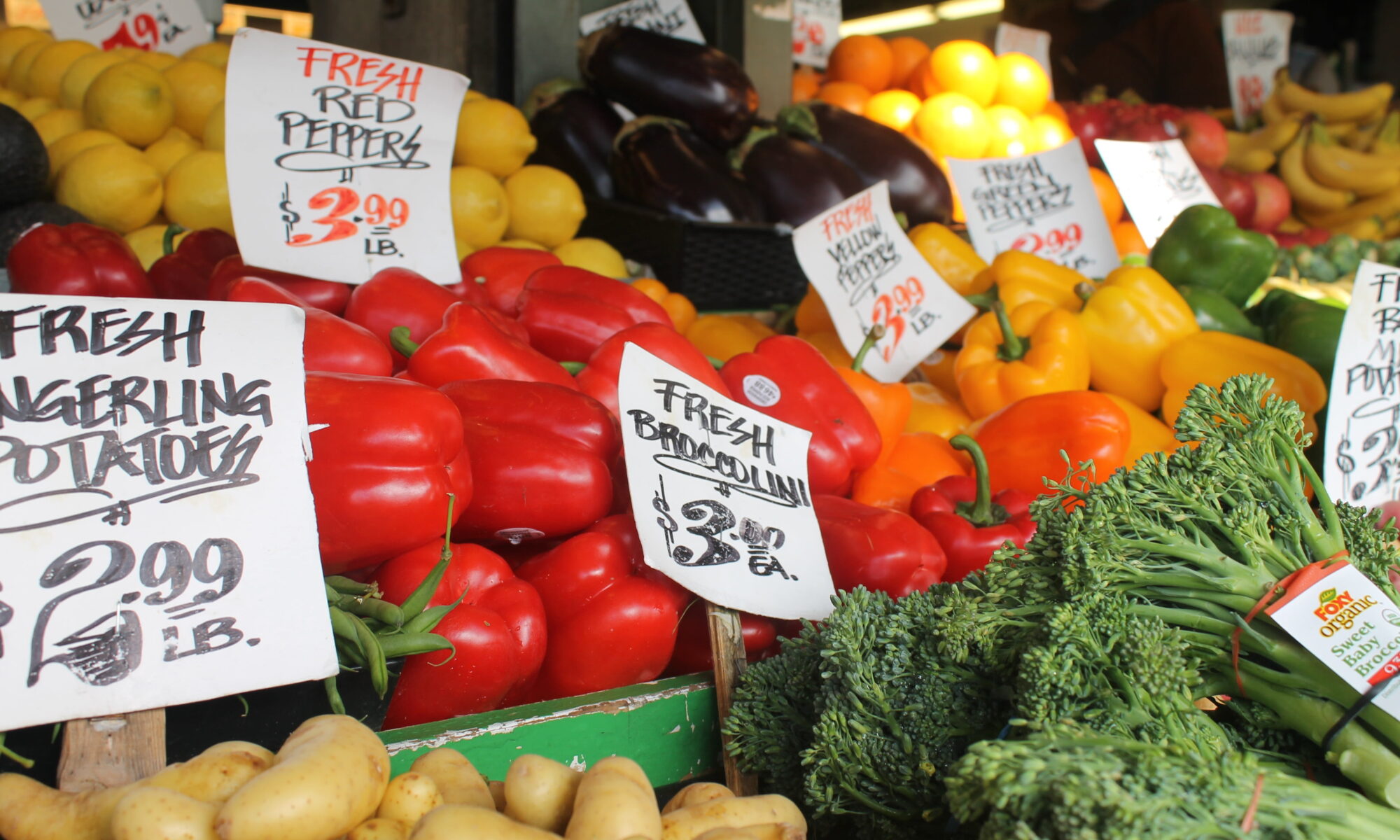
Food prices stabilising but yet to fall

I wrote a blog post in March this year “Food price inflation gathers pace” which used inflation data up to February. I concluded that post by noting that “the explanation for the continuing rise in food price inflation is mostly likely down to the lags in transmitting price changes through the food price chain. Food price increases in the past year, though very high, have not fully reflected the increases in prices at primary producer level. As food manufacturers and retailers continue to adjust their prices to these higher input costs, food price inflation is likely to continue at a high level”.

In this post, I bring the story up to date using information up to June 2023. My prediction in March 2023 seems borne out by the data. Food price inflation remains very high but there is evidence that food prices at EU level have stabilised and that we can expect some modest decrease in the coming months.… Read the rest
Food price inflation gathers pace

Overall inflation in the EU shows some tentative signs of moderating in the latest figures for the Harmonised Index of Consumer Prices (HICP) from Eurostat for February 2023. From a peak annual rate of inflation of 11.5% in October 2022, the annual rate fell to 9.9% in February 2023. This is entirely due to a fall in energy costs which also reached their peak in October 2022. Food price inflation, however, continues unabated and increased further in February 2023 to an unheard-of annual rate in recent decades of 19.1%. Unfortunately, this high rate of food price inflation looks set to continue for a further period.

Food price inflation in context

Food prices in the EU have risen dramatically in recent years (in this blog post, food prices include non-alcoholic beverages but exclude alcoholic beverages whose prices have risen at a slightly slower rate). In the EU as a whole food prices were 38% higher in February 2023 relative to the price level in 2015, while the overall price level rose by just 24% during this period.… Read the rest

Food prices, poverty and the CAP

The Fabian Society in the UK has established a Commission on Food and Poverty to examine how poverty relates to the food system. The Commission published an interim report in March based on the initial evidence it has gathered. The Commission’s approach is to look at access to food, health outcomes and what the consequences of the ways the food system operates are for low-income households in the UK and consequently elsewhere.
I recently made a submission to the Commission on the way in which agricultural policy affects food prices and the implications this might have for consumption, nutrition and health. Because of the recent and ongoing reforms of the CAP, I argue that the impact of agricultural policy on food prices is now much more limited than in the past. However, high tariff protection for some products means that food prices within the EU for a handful of commodities (beef, poultrymeat, potatoes, tomatoes and possibly fruit) are higher than they otherwise need to be.… Read the rest

Rising numbers of families cannot afford to spend enough on food

The consequences of recent economic trends and the economic crisis for food consumption are graphically highlighted in a recent OECD report Society at a Glance 2014. The report discusses how many families have cut back on essential spending, including on food, compromising their current and future well-being. Reduced spending on food is one of the main causes of food insecurity, a term that describes a situation where inadequate access to food does not allow all members of a household to sustain a healthy lifestyle. According to the OECD:

In the United States, where the incidence of food insecurity is monitored on a regular basis, rates of food insecurity have soared since 2007. While federal food assistance programmes in the United States now support roughly twice as many households as in 2007, the number with inadequate access to food at some time in the year has nonetheless climbed from 13 million (11% of all households) in 2007 to 17.6 million (15%) in 2012.

Read the rest

Comparative food prices across the EU

The food system has been subject to a series of shocks, including the sharp rise in commodity prices since 2007 and the economic recession and subsequent austerity measures in many countries since 2009. These shocks are likely to have affected different countries in different ways, so what has been happening to relative food prices across countries as a result?
Two sets of food price data are of use in this regard. Eurostat has developed a food prices monitoring tool which provides data on the monthly evolution of prices at different levels of the food value chain (commodity, processor and consumer) for EU countries. However, these data do not allow a comparison of the absolute level of food prices. For this, we need to look at Eurostat’s price level indices (PLIs) which are calculated as part of the Eurostat-OECD Purchasing Power Parities Programme.
National prices are collected for around 500 comparable food and drink products.… Read the rest

The development angle

“Waste at home and damage abroad”. That is how one Member of the European Parliament described the common agricultural policy. Gabrielle Zimmer, a German MEP who sits on the parliament’s development committee, was speaking at a conference convened last month by the United Nations Millenium Campaign to look at the impact of Europe’s farm tariffs and subsidies on developing countries.

According to Eckhard Deutscher, Chair of the OECD Development Assistance Committee (DAC) and another participant in the same meeting,

“The biggest challenge the EU’s development aspirations are facing is the lack of policy coherence. The trade, development, agriculture and environmental policies are simply out of sync with regard to developing countries.”

Eveline Herfkens, Founder of the UN Millennium Campaign, pulled no punches,

“An unreformed European agriculture policy will continue to hamper the EU’s and other donors’ efforts to eradicate poverty and will perpetuate human suffering.”

European countries lead the world as donors of development aid, but for decades the EU has pursued agriculture policies which have had the reverse effect – whether it’s trade barriers that make it harder for developing countries to export farm produce to Europe or subsidies that encourage European farmers to overproduce, driving prices down and undercutting unsubsidised farmers in poorer countries.… Read the rest