LULUCF targets off-course

The EEA recently published updated projections for LULUCF emissions and removals by Member State to 2030 and 2050. It is not good news. Although the fall in the LULUCF sink appears to have been halted over the past six years, the EU27 net sink in 2023 was just 198MtCO2e and estimated at 212MtCO2e in 2024. This compares to the 2016-2018 average of 268MtCO2e and the 2030 target of 310MtCO2e set in the LULUCF Regulation (Figure 1).
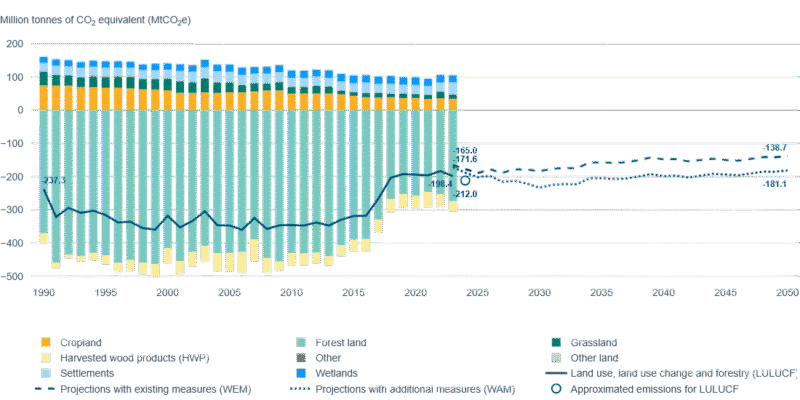
Figure 1. EU emissions and removals of the LULUCF sector by main land use category
Source:  EEA, 2025.

The projections show that, with existing measures (the WEM scenario), the EU27 net sink is projected to be 183Mt CO2e in 2030 (all subsequent figures are in CO2e units). This does not necessarily imply a further fall in removals, as the base year removals for the projections in 2023 and 2024 are lower in the projections than in the inventory figures (165Mt and 172Mt, respectively).… Read the rest
What does the Commission’s proposed 2040 climate target mean for agriculture?

On 6 February last, the Commission published its Communication Securing our future:  Europe’s 2040 climate target and path to climate neutrality by 2050 building a sustainable, just and prosperous society. The Communication proposes a Union-wide, economy-wide 2040 target reaching 90% net GHG emissions reduction compared to 1990 levelsthat will put the EU on an effective, cost-efficient, and just trajectory towards climate neutrality by 2050, as called for under the European Climate Law”.

In fact, what the Climate Law calls for is ambiguous. In recital (30), the Commission should propose a Union intermediate climate target for 2040, as appropriate, at the latest within six months of the first global stocktake carried out under the Paris Agreement and which was concluded at COP28 in Dubai in December 2023. But in the text of the Law, Article 4(3) states that the Commission “at the latest within six months of the first global stocktake … , the Commission shall make a legislative proposal, as appropriate, based on a detailed impact assessment, to amend this Regulation to include the Union 2040 climate target, ..’.… Read the rest

Carbon removal certification and carbon farming

The concept of ‘net zero’ greenhouse gas emissions enshrined as the EU target in the European Climate Law implies that there will continue to be ‘unavoidable’ emissions in 2050 which will need to be offset by carbon removals from the atmosphere. For example, it is not possible for primary agriculture to reduce its gross emissions to zero and in a net zero world these will have to be offset by carbon removals. Furthermore, the Law sets the aim of negative emissions after 2050. While the IPCC recognises that carbon removals will be necessary to meet the Paris Agreement targets, there is still debate around how to define ‘unavoidable’ emissions and how large carbon removals will need to be by mid-century. The Commission has estimated that carbon removal levels between 300 and 500 MtCO2 will be needed by 2050 depending on the emission reduction pathway to net zero.

Sustainable carbon cycles

The Commission in its Communication on Sustainable Carbon Cycles in December 2021 recognised the need to significantly scale up carbon removal solutions in the coming decade.… Read the rest

Commission’s 2030 Climate Target Plan proposes radical changes in the rules governing agricultural and land GHG emissions

In my post in March 2020 on EU climate policy and agriculture, I highlighted the limited expectation among Member States in reporting their projected greenhouse gas (GHG) emissions to the European Environment Agency (EEA) to make significant reductions in agricultural emissions by 2030.

Given the greater climate ambition set out in the European Green Deal and the Farm to Fork Strategy, I argued that, to properly incentivise, motivate and track progress in the farming sector, a focus on agricultural emissions alone is misleading and should be supplemented by also considering changes in land use emissions and removals that are under the control of farmers. I noted this would require changes in the way that the EEA presents its inventories as well as rethinking the relationship between emissions covered by the Effort Sharing Regulation (ESR) and emissions and removals in the land sector (land use, land use change and forestry or LULUCF) in EU climate policy.… Read the rest

Climate measures in agriculture

The need and opportunities to accelerate the reduction in agricultural greenhouse gas (GHG) emissions have been underlined in a number of recent reports (see, for example, the IPCC Special Report on Climate Change and Land (2018) or the IEEP report Net-Zero Agriculture in 2050: How to Get There (2019)). Following a period from 1990 to 2012 with a steady decrease in EU agricultural emissions amounting to 22% in total, these emissions have begun to increase since then, growing by 4% over the 2012-2017 period.

In this post, I examine the projected trend in agricultural emissions to 2030, drawing on the most recent European Environment Agency (EEA) report on Trends and Projections in Europe 2019 as well as the inventory of policies and measures that Member States have taken or plan to take to reduce these emissions in future. These policies and measures are discussed in the Eionet report Overview of reported national policies and measures on climate change mitigation in Europe in 2019 and collected in the EEA database on climate change policies and measures in Europe (both accessible from the EEA webpage on Policies and Measures).… Read the rest

Role of the land sector in meeting EU’s climate targets

The EU has signed up to the 17 UN Sustainable Development Goals to be achieved by 2030. Among these are Goal 13 to take urgent action to combat climate change and its impacts and Goal 15 to protect, restore and promote sustainable use of terrestrial ecosystems, sustainably manage forests, combat desertification, and halt and reverse land degradation and halt biodiversity loss.

The incoming Commission President-elect Ursula von der Leyen set out in her Political Guidelines for the new Commission her ambition that the EU should raise its commitment to reduce greenhouse gases (GHGs) in 2030 from 40% to 50% immediately and to 55% in the first half of the next decade compared to 1990. This is intended to put the EU on course to become the first climate-neutral continent with a net-zero emissions commitment by 2050.

The net-zero commitment refers to the aim in the Paris Agreement “to achieve a balance between anthropogenic emissions by sources and removals by sinks of greenhouse gases in the second half of this century” in order to achieve the long-term temperature goal of holding the increase in average global temperature to well below 2°C above pre-industrial levels and pursuing efforts to limit the temperature increase to 1.5°C above pre-industrial levels.… Read the rest

The role of the LULUCF sector in the EU’s long-term climate strategy

In its Decision adopting the Paris Agreement in 2015, the Conference of the Parties (COP21) of the United Nations Framework Convention on Climate Change (UNFCCC) decided to convene a facilitative dialogue among Parties in 2018 to take stock of the collective efforts of Parties in relation to progress towards the Agreement’s long-term goal and to inform the preparation of nationally determined contributions (NDCs) (Para. 20). It also asked those Parties that had submitted intended NDCs prior to the adoption of that Decision, such as the EU, “to communicate or update by 2020 these contributions” (Para. 24). Furthermore, it requested Parties to communicate to the secretariat , by 2020, mid-century, long-term low greenhouse gas emission development strategies in accordance with Article 4, paragraph 19, of the Agreement (Para. 35). The EU must thus submit both an enhanced NDC and a long-term strategy to the UNFCCC next year.

In this post, I discuss how the LULUCF sector is treated in the EU’s long-term climate strategy.… Read the rest

Accounting for the LULUCF sector in the EU’s 2030 climate targets

The land use, land use change and forestry (LULUCF) sector is assigned an important role in both global and EU climate policy because it is an important store of carbon (around four times as much carbon is stored in soils and biomass including forests as in the atmosphere itself (Lal, 2004) and it is, to date, the only sector with the large-scale potential to sequester carbon from the atmosphere.

The Paris Agreement highlights the potential contribution of the LULUCF sector by setting an objective to achieve a balance between anthropogenic emissions by sources and removals by sinks of greenhouse gases in the second half of this century in order to meet its overall goal of holding the increase in the global average temperature to well below 2°C above pre-industrial levels and pursuing efforts to limit the temperature increase to 1.5°C above pre-industrial levels.

Under the EU’s climate regime to 2020, the LULUCF sector does not count towards the EU’s domestic 20-20-20 targets.… Read the rest

Including LULUCF in the EU’s 2030 climate policy target

Today, Thursday 18 June, is the closing date for the Commission’s consultation on addressing greenhouse gas emissions from agriculture and land use, land use change and forestry (LULUCF) in the context of the 2030 EU climate and energy framework. The consultation will be followed by a Commission proposal in the course of next year (2016). This proposal will be a very significant initiative, and will have large implications for land use within the EU, as well as determining the severity of member state mitigation targets under the Effort Sharing Decision (ESD) to 2030.

Background

In 2012, agricultural non-CO2 emissions amounted to 10.3% of total emissions in the EU. Half of the agriculture-related emissions came from agricultural soils (mostly N2O), roughly one third from enteric fermentation in animals, primarily cattle (mostly CH4), and the remainder from manure management (N2O and CH4) and other activities.

Since 1990, the sector’s emissions have declined to 76% of the 1990 base year emissions in 2012.… Read the rest