The CAP Transitional Regulation and Next Generation EU funds

The European Parliament approved last Tuesday evening the common position on the CAP Transitional Regulation previously agreed with the Council. Once the Council gives its formal approval, it will take effect from 1 January 2021. The Regulation provides legal certainty regarding the rules for payments to farmers by continuing the application of the rules of the current CAP framework in the two calendar years 2021 and 2022 under the ‘old rules, new money’ principle.

The Regulation makes necessary amendments to the four CAP Regulations that make up the 2013 CAP reform (direct payments, rural development, single common market organisation, and horizontal matters). It also governs the spending of the EAFRD element of the European Union Recovery Instrument (EURI) during the two-year period 2021-2022. In this post, we focus on the rules introduced to govern EURI expenditure.

Although the Transitional Regulation broadly continues existing rules, there are some novel features that are worth noting.… Read the rest

CAP Transition Provisions 2021 Regulation delayed

In June 2020 the Council and COMAGRI negotiators reached a partial provisional political agreement on all essential aspects of the Commission draft Regulation extending the CAP provisions beyond 2020 (I discussed the Commission’s draft Regulation in this post). This followed a decision by COMAGRI to enter into negotiations with the Council without first seeking a Parliamentary first reading position on the basis of its legislative report on the draft Regulation agreed in May 2020. While most of the provisions of the CAP direct payments regulation would apply as long as that regulation remains in force, the transition regulation is necessary to provide a legislative basis for other CAP spending after 1 January 2021.

It had been intended that this political agreement would have been brought to the Parliament plenary taking place this week for a first reading/single reading approval. This did not happen. Instead, the transition regulation has got caught in the crossfire of various political disagreements.… Read the rest

Commission publishes CAP transition regulations recognising implementation of new CAP will be delayed

DG AGRI and the Commission have now officially recognised that, in view of the present state of play in both the Parliament and the Council, the basic acts governing the CAP post 2020 and the ensuing delegated and implementing acts will not be formally adopted by January 2020 and that, therefore, it will be necessary to plan for a transitional period. The new legal framework will now begin from 1 January 2022.

Although the current CAP Regulations continue in force until they are repealed, they need amendment to ensure that there is a legal basis for making payments to farmers in 2021. This is the purpose of the two draft Regulations published yesterday, one laying down transitional provisions in 2021 (including annexes) and the other extending the financial discipline provisions as well as the possibility to shift funds between the two Pillars of the CAP (including annexes).

This post examines the implications of the Commission’s proposals for Member States and farmers.… Read the rest

CAP spending in the next MFF

Last week, the European Parliament secretariat (Policy Department for Structural and Cohesion Policies) presented a briefing authored by Albert Massot and Francois Negre to the AGRI Committee comparing the Commission’s CAP legislative proposals for the period after 2020 with the current regulations. It consists of two documents: a relatively short contextual statement, and an annex containing six ‘Dashboards’ which in a two-column format set out in specific detail how the CAP reform package (2021-2027) proposed by the Commission on 1st June 2018 compares with the current CAP (2014-2020) regulations, topic by topic. It makes a very useful contribution in structuring the debate around the Commission’s CAP proposals.

In this post, I want to pick up on just one issue addressed in the briefing, namely the budgetary framework. In previous posts (here and here), I have tried to establish what the Commission’s MFF proposal made on 2 May 2018 implies for the future CAP budget.… Read the rest

Designating new Areas with Natural Constraints

One of the longer-running sagas in EU agricultural policy-making is now entering the end game. I refer to the redesignation of certain less favoured areas (now called Areas with Natural Constraints) for the purpose of determining eligibility for ANC payments under the CAP. After much foot-dragging, it was agreed in the 2013 CAP reform that updated designation criteria would be used for ANC schemes in the 2014-2020 Rural Development Programmes, but Member States were given leeway to delay their introduction until 2018.

Presentations by DG AGRI officials at two recent workshops on the new ANC criteria, one organised by the European Network for Rural Development in October last year, and the other organised by COPA-COGECA in November last year, provide an overview of the state of play. While a number of Member States/regions have completed the redesignation, the great majority are still outstanding at this point in time.

Purpose of the ANC scheme

The purpose of ANC payments is to provide total or partial compensation to farmers for the natural or specific disadvantages of farming in areas with natural or specific handicaps to ensure that this land remains in agricultural production and to prevent land abandonment.… Read the rest

Status update on Rural Development Programmes

DG AGRI was able to announce in this past week that it had approved a further 5 Rural Development Programmes (RDPs) for the period 2014-2020. This means that 78 of the 118 RDPs have now been adopted covering 76.6% of the envisaged funding. The state of play (as of the end of August) is shown in the graphic below. Note that one-third of RDPs still remain to be adopted at this point, even if they account for less than 25% of the envisaged expenditure.
Source: DG AGRI
Reasons for delays need to be examined

When the approval exercise is completed, we will need an investigation into the reasons for these unacceptable delays and some allocation of responsibility between possible contributing factors. Lessons need to be learned for the next programming period. The factors which might have contributed to the delays in approval fall under four headings:
• The delayed approval by the Council and Parliament of the basic legislation which in turn delayed the adoption by the Commission of the relevant delegated and implementing acts interpreting how the legislation should be implemented.… Read the rest

Commitments to rural development spending 76% below forecast in 2014

The publication by the Commission of its second Draft Amending Budget (DAB No.2) to the EU’s 2015 budget this week reveals in stark figures the extent of the hiatus in CAP rural development spending caused by the delays in passing the relevant legislation and in approving rural development programmes. I first highlighted how approval of rural development programmes was falling way behind schedule in this post; the Commission’s budget figures now allow us to quantify the extent of the damage.
The delays do not affect only rural development programmes but all programmes under the European Structural and Investment Funds, the Asylum, Migration and Integration Fund and the Internal Security Fund. The Commission reports that 645 programmes need to be approved in total, of which 118 are rural development programmes. It estimates that 252 programmes (39%) were adopted in 2014, 93 (14%) are eligible for adoption on 2014 appropriations carried over to 2015, and for the remaining 300 programmes (47%) the corresponding 2014 appropriations have been left unused.… Read the rest

Rural development programming 2014-2020

Rural development programming for the MFF period 2014-2020 seems to be a disaster zone, and it would be interesting to hear comments from those more directly involved in the process as to the reasons and implications of the huge delays which have built up.
At a recent Rural Development DG AGRI Civil Dialogue Group meeting, the Commission presented an update on the programming of the new Rural Development Programmes (RDPs) from which the table below is taken. It expects only 10 RDPs out of a total of 118 to be approved by the end of this year. Nearly all of the 118 RDPs have been submitted (2 are still outstanding), and the Commission has returned its observations on 75 of these (see table below).
So a huge workload remains. The DG AGRI estimate is that just another 15 or so RDPs will be approved by the end of March, with the remaining 93 having to wait until ‘after MFF review’.… Read the rest

The timeline for rural development programming

One of the innovations in rural development programming for the next multi-annual period is that there is meant to be much greater integration between EAFRD spending and spending through the other structural and investment funds. Trying to achieve this greater integration has been, and is, a fraught and time-consuming process, with implications for when member state and regional rural development programmes (RDPs) will get the green light to proceed.
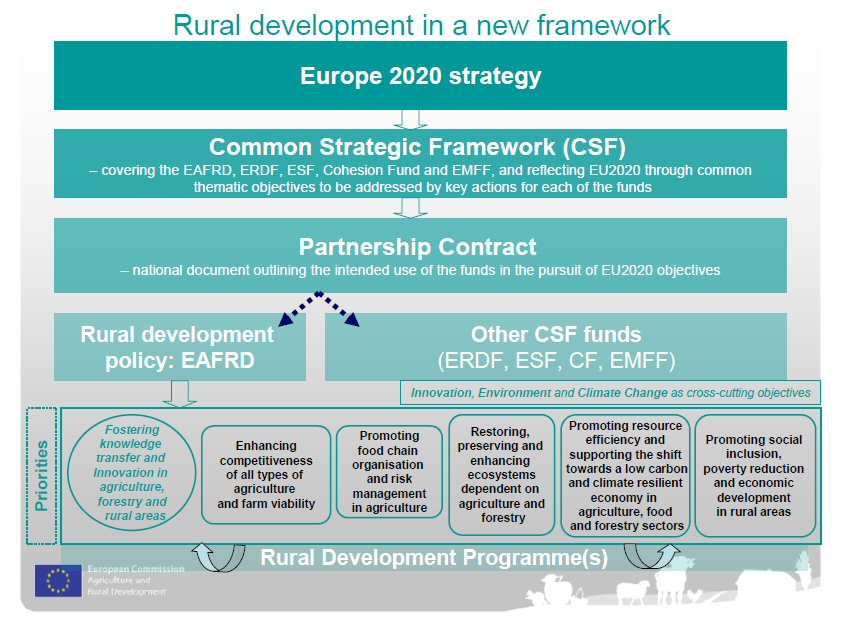
I described how this process is intended to work in an earlier post. In a first step, the Commission has drawn up a Community Strategic Framework (CSF) which is intended to facilitate the sectoral and territorial coordination of union intervention under the CSF funds and with other relevant Union policies and instruments. The CSF Funds include the European Regional Development Fund (ERDF), the European Social Fund (ESF), the Cohesion Fund (CF), the European Agricultural Fund for Rural Development (EAFRD) and the European Maritime and Fisheries Fund (EMFF).… Read the rest

More on Pillar 2 allocations by member state

In a previous post I commented that a noteworthy aspect of the Ciolos CAP reform was that, unlike previous reforms, it explicitly proposed to redistribute CAP resources between the member states and between farmers within member states. In writing this I was thinking primarily of Pillar 1 payments. Pillar 2 allocations between member states have been more variable, although still largely influenced by historical amounts (Zahrnt discusses the evolution of Pillar 2 shares in this European Parliament paper).
Also on this occasion, the Commission proposed (in its MFF budget proposals) that the distribution of Pillar 2 rural development support should be based on objective criteria linked to the policy objectives taking into account the current distribution. However, the final allocation was once again largely determined by political bargaining, with some evidence that countries losing heavily from the proposed Pillar 1 redistribution were partially compensated through extra ‘sweeteners’ received in the Pillar 2 budget (see this post for a discussion of the Pillar 2 outcome).… Read the rest