Every two years the WTO secretariat undertakes a review of the EU’s trade policy including agricultural policy measures which affect trade. The agricultural section of the review builds on the EU’s notifications to the WTO under various agreements, notably the Agreement on Agriculture (particularly the notifications on domestic support, export subsidies and tariff rate quota utilisation) and the notification under the Agreement on Subsidies and Countervailing Measures. The latest EU trade policy review for 2013 was released last week following discussion in the WTO Trade Policy Review Committee.
The Trade Policy Review provides succinct summaries of the relevant EU farm legislation and policy instruments, even if some of its data (for example, on levels of domestic support) are a little outdated because of the time required to submit the relevant notifications.
The report updates information on levels of agricultural tariff protection provided to EU farmers to 2013.… Read the rest
Latest EU AMS notification confirms declining trend in WTO amber box support
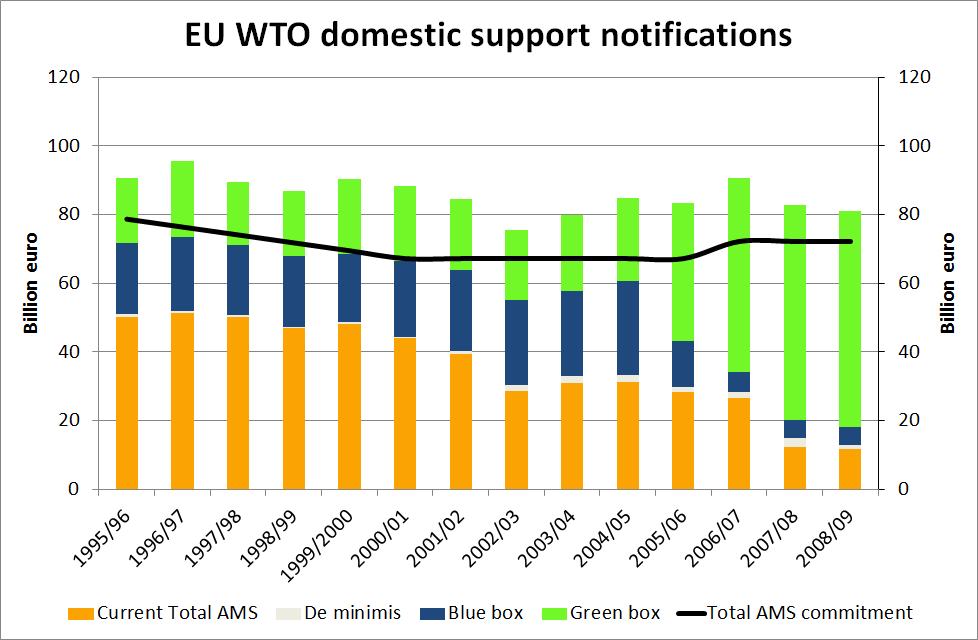
The EU has just submitted its domestic support notification to the WTO for the year 2008/09 (hat tip to LB) and this year there are no surprises. Total support (using the WTO definition) was a shade over €80 billion, but the value of its trade-distorting support (the so-called ‘amber box’, given by its current total Aggregate Measure of Support) fell to its lowest level ever, at just under €12 billion.
In that year, the EU used just over 16% of its Total AMS commitment (its bound ceiling) of €72.2 billion. In other words, the EU could have reduced its AMS commitment by over 80% in that year and would still have fulfilled its WTO amber box obligation.
The AMS includes three main categories of support: direct payments that do not fall under the green or blue boxes as non-exempt direct payments; market price support for products for which an administered price exists; and an equivalent measure of support for those products where the domestic market is supported but where no obvious administered price exists.… Read the rest
The changing landscape of agricultural support
Discussions on reducing agricultural support in the Uruguay Round and, especially, the WTO Doha Round have been framed increasingly in North-South terms. Developing countries have sought reductions in OECD country agricultural support while developed countries have sought increased access to their manufacturing and services markets in exchange.
However, the landscape of agricultural support is changing. While levels of agricultural support and protection have been falling in OECD countries (helped by high world market prices), agricultural support in a number of (but not all) emerging economies has been increasing (despite the increase in world market prices).
These changes in the global distribution of agricultural support have two main consequences. First, the pattern of global agricultural trade is increasingly influenced by agricultural policy interventions in non-OECD countries, even if OECD countries still have a predominant weight in global agricultural production and trade.
For example, world cotton prices which are a concern for the West African C-4 countries in the WTO are now more distorted by subsidies in China and Turkey than by subsidies in the US and the EU.… Read the rest
New Commission study on impacts of Doha Round
The G20 Cannes Summit, despite being side-tracked by the continuing eurozone crisis, did address other issues of importance to the global economy. In the section of its final communiqué on trade, the heads of state reaffirmed their ritualistic commitment to the Doha Round mandate. However, they went on to note that “It is clear that we will not complete the [Doha Development Agenda] if we continue to conduct negotiations as we have in the past.” Instead, they called for “fresh, credible approaches to furthering negotiations, including the issues of concern for Least Developed Countries and, where they can bear fruit, the remaining elements of the DDA mandate” to be pursued in 2012.
However, as the preparations for the forthcoming WTO Ministerial Council on 15-17 December rachet up in Geneva, there is little evidence that the same countries are ready to reach agreement on a common approach to the next steps to rescue the Doha Round.… Read the rest
Russian WTO accession by end year?
An announcement last week by Karel de Gucht, the EU Trade Commissioner, that the EU and Russia had struck a deal on remaining outstanding bilateral issues in negotiating Russia’s accession to WTO membership raises the prospect that this economic giant could become a WTO member by the end of this year.
Russia and the WTO
Russia first made its application in 1993 so has been negotiating its accession now for 18 years, by far the longest of any accession process by a WTO applicant. This reflects in part the country’s economic size (it is the sixth largest economy in the world on a PPP basis). Whereas normally 6-10 countries might seek to open bilateral negotiations with an acceding country because they had special trade interests at stake, in Russia’s case more than 60 countries made such requests.
But also China was a large economy whose WTO accession affected many countries, but despite the greater legacy of a command-and-control economy than in Russia’s case, China has now been a WTO member for a decade.… Read the rest
Doha round agreement would leave EU farm subsidies untouched
According to the EU’s recent notification of farm subsidies to the WTO for the marketing year 2007/08, the EU’s trade distorting farm subsidies fell to a record low of 12.3 billion euros.
As the ICTSD reports,
“For the first time ever, the recent figures would put the EU’s overall trade-distorting support below the proposed new ceiling of 22 billion euros that would be established by a Doha Round accord under the terms currently being considered at the WTO. The Doha deal would create a new subsidy cap that limits the total amount of amber, blue and de minimis support that countries are allowed to provide.”
In other words, on the basis of the notification for 2007/08 (the most up to date that the EU has made), a Doha deal would not require the EU to change any of its farm subsidy policies. This comes as little surprise since the EU wave the magic wand of decoupling and ensured that most of the money it pays farmers is theoretically ‘non trade distorting’ and therefore unaffected by WTO disciplines.*… Read the rest
The development angle
“Waste at home and damage abroad”. That is how one Member of the European Parliament described the common agricultural policy. Gabrielle Zimmer, a German MEP who sits on the parliament’s development committee, was speaking at a conference convened last month by the United Nations Millenium Campaign to look at the impact of Europe’s farm tariffs and subsidies on developing countries.
According to Eckhard Deutscher, Chair of the OECD Development Assistance Committee (DAC) and another participant in the same meeting,
“The biggest challenge the EU’s development aspirations are facing is the lack of policy coherence. The trade, development, agriculture and environmental policies are simply out of sync with regard to developing countries.”
Eveline Herfkens, Founder of the UN Millennium Campaign, pulled no punches,
“An unreformed European agriculture policy will continue to hamper the EU’s and other donors’ efforts to eradicate poverty and will perpetuate human suffering.”
European countries lead the world as donors of development aid, but for decades the EU has pursued agriculture policies which have had the reverse effect – whether it’s trade barriers that make it harder for developing countries to export farm produce to Europe or subsidies that encourage European farmers to overproduce, driving prices down and undercutting unsubsidised farmers in poorer countries.… Read the rest
DG Agri study: Don’t be afraid of liberalization
Farm interests routinely threaten that any reduction in support will provoke a slump in production, endangering EU food security, and threatening massive land abandonment to the detriment of rural life and biodiversity. The findings of the Scenar 2020-II – Update of scenario study on agriculture and the rural world, commissioned by DG Agri, strongly contradict such panicmongering about the looming end of EU agriculture.
The study looks at three scenarios. The reference case assumes a 20% (nominal) CAP budget reduction, reduced intervention stocks, full decoupling, a 30% direct payment reduction, a 105% increase for the second pillar, and a moderate Doha agreement (based on the Falconer paper, including the elimination of export subsidies). The conservative scenario presumes that the Health Check results are largely maintained, direct payments reduced by only 15% and second pillar payments raised by 45%. The liberal scenario is very liberal indeed, with a 55% CAP budget reduction, no intervention stocks, no direct payments, a 100% increase for the second pillar and no tariffs.… Read the rest
CAP support levels reach new high
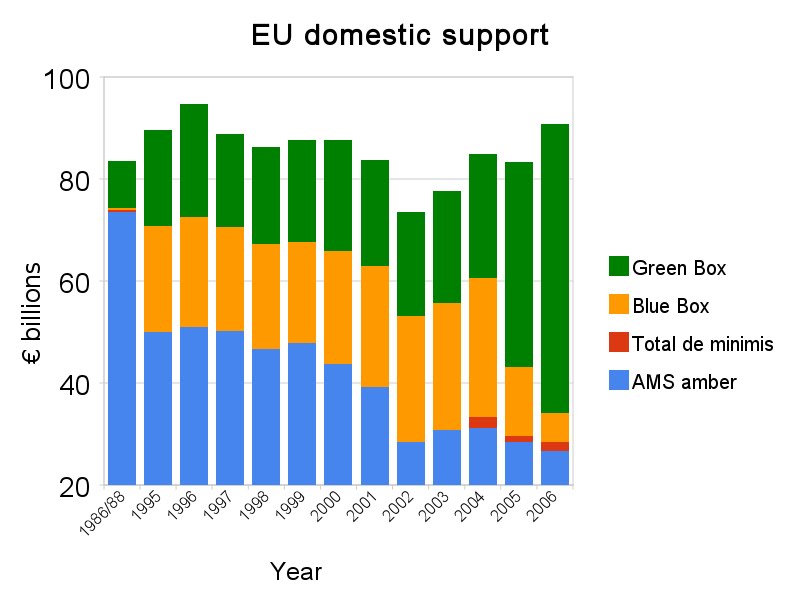
CAP subsidies as reported to the WTO reached a ten-year high of over €90 billion in the 2006/07 marketing year, but conveniently most of them have been parked in the allegedly non trade distorting green box, something that has provoked disquiet in Geneva. The EU notified €90.7 billion of support to the global trade body for 2006/2007 – up from €75.6 billion in 2002, when support was at its lowest in the last fifteen years.
More from ICTSD.… Read the rest
Another day, another declaration
Hot on the heels of the joint declaration by Birdlife International and the European Landowners Association and the declaration of 23 European agricultural economists comes the European Food Declaration (PDF).
The European Food Declaration diagnoses the problems of Europe’s food and farming system in the following way:
– dependence on under-priced fossil fuels
– failure to recognise the limitations of water and land resources
– promotion of unhealthy diets high in calories, fat and salt, and low in fruit, vegetables and
grains
– domination by transnational corporations and the World Trade Organisation (WTO)
The declaration argues that:
“All people should have access to healthy, safe, and nutritious food. The ways in which we grow, distribute, prepare and eat food should celebrate Europe’s cultural diversity, providing sustenance equitably and sustainably.”
The declaration sets out 12 principles, among them Principle 3 makes the curiously contradictory case for healthier eating and less consumption of meat and dairy products “while
respecting the regional cultural dietary habits and traditions”.… Read the rest