Why are we so lousy at measuring farmers’ incomes?
Jean-Christophe Bureau | July 30th, 2010 - 10:16 am

It has been heard and written everywhere for the last 18 months: farm incomes have gone down dramatically. After two years of carpet bombing by the media, with anything from 60 percent price fall in prices to desperate farmers spreading their milk in the fields, the consultation on the future of the CAP organized by Commissioner Ciolos suggest that many, in the civil society, are convinced that EU farmers are starving. As an external reviewer of the synthesis report of this consultation, I saw a large sample of individual contributions. My feeling is that for many people, the current low farm incomes justify subsidies, border protection and paying more attention to mechanisms to support farm prices. In France, the tone of the debates on the national agricultural law is such that for all journalists, and even more Members of Parliament, the current perception is that agriculture is a synonym for “lumpen proletariat”.

The fall in farm income experienced in 2009 was genuine. It resulted from falling output prices, while input prices had remained high. There is no question that the economic situation of many farms has been disastrous. All figures, whatever their sources, do show low incomes even when compared to period before the price peak 2007-2008. However, sugar prices have been high for quite a long time. Oilseed prices have remained steady. Butter prices recovered very rapidly in 2009. After two years of low prices, cereals prices recently reached levels that ensure a high return to most growers, and future markets suggest they will keep rising. Fertilizer prices went down. Still, most of the newspapers, politicians and the public opinion talk about farmers as the category being hit most by the economic crisis.

One explanation is that farmers’ organisations have been efficient at surfing on the agricultural crisis, stressing the low incomes and the need for assistance. It’s hard to blame them for “not missing the opportunity of a good crisis”. By playing the communication card on incomes – in particular to the ears of the European Parliament – they may even end up avoiding large budget cuts, if not complete dismantling of the CAP after 2013, something that was on the radar only 2 years ago. However, given the importance of the issue of farm income in the debates on the future CAP, we should be able to rely on good data. And on this issue, it is surprising to see that data on farm incomes are so poor and questionable.

One example of the crude statistics that have been put forward in the ongoing debate on the CAP is the way the Commission disseminates figures on agricultural income. I am seldom critical of DG Agri, which has an expertise that I find impressive and a political orientation (at least under the last three commissioners) that I find rather “fair and balanced”. However, I have a hard time with the graph below, which comes from a standard DG-Agri presentation (this one was given by Pierre Bascou in Paris but I suspect this is a graph that is part of all DG Agri representatives’ toolkit).

The point by DG Agri here, seems to illustrate that farmers’ incomes are low compared to the rest of the population. Hence the need for keeping agricultural policy instruments. While I can be sympathetic with the idea, I just can’t buy the figures. Indeed Spain is the only EU Member where farmers make more money than the average worker. In the EU-27, agricultural income is roughly 43% of the average income. In Denmark it is 10%. In France, it is 70%, and it is even less in the UK. And these figures are even before the large fall in income in 2009.

First, in all cases, the figures contradict fundamentally the findings of the last extensive study coordinated by Berkeley Hill at the beginning of the 2000s, by the OECD later, that compared the income of agricultural households and the average household, even if one updates this benchmark by national indexes of changes in real income over time. It contradicts the scarce national data on “professional farms” that shows that for these farmers, farm incomes are often comparable to other incomes over the period considered. Second, if farm income is only 10% of the national average, resources should be moving away from farming at a rate that far exceeds the one observed in Denmark: these figures just do not make sense from a macroeconomic point of view.
Clearly, there are several approaches to measure farm incomes. Much depend on:

- how you define a farmer (is 1 hectare or 10 beehives really enough to qualify?);

- how you measure farm labour (something done in a terrible way in the EU by the way with very crude measures such as the Annual Labour Unit, while in the United States statisticians can control for the actual number of hours working off-farm, qualification, age, gender, etc.);

- how you defined income (result of agricultural activity? Including subsidies? Including social transfers? Including rents of land leased out? Agritourism? Work carried out for other farmers? Off-farm income?);

- and which sources you start from, e.g. farm business association data or macroeconomic accounts.

I had been planning to take a deeper look at how DG Agri figures were calculated before posting anything. However, before having time to do so, I came across the recent text by Berkeley Hill, which I find very interesting. His comments are more general, but I find them particularly relevant to the DG Agri figures. He points out that the current approaches to measure farm incomes are not satisfactory, and he wonders why the different projects of measuring the income of the agricultural household have not been pursued further. I fully agree with Hill on his different points. I could also add critiques to the current approaches that he does not mention, for example:

- The EU does not do a good job with the measurement of farm income using macroeconomic accounts for methodological reasons. For example, you can pretty much get the net value added or the sectoral income you want by adopting a convention on the decay of the equipments and buildings (maximum service life, shape of the decay curve over time, e.g. geometric, linear, hyperbolic or “one hoss shay”, and if you are very smart, assumptions on the statistical distribution of the age of the buildings). All of these will affect your figure for depreciation and hence the net value added and income. There are also many possible assumptions on how you remunerate land in property by farmers, and massive assets such as plantations. For example, last time I looked at this (years ago, they may since have changed it) some member states used for the same building a depreciation period that ranged between 12 to 50 years, generating considerable differences in economic depreciation and hence in agricultural income just because of unsubstantiated assumptions. Perhaps not a big issue in time series comparisons, but so much for consistency and comparability across member states.

- Regarding microeconomic sources, the RICA (Farm Accounting Data Network sometimes called FADN) is representative of the all farm sector in some member states but much less in others. Part time farmers are not included. Large farmers refuse to cooperate and are simply not represented in some member states where collection of data is on a voluntary basis. And off-farm income is not included while it is now a major source of income in many EU agricultural households. The measurement of labour is particularly crude, with simplistic assumptions on the work of the spouse and other family labour. This is not a criticism: I am happy that this source exists since we have nothing else, and I often use it. But it hardly allows comparison of farmers’ incomes with the rest of the population.

The issue is complex and there is no simple solution from a methodological point of view. Other countries such as the United States face similar problems in defining what a farm is and what farm income amounts to. For example, USDA figures show that 87 percent of what the USDA defines as farms have less than $10 000 annually in agricultural revenue. No doubt that in the EU, such a figure would be used to show how poor farmers are. But US statisticians have managed to measure the actual income in a much more satisfactory way. And USDA figures indicate that the average household income of these farms that have less than $10 000 in agricultural sales is actually $71 000, once off-farm income and social transfers are taken into account. Something we seem unable to do in the EU, opening the door for journalists to publish dramatically low figures without the necessary precautions.

If the CAP moves towards a farm income support policy, which it did with the progressive decoupling of payments, and if farmers’ organisations stress the need for support on the basis of low incomes, one should be able to collect reliable information on farm incomes. And to see how these incomes compare to those of urban poor or other categories that are also hit by the economic crisis.

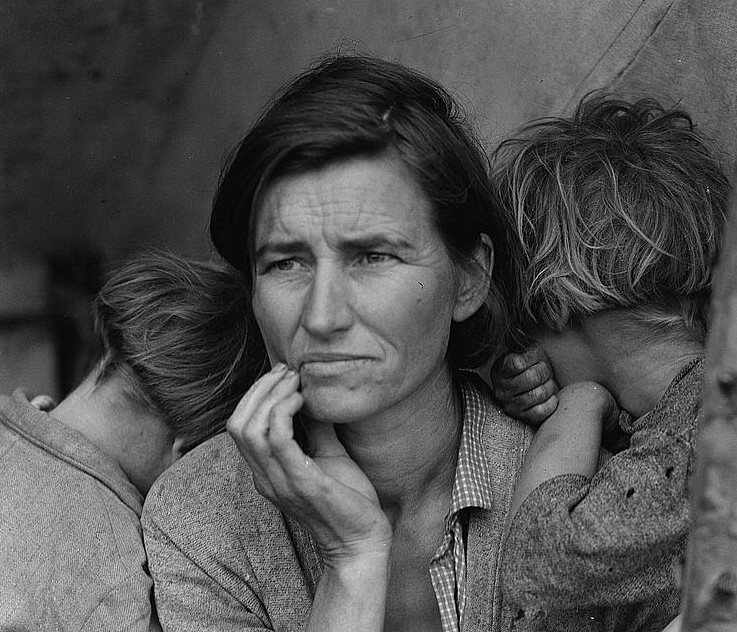
Photograph: Migrant Mother (1936) by Dorothea Lang. Lang’s photograph of a destitute 32-year old migrant farm worker and her children is among the most famous images of rural America during the Great Depression.

Crystal ball gazing: Scenar II study on the effects of CAP reform

Jack Thurston | March 22nd, 2010 - 3:41 pm

A new economic modelling study commissioned by DG Agriculture shows that many of the core claims made for the CAP are highly misleading, or downright wrong. The Scenar 2020 II study shows that if the subsidies, tariffs, intervention prices and quotas of the CAP were abolished and replaced with a free market, European overall agri-food production would be almost unchanged. This finding directly contradicts the argument that the CAP is an essential policy for ensuring that Europe remains a global agricultural powerhouse and ensuring European citizens have access to a reliable supply of affordable food.

The big picture message is that farming is subject to a range of economic, technological and demographic pressures that far outweigh the effects of agriculture policy, athough there are some exceptions. The economic story of farming over the past half century is of productivity increases (due higher yield varieties of crops & different farm management practices), declining employment (due to mechanisation) and a relative loss of income in agriculture compared to other parts of the economy.

The study predicts that the the European agri-food sector will see a 4 per cent increase in production between 2007 and 2020 if the current policy trajectory is maintained (including a cut in direct payments and an increase in rural development spending). Scrapping the CAP would reduce the increase to 3 per cent over the same period.

Looking beyond the aggregate production levels, the study finds that the effect of liberalisation would be to concentrate food production in regions that are best-suited to farming. More marginal areas (e.g. cold, arid, remote and mountainous regions) would be farmed more extensively, and in some places land would be taken out of production altogether. The study predicts full liberalisation would see a 6 per cent fall in land area devoted to farming, with the current policy resulting in a fall of around 1 per cent.

The likely intensification of production in the places best suited to farming shows the need for effective regulatory policies to reduce the harm that has been observed in the past, such as the leaching of chemical fertlisers and manure into rivers and seas, soil eroision, the unsustainable use of water, the destruction of wildlife habitats and the reduction in natural species caused by pesticides and herbicides.

Scenar 2020 II thus shows that the CAP is not a food security policy but a policy which maintains farmland prices at 30 per cent above their rightful level and bolstering agricultural wages by a much smaller amount. The policy also maintains some farming activity in remote and unfavourable areas where it is not economically viable without public support. It is overwhelmingly a redistributional policy – transferring benefits from one section of society to another.

Looking at different farm sectors, the study finds that the EU’s tariffs (and to a much lesser extent direct aid subsidies) ensure European beef, dairy and sugar production at greater levels than they would be in an open market, which would see a much greater share of European consumption met by imports from overseas. The study finds that scrapping the CAP would mean EU beef production would fall from 8 million tonnes in 2005 to 5 million tonnes in 2020. If more or less the current CAP were maintained the fall in beef production over the same period (as a result of macro factors unrelated to policy) would be less than a third of this. The fall in production would be greater in the EU-15 than the NMS, where beef production is much less anyway. The study also singles out dairy and sugar production as the two other sectors most sensitive to changes in the levels of border protection (and to a lesser extent, subsidies).

For dairy, the study shows that under the current CAP, dairy production is on course to increase by around 5 per cent, driven entirely by positive macroeconomic factors such as the growing world economy and changing diets in developing countries. Without the CAP, the increase would be less, just under 2 per cent. In a more open market, a decrease in EU beef production would be partially offset by an increase in pork production.

For cereals, the story is rather different. The study predicts that cereals output will increase with or without the CAP, and the effect of the CAP on cereals production is rather small. It also suggests that the area under cereals cultivation will fall slightly, suggesting that production gains are the result of intensification and better yields rather than putting more land to the plough.

The study shows that without the CAP, food prices paid by European shoppers would fall on account of increased imports from overseas and the competitive pressure on EU producers. If shoppers would gain from scrapping the CAP, the study offers some reveailing insights on who would stand to lose.

It finds that without the CAP, European land prices would fall by nearly 30 per cent. As Valentin Zarhnt argues in his post on the same report,

“This is nothing the public need worry about – but it explains the heavy lobbying of landowners for the preservation of a ‘strong’ CAP.”

As the chart below shows, the study predicts that scrapping the CAP would hit agricultural wages, though the impact would be less than the impact already mentioned on land prices.

For years farm incomes have been falling behind wages in the rest of the economy, and according to the study, without the CAP agricultural wages would fall further behind.

The study finds that many will see no alternative to accepting lower wages as it is difficult to find jobs outside agriculture. This speaks to the need for more imaginative policy interventions to offer alternatives to regions that are especially dependent on declining agricultural economies.

The study was carreid out by ECNC-European Centre for Nature Conservation, Landbouw-Economisch Instituut (LEI) and Leibniz-Zentrum für Agrarlandschaftsforschung e.V. (ZALF). It will provide interesting reading for DG Agriculture’s in-house sage Tassos Haniotis (artists impression, right, with turban and fake beard). Read the study in full, it’s well worth it:

Scenar 2020 II.

Roger Waite the new voice of DG Agri

Jack Thurston | January 15th, 2010 - 5:27 pm

Roger Waite, editor of Agra Facts and frequent podcast guest on this blog, has accepted the job of spokesperson for Agriculture Commissioner-designate Dacian Ciolos. It’s sometimes said that you can count the number of people who truly understand the Common Agricultural Policy on the fingers of one hand. Roger is certainly among that select few. He’s been reporting on agriculture policy in Brussels for the past 17 years and certainly knows his way around. He speaks fluent French (and German?) and has been said to possess a ’silver tongue’. He steps into the larger-than-average shoes of Michael Mann, another poacher-turned-gamekeeper who gave up his job as the Financial Times Brussels correspondent to speak for Ciolos’s predecessor Mariann Fischer Boel.

Unlike some longstanding members of the Brussels press pack, Roger could never be accused of being a ‘cynical old hack’. As well as being knowledgable about the CAP, he’s excellent company, good humoured and approachable. He’s a true European and genuinely believes in the possibilities of a common agricultural policy that is better aligned to meet the challenges of the 21st century and that operates in an accountable and transparent way. He understands the political pressures that come to bear on CAP decision-makers and I am certain he’ll be a valuable asset to the Commissioner in the years ahead. I wish Roger well in his new job and look forward to continuing our good working relationship, albeit in an altogether new modus operandi.

According to EuroPolitics, Commissioner-designate Ciolos has also named to his cabinet Yves Madre, agriculture adviser at the French Permanent Representation to the EU. Austrian Georg Häusler will be his head of cabinet and Romanian national Sorin Moisa deputy head of cabinet.