
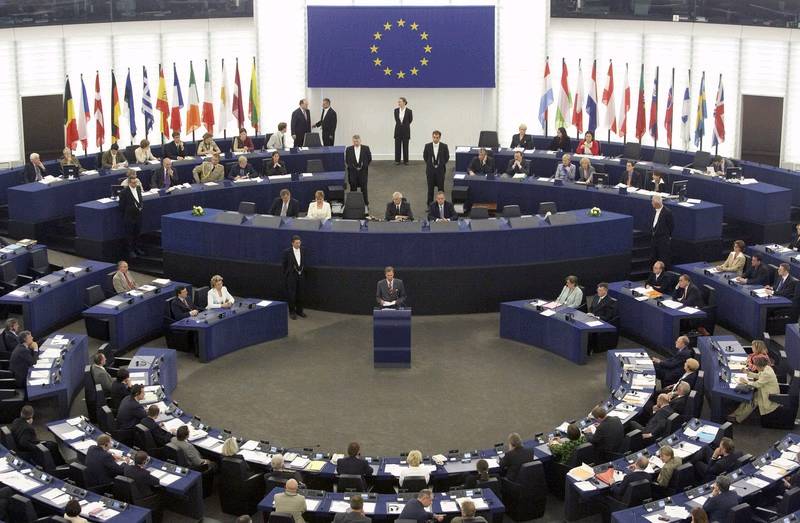
How MEPs voted on CAP reform

The website VoteWatch Europe monitors the voting of MEPs on each resolution and piece of legislation. It published the following commentary on the CAP reform voting earlier this month (thanks to Xavier Pavard @xpavard on Twitter for drawing attention to this source) which I reproduce here.
(Note: Right click on the images below and select Show picture to get clearer view of the graphics)

Centre-right wins battle over CAP reform; net contributor country MEPs outvoted

MEPs voted on a package of four legislative proposals that make up the reform of the Common Agricultural Policy (CAP). The subject was hotly debated, as CAP currently accounts for close to 40% of the EU budget. CAP is to be reformed with effect from 1 January 2014. To ensure better targeting of aid, the proposal gives Member States the responsibility for defining what constitutes an “active farmer”.
Other provisions are that no Member State’s farmers should receive less than 65% of the EU average, that young farmers should get a 25% top-up payment for a maximum of 100 ha and that direct payments to any one farm should be capped at €300,000.
Read the rest

Evolution of the direct payments regulation

In January I prepared a spreadsheet setting out the amendments to the Commission’s proposed direct payments regulation which took account of the COMAGRI rapporteur’s amendments May 2012, the Council’s position as summarised in the Cyprus Presidency document December 2012 and the COMAGRI compromise amendments Jan 2013.
Some readers found this useful so I have now updated the spreadsheet to take account of the COMAGRI proposal for a negotiating mandate in February 2013 (that is, after COMAGRI voted on the compromise and other amendments), the mandate following the European Parliament plenary vote in March 2013, and the successive versions of the regulation prepared by the Irish Presidency for the March 2013 Agricultural Council meeting. The updated spreadsheet can be downloaded here (use the download arrow in the top left corner when the Google Drive document opens to download the spreadsheet to your computer).
The Irish Presidency prepared three versions of Council’s general approach on the direct payments regulation.… Read the rest

Are we really moving forward?

The debate on the future of the CAP has recently moved on with two important steps – the European Parliament plenary vote and the European Council agreement. Just to take up the story, the European Parliament Plenary voted in Strasbourg on 13 March on the over 330 amendments COMAGRI made this year to the European Commission’s official communication on the CP reform in October 2011. This was the first time in history when the Parliament could use her co-decision powers, affecting European Council decisions. This all happened, of course, after the deal reached on long-term budget on February 8, the consequences of which are well summarised in the interview with Paolo de Castro, Chair of COMAGRI at the European Parliament (see the video made by Vi(eu)ws here).
The Plenary vote mainly favoured the Commission’s original ideas against the various amendments. Consequently, Dacian Ciolos, the European commissioner for agriculture, welcomed this fact and said that it was an important step in the CAP reform process (see full reaction here).… Read the rest

Implications of the new redistributive payment

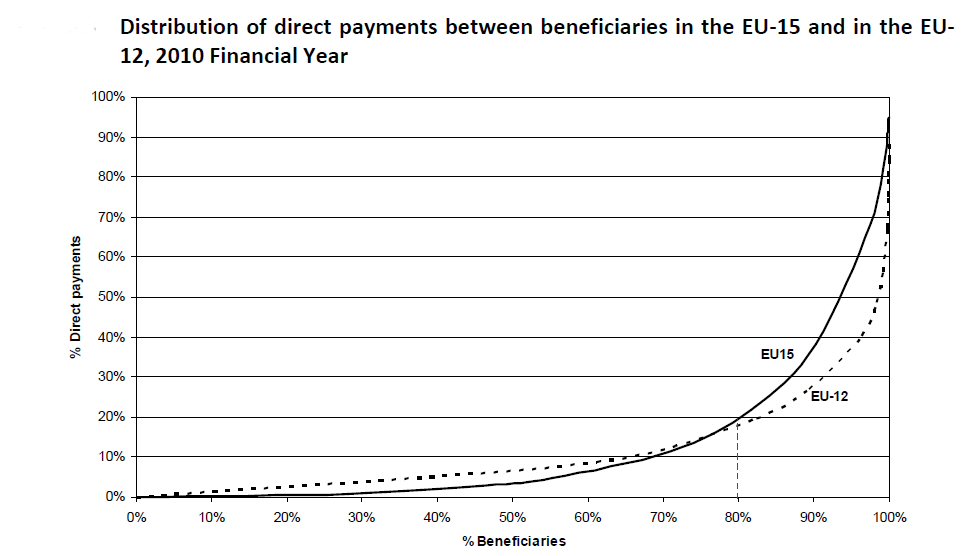
Ever since direct payments were introduced into the CAP, their unequal distribution has attracted unfavourable attention. The Commission’s 1991 paper The Development and Future of the CAP criticised the distribution of price support, noting that “80% of the support provided by FEOGA is devoted to 20% of farms which account also for the greater part of the land used in agriculture”. Yet the proportions remain exactly the same in both the EU-15 and EU-12 today, according to the Commission’s latest figures for the claim year 2009 (financial year 2010) (see diagram).

Even for those who argue that the specific nature of farming justifies a permanent system of direct payments support, the unequal distribution of support is hard to justify. The Commission has regularly made proposals to reduce payments to larger farms through either progressive modulation and/or capping. But these proposals equally regularly were either watered down or rejected by the member states.… Read the rest

The biodiversity consequences of killing Ecological Focus Areas

After the December 2012 Council proposed amendments, the vote of the agricultural committee of the European Parliament (COMAGRI) on January 24 2013 de facto kills any hope of deriving serious biodiversity benefit from the CAP reform. The COMAGRI amendments are particularly fatal to the Ecological Focus Area (EFA) measure, which is now nearly ‘as dead as a dodo’. The fact that the COMAGRI amendments largely restate the Agricultural Council’s draft position on the EFA leaves little hope for future debates between the Parliament and the Council. The conclusions of the European Council on February 8, 2013 can be seen as the burial of the EFA.
Many economists and think tanks doubted that the combination of Pillar 1 payments and green requirements was the most cost-efficient way to promote biodiversity and were not enthusiastic about the EFA idea. It is now time for them to realize that while Pillar 2 payments will be cut, Pillar 1 payments will be maintained but without any serious biodiversity requirement.… Read the rest