A provisional agreement has now been reached on the 2015 EU budget between the Council and Parliament following their inability to reach an agreement on the Commission’s first draft budget proposal in November (read here the reactions to the deal of the Commission, of the Council and of the Parliament). In terms of the headline figures for overall EU spending, the agreement is closer to the Council’s position, particularly in terms of payment appropriations, an outcome which was predicted as a consequence of the Lisbon Treaty changes in a series of papers by Giacomo Benedetto of the University of London.
The Parliament’s main demand was not so much adjustments to the 2015 figures but rather addressing the increasing backlog of unpaid bills (the result of a rising gap between commitment and payment appropriations in recent budgets). The amount of unpaid bills rose from €5 billion in 2010 to €23.4 billion at the start of 2014 and without an increase in 2014 payment appropriations would have risen further in 2015.… Read the rest
Rural development programming 2014-2020
Rural development programming for the MFF period 2014-2020 seems to be a disaster zone, and it would be interesting to hear comments from those more directly involved in the process as to the reasons and implications of the huge delays which have built up.
At a recent Rural Development DG AGRI Civil Dialogue Group meeting, the Commission presented an update on the programming of the new Rural Development Programmes (RDPs) from which the table below is taken. It expects only 10 RDPs out of a total of 118 to be approved by the end of this year. Nearly all of the 118 RDPs have been submitted (2 are still outstanding), and the Commission has returned its observations on 75 of these (see table below).
So a huge workload remains. The DG AGRI estimate is that just another 15 or so RDPs will be approved by the end of March, with the remaining 93 having to wait until ‘after MFF review’.… Read the rest
The Reform of the CAP: One Year After
Almost exactly a year ago the legislative bodies of the European Union accepted 4 new key Regulations that will determine the next period’s CAP. The Commission presented this reform, utilizing the label ‘Greening’, as a shift of paradigm and an introduction of certain other important changes in both the goals and the instruments of European agricultural policy. The essence of the new reform was to find a new justification for and mechanisms of agricultural policy. The reform, which took place in times of economic crisis, was accepted after the Lisbon treaty; as such it was characterized by a new form of legislation which equalized the roles of the European Parliament and Council as key legislators. A year has passed and it is time to try to assess our achievements from a distance, taking into account the future of the CAP.
CAP reform – The new and the old
It is my assessment that with the latest CAP reform there has been much change at the level of policy objectives, but less in the field of CAP instruments.… Read the rest
The Doha Round is back on track
On Thursday 27 November 2014 last, the WTO General Council approved three decisions related to public stockholding for food security purposes, the Trade Facilitation Agreement and the post-Bali work programme. With these agreements the hiatus in the WTO’s post-Bali work caused by India’s position on the 2013 Bali Ministerial Council decisions has been unblocked. India had demanded a commitment to faster progress on finding a permanent solution to the treatment of official procurement prices for food security stocks under domestic support disciplines, as well as the copper-fastening of the terms of the interim peace clause, in return for its willingness to approve the Protocol of Amendment to allow the Trade Facilitation Agreement to come into effect.
The drama leading up to these decisions and their significance is well described in this Bridges article. Addressing the General Council , the WTO Director-General Robert Azevêdo said:
… Read the restBy agreeing these three decisions we have put ourselves back in the game.
FADN data highlights dependence of EU farms on subsidy payments
Last week, the DG AGRI Farm Accountancy Data Network, FADN, made available aggregated data in its public database for the 2012 accounting year. In addition, there is now a Farm Economy Focus, or country fact sheet, based on the 2012 data for each member state which presents key FADN results in a graphical form for a general audience.
The FADN database is a key tool both for policy-makers and researchers seeking to understand the behaviour of farmers and the agricultural economy. The survey does not cover the smallest farms, but it is representative for over 4.9 million holdings across the Union. It contains a wealth of information on the economics of farm businesses, and the FADN team makes it easy to access this information through a very friendly user interface to their public database.
While the FADN tool is a terrific resource, some of the data it contains tell a less-than-encouraging story about the economic condition of EU farming.… Read the rest
EU sugar beet prices to fall by 22-23% when quotas eliminated
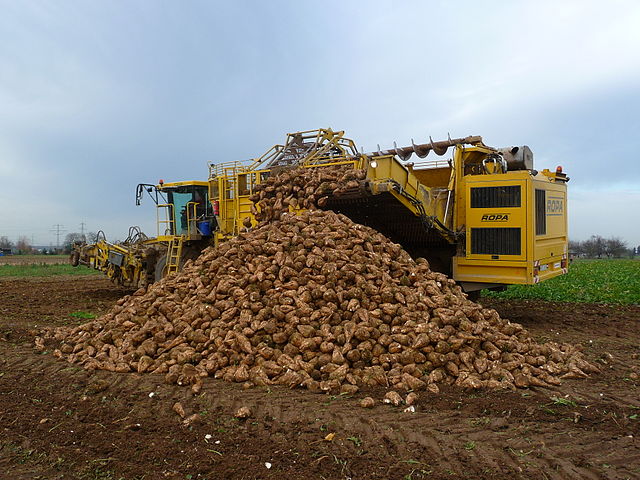
After much lobbying the Council and Parliament finally agreed that sugar quotas (including quotas on isoglucose) would be extended until the end of the 2016/17 season but would be abolished with effect from October 2017. In January this year, the EU’s Joint Research Centre (JRC) Institute for Prospective Technological Studies published its assessment of what might happen to the EU sugar market as a result of the abolition of sugar quotas. It is worth examining this report in some detail both for its substantive conclusions but also for some insight into the factors likely to affect the EU sugar market balance in the years after 2017.
The JRC study was completed at end-2012. It compares two alternative scenarios in the year 2020 – one scenario assuming that sugar quotas continued (the reference scenario) and one scenario in which sugar quotas are assumed eliminated in 2015. In the latter scenario, three alternatives are simulated with different assumptions regarding the share of isoglucose in the EU sweetener market.… Read the rest
An agricultural perspective on the European Council 2030 climate and energy framework conclusions
The European Council agreed on a set of climate and energy targets for 2030 (the 40/27/27 package) at its meeting last month. The agricultural sector has a particular interest in these conclusions given that it is affected by climate change targets in three different ways:
Farmers may have to pay for Russian crisis aid
One of the successes of outgoing Agriculture Commissioner Dacian Ciolos in the 2013 CAP reform was to maintain the size of the CAP budget in the 2014-2020 multi-annual financial framework (MFF), at least in nominal terms (and even in real terms in the Commission’s original proposal). This was no mean achievement given the extent of the financial crisis in Europe, the pressures on public spending and the competing demands for spending at EU level.
His success was due to persuading his fellow Commissioners that a larger share of the CAP budget would be devoted to paying for public goods, particularly environment and climate actions. However, in the subsequent negotiations on the details of the CAP reform, these commitments were greatly weakened, much to the frustration of the other Commissioners. It now appears that the other Commissioners have had enough and are fighting back, using the first amending letter to the 2015 EU budget as their instrument.… Read the rest
Agriculture in the 2030 Climate and Energy Package
The European Council comprising the EU Heads of State and Government will meet at the end of this week 23-24 October to take a final decision, among other issues, on the EU’s new climate and energy policy framework. The plan is to agree on the target level of GHG emission reductions for 2030 so that the EU can submit its contribution for the conclusion of a global climate agreement in Paris at the end of next year at the latest by the first quarter of 2015, in line with the timeline agreed by the UNFCCC. However, according to the EUObserver, there are still significant differences of view on the targets between member states, and deadlock at the meeting is not ruled out.
The state of play
The Commission Communication presenting the climate and energy framework was published in January this year and contained the following elements:
- – a greenhouse gas emissions reduction target of 40% below 1990 levels, to be achieved only through domestic measures (without the use of international credits);
- – this overall target to be met through a reduction of 43% in emissions from the ETS sector and a reduction of 30% in emission from the non-ETS sector, both compared to 2005.
What is the growth potential of EU agriculture?
Commissioner-designate Phil Hogan committed himself to a growth, jobs and investment agenda for agriculture in his confirmation hearing with the EP’s COMAGRI. Given the stuttering EU recovery and continued high unemployment in EU countries, this is an understandable objective. But can EU agriculture rise to the challenge? Not on its past record, at least without substantially changing the policy paradigm.
It is rarely recognised just how disappointing the growth performance of EU agriculture has been over the past two decades. As shown in the figure below, the average growth rate over the period 1990-2011 for the EU-28 has been a mere 0.2% per annum. That is, over the 21-year period, the volume of agricultural output in the countries that make up the EU today grew by just 4.5%.

These data are calculated using FAOSTAT data; the data from Eurostat tell a somewhat more optimistic story with a growth rate (for the EU-15) of 0.8% p.a.… Read the rest