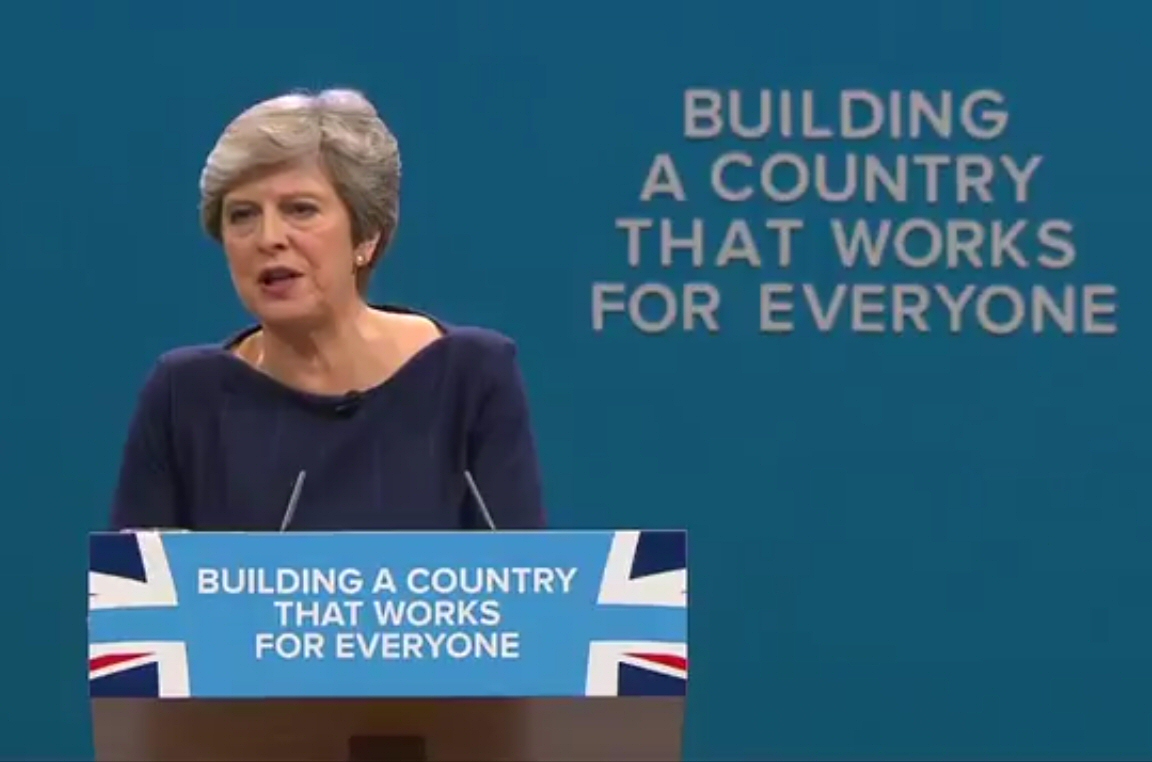
Given that Mrs Theresa May seems certain to be returned as UK Prime Minister with a greatly increased majority after the UK General Election on 8 June next, it is worth paying particular attention to what the Conservative Party manifesto which was launched yesterday has to say on Brexit issues in general and trade, immigration and agricultural issues in particular.
The manifesto actually has little new to say on these topics, with the exception of a new promise to extend agricultural support at current levels to the end of the next parliament, i.e. 2022 compared to the current commitment to maintain support at current levels to 2020. Given that EU agricultural spending may well be reduced in the next Multiannual Financial Framework period, we could end up with the paradoxical outcome that farmers in the UK, supposedly the greatest critic of the CAP, will receive higher payments following Brexit than if the UK were to remain a member of the EU, at least for a period (though of course direct payments are only one factor in farm incomes, and changes in trade access, tariff protection and exchange rates would also need to be factored in).… Read the rest
Does capping direct payments make sense?
CAP Pillar 1 direct payments were originally introduced to compensate farmers for the reduction in intervention support prices following the MacSharry reforms in 1994. This was an important and necessary step to help farmers adjust to a new economic situation. However, assistance for adjustment should only be temporary. As the years have passed, the argument that direct payments are intended as compensation payments has become less and less credible. As result, a number of alternative rationales for the continuation of Pillar 1 direct payments have been proposed.
These payments are variously justified as addressing low farm incomes, as a necessary support for EU food security, as providing a safety net for farmers against unexpected market shocks, as compensating for higher regulatory standards and as ensuring more sustainable management of natural resources. These are all important policy objectives, but there is little evidence that decoupled area-based payments are an effective, efficient or equitable way of achieving these objectives (these arguments are spelled out more fully in my recent paper for the RISE Foundation).… Read the rest
Promoting rural jobs through the CAP
In a previous post, I discussed trends in agricultural employment and the impact of CAP policies on these trends. I noted how policy-makers are asking whether EU agricultural policy could do more, or be more effective, in contributing to job creation. Last year the European Parliament passed a resolution on how the CAP could improve job creation in rural areas. The issue will also be raised in the Commission’s Communication on modernising and simplifying the CAP which is expected towards the end of this year.
In this post, I discuss the role that the CAP could play in promoting jobs. I confine myself to the question of job creation in agriculture and its related value chains as part of the rural economy. Some, though not all, rural areas face challenges in terms of low incomes, negative population growth, a lack of jobs and a high rate of unemployment. There are important synergies between the agricultural and rural economies; agriculture and its value chains remain an important contributor to rural employment in many rural regions, while a vibrant rural economy offers opportunities for off-farm employment which can help to sustain agricultural employment.… Read the rest
CAP – out of the box thinking
Last Monday saw the launch of a report “CAP – thinking out of the box” by the Rural Investment Support for Europe (RISE) Foundation. The report director was Allan Buckwell and the other contributors to the report are Erik Mathjis, David Baldock and myself. The report is a response to the public consultation on the modernisation and simplification of the CAP launched by Commissioner Phil Hogan in February.
Below, I reproduce a short summary of the key messages of the report.
… Read the restFurther adaptation of the CAP is necessary to help EU farming become a well-structured industry which is economically viable and environmentally sustainable. The next 15 years will see a generational turnover amongst farmers as millions of farmers already over 60 retire. The new generation have before them the exciting challenge of embracing the wealth of new technology based on precision, digitisation, big data and even robotics which when applied to plant and animal genetics and nutrition can raise their productivity, and thus incomes, and equip them to combine Europe’s high quality food production with high and rising environmental performance as they steward our natural resources.
Does the Basic Payment make farmers lazy?
The provocative title of this post was prompted by a tweet in my Twitter timeline (@xAlan_Matthews) which told how a farm speaker at a meeting the tweeter had attended had said he/she was frustrated by how many farmers do not manage their farms as businesses and that the Basic Payment makes some lazy.
I do not want to make moral judgements about anyone’s conduct but it is, indeed, an interesting question to ask how the CAP support system affects farmers’ individual behaviour. It is, of course, well known that farmers’ decision-making is often motivated by reasons other than rational profit-maximising behaviour. Society often benefits from the multiple goals of farm decision-makers, as when farmers are prepared to undertake environmental stewardship even where it might not be the most economically efficient thing to do.
Translating the value-laden terms ‘lazy’ and ‘hard-working’ into more neutral language, the question might be rephrased in terms of ‘technical efficiency’.… Read the rest
The CAP and agricultural employment
Phil Hogan, the EU Commissioner for Agriculture and Rural Development, has promised a Communication on modernising and simplifying the CAP before the end of 2017. One of the six broad objectives for the CAP set out in the Commission’s inception impact assessment is to “encourage a vibrant rural economy by fostering growth and jobs in rural areas and encouraging generational renewal”.
This builds on one of the three objectives for Pillar 2 rural development spending in the 2014-2020 period which is “achieving a balanced territorial development of rural economies and communities including the creation and maintenance of employment” (Art. 4, Regulation (EU) No 1305/2013).
It also follows on Commission President Juncker’s mission letter to the incoming Commissioner in October 2014 which highlighted the importance of the Commission’s jobs, growth and investment agenda. Hogan was asked to ensure “that rural development spending is well integrated into jobs- and growth-generating investment strategies at national and regional level”, to implement the recently agreed CAP reform “so as to maximise its contribution to our jobs and growth agenda”, and to contribute to the 2016 review of the Multiannual Financial Framework “by identifying ways of further increasing the focus of the CAP on jobs, growth, investment and competitiveness”.… Read the rest
The viability of EU farms
Economic sustainability is usually taken to be one of the three legs of the sustainability concept (the others being environmental and social sustainability – hence the phrase ‘people, planet, profit’). But what do we know about the economic sustainability of EU farming and how to measure it? A recent paper by researchers (Cathal O’Donoghue, Simon Devisme, Mary Ryan, Ricky Conneely, Patrick Gillespie and Hans Vrolijk) participating in the FLINT project have now used a pilot dataset collected at farm level in 8 Member States to focus attention on this issue.
The FLINT (Farm Level Indicators for New Topics) research project investigates the feasibility of providing policy-makers and the agro-food industry with farm-level indicators on sustainability and other relevant new issues. The project established a pilot network of around 1100 farms already participating in the FADN network in nine Member States to investigate the feasibility of collecting these indicators. Having demonstrated the feasibility of collecting a set of relevant indicators on these pilot farms, the project is recommending that the FADN sample should be reduced from 85.000 to 75.000 farms to have capacity for sustainability data on 15.000 farms.… Read the rest
AGRIFISH Council meeting underlines pressures to reverse CAP reform
Agricultural Ministers had a round table discussion on the future of the CAP at yesterday’s AGRIFISH Council meeting in Brussels. This was based on an orientation paper prepared by the Maltese Presidency.
The orientation paper identified six CAP priorities. These included the three previously identified by the Commissioner – building resilience, responding to environmental challenges, and generational renewal – and three others – investing in rural viability and vitality, maintaining a market orientation and strengthening farmers’ position in the food chain. Ministers were invited to answer the following questions:
In your view, what would be most effective way to address the CAP priorities?
Without prejudice to the overall financing of the CAP, do you think that a rebalancing exercise should take place between the first and the second pillar of the CAP in order to deliver on these priorities?
The round table was held in closed session, and little information was provided at the subsequent press conference on the range of views expressed by individual Ministers.… Read the rest
COMAGRI rapporteur’s draft amendments to Omnibus Regulation
The COMAGRI rapporteur on the agricultural articles of the Omnibus Regulation Paolo de Castro (the other proposed co-rapporteur Albert Dess having at least temporarily dropped out of sight) has now circulated his Draft Opinion containing proposed amendments to the Committee to be debated later this month. The Omnibus Regulation (which is actually a proposal for a Regulation on the financial rules applicable to the general budget of the Union but as well amends a number of sectoral regulations) is the first opportunity to make changes to the CAP basic acts since the 2013 CAP reform was concluded.
In this previous post, I reported on the contributions made during the first debate on the Omnibus Regulation in COMAGRI in December last year. Here, the tone from the principal political group spokespersons was sober and measured, with speakers emphasising that the Committee should adopt a narrow interpretation of its powers to amend the proposal, keeping in mind that its purpose is to deliver simplification of the CAP both for managing authorities and for farmers.… Read the rest
What can we expect following the CAP public consultation?
DG AGRI launched its 12-week public consultation on modernising and simplifying the CAP on 2 February last. The publication of the on-line consultation was accompanied by an inception impact assessment to support the preparation of a Commission Communication on modernising and simplifying the CAP which is expected late this year, possibly in November.
According to the Q&A memorandum prepared by DG AGRI which accompanied these documents, the stakeholder consultation is expected to provide opinion-based information. “It is an opportunity to take into account societal demands in the policy discussions on the future of the CAP and adapt it to better integrate the new political priorities in an inclusive and comprehensive manner.” The impact assessment, on the other hand, proceeds on an evidence basis. “It identifies challenges, outlines objectives, and draws up policy options to achieve them. Impacts of these policy options are then assessed, considering economic, social and environmental dimensions.… Read the rest