One of the successes of outgoing Agriculture Commissioner Dacian Ciolos in the 2013 CAP reform was to maintain the size of the CAP budget in the 2014-2020 multi-annual financial framework (MFF), at least in nominal terms (and even in real terms in the Commission’s original proposal). This was no mean achievement given the extent of the financial crisis in Europe, the pressures on public spending and the competing demands for spending at EU level.
His success was due to persuading his fellow Commissioners that a larger share of the CAP budget would be devoted to paying for public goods, particularly environment and climate actions. However, in the subsequent negotiations on the details of the CAP reform, these commitments were greatly weakened, much to the frustration of the other Commissioners. It now appears that the other Commissioners have had enough and are fighting back, using the first amending letter to the 2015 EU budget as their instrument.… Read the rest
Agriculture in the 2030 Climate and Energy Package
The European Council comprising the EU Heads of State and Government will meet at the end of this week 23-24 October to take a final decision, among other issues, on the EU’s new climate and energy policy framework. The plan is to agree on the target level of GHG emission reductions for 2030 so that the EU can submit its contribution for the conclusion of a global climate agreement in Paris at the end of next year at the latest by the first quarter of 2015, in line with the timeline agreed by the UNFCCC. However, according to the EUObserver, there are still significant differences of view on the targets between member states, and deadlock at the meeting is not ruled out.
The state of play
The Commission Communication presenting the climate and energy framework was published in January this year and contained the following elements:
- – a greenhouse gas emissions reduction target of 40% below 1990 levels, to be achieved only through domestic measures (without the use of international credits);
- – this overall target to be met through a reduction of 43% in emissions from the ETS sector and a reduction of 30% in emission from the non-ETS sector, both compared to 2005.
What is the growth potential of EU agriculture?
Commissioner-designate Phil Hogan committed himself to a growth, jobs and investment agenda for agriculture in his confirmation hearing with the EP’s COMAGRI. Given the stuttering EU recovery and continued high unemployment in EU countries, this is an understandable objective. But can EU agriculture rise to the challenge? Not on its past record, at least without substantially changing the policy paradigm.
It is rarely recognised just how disappointing the growth performance of EU agriculture has been over the past two decades. As shown in the figure below, the average growth rate over the period 1990-2011 for the EU-28 has been a mere 0.2% per annum. That is, over the 21-year period, the volume of agricultural output in the countries that make up the EU today grew by just 4.5%.

These data are calculated using FAOSTAT data; the data from Eurostat tell a somewhat more optimistic story with a growth rate (for the EU-15) of 0.8% p.a.… Read the rest
Phil Hogan confirmed as Commissioner
Agriculture and Rural Development Commissioner-designate Phil Hogan was strongly confirmed following his hearing before the European Parliament COMAGRI yesterday by 32 votes to 10 on the question whether he is qualified to be a Commissioners, and by 31 votes to 11 on whether he is qualified to take responsibility for his portfolio.
There were no surprises in either Phil Hogan’s opening statement or in his answers to questions (the DG AGRI website has a copy of his opening statement and a video link to the hearing). I see no reason to revise my previous assessment of the priorities for agricultural policy under Hogan’s mandate.
… Read the restThere appears to be little appetite for further substantial steps towards a more targeted CAP focused on the delivery of public goods. On the contrary, the specific mandate given to Hogan by the Commission President is to increase the focus of the CAP on “jobs, growth, investment and competitiveness”.
Trends in EU agricultural self-sufficiency
Worries and concerns about food security, real or imagined, have figured prominently in the debate on EU agricultural policy since the Commission launched its consultation document on the recent CAP reform in 2010, stimulated by the price spike on global food markets in the years 2007-08. This week, at the informal Farm Council in Milan on Tuesday 30 September under the Italian Presidency, agricultural ministers will discuss how EU agriculture can contribute to the food security challenge.
One of the issues that constantly pops up in this debate is the importance of food self-sufficiency as a guarantor of food security. Food self-sufficiency is defined as the proportion of domestic consumption met from domestic production. In my view, identifying food security with food self-sufficiency is misleading and, indeed, potentially dangerous if it diverts attention away from more real threats to food security, but that argument is for another day. Nonetheless, to debate this issue requires, at least, good information on the underlying figures and trends.… Read the rest
Prospects for the next CAP reform
The newly-elected MEPS are now finding their feet in Brussels and committee memberships have been assigned. Commission President Juncker has allocated portfolios to the Commissioners nominated by member states, and the European Parliament has scheduled its confirmation hearings beginning next Monday 29 September. The hearing for the Commissioner-designate for Agriculture and Rural Development, Phil Hogan, is scheduled for Thursday 2 October.
What will the new Commissioner and the new Parliament mean for future CAP reform? With the implementation of the Ciolos CAP reform not even begun, it might seem presumptuous to turn to thinking about the timetable and prospects for the next CAP reform. Nonetheless, in this post, I discuss the likely timeline and speculate on the possible outcome.
A possible reform timetable?
A number of possible trigger points are already set. The most important of these is the renegotiation of the EU’s Multi-annual Financial Framework (MFF) for the period after 2020 (the duration of this remains to be decided but must be of at least five years).… Read the rest
Russian food sanctions against the EU
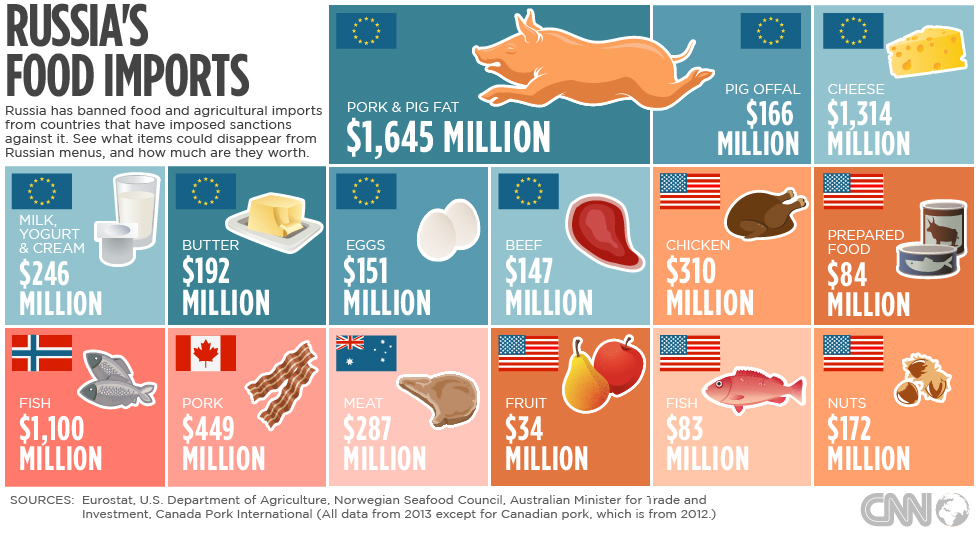
The Russian ban on the import of certain food products from the EU (and some other countries) has led to a chorus of appeals from member states and from farm groups for aid and compensation. The Russian ban has created an immediate problem in the fruit and vegetables sector, where the summer harvest for fruits is in full swing, there is a high dependence on the Russian market, and the produce is perishable with few immediate alternative outlets. But the overall scale of the problem needs to be kept in perspective. In this post, I present the data on the countries and products affected.
To date, the response of the Commissioner and the Commission has been measured and appropriate. In his first statement on the day after the ban came into force, the Agriculture Commissioner acknowledged the concerns of farmers, requested a potential impact analysis from his officials, and called a management committee meeting which took place yesterday.… Read the rest
WTO failure on trade facilitation agreement puts question mark over Doha timeline
On Thursday this week, the WTO Director-General Robert Azevêdo admitted to failure in concluding the negotiations to adopt the Protocol of Amendment on the Trade Facilitation Agreement (TFA) by 31 July as had been agreed by Ministers at the WTO Ministerial Conference in Bali last December. The Protocol of Amendment was intended to start the process to formally insert the trade facilitation deal into the overall WTO Agreement.
The TFA was part of a carefully-balanced package at Bali designed to get substantive negotiations on the Doha Round again underway. In addition to a series of decisions and declarations on trade facilitation, agriculture, cotton, development and least developed country (LDC) issues, the Ministerial Conference had set a deadline of the end of 2014 for the Trade Negotiations Committee to develop a clearly-defined work programme on the remaining Doha Round issues. Work in Geneva had begun to focus on developing this work programme, but as Director-General Azevêdo admitted to the meeting of the WTO General Council on 25 July last, the talks were still at an early stage.… Read the rest
The draft 2015 CAP budget
The annual budget is an important statement of any organisation’s strategic priorities. The EU budget is no exception, but its sheer size and complexity makes it difficult for the interested lay person to interpret and to understand.
The Commission proposed a draft budget (DB) for 2015 in June, and the figures are now under negotiation between the two legislative institutions. Since the Lisbon Treaty, the annual budget is agreed by co-decision between the Council and the Parliament, although the outcome must observe the ceilings agreed in the 2014-2020 multiannual financial framework (MFF).
Once the draft budget is proposed, the Council first adopts its position and forwards it to the European Parliament (EP). The Council’s position on the DB 2015 was agreed by its Permanent Representatives’ Committee on 15 July last. This is its mandate for the negotiations with the EP under the Italian Presidency in September.
The Parliament, meanwhile, is in the process of drawing up its own position.… Read the rest
Geographical indications (GIs) in the US-EU TTIP negotiations
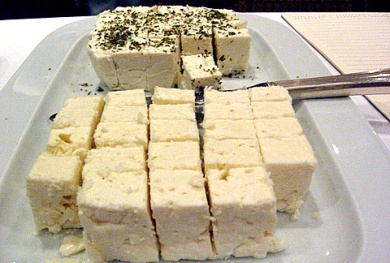
The US Agriculture Secretary, Tom Vilsack, was in Brussels this week, among other things to have lunch with EU Agriculture Ministers during their monthly Council meeting. He also took the opportunity to have a discussion with Commissioner Ciolos on some of the agricultural issues that are proving difficult to resolve in the ongoing negotiations on the US-EU Transatlantic Trade and Investment Partnership (TTIP) free trade agreement.
One of these issues is the EU demand that the US should recognise and protect the EU’s list of geographical indications (GIs). Geographical Indications are defined in the WTO as “indications which identify a good as originating in the territory of a Member, or a region or locality in that territory, where a given quality, reputation or other characteristic of the good is essentially attributable to its geographical origin”. The EU recognises two types of GIs for foodstuffs – Protected Designation of Origin and Protected Geographical Indication – and similar categories for wines and spirits.… Read the rest