The rural 10% target cannot be monitored

In the autumn of last year, the European Parliament came close to rejecting the Commission’s MFF proposal as the basis for negotiations. In October 2025, the leaders of four of the main political groups in the Parliament – EPP, S&D, Renew and Greens/EFA – wrote to President von der Leyen stating plainly that the Commission proposal had not taken the Parliament’s core requests into consideration and demanding an amended proposal reflecting these requests to allow negotiations with the Parliament to move forward (a copy of this letter was made available by Politico Europe).

In response, the Commission in a non-paper (made available by Euractiv) proposed several amendments to its proposal, which were subsequently included in a speech made by President von der Leyen at a plenary debate of the Parliament on the MFF’s architecture and governance in November 2025. This included a proposal for a rural target expressed as a minimum percentage of the NRP Plans’ financial allocation envelope outside of the earmarked amounts for the CAP and CFP as well as the Catalyst Europe loans to be spent in rural areas.… Read the rest
Lessons from the new U.S. Dietary Guidelines for Americans

I am not an expert in nutrition and, if I am honest, I have been sceptical of the significance of occasional health-related claims such as the claimed link between red meat and cancer. But that there is a link between diets and ill-health is indisputable. What is less clear is the nature of these links, which has been brought into sharp focus by the publication of the latest U.S. Dietary Guidelines for Americans 2025-2030 by U.S. Department of Health and Human Services Secretary Robert F. Kennedy, Jr. and U.S. Department of Agriculture Secretary Brooke Rollins two days ago on 7 January 2026.

In 2021, the OECD published a report prepared by Koen Deconinck Making Better Policies for Food Systems which argued that achieving better food policies for food systems requires overcoming frictions related to facts, interests and values. The latest U.S. Dietary Guidelines provide a relevant case study of the way differences in the interpretation of facts can influence policy recommendations.… Read the rest

Potential increase in CAP funding in next MFF

The figures in Table 1 have been slightly revised since the original post to calculate the flexibility amount as 25% of a country’s NRPF financial allocation less its minimum ring-fenced amount for CAP income support (from which the allocation for CAP investment supports for farmers and foresters should be deducted). In the original post I had based the calculation on the NRPF general allocation.

Commission President von der Leyen sent a letter to the Cypriot Presidency of the Council and to the President of the European Parliament yesterday 6 January 2026, in which she proposed to make additional resources available as of 2028 to address the needs of farmers and rural communities (with thanks to Politico Europe for the link).

This letter was sent on the same day as the Cyprus Presidency invited all Agriculture Ministers to a meeting also attended by the Commissioners for agriculture, trade and health to provide reassurances to Italy and other Member States to sign up to the contentious EU-Mercosur free trade agreement on Friday.… Read the rest

The role of borrowing in the EU’s MFF budget discussions

The New Year 2026 will see negotiations on the EU’s next medium-term budget step up in gear. Many Member States have called to set a deadline of end 2026 to agree on the next Multi-annual Financial Framework (MFF). This is necessary if the new MFF programmes are to start on 1 January 2028.

That this is a very ambitious deadline is an understatement. The Danes set a cracking pace in organising the Council’s MFF discussions under their Presidency, and presented a first draft of the famous ‘negotiating box’ to the European Council meeting in December 2025. This draft, without figures, was presented under the sole responsibility of the Presidency. The accompanying progress report recognised that significant political as well as technical issues remain to be resolved. Bridging these divides under the Cypriot and Irish Presidencies will require a massive effort in the coming twelve months.

Although it is the Council that negotiates the MFF budget, the European Parliament (EP) must also give its consent.… Read the rest

Navigating the EU-U.S. trade relationship

2025 marked a decisive break in relations between the United States and Europe. From U.S. Vice-President Vance’s speech in February at the Munich Security Conference to the publication of the U.S. National Security Strategy at year’s end, Washington has framed the European Union not as a strategic partner but as an obstacle to U.S. objectives. This shift was illustrated throughout the year by escalating trade actions, growing divergence over Ukraine, and threats against tech regulation. By the end of the year, the EU had accepted an unequal trade deal with the United States, undermining its long-standing self-image as a ‘soft power’.

The EU is also addressing mounting tensions with China, a consequence of the widening Chinese trade surplus, its willingness to assert its control over rare earths and magnets, and a series of tariff actions affecting particularly agri-food products. Trade relations with Russia have been subject to restrictions since the Russian invasion of Crimea in 2014 and subsequent sanctions following its invasion of eastern Ukraine.… Read the rest

2025 was a record year for farm income, though not for all

As the tractors arrived in Brussels yesterday, it is important to keep a sense of perspective. European farm incomes broke a new record high in 2025 – also in real terms – although not all farmers participated in this. But amid all the doom and gloom spread about an industry on its knees (a narrative with an explicitly political objective), and despite the evident challenges, it is even more important to keep an eye on the underlying facts.

The record farm income is reported in Eurostat’s first estimate of the economic accounts for agriculture earlier this week. This gives a snapshot of the economic health of the agricultural sector, summarised in what Eurostat calls Indicator A.

Indicator A represents an index of the real factor income per annual work unit (AWU) in agriculture. It measures the remuneration of all factors of production (land, capital, labour) by the equivalent of each full-time worker in the agricultural industry, presented in real terms (adjusted for inflation) and expressed as an index.… Read the rest

The looming Mercosur tragedy

Weak political leadership in Europe looks likely to doom the EU-Mercosur free trade agreement in a vote among EU Member States later this week. Denmark, as current Council President, has indicated it intends to schedule a vote at Ambassador level (COREPER II) to take place either Thursday or Friday this week. To be approved, the Agreement must gain the support of 55% of Member States (currently, 15 out of 27) representing at least 65% of the EU population. The Agreement can be blocked by a blocking minority which requires at least 4 countries representing at least 35% of the EU population. If a country abstains, its vote does not count either for the proponents or opponents.

As the thresholds are calculated against the total EU membership, and not just those who cast a yes/no vote, an abstaining country makes it more difficult both for proponents to gain a qualified majority and for opponents to form a blocking minority.… Read the rest

LULUCF targets off-course

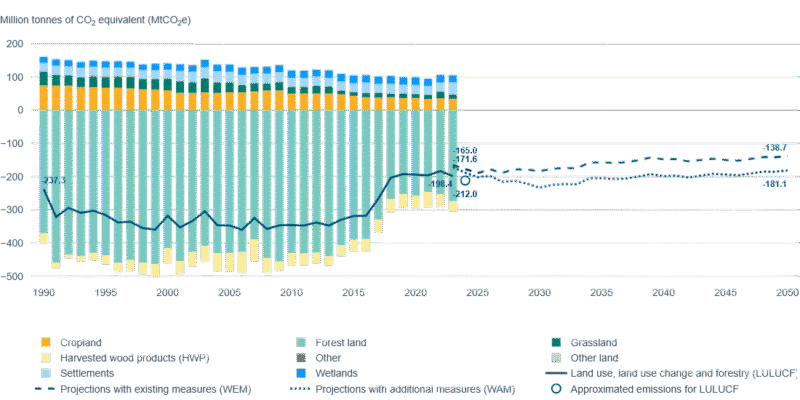
The EEA recently published updated projections for LULUCF emissions and removals by Member State to 2030 and 2050. It is not good news. Although the fall in the LULUCF sink appears to have been halted over the past six years, the EU27 net sink in 2023 was just 198MtCO2e and estimated at 212MtCO2e in 2024. This compares to the 2016-2018 average of 268MtCO2e and the 2030 target of 310MtCO2e set in the LULUCF Regulation (Figure 1).

Figure 1. EU emissions and removals of the LULUCF sector by main land use category
Source:  EEA, 2025.

The projections show that, with existing measures (the WEM scenario), the EU27 net sink is projected to be 183Mt CO2e in 2030 (all subsequent figures are in CO2e units). This does not necessarily imply a further fall in removals, as the base year removals for the projections in 2023 and 2024 are lower in the projections than in the inventory figures (165Mt and 172Mt, respectively).… Read the rest

The role of capital in agricultural productivity growth

Discussions on the future competitiveness of European agriculture often return to the role of capital. Investment in modern equipment, digital technologies, and precision farming systems is widely regarded as essential to sustain productivity growth and to meet new environmental and market challenges. While the Draghi report on EU competitiveness did not directly address the agriculture and food sector, questions are increasingly asked about whether the current pace and composition of investment are adequate, and whether capital is being used efficiently within the sector. These questions are particularly relevant as structural change continues, with a declining labour force and a growing reliance on technological and digital solutions.

The relationship between capital, labour and output in agriculture provides a useful framework for examining these issues. In accounting terms, labour productivity—measured as output per worker—depends both on the amount of capital each worker uses (capital per worker) and on how efficiently that capital is employed (output per unit of capital).… Read the rest

Understanding the structure of EU agriculture

Agricultural structure data represent the crown jewels of agricultural policymaking. For researchers and policymakers alike, the Farm Structure Survey and Agricultural Census are a rich and detailed source for understanding how Europe’s farms operate and evolve. They provide indispensable insights into the dynamics of land use, labour, and production systems, informing strategies for food security, generational renewal, environmental stewardship, and rural development.

In this post, I look at how agricultural structure data are used to track changes in the structure of agricultural holdings over time. I focus in particular on the statistical coverage of the data, the population of holdings that are included. Choosing different cut-off points for the population of holdings represented by the data can give us very different pictures of the agricultural sector.

For example, in a statistical brief summarising the results of the 2020 Agricultural Census, Eurostat informs us that there were 9.1 million agricultural holdings in the EU, of which 2.9 million holdings (the equivalent of 31.8 %) were located in Romania. However,… Read the rest