Commitments to rural development spending 76% below forecast in 2014
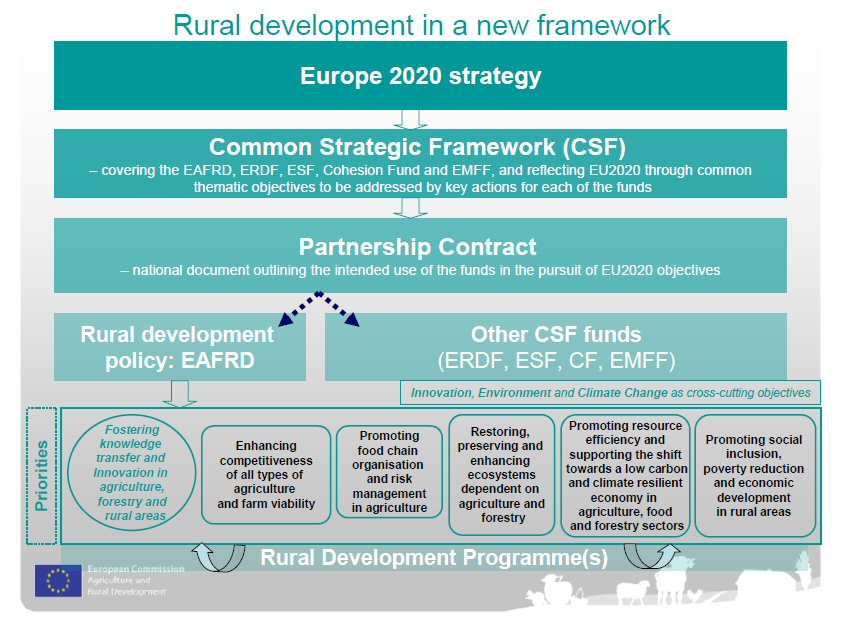
The publication by the Commission of its second Draft Amending Budget (DAB No.2) to the EU’s 2015 budget this week reveals in stark figures the extent of the hiatus in CAP rural development spending caused by the delays in passing the relevant legislation and in approving rural development programmes. I first highlighted how approval of rural development programmes was falling way behind schedule in this post; the Commission’s budget figures now allow us to quantify the extent of the damage.
The delays do not affect only rural development programmes but all programmes under the European Structural and Investment Funds, the Asylum, Migration and Integration Fund and the Internal Security Fund. The Commission reports that 645 programmes need to be approved in total, of which 118 are rural development programmes. It estimates that 252 programmes (39%) were adopted in 2014, 93 (14%) are eligible for adoption on 2014 appropriations carried over to 2015, and for the remaining 300 programmes (47%) the corresponding 2014 appropriations have been left unused.… Read the rest

Agricultural implications of British EU withdrawal for rest of the EU

This Sunday, the Greek general election may decide if Greece will leave the Eurozone, sometimes referred to as Grexit. None of the likely winners of the election, including Syriza, want this, but if there is an unwillingness to address the restructuring of Greek debt, particularly given Syriza’s promises to dramatically increase public spending, this could be the outcome. Whether Greece would then remain a member of the EU if this were to happen is uncertain, with The Economist arguing this week that, in all likelihood, Greece would have to leave the EU as well.
Later this year, on 7 May, the British general election takes place. The outcome of this election will influence the likelihood of Brexit, namely, British withdrawal, not from the Eurozone, but from the EU. David Cameron, the UK Prime Minister, has promised to hold a referendum on UK membership of the EU in 2017 if the Conservatives are returned to power.… Read the rest

Impact of the MFF negotiations on the CAP 2013 reform

The CAP 2013 reform was the first negotiated under the ordinary legislative procedure (co-decision) in which both the Parliament and the Council had equal powers. A project undertaken by the Centre for European Policy Studies in Brussels for the European Parliament’s Policy Department has sought to examine what impact and influence the Parliament had on the CAP 2013 out-turn as a result of co-decision. Did co-decision give the Parliament a greater opportunity to influence the final outcome, who were the key players in shaping the Parliament’s views and what did the Parliament use its influence to achieve?
The final study, when it is published, will throw light on these issues. The team behind the study (of which I was one) also commissioned a series of case studies on specific issues raised in the co-decision process. These case studies are now available on the CEPS website. They include a detailed amendment analysis by Imre Fertð and Attila Kovács of the Council and Parliament amendments to the Commission’s original draft proposals which evaluates the relative effectiveness of the two bodies in carrying their amendments into the final legislation, a detailed study of the role of COMAGRI by Christilla Roederer-Rynning, an analysis of the evolution of the greening debate by Kaley Hart, and an analysis of the European Parliament’s position on market regulation by Alessandro Olper.… Read the rest

Simplification as a top priority in 2015

The heading of this post is taken from the title of the speech delivered by the Commissioner for Agriculture and Rural Development Phil Hogan when addressing the EP COMAGRI on 3 December last. It follows his commitment in his confirmation hearings to a simplification and subsidiarity strategy for the CAP. It seems simplification will be a big buzz word in CAP discussions in 2015. But what can we expect from this initiative, and how important is it likely to be in practice?

Simplification: a Sisyphean task

CAP simplification has been a mantra of all previous Commissioners. For example, shortly after taking up office as Commissioner for Agriculture in 1995, Franz Fischler, in a speech on 28 September 1995, declared:

For my part, I intend to contribute to review existing E.U. legislation, notably in my area of competence, so as to make the C.A.P. easier to understand and to apply. C.A.P. simplification is an overriding objective, not only because our farmers, in particular the smaller ones, seek it and need it, but also because, without it, it will prove exceedingly difficult to implement the C.A.P.

Read the rest

The 2015 EU budget and agricultural spending

A provisional agreement has now been reached on the 2015 EU budget between the Council and Parliament following their inability to reach an agreement on the Commission’s first draft budget proposal in November (read here the reactions to the deal of the Commission, of the Council and of the Parliament). In terms of the headline figures for overall EU spending, the agreement is closer to the Council’s position, particularly in terms of payment appropriations, an outcome which was predicted as a consequence of the Lisbon Treaty changes in a series of papers by Giacomo Benedetto of the University of London.
The Parliament’s main demand was not so much adjustments to the 2015 figures but rather addressing the increasing backlog of unpaid bills (the result of a rising gap between commitment and payment appropriations in recent budgets). The amount of unpaid bills rose from €5 billion in 2010 to €23.4 billion at the start of 2014 and without an increase in 2014 payment appropriations would have risen further in 2015.… Read the rest

Rural development programming 2014-2020

Rural development programming for the MFF period 2014-2020 seems to be a disaster zone, and it would be interesting to hear comments from those more directly involved in the process as to the reasons and implications of the huge delays which have built up.
At a recent Rural Development DG AGRI Civil Dialogue Group meeting, the Commission presented an update on the programming of the new Rural Development Programmes (RDPs) from which the table below is taken. It expects only 10 RDPs out of a total of 118 to be approved by the end of this year. Nearly all of the 118 RDPs have been submitted (2 are still outstanding), and the Commission has returned its observations on 75 of these (see table below).
So a huge workload remains. The DG AGRI estimate is that just another 15 or so RDPs will be approved by the end of March, with the remaining 93 having to wait until ‘after MFF review’.… Read the rest

The Reform of the CAP: One Year After

Almost exactly a year ago the legislative bodies of the European Union accepted 4 new key Regulations that will determine the next period’s CAP. The Commission presented this reform, utilizing the label ‘Greening’, as a shift of paradigm and an introduction of certain other important changes in both the goals and the instruments of European agricultural policy. The essence of the new reform was to find a new justification for and mechanisms of agricultural policy. The reform, which took place in times of economic crisis, was accepted after the Lisbon treaty; as such it was characterized by a new form of legislation which equalized the roles of the European Parliament and Council as key legislators. A year has passed and it is time to try to assess our achievements from a distance, taking into account the future of the CAP.

CAP reform – The new and the old

It is my assessment that with the latest CAP reform there has been much change at the level of policy objectives, but less in the field of CAP instruments.… Read the rest

The Doha Round is back on track

On Thursday 27 November 2014 last, the WTO General Council approved three decisions related to public stockholding for food security purposes, the Trade Facilitation Agreement and the post-Bali work programme. With these agreements the hiatus in the WTO’s post-Bali work caused by India’s position on the 2013 Bali Ministerial Council decisions has been unblocked. India had demanded a commitment to faster progress on finding a permanent solution to the treatment of official procurement prices for food security stocks under domestic support disciplines, as well as the copper-fastening of the terms of the interim peace clause, in return for its willingness to approve the Protocol of Amendment to allow the Trade Facilitation Agreement to come into effect.
The drama leading up to these decisions and their significance is well described in this Bridges article. Addressing the General Council , the WTO Director-General Robert Azevêdo said:

By agreeing these three decisions we have put ourselves back in the game.

Read the rest

FADN data highlights dependence of EU farms on subsidy payments

Last week, the DG AGRI Farm Accountancy Data Network, FADN, made available aggregated data in its public database for the 2012 accounting year. In addition, there is now a Farm Economy Focus, or country fact sheet, based on the 2012 data for each member state which presents key FADN results in a graphical form for a general audience.
The FADN database is a key tool both for policy-makers and researchers seeking to understand the behaviour of farmers and the agricultural economy. The survey does not cover the smallest farms, but it is representative for over 4.9 million holdings across the Union. It contains a wealth of information on the economics of farm businesses, and the FADN team makes it easy to access this information through a very friendly user interface to their public database.
While the FADN tool is a terrific resource, some of the data it contains tell a less-than-encouraging story about the economic condition of EU farming.… Read the rest

EU sugar beet prices to fall by 22-23% when quotas eliminated

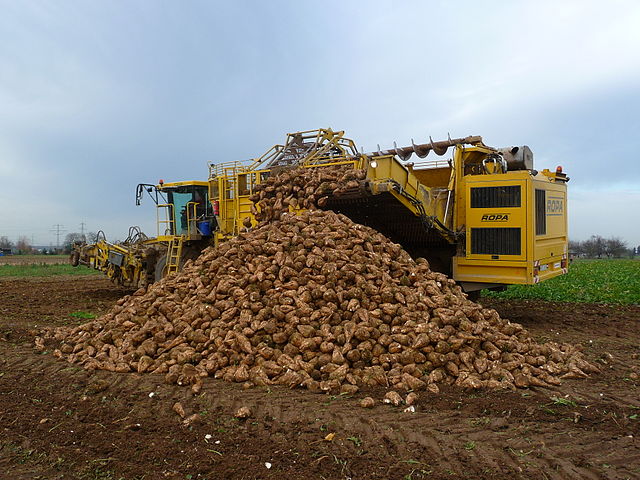
After much lobbying the Council and Parliament finally agreed that sugar quotas (including quotas on isoglucose) would be extended until the end of the 2016/17 season but would be abolished with effect from October 2017. In January this year, the EU’s Joint Research Centre (JRC) Institute for Prospective Technological Studies published its assessment of what might happen to the EU sugar market as a result of the abolition of sugar quotas. It is worth examining this report in some detail both for its substantive conclusions but also for some insight into the factors likely to affect the EU sugar market balance in the years after 2017.
The JRC study was completed at end-2012. It compares two alternative scenarios in the year 2020 – one scenario assuming that sugar quotas continued (the reference scenario) and one scenario in which sugar quotas are assumed eliminated in 2015. In the latter scenario, three alternatives are simulated with different assumptions regarding the share of isoglucose in the EU sweetener market.… Read the rest