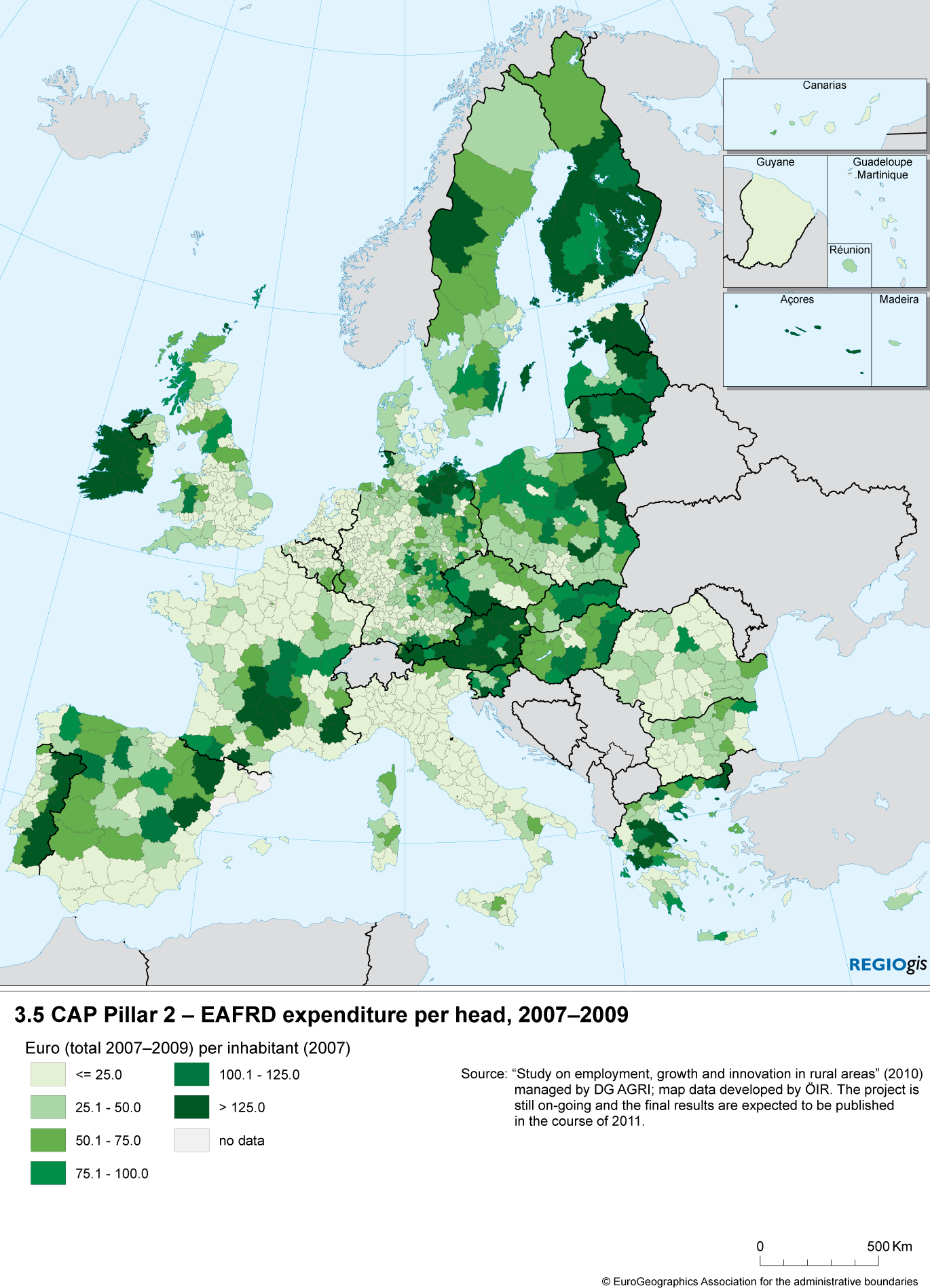
DG Regio’s compendious Fifth Report on Economic, Social and Territorial Cohesion contains a pair of maps looking at CAP expenditure by region.
The first shows the level of Pillar 1 spending per hectare of farmland in in each EU NUTS-3 region over the period 2000-2006.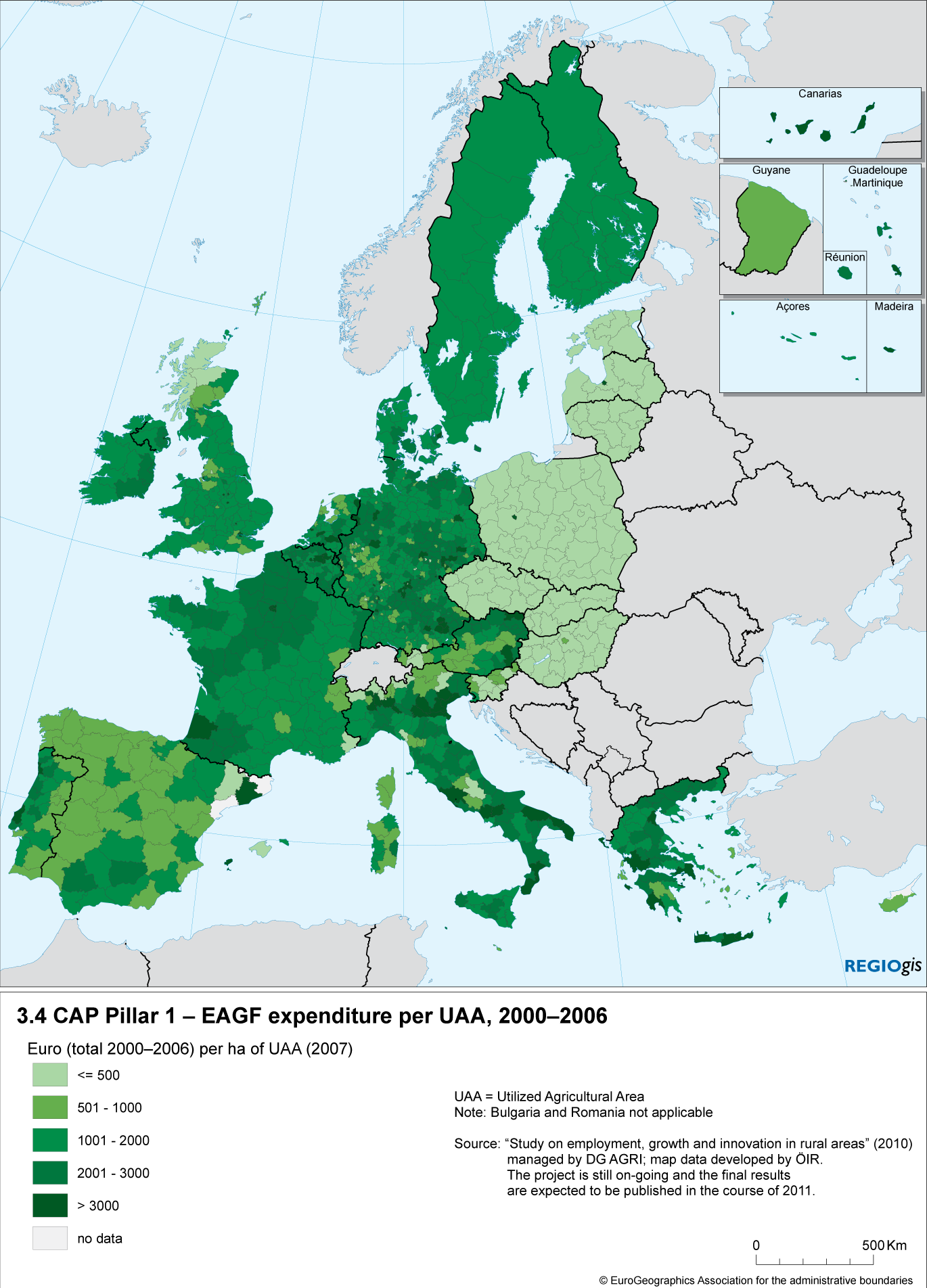
The second shows the level of Pillar 2 spending per inhabitant in each region between 2007 and 2009.
What do the maps tell us? The first map shows the uneven distribution of direct aids among EU regions of the EU-15. Spain seems to do relatively badly on this score and there is a striking east-west divide in Portugal. Italy resembles a green patchwork quilt, indicating that payments vary considerably among regions. Since the map shows spending from 2000 to 2006, it doesn’t tell us much about the CAP in the new member states, which only joined the EU in 2004.
The second map shows that Austria gets a large amount of EU rural development funding per inhabitant, reflecting a funding formula that takes into account previous national commitments to farmland conservation measures.… Read the rest
What ‘common’ agricultural policy?
DG Regio’s compendious Fifth Report on Economic, Social and Territorial Cohesion contains a pair of maps looking at CAP expenditure by region.
The first shows the level of Pillar 1 spending per hectare of farmland in in each EU NUTS-3 region over the period 2000-2006.
The second shows the level of Pillar 2 spending per inhabitant in each region between 2007 and 2009.
What do the maps tell us? The first map shows the uneven distribution of direct aids among EU regions of the EU-15. Spain seems to do relatively badly on this score and there is a striking east-west divide in Portugal. Italy resembles a green patchwork quilt, indicating that payments vary considerably among regions. Since the map shows spending from 2000 to 2006, it doesn’t tell us much about the CAP in the new member states, which only joined the EU in 2004.
The second map shows that Austria gets a large amount of EU rural development funding per inhabitant, reflecting a funding formula that takes into account previous national commitments to farmland conservation measures.… Read the rest
French government fighting itself
France has always played a pivotal role in the CAP. As a founder member of the EU, Europe’s largest agricultural economy and the biggest single beneficiary of CAP monies, it has a lot at stake. It is therefore fascinating to witness a violent power struggle within Nicolas Sarkozy’s government over the future of the policy.
On 18 October, French Environment Minister Jean-Louis Borloo and Sustainable Development Minister Chantal Jouanno put their names to a 16-page reform proposal that would see France’s current annual €10 billion a year in CAP payments be divided between basic income payments with environmental compliance (€3 billion), farmland conservation contracts (€6 billion) and food chain and price safety nets (€1 billion). This would be a radical redistribution. Currently 90 per cent of CAP spending in France is in the form of direct aids and market measures, with only ten per cent spent on farmland conservation and rural development.… Read the rest
The surge in sugar prices
In the past few years commentators have emphasised the growing integration between food and energy markets. Food prices were always influenced by energy prices on the cost side, but with the growth of markets for biofuels made from agricultural feedstocks, prices are also linked on the demand side. If oil prices rose, this would tend to pull up food prices as grains, sugarcane and vegetable oils were diverted to fuel production, and if oil prices fell, feedstocks would move back again to the food market also pushing down prices there. The crucial lever here was seen as the Brazilian sugar-ethanol complex and Brazil’s fleet of flex-fuel vehicles, which facilitated easy substitution between the two markets.
But agricultural markets are subject to their own shocks independent of the energy market, and the price integration is far from perfect as shown by a comparison of sugar and oil prices over the past twelve months.… Read the rest
Court of Auditors criticises sugar reform
The European Court of Auditors today released a report reviewing the outcome of the 2006 sugar regime reform. The Court makes some criticisms of the design of the 2006 reform, but more important are its findings and recommendations which are likely to feed into the debate on the shape of the CAP post-2013. Here the report manages to give ammunition to both CAP reformers and diehards, and if early reactions in my own Irish media are any guide it is the more reactionary views which are getting the media spin.
The Court notes that one objective of the reform was to contribute to a more competitive sugar industry, and that this was to be achieved by concentrating quota reductions in the least competitive areas. The audit criticises the Commission for the absence of data on the productivity of individual factories and for the fact that data on the overall competitiveness of sugar production in different Member States was somewhat dated.… Read the rest
Battle heats up on indirect land use change effects of biofuels
The EU renewables target of 10% of transport fuel by 2020 to be met mainly by biofuels has been heavily criticised for its potential impact on diverting land from food to fuel production and thus putting upward pressure on food prices. Another source of criticism is whether it does actually contribute to reducing overall greenhouse gas (GHG) emissions. The Commission sought to deflect this latter criticism by requiring that biofuels which count against the renewables target must show a direct GHG saving of 35% compared to the fossil fuel that they displace. This saving requirement is gradually increased to 50% and 60% for fuels produced by installations that start production after 2017 and 2018, respectively.
However, these GHG reduction requirements do not take into account the possible indirect effects of converting cropland to biofuel production, which will encourage indirect land use change (ILUC) by conversion of pasture or forest to produce the food crops displaced by biofuels.… Read the rest
The CAP and semi-subsistence farmers
One result of the last two enlargements in 2004 and 2007 was to bring millions of small farms into the EU, most of which are either subsistence farms (SFs) or semi-subsistence farms (SSFs). Various definitions of what is a subsistence or semi-subsistence farm exist (see the background paper on this topic by Sophia Davidova and colleagues for the recent seminar in Sibiu, Romania on semi-subsistence farming) including physical area (e.g. less than 5 ha), size of farm business (below a certain ESU threshold) or market orientation (share of production going to own consumption).
According to Eurostat FSS, in 2007 there were 11.1 million small farms (below 8 ESU) within the EU-27. Of these, 6.4 million were below 1 ESU, therefore considered SFs and the remaining 4.7 million were SSFs. The total number of holdings in 2007 in the EU-27 was 13.7 million, so the share of SFs and SSFs was equal to 46.6% and 34.5% of the total number, making them the dominant farm type in Europe.… Read the rest
EU budget review cautious on future spending priorities
The Commission has published its long-delayed budget review which follows a public consultation on the EU budget which began as a mid-term budget review in 2008-09. An earlier version leaked last year, and apparently drafted by Commission President Barroso’s advisers (see Jack Thurston’s post on this), recommended specific targets for the reallocation of EU spending, including a reduction in agricultural spending to around one-third of the budget.
The review published today is a more anodyne document, and it shies away from making specific recommendations on which expenditure areas might see their budgets cut. In this it closely resembles the leaked document on CAP reform put into the public domain earlier this month and which also summarises the conclusions of a public consultation. Indeed, the budget review document is even less prescriptive in that it does not even attempt to sketch out alternative models for the financial perspective period. The document makes the usual rhetorical references to the need for the budget to reflect EU priorities (particularly the 2020 strategy), to concentrate on areas where there is European value added, and to allocate resources on the basis of results.… Read the rest
Commission leaked draft fails to advance reform debate
The draft Commission communication on the CAP towards 2020 is an underwhelming document, not just for those seeking to push an ambitious reform agenda but also for those seeking a roadmap to address issues that the Commissioner himself has identified as up for discussion. As Mairead McGuinness, the Irish MEP, commented, it lacks both detail and substance, and is devoid of both figures and analysis.
Nonetheless, it does contain some clues on what DG Agri might like to see in the final package, however cautiously they are expressed. The language used does nudge the debate on the future CAP in slightly different directions to the current CAP. The document is now in inter-services consultation, and the comments of other Commission DGs such as Budget, Finance, Trade and Environment have yet to be incorporated. Assuming that these DGs have been kept in the loop as the document was drafted, their comments are unlikely to modify it in any major way before its publication due next month.… Read the rest
The circle that cannot be squared
 An extended guest post by Jorge Núñez Ferrer , takes a close look at the leaked commission communication on the future of the CAP. Dr Núñez Ferrer (pictured, right) is Associate Research Fellow at the Centre for European Policy Studies and has written widely on the CAP and the EU budget
The CAP 2020 reform philosophy has finally seen the light, albeit only in leaked form. A carefully drafted document contains the usual CAP rhetoric punctuated by some apparently strong deviations from past doctrine. But once the objectives and policy proposals are reduced to their basic components, much of the fizz disappears.
Looking beyond the politically correct drafting and generalisations (and the inevitable linguistic awkwardness of an English text primitively translated from the French of the original draft), one finds the following objectives and reasoning as the guiding principles and motives:
The CAP should ensure that agricultural production across the whole European Union is maintained and even enhanced.… Read the rest