Recently, I attended a conference of the British Land Use Policy Group (LUPG) on ‘Securing our Common Future through Environmentally Sustainable Land Management – Vision for the Future of the CAP post 2013’. The first speaker noted that ‘the challenge of the next months is to identify the questions for CAP reform’. Toward the end, a commentator from the floor summarized the discussion: ‘We had a lot of questions and not many answers.’ Should we really place ourselves at such an early, exploratory stage where we struggle to grasp the main dimensions of the problems, at best determine broad directions for reform? Continue reading “Let's get concrete and controversial!”
Let’s get concrete and controversial!
Recently, I attended a conference of the British Land Use Policy Group (LUPG) on ‘Securing our Common Future through Environmentally Sustainable Land Management – Vision for the Future of the CAP post 2013’. The first speaker noted that ‘the challenge of the next months is to identify the questions for CAP reform’. Toward the end, a commentator from the floor summarized the discussion: ‘We had a lot of questions and not many answers.’ Should we really place ourselves at such an early, exploratory stage where we struggle to grasp the main dimensions of the problems, at best determine broad directions for reform? Continue reading “Let’s get concrete and controversial!”
Re-education for Commission officials
On a visit to China a few years ago I met an elderly professor who had been sent with his students to the countryside during the Maoist period for ‘re-education’ by the peasants. He struck a deal with the local peasants that allowed them to work on their books two days a week. Now farm commissioner Mariann Fischer Boel, a large-scale farmer with her husband in Denmark, has decided that Commission officials in DG Agri need re-education. She considers that they are too detached from farmers and don’t understand their problems. Continue reading “Re-education for Commission officials”
A chorus of despair
Earlier this week I was invited to take part in a round table discussion, as part of a major conference on the future of the CAP, organised by Birdlife/SEO and WWF. The conference began with a joint presentation by SEO and WWF of an interesting new proposal for CAP reform in Spain. The proposal envisages an end to Pillar 1 by 2019 and the transfer of all CAP funds to an environmental and rural policy oriented around the principle of ‘public money for public goods’, by which is meant those environmental ‘services’ provided by farmers, particularly in areas of high nature value (HNV) farming such as upland pastures and native grasslands. Continue reading “A chorus of despair”
Jamie Oliveoil explains the politics of the CAP
I don’t much agree with the Taxpayer Alliance, a right-wing campaign group based in London. The TA thinks taxes are theft and believes governments are rife with waste, fraud and abuse. I think paying taxes is patriotic and believe most public servants are well motivated and do a good job. The TA uses the CAP as a stick to beat the EU. I think the CAP gives the EU a bad name and want to see it reformed because I am a strong supporter of the EU.
Our differences aside, I’ll admit that TA has produced an amusing viral video to publicise its new report on the economics and the politics of the CAP, featuring a spoof of Jamie Oliver, the TV chef. Be warned, the report itself doesn’t have much greater analytical depth than the video. But that shouldn’t be much of a surprise as it was written by a former researcher to loony tunes MEP and YouTube sensation Daniel Hannan who, only a few years ago, was waxing lyrical about the economic miracle of, erm, Iceland. Anyway, check out Jamie Oliveoil after the jump. Continue reading “Jamie Oliveoil explains the politics of the CAP”
Fischer Boel golden goodbye: "Because I'm worth it"
The anti-EU agitprop outfit Open Europe has been huffing and puffing over the golden goodbyes that await those European Commissioners who will be put out to pasture when the current Commission’s five year mandate comes to an end later this year. Among their number is thought to be our own Agriculture Commissioner, Mariann Fischer Boel who, after five years of service in Brussels stands to receive approximately 270,000 euros of ‘transition money’ before her 43,000 euro a year pension kicks in.
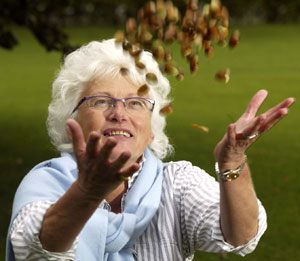
The 66-year old Dane, who sports a trademark shock of snow white hair, has invoked the spirit of Hollywood actress Jennifer Aniston in the L’Oréal commercials, insisting the payout is entirely justifiable “because I’m worth it”. It’s just as well that the Commission scheme is so generous since Fischer Boel, who together with her husband owns several large livestock farms, is too old to qualify for the EU-funded early retirement scheme for farmers, which pays out a maximum of €18,000 a year to farmers who quit before turning 55. The typical ruse is for farmers approaching 55 to “retire” and apply for the early retirement money while passing the legal title of the farm on to a son or daughter who, in all likelihood, will qualify for an EU-funded young farmers startup grant worth up to €40,000. Both continue to work on the farm as before.
Fischer Boel golden goodbye: “Because I’m worth it”
The anti-EU agitprop outfit Open Europe has been huffing and puffing over the golden goodbyes that await those European Commissioners who will be put out to pasture when the current Commission’s five year mandate comes to an end later this year. Among their number is thought to be our own Agriculture Commissioner, Mariann Fischer Boel who, after five years of service in Brussels stands to receive approximately 270,000 euros of ‘transition money’ before her 43,000 euro a year pension kicks in.
The 66-year old Dane, who sports a trademark shock of snow white hair, has invoked the spirit of Hollywood actress Jennifer Aniston in the L’Oréal commercials, insisting the payout is entirely justifiable “because I’m worth it”. It’s just as well that the Commission scheme is so generous since Fischer Boel, who together with her husband owns several large livestock farms, is too old to qualify for the EU-funded early retirement scheme for farmers, which pays out a maximum of €18,000 a year to farmers who quit before turning 55. The typical ruse is for farmers approaching 55 to “retire” and apply for the early retirement money while passing the legal title of the farm on to a son or daughter who, in all likelihood, will qualify for an EU-funded young farmers startup grant worth up to €40,000. Both continue to work on the farm as before.
Why CAP reform happened
The latest Journal of Common Market Studies (vol.47, 2, March 2009) contains an important article exploring the determinants of CAP reform. It is written by Alan Swinbank, a distinguished agricultural economist and a leading proponent of reform and Arlindo Cunha who was chair of the Agriculture Council in 1992 at the time of the MacSharry reform. Continue reading “Why CAP reform happened”
Pressure building on Commission to postpone milk quota reform
If there was a jewel in the crown of the CAP health check deal agreed last November it was probably the decision to phase out milk quota between now and 2015, with a one per cent increase in quota each year. But this prize is now under threat as several powerful EU member states led by Germany have argued at today’s Agriculture Council meeting that the reform should be postponed. Continue reading “Pressure building on Commission to postpone milk quota reform”
Farming and the depression
Is it too early to call it a depression? Difficult to tell, but all the news this month is pointing in that direction. So it is timely that over at the CAP2020 blog, Martin Farmer has written a lengthy post on the impact of the global economic slowdown on farming. In many respects, it’s a case of swings and roundabouts. Commodity prices are down, but so too are key input prices like oil. Consumers have less money to spend, but they still need to eat. Recent spikes in profits provide new money for investment, but bank loans have never been more costly. Governments have less revenue for costly handouts to farmers, but there is talk of a new wave of trade protectionism. Continue reading “Farming and the depression”