Use of risk management tools in the CAP

It has long been recognised that greater price and income volatility would accompany the move to a more market-oriented Common Agricultural Policy (CAP). Already in the run-up to the Fischler Mid-Term Review (MTR) in 2003 which led to the decoupling of direct payments, the Commission published a working document on risk management tools for agriculture, with a special focus on insurance, in 2001. The Council MTR agreement mandated the Commission to study specific measures to address risks, crises and natural disasters that agriculture may face. This led to a Communication from the Commission in 2005 on risk and crisis management in agriculture which discussed different instruments that could be implemented in the CAP. Some tentative steps were taken in the 2008 Health Check to encourage member states to give greater attention to this issue.

Yet farmers, processors and policy-makers have struggled to respond. Risk management instruments supported by the CAP up to 2013 were not very successful.… Read the rest
Rising Agricultural Incomes in Europe

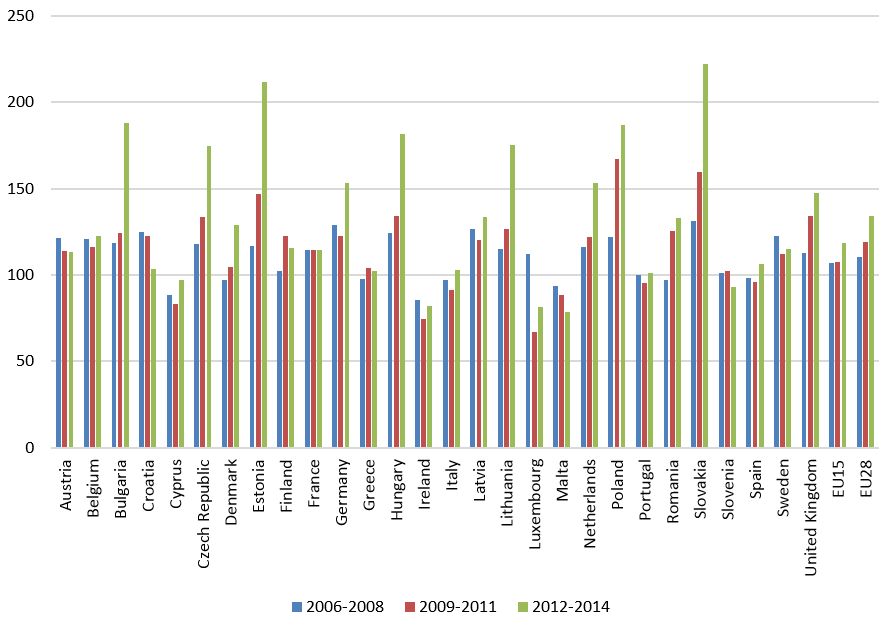
The index of the real income of factors in agriculture per annual work unit (better known as index of agricultural income or Indicator A) has increased by 18% in EU15 countries and 35% in EU28 countries from 2005 to 2014 as evident from Eurostat statistics. It is clear from the figure below that compared to 2005, agricultural incomes more than doubled in Estonia and Slovakia in 2012-2014, while it was just decreasing in Cyprus, Ireland, Luxembourg, Malta and Slovenia.

Agricultural income in the European Union by member state, 2005-2014 (2005=100)

Source: Own composition based on Eurostat 2015 data.

Without going very much into detail, it is apparent that agricultural income has been increasing in each period in the majority of the cases. Even in 2009-2011 when the economic crisis definitely had the biggest impact, agricultural real income per worker was just lower on 2005 basis in seven EU members. It is also evident from the figure above that due to increasing support, income of the New Member States (NMS) were increasing at a higher pace than that of EU15.… Read the rest

Are we really moving forward?

The debate on the future of the CAP has recently moved on with two important steps – the European Parliament plenary vote and the European Council agreement. Just to take up the story, the European Parliament Plenary voted in Strasbourg on 13 March on the over 330 amendments COMAGRI made this year to the European Commission’s official communication on the CP reform in October 2011. This was the first time in history when the Parliament could use her co-decision powers, affecting European Council decisions. This all happened, of course, after the deal reached on long-term budget on February 8, the consequences of which are well summarised in the interview with Paolo de Castro, Chair of COMAGRI at the European Parliament (see the video made by Vi(eu)ws here).
The Plenary vote mainly favoured the Commission’s original ideas against the various amendments. Consequently, Dacian Ciolos, the European commissioner for agriculture, welcomed this fact and said that it was an important step in the CAP reform process (see full reaction here).… Read the rest

What the proposed MFF has for agriculture?

Herman Van Rompuy, President of the European Council introduced the acceptance of the new MFF yesterday on his Twitter page by writing that

Deal done! The European Council has agreed on MFF for the rest of the decade. Worth waiting for.

Although this is not the final agreement as the European Parliament still has to confirm the Council decision, it is highly unlikely that the EP risks the hard-fought agreement reached at the Council.  Therefore, the playing arena for agriculture in the next seven years is set in the final conclusions published by the Council.
In general, the deal reached limits the maximum possible expenditure for a European Union of 28 Member States (with Croatia’s accession this year) to €960 billion in commitments, corresponding to 1.0% of the EU’s GNI. This means that the overall expenditure ceiling has been reduced by 3.4% in real terms, compared to the current MFF – the first time in history when such a reduction is made.… Read the rest

Who is happy with EP COMAGRI’s recent vote?

After more than a year of debate, the EP Agriculture and Rural Development Committee began adopting several amendments to the future CAP legislation on 23 and 24 January but approval remains far from certain.
Many criticisms have been made since the vote. The agro-lobby is talking about a melt-down of the urgently needed reforms and greening, reacting on the COMAGRI proposal to allow farmers to ‘opt out’ of mandatory greening requirements and still get at least 70% of the direct payments as well as watering down every single measure with so called ‘equivalents’.
Environmental campaigners also criticised the vote, alleging that the debate was dominated by agricultural interests. The EEB is complaining that the CAP continues to suffer from a fundamental lack of legitimacy as it continues what they call a ‘money for free’ approach, thereby criticising the COMAGRI to pay farmers twice for the same work. Birdlife, for instance, is neither happy with the vote as MEPs have deleted or watered down 10 out of 21 cross-compliance rules, one of the most important ones in the current regime for preserving nature as they say.… Read the rest

Nobody cares what we spend our money on

All we know that no decision was made last week in Brussels on how much money the EU should spend in the next programming period (MFF). Besides Van Rompuy’s detailed and complicated figures and plans, it is pretty evident that the debate is about the possibility to redistribute the European Budget among Member States.

If one takes a short look to the operating budgetary balance of the Member States, it becomes evident that Poland, Greece, Hungary, Spain and Portugal are the greatest recipients of the current system, while Germany, France, Italy, the United Kingdom and Netherlands are the biggest contributors in absolute terms. This picture varies, of course, if we analyse the balance per capita or as a proportion of GDP. It is also evident that the former group wants to save the status quo, while the latter wants to cut the budget.

Source: http://ec.europa.eu/budget/figures/interactive/index_en.cfm

If we compare the figure above with the one below, it turns out that expenditure on agriculture and rural development by country shows a great diversity among Member States as well.… Read the rest

Strengthening the role of young farmers in the future CAP

The European Council of Young Farmers (CEJA) has recently launched a campaign “Future Food Farmers” to raise public awareness of the impending age crisis in European agriculture. The aim of the campaign is to achieve progress on generational renewal in the agricultural sector in the future CAP.

The issue is highly relevant these days as only 6% of agricultural holders in the EU are below the age of 35, while one third are over 65. However, Member States show a great diversity in this issue as Poland has the highest share of young farmers in Europe (12%), while Portugal has the lowest (2%), according to Eurostat data. Neither figure is promising for the future, though.

The ‘young farmers problem’ affects European agriculture in many different ways. Just to mention a few, food security, biodiversity, rural job creation as well as productivity and competitiveness are at stake. Young farmers are faced with significant entry barriers (access to land and credit, investments, etc.),… Read the rest

Farmer-friendly ideas on greening

COPA-COGECA leaders are currently presenting their new detailed position on greening and green growth at the Congress of European Farmers, organised in Budapest on October 1?3, 2012. The theme of the Congress  is “The Future Common Agricultural Policy (CAP): How European Farmers can ensure Food Security Innovatively and Profitably”.

COPA-COGECA is largely against the greening proposals tabled by the Commission last year, saying that they make farmers do a lot more for less money, thereby leading to higher costs, higher food prices and more dependence on imports. They would also increase bureaucracy, of course. Therefore, the farmers’ organisation produced a list of six alternative measures to tackle the problem of greening in a farmer-friendly way: crop diversification (of rotated crops), a certification scheme (food), permanent grasses, replacement of EFAs by uncultivated land, break crops, protein crops.

These items, serving as an extended list of greening measures for farmers, reflects the diverse nature of European agriculture and allowing farmers to make choices more flexibly, based on their own farm situation – says COPA-COGECA.… Read the rest

The future for national envelopes and Member State flexibility in Pillar 1

A feature of the move towards decoupled direct payments in the EU since the Fischler 2003 reform has been greater flexibility for Members States in the management of these payments. This can be seen in various ways: the different options on which to base the Single Payment Scheme; different cross compliance requirements including definition of Good Agricultural and Environmental Conditions; different possibilities for modulating payments between Pillar 1 and Pillar 2; and provisions for ‘national envelopes’ and for the retention of partial coupling.

In this post I examine the future for national envelopes and partial coupling in the light of the Commission’s draft regulation on direct payments after 2013. At issue is the extent to which the draft proposals expand the scope for coupled payments and national flexiblity more generally in the post-2013 period.

National envelopes sometimes refer to the overall ceiling on the funding for direct payments allocated to each Member State, but here I use it in the more specific sense to refer to the share of direct payments over which Member States have some discretion over how to make these payments.… Read the rest

Budget rumbles in Brussels

The summer break has come and gone and with the European Parliament back in session, Commissioners back from their yachts and their fonctionnaires back at their desks, the future of the EU budget is back in the spotlight.

As part of the December 2005 heads of government agreement on the 2007-2013 financial perspective it was agreed that there would be a midterm ‘budget review’ in 2008-09 which would look at all areas of the EU budget. including the two hottest political potatoes – the large share of funds going to the CAP and the British budget rebate. The review began with a big public consultation led by the then Budget Commissioner Dalia Grybauskaite, who pulled no punches in describing the budget as largely out of tune with Europe’s current and future challenges. However, she left the Commission early to become President of Lithuania and with delays to the Lisbon Treaty ratification the review process slowed to a standstill.… Read the rest