How Member States are implementing the new CAP
All the focus last week was on the publication of the Commission Communication on the Future of Food and Farming. This document has been greeted with both curiosity (concerning the potential of the proposed new mode of delivery and governance to deliver both simplification of the CAP as well as improved targeting and results on the ground) and criticism (from farm groups worried that it eliminates the ‘common’ in the Common Agricultural Policy and environmental groups worried that it could facilitate the continued transfer of a large chunk of the EU budget to farmers with no questions asked). It will take some time to tease out its full implications, and this is something I will return to on this blog in the future.
Last month DG AGRI also published without fanfare on its website a very useful summary report on the implementation of the 2013 CAP reform in the 2015 claim year, the first year of implementation of the new CAP.… Read the rest

Another look at the possible Brexit implications for the CAP budget

Preparations within the Commission for its next MFF proposal, which is now expected in May next year, are well under way. Thinking on the shape of the next MFF began in January last year with the Dutch Presidency Conference on preparing for the next MFF. In December 2016 the High Level Group on the Future Finances of the EU produced its final report and recommendations for a reform of the own resources side of the MFF. In June 2017, the Commission produced its Reflections Paper on the Future of EU Finances. This was one of a series of Reflection Papers published by the Commission in the wake of its White Paper on the Future of Europe published in March 2017.
The Reflections Paper provides a coherent account of the challenges that the EU budget is required to address, including those that have recently emerged. In addition to classical areas such as investments in public goods managed at the EU level (including research and major infrastructure), economic and social cohesion and sustainable agriculture, the paper notes the growing importance of managing migration as well as external challenges in security, humanitarian aid and development.… Read the rest

Leaked draft of the Commission Communication on Future of the CAP

Brussels has been buzzing in the past week since copies of the draft Commission Communication on the Future of the CAP which is set to be launched on 29 November next were leaked – you can read it and download a copy from the ARC2020 website. The status of this document is not clear – my guess is that this is the version that has been prepared by DG AGRI for the Inter-Service Consultation process which normally takes two to three weeks. This is where DG AGRI would get the formal opinion of the other DGs on its proposal, which it would then take into account in its final Communication. So there is still the possibility that the final Communication could differ from the leaked version, although one assumes that DG AGRI have been in close touch with their colleagues in the process of drafting, so I would not expect substantial changes at this stage.… Read the rest

Does the WTO discipline really constrain the design of CAP payments?

This post is contributed by Jean-Christophe Bureau who is professor of of economics at AgroParisTech, Université of Paris-Saclay, and heads the joint research team in public economics of INRA, the National Institute for Agricultural Reseach in France.

The idea that the definition of CAP instruments has been (and still is) heavily constrained by World Trade Organisation rules is widespread. In debates on the post 2020 CAP, the issue of compatibility with WTO disciplines is raised each time coupled payments, countercyclical payments, support to production in less favoured areas, risk management or income stabilization schemes are discussed. An issue of particular interest (which this post focuses on) is environmental payments.

It is often stressed that WTO discipline imposes strict limitations in this area; in particular, that payments to farmers for environmental services need be limited to compensation of the additional costs experienced. This has important consequences for the design of the future CAP.… Read the rest

The UK must pay for access to the single market

The British Foreign Secretary Boris Johnson revealed his four ‘red lines’ in the Brexit negotiations in an interview in The Sun newspaper recently. They include:

1. The transition period post-Brexit must be a maximum of 2 years and not a second more
2. UK must refuse to accept new EU or European Court of Justice rulings during transition
3. No payments for single market access when transition ends
4. UK must not agree to shadow EU rules to gain access to market.

On the budget payments issue, Johnson explained: “What I have always said is that we will pay for things that are reasonable, scientific programmes. But when it comes to paying for access to the market, that won’t happen any more than we would expect them to pay us for access to our market.”

That the UK might continue to have access to the single market but not contribute to the economic and social cohesion of this market was a widely-heard refrain at the fringe meetings during the recent Conservative Party conference.… Read the rest

Macron's views on the Common Agricultural Policy

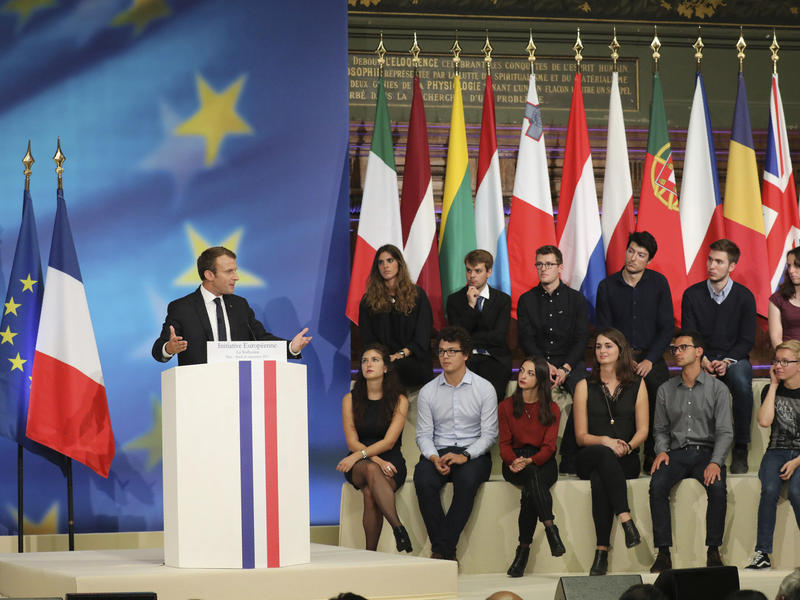
President Emmanuel Macron laid out his vision for Europe in a major speech at the Sorbonne yesterday. This speech was billed as an Initiative for Europe and set out the President’s ambitions in a range of areas – defence, counter-intelligence, asylum and migration policy, an external policy focused on Africa and the Mediterranean, a sustainable development agenda (including ideas for a more flexible CAP), addressing the challenges of the digital economy, reforms of the eurozone, and institutional reform. He proposed that each Member State that signs up to this agenda (recognising that not all will want to) should organise a citizen’s dialogue in the coming months with a view to feeding into a new “group for overhauling Europe” which would be tasked to produce a report by Summer 2018 on measures to implement these ambitions.
The full speech (in French) is here, with the official English summary here.
There is much to get to grips with in this speech.… Read the rest

The budgetary context for the CAP after 2020

Last week I attended the XVth Congress of the European Association of Agricultural Economists which was held in Parma, Italy. With almost 600 contributed papers, poster papers, organised sessions and panels, it was a feast both of stimulating ideas and great food. Over the next few weeks, I hope to highlight a few of the papers which were of interest to me. In this post, I take the opportunity to refer to my own contribution to an organised session on the economics and politics of the CAP after 2020.
This panel discussion also included contributions from Tassos Haniotis (DG AGRI), Jean-Christophe Bureau (AgriParisTech) and Johan Swinnen (University of Leuven). My contribution dealt with the state of play and the process of shaping the CAP post 2020, Haniotis and Bureau discussed some of the substantive issues under discussion, while Swinnen discussed the political economy of a reform agenda, drawing on analytical insights from previous CAP reforms.… Read the rest

Price transmission in the dairy supply chain

DG AGRI’s Milk Market Observatory (MMO) is now proving its worth as a source of up-to-date data on milk and dairy product market developments. It is also an excellent source for historical time-series statistics which allow us to see patterns in the data and to develop hypotheses about the behaviour of actors in the food chain.
The chart below taken from the MMO shows the evolution of two indicators of producer prices for raw milk. One is the weighted average price that EU farmers received for raw milk at real fat and protein content (the ‘producer price’). The other is a hypothetical price, the farmgate milk price equivalent (FMPE), which is the price processors would be expected to pay based on the going market prices for butter and skimmed milk powder after deducting an average processing cost.
The producer price a farmer receives may be different from this hypothetical FMPE because of differences in actual fat and protein content from that assumed in the FMPE calculation, because actual processing costs may differ from those assumed in the calculation, and because much milk production is transformed into other types of dairy products which may have higher or lower value in the market place.… Read the rest

Which is the best risk management tool?

The extent and nature of the risk management tools that should be offered to EU farmers is one of the main issues which will be debated in the context of the future CAP after 2020. Already, in the COMAGRI amendments to the Omnibus Regulation, we see the interest of parliamentarians to extend the risk management toolkit and to make it more attractive for farmers to use.

The COMAGRI amendments seek to allow Member States to use CAP funds to contribute to insurance premiums for market-related hazards (that is, price variability) and revenue variations as well as just production variations due to adverse climatic events, diseases, pest or an environmental incident as at present; to provide for sector-specific income stabilisation tools so that farmers could enrol in schemes for a specific production and not necessarily for whole farm income; and would allow indemnification payments to farmers whenever the production loss (or income loss in the case of mutual funds operating an income stabilisation tool) exceeds 20% rather than the 30% in the existing legislation.… Read the rest

UK publishes proposals on customs arrangements with the EU

In her keynote Brexit speech at Lancaster House in January this year, the Prime Minister outlined:

“I do want us to have a customs agreement with the EU. Whether that means we must reach a completely new customs agreement, become an associate member of the Customs Union in some way, or remain a signatory to some elements of it, I hold no preconceived position. I have an open mind on how we do it. It is not the means that matter, but the ends.”

In the White Paper that followed in February, the Government stated that it would prioritise securing “the freest and most frictionless trade possible in goods (…) between the UK and the EU“.
Last week, the UK government published two policy papers which attempted to propose possible solutions to the conundrum posed by Brexit: how to facilitate “the freest and most frictionless trade possible in goods between the UK and the EU” once the UK leaves both the EU Customs Union and the EU Single Market.… Read the rest