Has the starting signal sounded for the next CAP reform?

Yesterday, the Juncker Commission released its third annual Work Programme for 2017. This year’s Work Programme proposes 21 key initiatives as well as a further 18 REFIT proposals intended to improve the quality of existing EU legislation. In addition, the Commission Work Programme identifies 34 priority pending proposals made in the past two years where it seeks swift adoption by the Parliament and Council.

The Work Programme Communication contains two specific references to agricultural policy development. The full paragraph reads as follows:

The Commission will take forward work and consult widely on simplification and modernisation of the Common Agricultural Policy to maximise its contribution to the Commission’s ten priorities and to the Sustainable Development Goals. This will focus on specific policy priorities for the future, taking account of the opinion of the REFIT Platform, and without prejudice to the Commission proposal to revise the Multiannual Financial Framework. As concerns the position of farmers in the food supply chain, in the light of the outcome of the ongoing work of the Agricultural Markets Task Force and the High Level Forum on the food supply chain, the Commission will consider further action as necessary.
Read the rest

Mitigation potential in EU agriculture

In my previous post on this blog, I noted that the Commission’s impact assessment (IA) accompanying its presentation of the new Effort Sharing Regulation (ESR) proposal concluded that very little additional agricultural mitigation is expected in the period 2021-2030, over and above what is projected to occur under current policies.

Two possible conclusions might be drawn from this finding. One is that the agricultural sector lobby organisations have used their political clout to ensure that the sector is required to do as little as possible to contribute to the EU’s 2030 climate targets. This reaction was advanced by some NGO activists in response to the post.

The other explanation is that it is difficult (and expensive) to achieve additional agricultural mitigation above and beyond the business as usual scenario. This was the view of the European Council in October 2014 when, in agreeing the EU’s 2030 climate targets, it noted the lower mitigation potential of the agriculture and land use sectors.… Read the rest

Is agriculture off the hook in the EU’s 2030 climate policy?

In October 2014, the European Council agreed the 2030 policy framework for climate and energy policy. The framework sets out the European Union (EU)’s commitment to a binding target of at least a 40% domestic reduction in economy-wide greenhouse gas (GHG) emissions by 2030 compared to 1990, with the reductions in the Emission Trading System (ETS) and non-ETS sectors (NETS) amounting to 43% and 30% respectively by 2030 compared to 2005. The European Council also set an EU target of at least 27% for the share of renewable energy consumed in the EU in 2030, and an indicative target at the EU level of at least 27% for improving energy efficiency in 2030 compared to projections of future energy consumption based on current trends. This will be reviewed by 2020, having in mind an EU level of 30%.

In a previous post, I examined the likely treatment of agriculture in this 2030 Climate and Energy Framework in the run-up to the European Council meeting which agreed the 2030 targets.… Read the rest

How external influences have shaped the CAP

When the external impact of the Common Agricultural Policy (CAP) is discussed, it is often in the context of evaluating the CAP’s impact on world markets and third countries. For example, there is a substantial literature which looks the coherence of the CAP with the EU’s development co-operation objectives by examining its impact on developing countries (see my 2014 review chapter here).

In a new study for the AGRI Committee of the European Parliament, Professor Alan Swinbank of the University of Reading turns this traditional focus on the impact of the CAP on world markets on its head. His study The Interactions between the EU’s External Action and the Common Agricultural Policy instead looks at how the external dimension of the EU – including trade policies pursued through the WTO and other international obligations and its development co-operation activities with neighbouring states and developing countries – have influenced the evolution of the CAP.… Read the rest

Impact of Brexit on the EU budget

In a post last month, I made some estimates of the likely impact of Brexit on the CAP budget and which member states would have to stump up if overall CAP spending were to be maintained following a UK exit from the EU. These estimates were based on particular assumptions about how to calculate member states’ notional contributions to the CAP budget and how to calculate the CAP share of the overall UK rebate.

Of course, Brexit would have budgetary consequences not only for the CAP but for the UK net balance of contributions to all EU policies and for the overall EU budget. There has been controversy in the UK over the exact size of the UK’s net contribution to the EU budget (which, conversely, also represents the budget gap to be filled by the remaining member states if the level of EU spending in the remaining EU-27 countries and outside is to be maintained after Brexit).… Read the rest

Karl Falkenberg’s reflections on the CAP

Karl who, you might well ask? Well, Mr Falkenberg has just published a reflections paper setting out a European vision for sustainability which goes into some detail about his views on the future of EU agricultural policy. Indeed, one-fifth of his relatively short document is devoted to this topic. You might well shrug that yet another viewpoint added to the hundreds of others (including those aired on this blog) discussing how Europe’s Common Agricultural Policy should be reformed after 2020 is hardly worth getting exercised about. But Mr Falkenberg’s views may deserve more attention than most.

After all, Mr Falkenberg spent more than six years as Director-General in DG ENVI after a distinguished career in the Commission civil service including a stint as Deputy Director-General in DG TRADE. Perhaps more important, he was appointed in September 2015 as a Senior Advisor for Sustainable Development to the President of the European Commission, Jean-Claude Juncker.… Read the rest

Focus on the distribution of direct payments

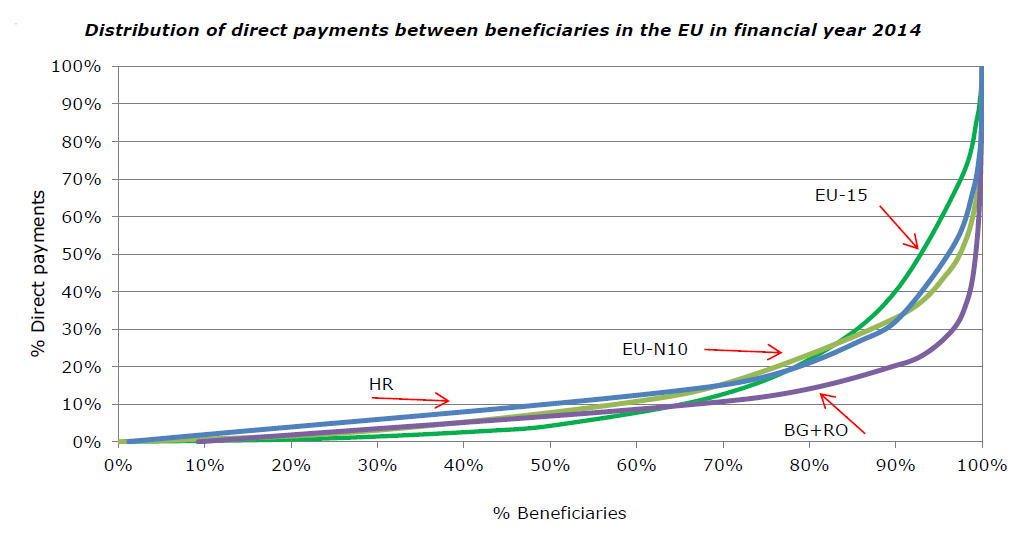
Each year, the Commission presents a report on the distribution of direct aids to agricultural producers (links are provided on this web page). In this report, the Commission presents the breakdown of direct payments by Member State and size-class of aid. It is the source for the graphs which compare the cumulative amounts of payments with the cumulative number of beneficiaries.

The graph from the most recent report for the 2014 financial year (thus covering direct payments made to farmers in 2013 as Member States are reimbursed in the following financial year) is shown below. It confirms that the oft-quoted statistic that 80% of direct payments go to just 20% of farmer beneficiaries is alive and well; indeed, the distribution is even more skewed in Bulgaria and Romania than in other Member States.


Measures included in the 2013 CAP reform to equalise payments per beneficiary

The 2013 CAP reform attempted to reduce the degree of inequality in the distribution of payments through two mechanisms, degressivity/capping and the redistributive payment.… Read the rest

Impact of Brexit on CAP budget net balances for remaining Member States

Much of the recent discussion on agricultural matters in the fall-out from the UK referendum vote on Brexit in June has focused on the implications for UK agriculture. What agricultural policy will the UK pursue after Brexit? What type of trade relationship will it have with the EU and with other countries? What arrangements might be put in place for seasonal migrant workers who play an important role in the production of certain UK crops?

However, Brexit will also have implications for the agricultural policy of the EU. I previously explored these implications in general terms in this Eurochoices article. In this post, I look more closely at the effect that Brexit will have for the net budget balances (gains and losses) of the remaining EU Member States. This can have an important bearing on the positions individual Member States take when discussing a future CAP reform (see my previous discussion on the role of net budget balances in the CAP).… Read the rest

The voluntary milk supply reduction measure in the July 2016 farm aid package

Last week the Commission proposed at the July AGRIFISH Council meeting a further aid package for farmers worth €500 million of EU money (and up to €850 million if Member States take up the opportunity to add national financing). This brings the total additional EU financing to support farmers since 2014 to €1.5 billion. The money for the latest package comes from unspent funds in the CAP budget and does not involve making use of the crisis reserve. In his address to COMAGRI outlining the package the following day Commissioner Hogan thanked President Juncker and the budget Commissioner Vice-President Georgieva for their support in making the package possible.

The July 2016 support package

The package contains three main elements:

  • A EU-wide scheme to incentivise a reduction in milk production (€150 million)
  • Conditional adjustment aid to be defined and implemented at Member State level out of a menu proposed by the Commission (€350 million that Member States will be allowed to match with national funds, thus potentially doubling the level of support being provided to farmers)
  • A range of technical measures to provide flexibility (e.g.
Read the rest

UK Brexit and WTO farm support limits

Today, we are pleased to present a guest post by Lars Brink who is affiliated with the Global Issues Initiative at Virginia Tech University and a leading expert on domestic support issues in the WTO Agreement on Agriculture.

Background

Domestic support and Bound Total AMS (Aggregate Measurement of Support) may not be high priority items, compared to market access, in terms of analysing trade distortions. Still, anything that touches on farm support and limits on such support attracts attention. This may apply also in a case of Brexit negotiations. This note is about the WTO domestic support commitment of the United Kingdom in case of a Brexit. It thus concerns the Bound Total AMS of the UK and that of the remaining EU27. The EU refers to the European Communities and the European Union, and EUR refers to European Currency Units (ECU) and euros.

In his immensely insightful post on 5 January 2016 entitled WTO dimensions of a UK ‘Brexit’ and agricultural trade, Alan Matthews raised the possible need to share out the EU commitment between the UK and the remaining EU27 (no, Alan did not make me say this as his price for accepting this post).… Read the rest