Navigating EU fertiliser policy through turbulent times

The governance of nitrogen fertiliser markets in the European Union has long been shaped by a fundamental and persistent tension between the competing interests of farmers and domestic fertiliser producers. On one side, European farmers advocate for unfettered access to nitrogenous fertilisers at the lowest possible prices—inputs that are critical to their productivity and competitiveness. On the other side, EU-based fertiliser manufacturers have lobbied for trade protection to shield themselves from what they view as unfair competition—particularly low-cost imports of ammonia and nitrogen fertilisers often linked to price dumping or state subsidies in exporting countries.

This traditional conflict has become significantly more complex in recent years, as new forces reshape the political economy of fertiliser trade. The Russian invasion of Ukraine in 2022 dramatically altered global energy markets, sending natural gas prices—the main feedstock for synthetic nitrogen fertilisers—soaring across Europe. This not only undermined the cost competitiveness of EU fertiliser producers but also exposed vulnerabilities in the Union’s supply chains, especially its reliance on imports from geopolitically sensitive suppliers such as Russia (see my previous post detailing trends in import sourcing of nitrogenous fertilisers to the EU).… Read the rest
Russian food sanctions against the EU

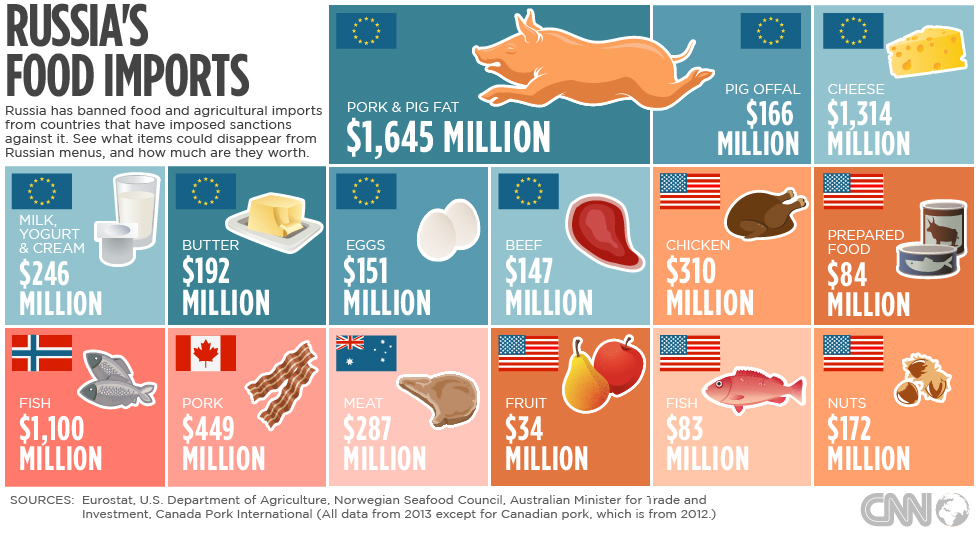
The Russian ban on the import of certain food products from the EU (and some other countries) has led to a chorus of appeals from member states and from farm groups for aid and compensation. The Russian ban has created an immediate problem in the fruit and vegetables sector, where the summer harvest for fruits is in full swing, there is a high dependence on the Russian market, and the produce is perishable with few immediate alternative outlets. But the overall scale of the problem needs to be kept in perspective. In this post, I present the data on the countries and products affected.
To date, the response of the Commissioner and the Commission has been measured and appropriate. In his first statement on the day after the ban came into force, the Agriculture Commissioner acknowledged the concerns of farmers, requested a potential impact analysis from his officials, and called a management committee meeting which took place yesterday.… Read the rest

Russian WTO accession by end year?

An announcement last week by Karel de Gucht, the EU Trade Commissioner, that the EU and Russia had struck a deal on remaining outstanding bilateral issues in negotiating Russia’s accession to WTO membership raises the prospect that this economic giant could become a WTO member by the end of this year.

Russia and the WTO

Russia first made its application in 1993 so has been negotiating its accession now for 18 years, by far the longest of any accession process by a WTO applicant. This reflects in part the country’s economic size (it is the sixth largest economy in the world on a PPP basis). Whereas normally 6-10 countries might seek to open bilateral negotiations with an acceding country because they had special trade interests at stake, in Russia’s case more than 60 countries made such requests.

But also China was a large economy whose WTO accession affected many countries, but despite the greater legacy of a command-and-control economy than in Russia’s case, China has now been a WTO member for a decade.… Read the rest