
CAP Transition Provisions 2021 Regulation delayed

In June 2020 the Council and COMAGRI negotiators reached a partial provisional political agreement on all essential aspects of the Commission draft Regulation extending the CAP provisions beyond 2020 (I discussed the Commission’s draft Regulation in this post). This followed a decision by COMAGRI to enter into negotiations with the Council without first seeking a Parliamentary first reading position on the basis of its legislative report on the draft Regulation agreed in May 2020. While most of the provisions of the CAP direct payments regulation would apply as long as that regulation remains in force, the transition regulation is necessary to provide a legislative basis for other CAP spending after 1 January 2021.

It had been intended that this political agreement would have been brought to the Parliament plenary taking place this week for a first reading/single reading approval. This did not happen. Instead, the transition regulation has got caught in the crossfire of various political disagreements. On the one hand, the Council and Parliament want a two-year transition while the Commission is still holding out for a one-year transition. On the other hand, at least some Member States in Council and COMAGRI want the additional funds proposed for rural development in the European Council conclusions in July 2020 as part of the Next Generation EU recovery instrument to be included in the transitional regulation for release and spending in 2021. The Commission’s draft regulation on Next Generation EU and the Recovery Instrument programme for rural development does not foresee this spending taking place until, under its timetable, the CAP Strategic Plans are in place on 1 January 2022.

The reason why the political agreement between Council and Parliament in June was only a partial one was that the key Annexes setting out the national ceilings for direct payments and rural development could not be filled in pending agreement on the MFF totals. Thus, all provisions with budgetary implications were left aside until the MFF negotiations were complete. Before reviewing the two ongoing political debates, we first examine some of the other changes to the draft transition regulation that have been agreed by the Council and Parliament.

Major amendments proposed by Council and Parliament

The major amendments to the Commission’s draft transition regulation are described below.

Funding for rural development. The Commission had proposed a dual approach to the continuation of rural development programmes in the transition year. Member States without unused funds from the 2014-2020 programming period could extend their existing programmes using the EAFRD allocation under the 2021-2027 MFF for the year 2021. Member States with unused funds could use these funds to enter into new commitments in 2021, and could carry over any unused funds from their 2021 EAFRD budget allocations to the later years 2022 to 2025. The Commission would have the power to reject applications that used ‘new’ 2021 money if it thought these were not justified. The European Court of Auditors predicted that only a small share of Member States would make use of their budget allocation for the year 2021. At the end of 2020, unspent funds for the current programming period are expected to range from less than 10% for Finland and Ireland to almost 50% for the Netherlands.

The rationale for this dual approach was not clearly spelled out in the preamble to the Commission’s draft Regulation. It seems the Commission was trying to ensure that as much of the new EAFRD money in the 2021-2027 MFF would be spent according to the new MFF rules with its anticipated higher levels of environmental and climate ambition. This objective now conflicts with the desire of the co-legislature to increase EAFRD spending in 2021 in response to the COVID-19 pandemic, and indeed the Commission itself has proposed the front-loading of €2.68 billion of EAFRD funds in current prices to 2021. In this context, it does not make sense to incentivise Member States to hoard these funds until later years in the MFF.

The common position does away with any restrictions and insists that Member States should have the possibility to finance their extended rural development programmes from the corresponding budget allocation for the years 2021 and 2022. Regulation (EU) No 1303/2013 would continue to apply to programmes supported by the EAFRD under the 2014–2020 programming period and to the programmes for which Member States decide to extend the 2014-2020 period. The main consequential change would be a requirement on Member States to amend their targets established in the context of the rural development performance framework to establish targets for 2025.

Green ambition. The common position would require that extended programmes should aim at maintaining at least the same overall share of the EAFRD contribution reserved for the environment and climate measures defined in Regulation (EU) 1305/2013 (which includes spending on ANC areas). This closes a potential loophole identified by the European Court of Auditors in the Commission’s wording that could have been taken to mean that a Member State that had spent more than 30% on environment-climate measures to date could pursue a lower allocation in the transition period.  Rather cheekily, the common position justifies this maintenance of the status quo by stating that it is “in line with the new ambitions set out in the Commission’s Communication of 11 December 2019 on the European Green Deal”.  On a practical level, where the Commission proposal limits new commitments in 2021 mostly to three years, the common position would allow a longer period for certain environment-climate commitments including organic transition.

Relaxation of rules for phasing out payments to those who lost entitlement to ANC payments because of the new delimitation of ANC areas. The new criteria for designating Areas of Natural Constraints meant that some areas lost ANC status. Provision was made in the 2013 Rural Development Regulation that, for farmers adversely affected by the new delimitation, payments could continue to be paid for a maximum period of four years but only until 2020. Because of the long delays in many Member States to complete the new designations, the initial deadline was extended to 2019. In these cases, as the phasing out of payments had to be completed by 2020, they could not benefit from the maximum four years extension. The Council/Parliament common position would allow these transitional payments to be continued in 2021 and 2022 provided they do not exceed €25 per hectare.

Further encouragement for risk management instruments. In order to further promote the use of mutual funds and of the income stabilisation tool for farmers of all sectors, the common position would relax the threshold of 30% that triggers the compensation of farmers for the drop in production or income applicable to the respective tool. The reduced threshold should not be fixed at a percentage lower than 20%.

Transitional national aid. Under the 2013 direct payments Regulation, Member States applying the Single Area Payment Scheme could decide to grant Transitional National Aid (TNA) in the period 2015-2020 to avoid a sudden decrease of support in those sectors benefiting from TNA until 2014. The maximum TNA payments allowed for these sectors decreased gradually from 75% of the 2013 level of SAPS aid in 2015 to 50% in 2020. The latest data (for claim year 2018) indicate that the ten Member States applying SAPS intended to provide around €623 million in TNA although, because of budgetary restrictions, actual payments were somewhat less at €501 million. Although TNA payments were intended to cushion a drop in support that occurred in 2014, the common position would allow this support to continue in the years 2021 and 2022 under the same conditions and limitations as in period 2015-2020 to ensure that “such aid continues to play its role in supporting the income of farmers in those specific sectors”.

The common position calls for a two-year transition

A new Recital (3) in the preamble notes that the legislative procedure for the CAP post 2020 still needs to be concluded and the CAP Strategic Plans to be developed with the need to consult stakeholders. Thus, it provides that the period for the continuation of the current CAP framework should be two years and not one year as the Commission proposed. The common position argues that the longer period would facilitate a smooth transition for beneficiaries to a new programming period and the possibility to take into account the Commission Communication on the European Green Deal.

Until now, the Commission has not been willing to budge on this issue (more under pressure from DG BUDG rather than DG AGRI, it would seem). However, in his intervention before COMAGRI in early September, Commissioner Wojciechowski seemed to suggest that a solution would be found in the context of the agreement on the disbursement of Next Generation EU funds for rural development. This is the other main political disagreement holding up ratification of the Transitional Regulation.

Disbursement of Next Generation EU recovery instrument funds for rural development

As I noted in a previous post, the AGRI coordinators in COMAGRI have decided to integrate provisions on the management of the NGEU/ERI-funds into the future CAP Transitional Regulation. The objective is to merge the two ongoing procedures into a single and final act. Paolo de Castro MEP is the rapporteur on the Commission’s draft legislation authorising expenditure from the European Recovery Instrument for EAFRD rural development spending.

The Commission’s original proposal for the ERI would have allocated €15 billion in constant 2018 prices (€16.5 billion in current prices) as assigned revenue to the EAFRD. Its draft legislation proposed that 50% of this total would be committed in 2022 with a further 25% being committed in the each of the years 2023 and 2024 (with payments continuing to be made until 2027).  

The European Council conclusions reduced this addition to EAFRD spending to €7.5 billion in constant 2018 prices. Like the AGRI coordinators, a majority of Member States in the Council in early September wished to frontload this spending to 2021 and 2022. The Council noted that the Commission has brought forward standard EAFRD MFF spending to 2021 and has proposed that the additional assigned revenue would be divided on a 30:70 basis between the 2021 and 2022 financial years. This differentiated allocation will compensate the effect coming from the frontloading of the original EAFRD funds. The compromise Commissioner Wojciechowski seemed to be hinting at is that the Commission might be prepared to accept bringing forward this spending if, in turn, the co-legislative were to limit the transitional period to the one year it originally proposed.

Conclusions

If all had gone according to plan, the Council and Parliament’s common position on the transitional regulation should have been approved at first reading in the Parliament’s plenary session this week. This would have provided certainty on CAP rules and funding in the coming year.

This timetable has now been further delayed, in part because the common position provides for a two-year transitional period rather than the one year favoured by the Commission, and further complicated by the desire of the Council and Parliament to incorporate accelerated spending from the Next Generation EU recovery instrument for rural development purposes in the Transitional Regulation.

The COMAGRI meeting scheduled for 12 October 2020 provides for a vote on amendments to de Castro’s draft report on the Next Generation EU draft regulation as well as scheduling an exchange of views on the CAP files. This will be an opportunity for an update on where the negotiations have reached both on the MFF, Next Generation EU, CAP Strategic Plans and Transition Regulation files.

Finally, the reason why the political agreement between Council and COMAGRI in June was only a partial one was that the key Annexes setting out the national ceilings for direct payments and rural development could not be filled in pending agreement on the MFF totals. The Commission published the Member State ceilings consistent with the European Council MFF conclusions last week. They make for very interesting reading and I will explore these figures in a separate post.  

This post was written by Alan Matthews

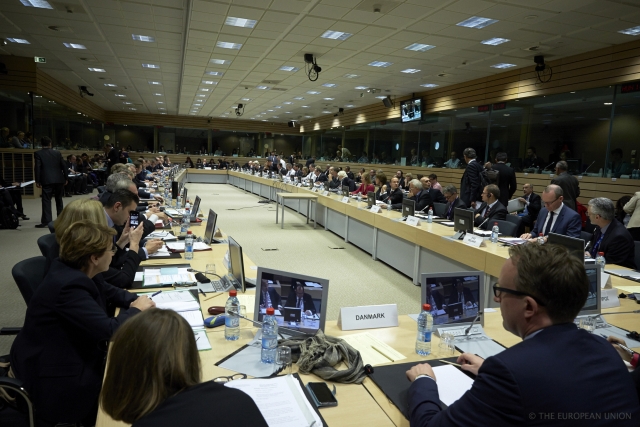
Photo credit: European Parliament used under a Creative Commons CC by 2.0 licence

Coronavirus uncertainty as CAP decisions are postponed

There is increasing focus on how the coronavirus pandemic is likely to affect agricultural markets, food supply chains and farm incomes (for example, the series of IFPRI Resources and Analyses on COVID-19). Panic buying of long-life staples – as well as toilet roll, of course – led to temporary shortages on supermarket shelves but supplies were very quickly replenished.

In the medium-term, there are concerns that labour shortages, logistical difficulties in transporting goods across borders and falling export demand have the potential to cause disruption. The various actors in the European food chain issued a statement on 19 March calling attention to likely operational difficulties and asking the Commission to ensure that free movement of goods within the single market can continue, including through managing ‘green lanes’ at borders, to allow the food chain to function effectively.

The European Milk Board has called on the Commission to start preparing the launch of a voluntary milk supply reduction scheme as it expects processing capacity will not be sufficient to handle the volume of milk farmers are able to produce.

Any or all of these initiatives would require policymakers to respond. The question how policymaking can continue with stringent social distancing restrictions in place has thus become more urgent. In this post, we look not at the short-term responses to the potential for disruption but rather at the implications of the COVID-19 pandemic for ongoing negotiations affecting the future of the CAP. The most important of these is the need to agree on the EU long-term budget, the Multi-annual Financial Framework (MFF), for the 2021-2017 period.

The 2021-2027 MFF

The extraordinary meeting of the European Council called to discuss the MFF in February failed to reach agreement with positions between the net contributor Member States and the net recipient Member States far apart. Farmers are aware that the CAP budget included as part of the package put on the table for that meeting represented a 3% reduction in nominal terms compared to CAP spending in the current MFF period.

Another meeting of the European Council should have taken place later this week which might have provided another opportunity for discussion. However, this European Council meeting has been postponed and will be replaced by a videoconference where only responses to the coronavirus pandemic will be discussed.

The MFF negotiations are important not only because they establish the ceiling for CAP support in the medium term, they also determine the value of payments that farmers will receive later this year. This is because direct payments to farmers in 2020 are financed from the 2021 EU budget due to the way the EU budget works.

When the MFF negotiations resume, they will take place in a vastly different economic context. The fall in economic output this year could rival that of the Great Financial Recession in 2008, depending on how long the economic lockdown continues.

Such a negative economic shock will require a major injection of public funds to overcome. Already, we are seeing European governments respond to the crisis with astronomical compensation packages for businesses and workers. One estimate is that countries such as Germany, the UK and Denmark have already announced stimulus packages (or what some economists are calling shield packages) amounting to 15% of their GDP. In the context of the enormous sums now being mobilised at very short notice to minimise the adverse effects of the restrictions necessary to address the pandemic, the amounts at stake in the MFF negotiations are puny.

Whether these compensation packages will encourage Member States to look more favourably on increased EU spending including the CAP budget, or whether they will constrain their ability to finance such spending, is not yet clear. It will depend, in part, on the depth and persistence of the economic collapse and on how farm incomes are affected relative to other workers in the economy including the self-employed.

There is still time to reach an MFF agreement before the end of this year but Member States may be reluctant to resume serious negotiations until the economic fallout from the coronavirus pandemic is clearer.

If no agreement is reached, the EU Treaties provide that there is an automatic and temporary extension of the ceilings in the last year of the current MFF. Paradoxically, this would result in a significantly higher MFF volume (around 1.15% of EU GNI) compared to the 1.11% proposed by the Commission and the 1.074% proposed by the European Council President prior to its February 2020 meeting.

However, as the MFF co-rapporteurs in the European Parliament’s Budget Committee have pointed out in a draft own-initiative resolution, having money available to spend does not help if there is no legal authority to use this money. Many expenditure programmes contain expiry dates that have to be prolonged to avoid a shutdown of the concerned programmes and to protect the beneficiaries. Their draft resolution calls on the Commission to propose legislation by 15 June 2020 that would extend the time limits laid down in the basic acts of all concerned expenditure programmes and to update the relevant financial amounts on the basis of technical prolongation of the 2020 MFF ceilings.

The CAP transition regulation

As it happens, such a transition regulation was already proposed by the Commission in October 2019 to cover the CAP. This was not because of the delays in the MFF at the time, but in the light of the slow pace of negotiations on the CAP reform package proposed by the Commission in 2018. This slow pace was due to disruptions caused by the Brexit negotiations, elections to the European Parliament in the middle of 2019, as well as the failure until now to agree a budget framework for the coming period. All of this meant that the deadline for submission of national CAP Strategic Plans for approval by the Commission by 1 January 2020 could not be met.

The idea behind the transition regulation is that existing rules would continue to apply for at least one more year within the framework of the budget ceiling given by the new MFF. Member States that have already used up their funds avaliable for the 2014-2020 period will be able to finance these extended programmes from the corresponding budget allocation for the year 2021. They will be expected to maintain at least the same overall environmental and climate ambition when prolonging their schemes. Member States that still have funds available are given the option to transfer their 2021 budget to the 2022-2027 period if they wish.

The Parliament’s AGRI Committee had intended to provide its opinion on this draft regulation in April with a vote scheduled in the whole Parliament in June which would allow negotiations to open with the Council of Agriculture Ministers. The position of the Council is not yet finalised and its working documents with proposed amendments are not available to the public. However, decisions should be made by mid-2020 to allow Member States to make the necessary adaptations at national level.

Many are of the view that it would make sense to extend the transition regulation for a two-year period given this uncertainty. In the COMAGRI rapporteur Elsi Katainen’s draft report, the Commission’s draft regulation is amended to extend the transition period to two years if MFF conclusions for the period 2021-2027 are not published in the Official Journal by the end of September. I suspect this amendment will be supported by the Committee and by the Parliament in plenary and will also find support in the Council. Given the delays and difficulties in finalising the MFF, a two-year transition must now be the most likely outcome.

The CAP budget for direct payments in 2020

The transition regulation also sets out the national envelopes for Member States for 2021 for both direct payments and rural development spending. Because the MFF was not concluded when the Commission prepared the draft regulation, it entered figures based on the overall ceilings for Pillar 1 and Pillar 2 spending contained in its own MFF proposal from May 2018. While this proposal foresees a relatively small reduction in spending on Pillar 1 direct payments in nominal terms, it included a significant reduction in Pillar 2 spending on rural development.

The COMAGRI rapporteur argues that, if farmers should work to the same rules in 2020 as in 2019, they should also work for the same money. She has proposed that the national allocations included in the Annexes to the transition regulation should be calculated on the basis of the figures agreed for the MFF 2021-2027 or, if not adopted in time, on the basis of extended 2020 ceilings in accordance with the Treaty provisions.

In case this results in a sharp cut in Pillar 2 ceilings in 2021, the rapporteur suggests allowing Member States to increase their national co-financing to allow rural development programmes to continue without any cuts to farmers.

When discussing the roll-over arrangements for the MFF ceilings in the event of no MFF agreement being concluded before the 2021 EU budget is adopted, I highlighted that the 2020 ceilings for the various headings and sub-headings, including the CAP, would automatically be carried forward to 2021. In principle, therefore, it would be possible to continue to make direct payments to farmers at the same level in 2020 as in 2019.

Whether this would happen in practice would depend on the outcome of the EU’s 2021 budget negotiations later this year, where decisions in the Council are taken by qualified majority and the Parliament has equal status as co-legislator. It could therefore be quite late into this year before farmers know the value of their direct payments.

Farm to Fork Strategy

Another argument for a longer transition period is that it would allow more time to absorb the implications of the Farm to Fork Strategy which is the agri-food component of the European Green Deal and to integrate its objectives into the CAP Strategic Plans.

The Strategy was originally expected to be announced this week but this has now also been postponed by at least one month. It is expected to contain high-level targets for reduced use of fertilisers, pesticides and antibiotics, an expansion in organic farming while also highlighting the more ambitious targets to reduce net greenhouse gas emissions and incentivising carbon sequestration practices.

Finding a way to properly debate these potentially far-reaching proposals if the social distancing measures to address the coronavirus pandemic remain in place will be a challenge. At a purely banal level, EU rules of procedure to allow decisions to be taken by videoconference rather than requiring a quorum at physical meetings will be necessary.

Conclusions

In summary, policymaking in the coronavirus era will have to adapt until population immunity is built up and a vaccine is available. A way will be found to make farm direct payments in 2020 but the level of these payments may not be known until much later this year.

The delays in decision-making mean that any new CAP rules under the CAP Strategic Plans will be postponed most likely now for two years.  To the extent that the new CAP framework would have facilitated a greater emphasis on addressing urgent environmental and climate challenges, this delay is unfortunate.

These challenges do not simply disappear because of the coronavirus. This makes it all the more important to use the additional time as productively as possible to see how best to integrate the recommendations of the Farm to Fork Strategy into Member States’ CAP Strategic Plans. As the European Court of Auditors notes in its Opinion on the transition regulation: “This additional time should be used to address the climate and environmental challenges set out in the Green Deal, ensure robust governance of the future CAP and shore up its performance framework“. I agree totally.

This post was written by Alan Matthews.

Update 12 May 2020: The description of the options available to Member States with respect to their rural development programmes has been corrected.

Commission publishes CAP transition regulations recognising implementation of new CAP will be delayed

DG AGRI and the Commission have now officially recognised that, in view of the present state of play in both the Parliament and the Council, the basic acts governing the CAP post 2020 and the ensuing delegated and implementing acts will not be formally adopted by January 2020 and that, therefore, it will be necessary to plan for a transitional period. The new legal framework will now begin from 1 January 2022.

Although the current CAP Regulations continue in force until they are repealed, they need amendment to ensure that there is a legal basis for making payments to farmers in 2021. This is the purpose of the two draft Regulations published yesterday, one laying down transitional provisions in 2021 (including annexes) and the other extending the financial discipline provisions as well as the possibility to shift funds between the two Pillars of the CAP (including annexes).

This post examines the implications of the Commission’s proposals for Member States and farmers.

The 2014 transition regulation

There was a similar hiatus in CAP programming in 2014 due to the late adoption of the 2014-2020 Multi-annual Financial Framework (MFF) Regulation and the CAP reform package in 2013. On that occasion, the Commission put forward its proposal for a transition regulation in April 2013 to cover payments in the year 2014.

One important difference between now and then is that the European Council had agreed the MFF conclusions (including the pre-allocated amounts to Member States for direct payments) in February 2013 (although the European Parliament had not at that point in time given its consent to these conclusions).

Regarding direct payments, the basic approach was to postpone the legal changes (such as greening rules, payment degressivity, internal convergence of payments etc) but to implement the new financial ceilings that had been agreed by the European Council the previous February. This meant that the process of implementing the move towards a more uniform distribution of unit payment values between Member States – external convergence – already applied in the 2014 claim year. This was summarised by the then Agriculture Commissioner Dacian Ciolos as “existing rules, new budget”. The national envelopes for direct payments allocated to each Member State were set out in square brackets, indicating they waited on final legal confirmation.

For rural development, transitional rules were needed partly because the postponement of the new rules for direct payments had a knock-on effect for certain rural development measures especially as regards the baseline for agri-environment and climate measures and the application of the cross-compliance rules.

Transitional arrangements were also needed to ensure that Member States could keep on undertaking new commitments for certain area and animal-related measures in 2014 even if the resources for the current period had been exhausted. The transition regulation clarified that these new commitments, as well as corresponding on-going commitments, could be funded from the new financial envelopes of the rural development programmes of the next programming period. At this stage the annex with rural development ceilings by Member State had not been made public, so no change was required here.

The transition regulation also addressed some other financial issues. On financial flexibility between Pillars which the Commission accepted was a matter to be decided by the ordinary legislative procedure, its proposal recognised that, as of April 2013, there was a difference of view between the Council and the Parliament. The Council had taken over the European Council’s percentages on the shares of either Pillar that could be transferred to the other Pillar, while the Parliament wanted higher percentages. The Commission thus put this specific element in square brackets in its proposal to indicate it was not taking sides in this dispute.  It also decided that the new co-financing rate for rural development should apply to the transitional RD expenditure in 2014.

The 2019 draft transition regulation

The Commission’s transition regulation for 2021 follows the general principle enunciated by former Commissioner Ciolos of “existing rules, new budget”. For direct payments, the current rules are extended for the claim year 2021. This implies, for example, that Member States that adopted the derogation of the ‘tunnel’ or ‘Irish’ model of internal convergence can continue this process after 2019. The farm union Via Campesina regrets that the delay means that the Commission’s proposal for capping and the redistributive payment will not be introduced until 2022.

For rural development programmes, Member States are given an option. They can either extend their existing RDPs (schemes, rules etc) by one year, drawing on the proposed 2021 financial allocation to cover the funding. If they decide to do this, there are certain restrictions imposed. The extended programmes should aim at maintaining at least the same overall level of environment and climate ambition. In order to limit a significant carry-over of commitments from the current programming period for rural development to the CAP Strategic Plans, the duration of new multiannual commitments in relation to agri-environment-climate, organic farming and forest-environment should be limited to a period of maximum 3 years. The extension of existing commitments should be limited to one year.

On the other hand, Member States can opt not to extend their RDPs and then they can carry over the budget allocation for RDPs in 2021 and add it to their 2022-2027 allocations. This option was implicit in the 2014 transition regulation. That gave Member States the possibility to keep on accepting new commitments for area and animal-based measures but did not oblige them to do so. This new draft proposal makes this option explicit. If Member States do decide to open existing schemes for a further year, this is not confined to “area and animal-based measures” but can also cover investment aids, young farmers’ installation aids, etc.

For some schemes, such as Areas with Natural Constraints and organic farmers, I expect Member States will roll over the payments. For agri-environment-climate measures (AECMs), many Member States may prefer to wait until the new CAP starts rather than re-open these schemes for new applicants. This would obviously adversely impact farmers who might wish to have the opportunity to participate in such schemes.

Interestingly, unlike in 2014, the Commission does not suggest that the new co-financing rates it has suggested in its draft legislative proposal should apply already in 2021. This may reflect recognition of the strong push-back this proposal has received from Member States.

For the national envelopes, the Commission has proposed the pre-allocated amounts reflecting its own draft MFF proposal. As in 2014, these amounts for direct payments reflect the further steps towards external convergence that the Commission has proposed. This could be controversial, as many Member States have objected to the cuts in the CAP budget implied by these figures so presumably will not be happy with the Commission’s way forward.

Unlike in 2014, the Commission does not have a set of European Council conclusions on which it can lean. Despite this, the amounts are not presented in square brackets as was done in 2014. The 2021 proposed ceilings for direct payments and rural development are shown in the following table. These figures are compared to the original 2020 amounts proposed in the 2013 regulations to avoid confusing the comparison with the transfers between Pillars made by Member States in 2020, and which they can continue to apply in 2021 but these decisions are not yet known.

In the Commission’s defence, it is hard to see how they could have proceeded differently given that the MFF ceilings for 2021-2027 are not yet agreed. Although not stated in the draft legislation, presumably if the MFF figures end up larger than what the Commission has proposed, a further amendment could be made to update the regulation.

Member States and the Parliament could argue for a different approach, one in which the 2021 amounts inserted into the Regulation are maintained at the 2020 levels, with the possibility to use the financial discipline mechanism to reduce these amounts to keep them within the MFF ceilings when they are agreed and known.

For the rural development ceilings, because the 2021 amounts represent an equi-proportionate cut on the 2020 ceilings for every Member State, the two approaches would end up with the same figures. However, using the 2020 amounts as the basis for determining the direct payment ceilings in 2021 would mean that external convergence would be delayed for one further year. Those Member States that benefit from the uplift in payments in 2021 (the Baltic States but also Poland, Portugal and Romania) would presumably object to this approach.

In any case, these pre-allocated amounts will be determined as part of the European Council negotiations on the MFF. Although they are formally implemented as part of a legislative proposal agreed under the ordinary legislative procedure, the Council will put forward the European Council’s conclusions and the Parliament would be wise not to challenge this (see discussion on the division of competences in this post).

The changes made in the accompanying draft legislative proposal on financial discipline and flexibility to transfer funds between Pillars are essentially technical, allowing the continuation of the measures in place into the 2021 financial year.

Conclusions

In summary, a delay in the introduction of new CAP legislation also occurred in 2014 where there was also a need for a transition regulation. A delay even for one year is disappointing where the new CAP rules are an improvement over the current ones.

The transitional regulation provides a legal basis for making payments to farmers in 2021. Compared to the 2014 transition regulation, the current Commission proposal provides Member States with a more explicit option not to open rural development programmes for new applications in 2021 if they want to wait to 2022. Where new commitments are made, for example, for AECM schemes, they are limited to a maximum of three years.

The transition regulation provides for pre-allocated national envelopes to Member States in line with the Commission’s draft MFF proposal. Many Member States have objected to the cuts in the CAP budget in this proposal, but presumably if there are changes to CAP funding agreed in the European Council conclusions on the MFF, these changes will automatically be included in an amendment to this regulation. The basis for the Commission’s proposal continues to be, as in 2014, “existing rules, new budget”.

This post was written by Alan Matthews