


The money likely to be available to support the CAP objectives post-2027 – income support, resilience and sustainability, innovation and competitiveness, risk management and development of rural areas – remains uncertain. The negotiations on the size and allocation of the EU budget appear far from resolution. The next version of the MFF negotiating box (‘negobox’) to be proposed by the Irish Presidency may be produced as early as next week, to give Member States time to digest the figures prior to the General Affairs Council on 13 October and the European Council summit on October 15-16.
As MFF negotiations enter a critical phase, agricultural stakeholders are concentrated on the size of the resources likely to be ultimately available to the CAP. Another focus in the negobox text will be the treatment of issues that are specifically relevant to agriculture such as the MFF inflation adjustment, the 10% rural target, the scale of the flexibility mechanisms, co-financing rates, the use of mid-term review funds and the design of direct payments. These parameters remained within square brackets in the Cyprus Presidency draft (meaning awaiting political arbitration). There will be a focus on whether additional agreement has been reached within the Council on these issues so that some of these square brackets are removed.
The debate about the CAP budget after 2027 to date has focused overwhelmingly on the size of the EU resources available. But the eventual resources available to agriculture will depend on two further decisions. The first is how much of the flexible NRPP resources Member States allocate to CAP measures in addition to the minimum ring-fenced amounts. Related to this decision is the amount of national co-financing Member States must make to supplement this EU funding. The second decision, which has received much less attention, is how much additional national financing Member States might be prepared to provide alongside EU funding and national co-financing.
Given that we will not know the outcome of these decisions until the publication of the CAP chapters in the NRPP Plans or even later, it is not possible to make a definitive judgement about the scale of the additional resources to support farmers that might become available. But this does not mean that the significance of these decisions and the resources associated with them should be ignored or overlooked. This post discusses each of these decisions in turn.
How much of the NRPP envelope will Member States devote to agriculture?
Even when the Council reaches agreement on the MFF and the Parliament gives its consent, the responsibility then shifts to the Member States to decide how large the CAP budget in each Member State will be. How much of the new NRPP envelope will Member States choose to devote to agriculture? The NRPP Regulation only specifies a minimum ring-fenced amount for CAP income support. Member States will have the option to add to this by bringing forward a share of the mid-term review flexibility amount if allocated to the CAP. Member States are also required to provide support for some additional CAP interventions (such as LEADER and AKIS) from the unallocated portion of the NRPP envelope.
These measures will be underpinned by the 10% rural target (based on the NRPP envelope excluding the ring-fenced amounts for the CAP and fisheries) to support investments in rural areas (the introduction of rural targeting is already agreed in the Cyprus Presidency negobox, the square brackets only refer to the precise percentage). This rural target creates an additional source of funding that could benefit agriculture. Commission President von der Leyen’s letter of 6 January 2026 making this proposal specifically notes that “Member States will allocate their rural target share to measures to be implemented in the agricultural sector at the initial stage of programming, similar to what happens in the current budget cycle, unless they decide for measures dedicated to rural areas”. This could incentivise Member States, for example, to increase support for investment in agriculture and food processing from the unallocated part of the NRPP Fund.
The draft Performance Regulation (Article 4) requires that programmes and activities shall be implemented with a view to achieving an overall spending target of at least 35% of the total amount of the MFF budget on climate action and environmental objectives. To meet this target, the NRPP fund is expected to contribute at least 43% of its overall financial envelope to these objectives, based on the EU coefficients attached to each intervention field. Some CAP measures contribute 100% to these objectives. Although the 43% figure is not a binding target as such, it could encourage Member States to direct additional NRPP resources to these measures if there is difficulty in reaching this percentage otherwise.
Even apart from the impact of regulatory obligations and incentives to increase the CAP budget allocation within the NRPP Fund beyond the minimum ring-fenced amount, Member States may voluntarily allocate additional support for the CAP within the NRPP envelope as an expression of national policy priorities. In a previous post, I discussed the scope for additional allocations, distinguishing between structural constraints and political willingness.
The structural constraint can be measured by the share of the CAP minimum ring-fenced amount in the overall NRPP envelope. The former is determined by the amounts Member States will receive in CAP payments in 2027, while the latter is determined by a new formula set out in the NRPP Regulation. The larger the share of the CAP ring-fenced amount in a Member State’s NRPP envelope, the smaller the headroom for reallocation within the NRPP Fund and the more difficult it will be for a MS to shift additional funding to the CAP.
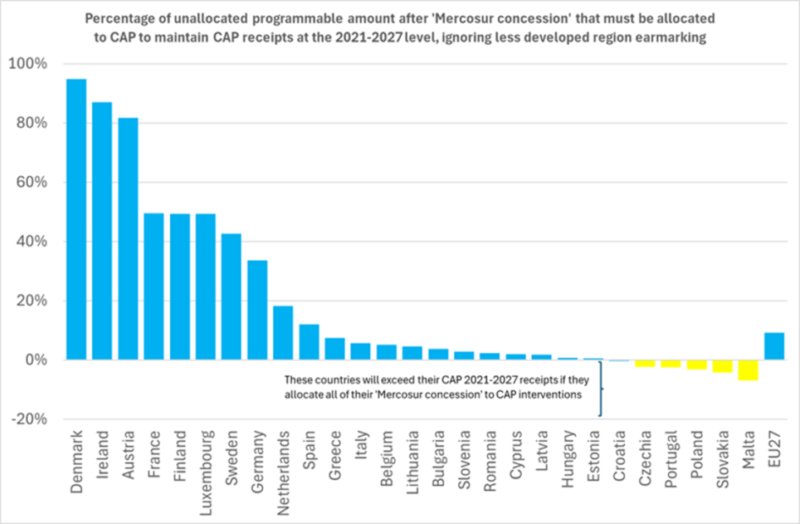
I measured the structural scope to increase CAP spending by comparing the headroom within the NRPP Fund with the amount needed to maintain CAP spending at the 2021-2027 level in nominal terms. I assume that MSs will utilise in full the ‘Mercosur’ concession which allows them to bring forward spending from the mid-term reserve (so-called because it was introduced as a concession to farmers at the time when ratification of the EU-Mercosur trade agreement was being discussed). There would be little point in discussing the prospect of MSs adding to their ring-fenced CAP amounts from the unallocated part of their NRPP envelopes if they did not first make full use of existing flexibilities. The comparison shows that the range is very wide, from some countries on the right of Figure 1 which would already exceed their current CAP budget after using the Mercosur amount, to countries like Denmark, Ireland and Austria to the left of the chart that will scarcely be able to make full use even of the Mercosur flexibility, so small is the NRPP headroom they have.
Source: As given in the original post.
National spending on agricultural support through co-financing
Once the NRPP Fund allocation to the CAP has been decided, Member States must then calculate their national contributions (what is referred to in the current CAP as national co-financing) to these CAP measures. For CAP interventions, there are three layers of minimum national contribution rates:
- No national contribution is required for four CAP interventions (a) degressive area-based income support (b) coupled income support, (c) crop-specific payment for cotton, and (g) support for small farmers (Art. 20(4) NRPF Regulation). Nor can additional national financing be provided for these interventions.
- For all other CAP interventions, the minimum national contribution rate shall be at least 30% of the estimated cost (Art. 35 (4)). Higher national contribution rates are allowed.
- However, these 0% and 30% minimum rates only apply to expenditure up to the minimum ring-fenced for CAP income support for each Member State. If a Member State wishes to top up this minimum amount by transferring unearmarked resources from the NRP Fund, the general regional rates apply. For CAP expenditure in NUTS2 less developed regions, this will be a minimum of 15%, 40% in transition regions, and in more developed NUTS2 regions it will be 60% (Art. 20(4)). These territorial differentiated rates are the same as under the current CAP except for the more developed regions where the minimum national contribution rate has been increased from 57% to 60%.
Whether these changes will lead to a significant additional requirement for national financing or a reduction compared to the current CAP cannot be determined at this point. Some changes point to a higher requirement for national contributions. Eco-schemes are currently fully funded by the EU budget but, as part of the new agri-environment-climate actions will now require a minimum national contribution. Agri-environment-climate actions, area-specific disadvantages arising from mandatory requirements, non-productive investments, EIP operational groups and LEADER all have more favourable minimum national contribution rates (20%) in the current CAP. For less developed regions, their maximum contribution rate of 15% under the current CAP will increase to 30% for many CAP interventions, to the extent that they are funded from the minimum ring-fenced amount.
There are some moves in the other direction which benefit transition and more developed regions. The new 30% minimum national contribution rate for interventions financed by the ring-fenced CAP amount represents a reduction from their standard rates for other CAP interventions such as risk management tools, investment aid and installation aid, and also for ANC payments (where the current minimum rate is 35%).
From the figures in Table 1, national co-financing of rural development interventions amounts to 40% of the total public expenditure on these interventions in the CAP Strategic Plans. This is equivalent to 68% of the EU budget contribution. How this proportion will change in the post-2027 period will depend on how Member States distribute their ring-fenced resources between interventions that do not require national contribution and those that do, the extent to which they supplement these ring-fenced amounts from the flexible portion of the NRPP Fund, and the spatial distribution of CAP spending across NUTS2 regions with different development status.
Additional national spending on agricultural support
The second decision that Member States must make is how much additional national money they are prepared to use to support agriculture once their EU allocation and national contribution has been determined. This is entirely overlooked in the current debates around the CAP budget, but the experience of recent years suggests that it deserves more attention than it has received. The size of the EU CAP allocation provides only part of the picture of the resources that Member States make available to agriculture. In this section, I look at the numbers for the current programming period, recognising that it is not proposed to extend all of these meaures into the post 2027 CAP period.
In addition to obligatory national co-financing, Member States can support agriculture through Article 146 financing in the CAP Strategic Plans Regulation (EU) 2021/2115. This allows Member States to provide additional national financing for rural development interventions included in their CAP Strategic Plans in relation to operations that fall within the scope of Article 42 TFEU, provided that they comply with the conditions set down in that Regulation.
Member States cannot add national financing to interventions supported under the CAP Pillar 1 except where it is provided for in relation to certain sectoral interventions. However, Article 147 allows certain Member States to continue to provide transitional national assistance (TNA) to their farmers which take the form of either decoupled or coupled payments. The countries targeted are those that joined the EU after 2004 and that provided TNA in the period 2015-2022 (seven countries are eligible). The maximum TNA amounts are linked to the amounts agreed per sector in 2013 on a declining scale – so 50% of the 2013 amounts in 2023 falling to 30% in 2027 – although the actual amounts granted can be considerably lower.
Member States can also provide national State aid to agriculture. New aid measures normally have to be notified to the Commission and approved before they can be implemented. However, the Agricultural Block Exemption Regulation (ABER) exempts specified categories of agricultural aid from the prior notification requirement, provided that the conditions of the Regulation are met. A separate de minimis regime allows relatively small amounts of support to be granted outside the EU State aid control system
The ABER permits aid without prior notification to the Commission for specified categories, including investment in agricultural holdings, environmental and climate measures, animal welfare, risk prevention and restoration following natural disasters, research and innovation, and certain measures for processing, marketing and rural development, provided that the detailed eligibility, aid intensity, transparency and other conditions of the Regulation are met. These are similar to measures funded under the CAP rural development Pillar 2.
The Agricultural De Minimis Regulation provides a simpler route for relatively small amounts of support: since December 2024, aid to a single undertaking (for example, a farm) may not exceed €50,000 over three years, while Member States must also respect a national ceiling for aid to primary agricultural producers and comply with cumulative-aid and record-keeping requirements. De minimis aid is much more flexible than ABER and is not tied to a particular type of intervention or eligible expenditure. It may therefore be used to make direct payments to producers, subject to the overall ceiling of €50,000 per undertaking over three years. The Commission’s State Aid Scoreboard covers State aid reported under the relevant State aid rules, but does not include amounts granted under the de minimis rules. The data reported are the aid element; for grants, the amounts are the aid element but for instruments like loan guarantees or interest rate subsidies, the amount of support can be much higher than the aid element alone.
Finally, Member States have increasingly resorted to providing nationally-funded crisis payments to farmers, both under the several Temporary Crisis Aid packages introduced first at the time of COVID-19 and later in response to the Russian invasion of Ukraine, but also under the exceptional measures provisions of the Common Market Organisation (CMO) Regulation. The latter are normally funded by the agricultural crisis reserve, but the Commission frequently allows Member States to provide additional top-up aid which is not governed by State aid rules. The Commission has published a report to the Council and Parliament listing the use of crisis measures between 2014 and 2023 authorised under the exceptional measures provisions of the CMO Regulation (Commission 2024).
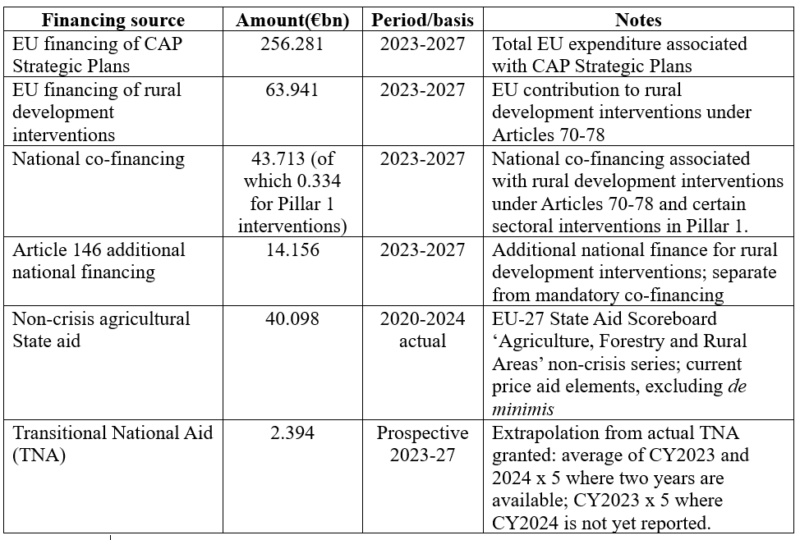
Table 1 provides a summary of some of these measures using the available information. Some totals are specified in CAP Strategic Plans and are known and fixed for the 2023-2027 period. To provide an order of magnitude of non-crisis State aid, I have included actual expenditure for the latest available five year period 2020-2024. TNA is also provided outside of the CAP Strategic Plans on an annual basis. I make an estimate of potential spending by extrapolating data on TNA granted in the first year or two of the CSPs. For reference, I include EU spending on CAP Pillar 2 rural development measures as, with the exception of TNA, the other items of national spending concern similar measures. Because the various items are based on different time periods and methods of estimation, it is not appropriate to add them together to obtain an overall total. Instead, the figures are intended to provide some relative orders of magnitude.
These figures are still an underestimate of national spending on agricultural support. The missing items include crisis aid spending to support agriculture and de minimis aid to agriculture. Central register reporting for de minimis aid only begins in 2027 and the first annual aggregate data submission to the Commission will cover aid granted in 2027. Crisis aid expenditure has been excluded due to lack of data as the State Aid Scoreboard only provides an overall figure which is not broken down by benefitting sector. Although some Member States introduced crisis schemes that specifically targeted farmers, in other countries farmers could benefit from aid that was widely available to all sectors. In any case, crisis aid is episodic and exceptional and therefore provides a poor indicator of Member States’ normal willingness to devote national resources to agricultural policy. On the other hand, not all rural development spending benefits agricultural producers as some is directed to non-farmers and rural areas more generally.
The most important conclusion I draw from Table 1 is that Member States show considerable willingness to voluntarily provide additional national financing for farmers in the current CAP programming period. Keeping in mind that the figures are not directly comparable, they suggest that Member States have been prepared to provide voluntary additional national financing on a scale comparable with their mandatory co-financing requirements either through additional national financing in their CAP Strategic Plans or through providing non-crisis State aid. Relatively little of this additional national CAP support goes to agri-environment-climate measures (around 16% of annual national financing in CAP Strategic Plans, and around 6-7% of non-crisis state aid in the years 2023-2024) with significant shares earmarked for investment.
Sources: For the data extracted from the CAP Strategic Plans in the first four rows, DG AGRI, Catalogue of CAP Interventions, https://agridata.ec.europa.eu/extensions/DashboardCapPlan/catalogue_interventions.html, accessed 1 October 2026.
For non-crisis State aid, State Aid Scoreboard data (2000-2024) https://competition-policy.ec.europa.eu/state-aid/scoreboard/scoreboard-state-aid-data_en
For Transitional National Aid (TNA), Table 2.6.3 Information on transitional national aid, Country Annual Performance Reports accessed through https://agriculture.ec.europa.eu/cap-my-country/cap-strategic-plans_en.
Additional national spending by Member State
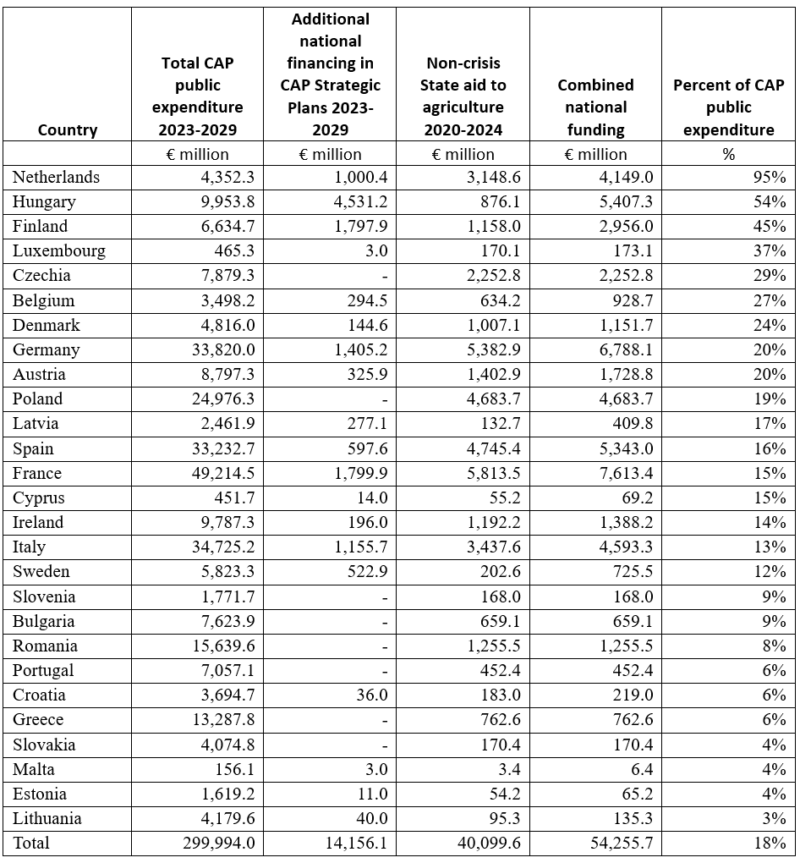
An issue often raised with respect to additional national financing by Member States is the unequal fiscal capacity to afford such spending. Therefore, we next examine if there is a pattern of additional national spending across Member States. For this purpose, we combine the projected additional national spending reported in CAP Strategic Plans with actual State aid non-crisis spending on agriculture, forestry and rural areas in the most recent five-year period 2020-2024. These are not overlapping periods so we must be careful how to interpret the results. To normalise the data, we could express this combined additional national spending as a percentage either of the total public expenditure on CAP Pillar 2 or of total CAP spending in the CAP Strategic Plans. Because the share of Pillar 2 funding in total CAP funding differs considerably between Member States, calculating the shares relative to Pillar 2 spending can give high percentage shares for those Member States with a relatively limited Pillar 2 budget, without necessarily revealing whether they have a greater political willingness to support farmers. For this reason, we normalise the combined national spending amounts by expressing these as a percentage of the total public spending on the CAP in their CAP Strategic Plans (see Table 2).
There is clearly a significant range in the extent to which Member States provide additional national financial support to their farmers. At the top of the ranking sit the Netherlands, Hungary and Finland where the combined national funding amounts to 45-95% of projected spending in the CAP Strategic Plans, while at the bottom of the ranking sit Malta, Estonia and Lithuania with shares around 3-4%. The data show a positive association between national prosperity, as a proxy for fiscal capacity, and the extent of additional national support. This is borne out by the positive correlation shown in Figure 2. But there is much variation around this relationship. Hungary, Czechia and Poland provide substantially more national support than would be suggested by their position on the GNI per capita relationship, while Sweden, Italy and Ireland all lie below the EU average.
Source: As for Table 1.
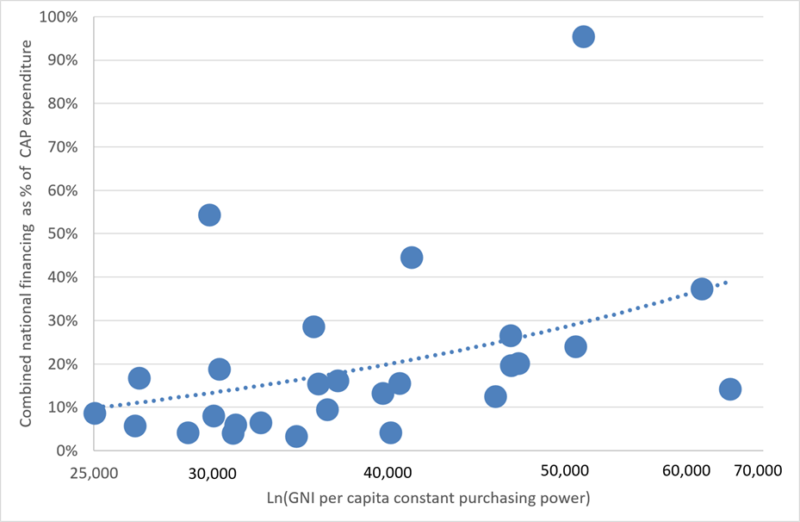
Source: GNI per capita at purchasing power standard (PPS, EU27 from 2020) in 2024 from Eurostat, Gross national income (GNI) per capita, nama_10_pp. Percentage shares of combined national financing relative to total CAP expenditure from Table 2.
Conclusions
In this post, we examine the two decisions that Member States must take under the Commission’s new MFF proposal to determine the overall budget available to support farmers in the post-2027 period. The first decision is how much of the unallocated portion of EU funding in the NRPP envelope to use to top up the minimum ring-fenced amount for the CAP. I highlight the structural context which can either facilitate or constrain the ability of Member States to add to the minimum CAP ring-fenced amount. My analysis shows that Member States have very different capacity to tap into the unallocated part of their NRPP envelope to increase the ring-fenced CAP budget. In turn, the choices that Member States make will have implications for the national contributions they are required to make to supplement EU budget funding for most CAP interventions.
The second decision, which is rarely raised in discussion, is how much additional national financing, on top of obligatory co-financing of CAP measures, to provide. Experience shows that additional national financing, both channelled through the CAP Strategic Plans but also through State aid, is significant and should not be discounted. Member States have shown considerable willingness to voluntarily provide additional national financing through these channels. But it is also clear that Member States differ in fiscal capacity and thus in their ability to supplement their mandatory CAP spending in this way.
The key message is that post-2027 agricultural support will not be determined solely by the EU-level ring-fenced CAP allocation. Member States can decide how to use the flexible portion of their NRPP envelopes, national contributions will be required for many CAP measures, and Member States will have considerable discretion to add to this through additional national financing and State aid measures. Past experience may not be a guide as to what to expect post-2027. The fiscal position of most EU Member States has deteriorated so the scope to top up CAP spending in the coming period may be greatly reduced. Still, these often overlooked sources of funding for farmers should not be ignored in discussions of the CAP budget post 2027.
This post was written by Alan Matthews.
4 October 2026. The post was updated to make clear that the default route for State aid to agriculture is notification to and approval by the Commission while ABER provides automatic approval for the range of measures covered by that Regulation.
Photo credit: Flickr, Images Money, used under a CC by 2.0 licence.
