Greening of the CAP: is the “Emperor Naked”?

Greening of direct payments is the focal point of the Commission’s legislative proposal. By this measure, Commissioner Dacian Ciolos substantiates the reform orientation and greater target orientation of the proposed new Common Agricultural Policy. Out of all funds for direct payments, 30 % would be allocated to fulfilling the environmental conditions, which is EUR 12.5 billion annually and five times more than the amount of funds for the agri-environmental measures under the current rural development policy.  The impact of agriculture on the environment is undisputable; we economists understand it through the concept of externalities or public goods, as something that cannot be regulated societally correctly by market forces.

Two poles: environment as target or excuse?

In last two decades, the arguments for the reform of traditional agricultural policy through targeted support for eco-system services of agriculture have been strengthening. The latter is also a part of the pro-reform campaign by the environmental organisations, which also emphasise that these services need to be carried out in a controlled manner.… Read the rest
Leaked Commission figures sound death knell for biodiesel

Euractiv has a post purporting to contain the default carbon emission values to be assigned to biofuels made from feedstocks such as palm oil, soybean or sugar beet when the European Commission releases its proposed legislation on biofuels and indirect land use change later this spring, based on a leaked draft of the proposal.

Any application of the leaked values would severely hamper the ability of biodiesel manufacturers to enter into the EU’s new biofuels certification plan, announced last August.

Assuming that the EU does not relax its overall target for renewable energy in transport fuel (10% by 2020), if biodiesel fails to make the grade this would raise the demand for bioethanol made either from domestically-produced sugar beet or imported either from Brazil or Southern Africa.

This post was written by Alan Matthews.Read the rest

Agricultural Council discusses the single CMO

Danish Agricultural Minister Mette Gjerskov presided over her first Agricultural Council of the Danish Presidency with some dash and vigour last Monday 23 January. Her energy contrasted with the comments of some of her fellow Ministers in their first formal debate on the Commission’s single CMO legislative proposal, with a number of ministers seeking to roll back some previous reforms.

The Presidency structured the debate around two themes: the effectiveness of exceptional measures in case of market disturbances and crisis; and the proposed measures aiming at a more competitive and well-functioning food supply chain. The debate, which lasted just over two hours, can be followed here on video.

The key battle lines that emerged can be summarised as follows. For simplicity, I refer to those who would like to return to a more managed market as the ‘blues’, and those who would like to push further in a more market-oriented direction as the ‘reds’, while recognising that this crude distinction does not always work.… Read the rest

The political feasibility of CAP redistribution

A novel feature of the current round of CAP reform negotiations is that it explicitly aims to redistribute budget resources between member states. One of the reasons for the success of the 2003 Fischler Mid-Term Review and the 2008 Fischer Boel Health Check was that they left the pre-existing distribution of payments across member states more or less intact.

The demand from the new member states for greater convergence in the value of the direct payment per entitlement (or eligible hectare) in the current CAP negotiations means that redistribution is now firmly on the reform agenda. But it also makes reaching agreement much more difficult.

This is illustrated in a paper by Kyosti Arovuori from the Finnish Pellervo Economic Research PTT institute and and Jyrki Niemi from MTT Agrifood Research Finland at the Annual IFAMA World Symposium in Frankfurt last June. They examine a set of potential redistribution criteria identified in the Commission’s November 2010 Communication for their ‘political feasibility’, and conclude that none would pass the voting procedures of the European Council.… Read the rest

The CAP at Fifty

Today, the European Commission has launched the CAP@50 communication campaign to mark the fiftieth anniversary of the Common Agricultural Policy.

The Commission’s campaign wants to emphasise the CAP as a cornerstone of European integration, as a policy that has provided European citizens with half a century of food security and a living countryside. The year-long communication campaign includes an interactive website, an itinerant exhibition, audio-visual and printed materials, as well as a series of events in Brussels and the Member States.

No one wants to spoil a good party, but of course the overall balance sheet of the CAP remains controversial, to say the least.

CAP benefits and costs

Yes, the CAP helped to stabilise farm prices for EU farmers over the past 50 years and by reducing risk it encouraged farmers to make the investments which contributed to the modernisation of European agriculture over that period. Yes, the CAP resulted in a transfer of income to farmers which helped to smooth the huge rural to urban migration and adjustment that characterised European society in the 1960s and 1970s.… Read the rest

Rising agricultural incomes: good or bad news?

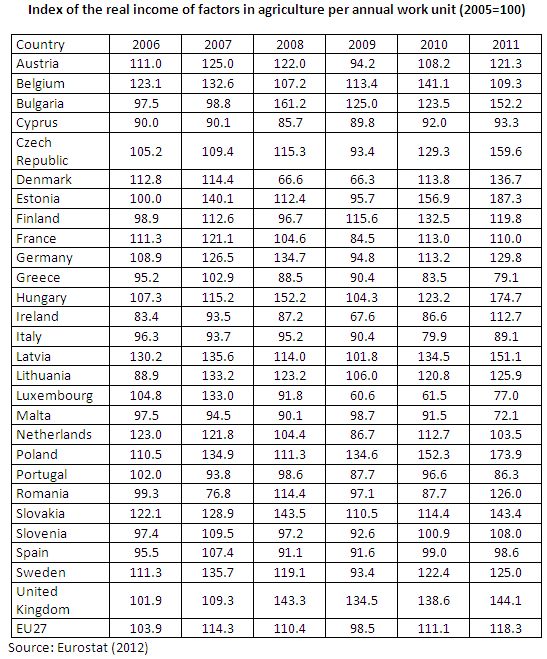
EU agricultural real income per worker has increased by 6.7% in 2011 compared to 2010 levels, according to initial estimates issued by Eurostat in 20 December 2011. This increase results from a rise in real agricultural income (+3.9%), due to higher commodity prices, together with a decline in the number of farm workers (-2.7%). Therefore it seems that the economic & food crisis together was beneficial for farm incomes in 2011. The first estimates also reveal that between 2005 and 2011, EU27 real agricultural income per worker have also increased (+18.3%), while agricultural labour input has fallen (-15.2%). Thereby it seems there is something like a longer trend here, underpinned by detailed country level data.

Without going very much into detail, it is apparent from the table that agricultural income has been increasing in each and every year in the majority of the cases. Except 2009, the peak of the economic crisis, agricultural real income per worker was higher in all years analysed than in 2005 in most EU-27 countries.… Read the rest

More on the European Innovation Partnership for Agricultural Productivity and Sustainability (EIP-A)

One of the themes of this CAP reform is the need for a major increase in research and innovation to address the urgent social challenges of providing more food in an environment of increasing land use competition and pressures on resources and the environment. Whether the Commission’s proposals actually deliver on this objective is still an open question.

Three instruments are envisaged in the Commission’s CAP reform proposals to support this agenda:
• Continued support in the Rural Development Pillar 2 for investment in physical assets, business development, cooperation for the development of new products, processes and technologies in the agriculture and food sector as well as a revamping of farmer advisory services to broaden their scope and improve their effectiveness.
• A new European Innovation Partnership instrument for agricultural productivity and sustainability (EIP-A) also in the Rural Development Pillar.
• Increased funding for agricultural and food research under the Commission’s Horizon 2020 research programme.… Read the rest

Changing global agricultural power

The Oxford Farming Conference which is held in the first week of January each year in the UK provides an opportunity for UK farming leaders to discuss the ‘big issues’ affecting the industry. This year, the Conference commissioned a report Power in Agriculture from the Scottish Agricultural College to examine the dynamics and implications of global agricultural power.

The purpose of the report was to examine where the economic, political and natural resource power currently lies in world agriculture, how that might change in the future, and what it means for British farmers. But the approach and findings clearly have a broader interest.

Sources of global agricultural power

The report raises three intriguing questions. What do we mean by global agricultural power? Why might it be important? And how can we measure it?

Power can be defined as the ability to persuade, compel or influence other actors to do something which benefits the actor or country exercising power.… Read the rest

Commission projects unchanged sugar market following quota elimination

Further details on the Commission’s expectations for the EU sugar market following the end of sugar quotas in 2015 are contained in its market outlook to 2020 publication published last month.

This medium-term outlook for the EU sugar market is based on a status quo assumption for agricultural and trade policy. The Commission notes that its CAP towards 2020 legislative proposal confirms the existing provisions on expiry of the regime after the marketing year 2014/15. Thus it argues that the policy assumption on the expiry of sugar quotas is in conformity with existing legislation.

In my own review of the legislative proposals I argued that the Commission’s decision not to propose an extension to the sugar quota regime after 2014-15 is a part of the 2013 CAP reform, on the grounds that this was the first time that the Commission had made its intentions clear. But formally the Commission is correct that the current legislation expires in September 2015 and would require a positive decision to extend it.… Read the rest

The Polish Presidency and Agriculture: A Mixed Performance

The 6-month tenure of the Polish Presidency came to an end in 31 December 2011. Although the Polish Presidency will mainly be remembered for finalising the EU Budget 2012 & adopting the ‘six-pack’ agreement, it also had some important results for agriculture. Such results include the informal agreement on the EU dairy package, the temporary solution for the ‘Aid for the Needy’ scheme for 2012 and 2013, the unanimous decision on the Green Paper on promotion measures and information provision for agricultural products, the compromise reached on biocides being more environmentally friendly and safer for user and the success of the Durban Climate Conference.

Moreover, a live debate has been started during the Polish Presidency on the Commission’s proposal package regarding the CAP post-2013, published in 12 October 2011. In their final meeting under the Polish Presidency, Agricultural Ministers did not support the Common Strategic Framework and the 5% performance reserve, but welcomed the general orientation of rural development measures.… Read the rest