
Why national co-financing of CAP Pillar 1 payments is needed in the MFF

There are few things that unite Agriculture Ministers more than their rejection of the idea of national co-financing of CAP Pillar 1 (P1) spending. In their first public discussion of the Commission’s November 2017 Communication of the future of the CAP post 2020 at the AGRIFISH Council meeting on 29 January, various agriculture Ministers, including France and Poland, explicitly made clear their opposition to national co-financing (as has Spain as reported here).

In early February, the Commission circulated a Communication ahead of the forthcoming European Council meeting on 23 February outlining the implications of different choices with respect to EU expenditure and financing in the forthcoming Multiannual Financial Framework (MFF). In his press conference at the end of the AGRIFISH Council meeting on 19 February, Commissioner Hogan explicitly drew attention, in a manner indicating his approval, to the fact that there was no mention of national co-financing of CAP P1 payments in this document, as had been the case in the previous Commission Reflection Paper of the Future of EU Finances.… Read the rest


Brakes removed from voluntary coupled support

I have previously written about the provisions for voluntary coupled support (VCS) in the 2013 CAP reform package in this blog post in 2015 entitled “Two steps forward, one step back: coupled payments in the CAP”. That post gives a historical overview of the gradual phasing out of coupled payments during the 2000s and the reversal of this process in the 2013 reform. In the recently-agreed Omnibus Agricultural Provisions Regulation (EU) 2017/2393, a significant relaxation of the conditions that Member States must meet in gaining approval for their VCS schemes was introduced. The negotiating history of this amendment is particularly opaque and sheds an interesting light on the secrecy and non-transparency of the trilogue process in which the Council and European Parliament, as co-legislators, try to reach agreement on legislative proposals.

In this post, I describe the changes introduced and assess their significance.

VCS in the 2013 CAP reform

To recap, the rules governing VCS following the last CAP reform were set down in the Direct Payments Regulation (EU) 1307/2103.… Read the rest

The ANC delimitation controversy continues

Last week it was the turn of farmers in the south-west of France to take to the streets to protest against the introduction of new maps of Areas facing Natural Constraints (ANCs). I have explained the background to this controversy in a previous post , which essentially revolves around how to define ANC category (b) areas which are described in the Rural Development Regulation 1305/2013 as “(b) areas, other than mountain areas, facing significant natural constraints.”

For years the European Court of Auditors criticised Member States for designating these areas (previously referred to as Less Favoured Area (LFA) intermediate areas) without proper documentary evidence. It also concluded that Member States often had very different interpretations of the delimitation criteria which in previous periods included socio-economic as well as bio-physical criteria, thus undermining common conditions of competition within the single market.

Already in the Rural Development Regulation (EC) No 1698/2005 it was agreed in principle that socio-economic criteria would no longer be used to designate intermediate LFA areas and a new definition of these areas was agreed.… Read the rest

Mr Oettinger’s budget arithmetic

Two events in the previous week give us a much clearer idea of what to expect for the CAP budget in the Commission’s proposal for the next Multiannual Financial Framework (MFF) at the end of May. Of course, the Commission’s proposal is only the start of the MFF negotiations. The MFF must ultimately be agreed unanimously by all Member States and (for the own resources decision) by their national parliaments, and also gain the approval of a majority in the European Parliament. Much can happen between the initial proposal and the final Council conclusions.

The two events in the previous week were Budget Commissioner Oettinger’s speech setting out his approach to the MFF proposal at a meeting in Brussels organised by the European Political Strategy Centre, the Commission’s in-house think tank, and his comments following the first presentation of his ideas to the Commission College.

Commissioner Oettinger states that he expects to make cuts of between 5-10% in both CAP and cohesion funding.… Read the rest

EU farm incomes in 2017

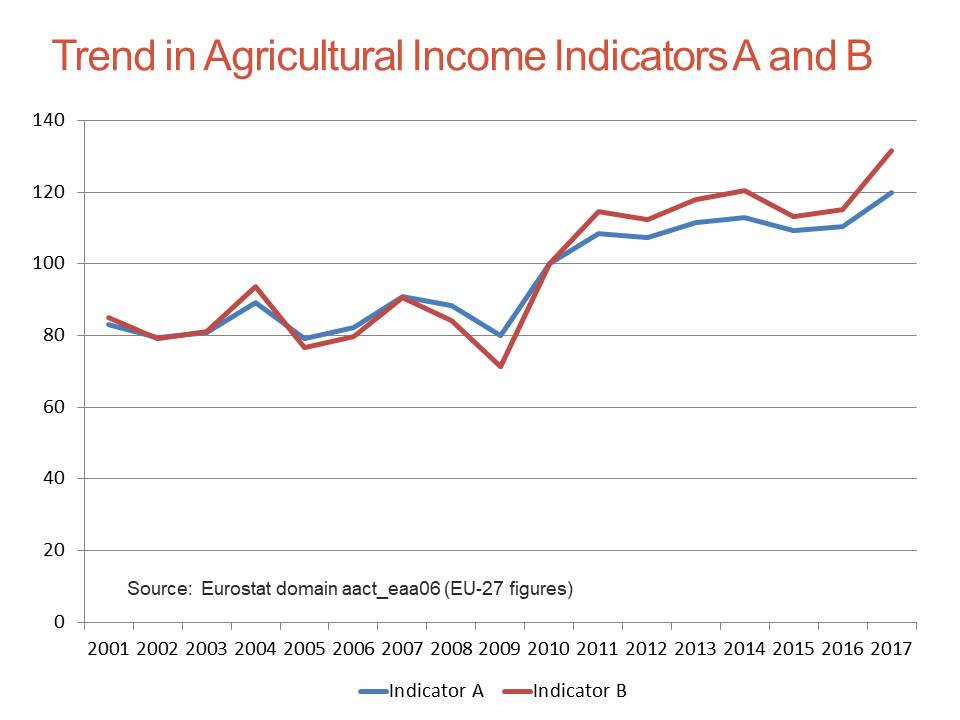
Eurostat has produced its first estimate of agricultural income in 2017, and it makes interesting reading. Both real agricultural income per Annual Work Unit (called indicator A in Eurostat terminology) as well as real agricultural entrepreneurial income per unpaid Annual Work Unit (Indicator B in Eurostat terminology) reached record levels (see chart below). This is surely something to be welcomed, even if COPA-COGECA did not issue a press release to draw attention to this fact. Across the EU as a whole, income from farming when divided among those working in the industry is in a robust state, even if the regular grumbling from industry representatives sometimes gives the opposite impression.

I discussed these income trends in detail this time last year in this post, so today’s post is an update. Just as a reminder, Indicator A corresponds to the real income of factors of production in agriculture, defined as net value added at factor cost, per Annual Work Unit.… Read the rest

Rethinking EU budget spending on agriculture in the next MFF

This post reproduces my key-note statement to the session More efficient use of scarce financial resources – An efficient Common Agriculture Policy and focussed structural Funds at the European Political Strategy Centre High Level Conference ‘Shaping our Future: Designing the next Multiannual Financial Framework’ which was held 8-9 January 2018 in Brussels. The delivered version was slightly abbreviated for time reasons.

The session was intended to reflect on more efficient use of scarce financial resources in the EU budget’s two largest spending categories – agricultural policy and structural funds. I expected my fellow panellists to have a lot to say about structural funds, so my presentation focused on agricultural policy.

The factual background

First, some background figures. CAP spending commitments including the Rural Development Fund make up 38% of the current MFF, just ahead of economic, social and territorial cohesion at 34%.

71% of CAP spending is currently devoted to Pillar 1 direct payments, hectare-based payments to all farmers with eligible land.… Read the rest