


European Council President Costa has now taken responsibility for finding agreement on the next Multi-annual Financial Framework EU budget and the accompanying Own Resources Decision from the Irish Presidency. The latter delivered its proposal for the negotiation box (‘negobox’) last month, you will find here my assessment of this proposal. On 21 November, President Costa delivered his first attempt to draft the European Council conclusions in advance of its meeting on 26-27 November next (the links to the proposal, together with the summary tables with the figures in current and constant prices, are included in the text of his press release accompanying the proposal).
Initial reactions in the first 24 hours to his proposal suggest there may still be some way to go. The strongest reaction so far has come from France, where the Élysée described the proposal as “deeply disappointing”. It noted that “It falls well short of what is needed, particularly on the Common Agricultural Policy, notably to guarantee income support for farmers. As it stands, this proposal from the President of the European Council does not provide a basis for an agreement.”
The online newsletter Rapporteur (formerly Euractiv) has a good roundup of reactions from both the frugal and friends of cohesion camps. Not surprisingly, the frugal camp with reactions from Sweden, Netherlands and Denmark, still consider the budget too high and unbalanced, while the friends of cohesion, in a statement from Poland, still want a greater allocation for agricultural and cohesion policies. One of the European Parliament’s lead negotiators on the budget, Siegfried Muresan, called the proposal unacceptable to the Parliament which is still holding out for an increase of 10% on the Commission’s overall proposal.
COPA-COGECA in a statement also rejected the proposal on the grounds that the proposed cuts in the Commission’s original MFF proposal remain while also listing a range of other grievances. These reactions reflect well-known positions and are par for the course at this stage in the negotiations as the different camps try to maximise their leverage in the final stages. The one area where there is agreement that some progress has been made is with respect to own resources (see below).
In this blog post, I compare President Costa’s proposed MFF budget with the Commission proposal and that of the Irish Presidency last month, with the focus on those aspects of most interest to agriculture. I also highlight some important modifications in the text of the MFF conclusions again with reference to agriculture. Finally, I discuss what the Costa proposal suggests in the way of own resources to help with the financing of the next MFF.
The expenditure side of the Costa MFF proposal
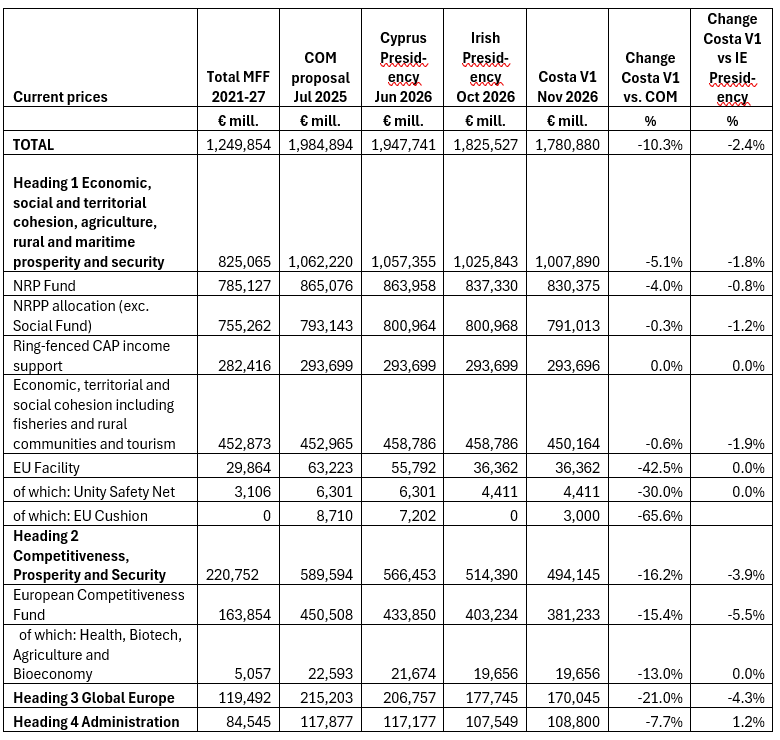
Table 1 shows the key MFF figures in the Commission proposal, successive versions of the negobox and now the Costa November 2026 proposal. The figures are presented in current prices as this allows a comparison with the corresponding figures in the current MFF (though with some caveats that I mention below). Percentages changes between the different versions are not changed whether we work in constant or current prices.
Source: Own table based on the official proposals.
The following changes can be highlighted in the Costa proposal:
- There are minor updates in the column showing the corresponding 2021-2027 MFF totals compared to the figures in the Irish Presidency negobox. An important caveat to note is that the comparative figure shown in the 2021-2027 MFF column for the CAP ring-fenced amount refers only to the CAP Pillar 1 commitments in this period. The table compares this with the minimum ring-fenced amount for “CAP income support” in the Commission proposal, but the latter also includes significant elements of CAP Pillar 2 commitments in the current period. The table thus gives the impression that there has been a slight increase in the CAP ring-fenced amount compared to the current CAP but this is a misleading comparison.
- The headline figure is that the Costa proposal reduces the overall MFF total by more than 10% compared to the Commission proposal and compared to an 8% reduction in the Irish Presidency negobox. This represents a further step towards accommodating the frugal camp’s demands. This has been achieved by hammering the EU Facility which is part of the NRP Fund (which is reduced by 43% compared to the Commission proposal, even though Costa has reinstated a small amount (€3 billion) for the EU cushion for unforeseen events compared to the Irish Presidency proposal).
- The Global Europe heading has also been further reduced representing a 21% cut compared to the Commission proposal, while the European Competitiveness Fund has been cut by 15%. Nonetheless, the totals for both of these headings are still significantly higher than the corresponding amounts in the current MFF in current prices.
- The National and Regional Partnership Fund (NRPF) is divided between the NRP Plan amounts and the EU Facility. The former corresponds to the pre-allocated funds received by Member States and are thus highly visible when countries calculate their net balance position vis a vis the EU budget. The great bulk of these funds are allocated to agriculture and cohesion including social objectives, with the balance allocated to fisheries and migration and internal security objectives, while a small amount is retained for technical assistance at the initiative of the Commission. Note that this pre-allocated amount in the Commission proposal (the NRPP envelope) is entered as €793.1 billion in the successive negobox proposals although the NRPF Regulation (Art. 10) includes the figure as €789.2 billion. The Costa proposal reduces this by nearly €10 billion compared to the Irish Presidency negobox, by cutting the unallocated amount for the NRP Plans (which would mainly be allocated to cohesion and social objectives but which can also be used to top up the CAP ring-fenced amount) by €8.6 billion and the Interreg allocation by €1.3 billion.
- The CAP ring-fenced amount in the Commission proposal remains unchanged (a minor reduction of €3 million though it is unclear what is going on here, in constant prices the Costa proposal is for an increase of €3 million compared to the Commission proposal!). However, what is not made clear in this table is that there is a significant increase in guaranteed CAP spending of a further €49.3 billion due to redefining the 10% rural development target (see below). This is a major achievement for agricultural stakeholders.
- The Costa proposal maintains the reduction in the Unity Safety Net introduced in the Irish Presidency negobox to be used to address agricultural market disruptions. It also maintains but does not cut further the reduction for the ‘Health, Biotech, Agriculture and Bioeconomy’ heading in the European Competitiveness Fund which will be used to support farmers and food businesses.
Agricultural issues in the draft MFF conclusions
I highlight the following issues. They are presented in the order in which they appear in the Costa text, with the one exception that I have brought forward the change in the definition of the 10% rural development target given its overall importance to the CAP funding debate.
- Conversion of the 10% rural development target announced by President von der Leyen in a non-paper in November 2025 into a guaranteed CAP envelope (paragraph 37). In her November 2025 non-paper, von der Leyen proposed that at least 10% of the NFPP financial envelope (excluding the ring-fenced amounts for the CAP and fisheries policy) should be dedicated to rural areas using the code 02 in the proposed Performance Regulation. In a previous blog post, I argued that, on the basis of the experience with rural targeting in cohesion policy, this rural targeting was largely unimplementable. The Costa proposal now clarifies that “At least 10 % of the global amount under the National and Regional Partnership Plans, excluding the minimum amounts for CAP and CFP interventions and financing under the Social Climate Fund, will be dedicated to CAP interventions”. This is a major victory for agricultural stakeholders in the negotiations. We should be clear that it is not all additional funding – under the Commission proposal, Member States are obliged to use some of the unallocated NRPP funding for CAP interventions that are not counted as income support under the new definition in the CAP Regulation. These are CAP measures such as co-operation (LEADER and EIP projects), school schemes, POSEI interventions, sectoral interventions, crisis payments and AKIS support. However, the Costa proposal now turns this into guaranteed CAP spending, with the requirement that at least 10% of the NRPP financial envelope less CAP and fisheries ring-fenced funding should be allocated to CAP interventions. Based on the figures in the Costa proposal, this amounts to an additional €49.3 billion in guaranteed CAP spending in current prices.
- Some weakening of the inflation adjustment mechanism in the Commission proposal (paragraph 6). The Costa proposal reads: “There will be automatic annual technical adjustments for inflation using a deflator of 2 %. Where the average annual inflation rate over the three-year period comprising years n-1, n and n+1 is below 1 % or above 3 %, the adjustment for year n+1 will be modified by 50 % of the difference between that three-year average inflation rate and the 2 % reference rate.” The Commission proposal proposed an adjustment based on the forecast inflation in the relevant year. Costa introduces a three-year average and only adjusts the deflator by half the deviation from 2%.
- Some potential weakening of the ‘Do No Significant Harm’ (DNSH) principle (paragraph 25). The principle requires that EU spending does not cause significant harm to any of the six environmental objectives defined in the EU Taxonomy Regulation (Regulation (EU) 2020/852). Removing the application of this principle to the CAP has been one of the targets for COPA-COGECA. The paragraph commits that “The ‘do no significant’ harm principle will be applied transparently and proportionally, where feasible and appropriate, in full consistency with the Regulation on the Performance Framework. A guidance on the principle’s streamlined application should be adopted by means of an implementing act under the examination procedure, following close consultation with the Member States. The guidance should identify policy areas or intervention fields that are deemed compliant with no further assessment”. Although the text introduces an explicit commitment to apply the DNSH principle, it qualifies this principle through the terms “where feasible and appropriate” and provides for streamlined guidance identifying fields that require no further assessment. It also gives Member States a formal role through the examination procedure.
- There is a guarantee (paragraph 49) that, in the event of late adoption of the MFF, appropriate measures should be taken to ensure income support to farmers from and including the year 2028.
- The mandate for the Unity Safety Net has been extended (paragraph 54). The Commission for some time has been trying to rein in the use of the agricultural reserve to address crises that are not due to market disturbances (see my blog post on the management of agricultural crises from August last year). It has wanted responsibility for responding to natural disasters to remain with Member States, to be addressed initially by reallocating funding within their National Plans, and then calling upon the flexibility amounts in the NRPP financial envelope. Member States have consistently pushed back against this, for example, deleting this idea from the Simplification Regulation. Here, the Costa proposal is explicit that the EU Facility includes a Unity Safety Net “to respond to market disturbances, stabilise agricultural markets and mitigate the impact on farmers and fishers caused by natural disasters”.
- Further clarification of area-based income support (paragraph 60). As I noted in my blog post on the Irish Presidency negobox, the range for the average DABIS payment per hectare has been increased from €90 to €240. Malta’s concerns have been addressed by allowing countries with an average farm size below 3 hectares to increase their DABIS payment above €240 per hectare.
- Degressivity and capping (paragraphs 61-64). As foreseen in the Irish Presidency negobox, the degressivity thresholds are significantly increased compared to the Commission proposal and degressivity is left voluntary for Member States (including an option to introduce further thresholds below the first threshold of €100,000, but as the deduction for the first threshold is limited to 15%, this is hardly significant). However, in a modification of the Irish Presidency proposal, the capping limit of €300,000 is made mandatory, with only area-based income support payments for young farmers excluded. In my previous blog post discussing the Irish Presidency proposal, I referred to the Presidency’s proposal as “hollowing out” the Commission proposal. The mandatory nature of capping at €300,000 (compared to the Commission proposal of €100,000) may be a small step, but I do not expect it to survive the subsequent European Council negotiations as it disproportionately affects a small number of Member States with powerful large farm interests.
- The decommitment period is extended by one year to the end of the second year following the budget commitment (paragraph 85). There is a specific exemption from this rule for certain CAP interventions but I have been unable to find what alternative rules apply and to which interventions. It is not clear if it is intended to revert to the n+3 decommitment rule for Pillar 2 rural development interventions that applied in the 2014-2022 programming period or to tighten the decommitment period for these interventions to n+1.
The Costa proposal for own resources
To recap, the existing own resources to finance the MFF are four-fold
- Traditional own resources, mainly import duties on imports from outside the Union, with 25% remaining with Member States to cover collection costs.
- VAT-based resource with a uniform call rate of 0.3%.
- A plastics-based resource introduced in 2021 based on the quantity of non-recycled plastic packaging waste generated in each Member State at a uniform rate of €0.80/kg.
- The Gross National Income (GNI)-based resource which is calculated as the residual once the revenues from the other three resources are deducted from the financing requirement.
The Costa proposal includes the following:
- Reducting the rebate for collection costs of traditional own resources from 25% to 10%.
- Increasing the call rate on non-recycled plastic from €0.8 to €1.25/kg.
- New own resources consisting of:
- A digital services tax
- A tax on tobacco products
- A tax on non-collected electronic waste
- A 30% call rate on auction revenues generated by the Emissions Trading Scheme (with the remaining 70% remaining with Member States)
- A 100% call rate on CBAM revenues
- A proposal to work towards a tax on crypto assets.
The Costa proposal also confirms the Commission proposal to eliminate national rebates.
It is relevant to point out that the tax on non-recycled plastic packaging is not a tax imposed directly on producers or consumers of plastic packaging. It is a contribution paid by Member States to the EU budget, calculated using national waste statistics. One presumes that the proposed taxes on tobacco consumptions and electrical waste would be calculated in the same way. As these taxes are paid directly from national budgets, the difference with the GNI resource is only the distribution key between Member States, not the perceived fiscal contribution of Member States.
Conclusions
The European Council debate on the MFF conclusions on 26-27 November next will reveal the usual fractures between the frugal camp and the friends of cohesion. All reactions to the Costa MFF proposal must be seen in the light of the inevitable endgame positioning of the different camps. However, earlier this month Chancellor Merz threw another unknown into the mix by threatening to block agreement on the budget unless all Member States commit to financing Ukraine beyond 2027. Czechia, Slovakia and Hungary were granted exemptions from financial obligations and budget guarantees for the most recent Ukraine loan of €90 billion which was agreed under the enhanced cooperation procedure. Bulgaria has also indicated that it will not participate in or financially guarantee the new loan of €45 billion that the Commission has proposed. How this issue will be resolved is at the moment not clear. The status of the debate on new own resources also remains unclear.
Reflecting on the implications of the Costa proposal for the agricultural sector, the proposal that 10% of the NRPP financial envelope excluding the minimum amounts already guaranteed for the CAP and fisheries will be additionally guaranteed for the CAP is a major change in funding. Adding €49 billion to the ring-fenced amount of €294 billion means a guaranteed CAP budget of €343 billion. To this, Member States have the option to add up to a further €45 billion from the mid-term flexibility amount for the CAP or measures for rural areas if they so wish, while also further adding to the CAP budget from the unallocated NRPP amount also if they so wish. It is hard to understand why France and COPA-COGECA seem unable to recognise these gains.
The significance of these flexibilities will differ between Member States, depending on the relative share of the ring-fenced CAP budget in their overall NRPP financial envelopes and thus the absolute size of the unallocated amounts. For a country like Ireland, where the unallocated amount in the NRPF financial envelope is small, so will be the additional amounts made available by these changes. But for countries like Italy and Poland, where the unallocated amounts are substantial relative to the CAP ring-fenced amount, these changes will add significantly to the amounts available for transfers to farmers.
But while the budget for farmers has been increased in the Costa proposal, we can fear for the way in which these funds will be used. While the lower threshold for the range of the DABIS payment has been further lowered from €130 to €90 per hectare, the higher threshold will allow the majority of Member States to increase area-based income support payments to farmers if they wish, thus greatly squeezing the potential funding for investment support, agri-environment-climate schemes, and risk management. There is no proposal to ring-fence a share of the CAP budget for agri-environment-climate schemes, although this would be more appropriate to include in the CAP Regulation (decided by co-decision) rather than in the MFF conclusions (where the Parliament only has the power of consent). The requirement to allocate at least 10% of the unallocated NRPP amount to CAP interventions does not limit this to rural development interventions, it can equally be used to increase the DABIS payment. Further, the hollowing out of degressivity means that much of the area-based income support will continue to go to larger farms with unclear income needs. While mandatory capping, albeit at a level of €300,000, may be seen as a positive step by those seeking a more equitable distribution of income support payments, I doubt that it will survive the European Council discussions.
This post was written by Alan Matthews.
Photo credit: Wikipedia.

