


The Irish Presidency has yesterday published its proposal for the MFF 2028-2034 negotiating box (‘negobox’) for consideration by the General Affairs Council on 13 October and the European Council summit on October 15-16. The negobox builds on the Commission’s MFF Regulation proposal but reduces its overall size by 8% compared to that proposal.
The MFF negotiations are always a tug-of-war between the Friends of Cohesion (mainly net recipients from the EU budget, in favour of an increased EU budget and supportive of both the Commission proposal and maintaining spending on traditional areas of agriculture and cohesion) and the Frugals (all net contributors to the EU budget, seeking a significant reduction in the size of the budget compared to the Commission proposal and in favour of modernising the budget by switching expenditure from the traditional areas to competitiveness, industrial policy, the green transition and security (read the Friends of Cohesion position here and the Frugals position here).
In this post, I examine the overall numbers and what they mean for CAP spending. I also look at some of the other financial provisions in the negobox that affect agricultural spending, including the significant amendments to degressivity and capping of the new DABIS payment as well as to con-financing.
The overall picture
Whereas the Cyprus Presidency negobox proposal had proposed minimal changes to the Commission’s MFF proposal with an overall reduction of less than 2%, the Irish Presidency has taken a tougher line and proposes a cut of 8%. Tables 1 and 2 show the main figures relevant to agricultural stakeholders in the Presidency’s proposal in constant 2025 prices and current prices, respectively, which enables us to see where the main reductions have been made.
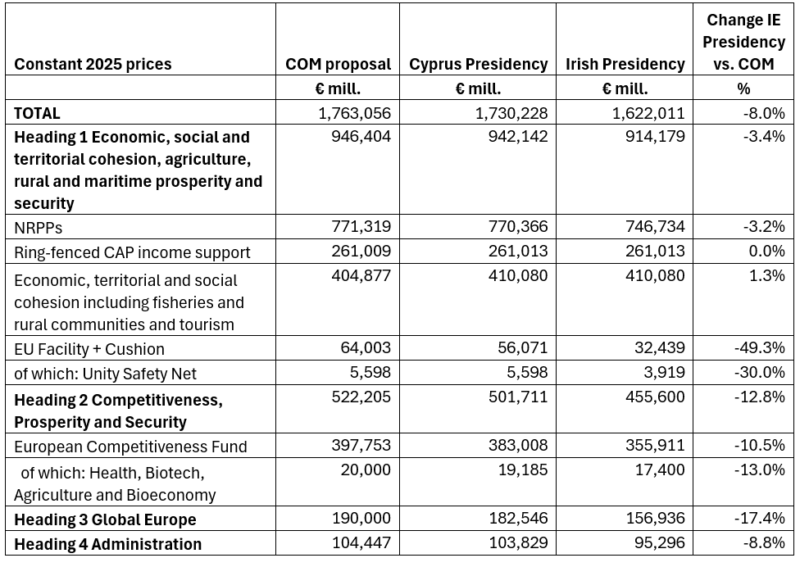
Sources: Cyprus Presidency negotiating box 11 June 2026, Council document 10058/26; Irish Presidency negotiating box 10 October 2026, Council Document 13922/26.
Focusing first on the four MFF headings, this overall reduction is disproportionately made in Heading 3 Global Europe (-17.4%) and Heading 2 Competitiveness, Prosperity and Security (-12.8%). Heading 4 Administration is cut in line with the overall cut (-8.8%), while Heading 1 which includes the traditional areas of agriculture and cohesion has the smallest reduction (-3.4%). Within Heading 1, the envelope for the National and Regional Partnership Plans faces a reduction of -3.2% relative to the Commission proposal.
However, this gives a misleading impression because the EU Facility is included under the NRPP heading in the Commission’s presentation. These are not pre-allocated funds to Member States to be programmed in their NRP Plans. When we look at the expenditure items that are pre-allocated, we see a different story. The totals for minimum CAP income support spending (along with home affairs and Interreg) remain unchanged from the Commission proposal, cohesion spending gets a small increase, while the minimum allocated to fisheries is doubled. The increase in cohesion spending reflects a commitment added in the Cyprus Presidency negobox to increase the general NRPP allocation by €5,203 million for Member States who benefited from the Cohesion Fund in 2021-2027 (para. 65).
This increase in pre-allocated spending is then more than offset by the proposed reduction in the allocation to the EU Facility (where the amount reserved for the Facility cushion for emerging challenges and priorities has been eliminated entirely) which in the Irish Presidency draft is halved (-49.3%). From the point of view of farmers, this cut in the EU Facility has also reduced the amount allocated to the Unity Safety Net by -30%. Finally, the funding allocated in the European Competitiveness Fund for the field ‘Health, Biotech, Agriculture and Bioeconomy” has also been reduced by -13%.
Table 2 shows the same figures in current prices. The percentage changes in the final column are of course the same as for Table 1, but the current price values can be more meaningful for interpretation. In particular, they allow a comparison with 2021-2027 spending on current prices. This makes clear, for example, that the increase in the agricultural crisis reserve from €450 million annually to €900 million annually as the Commission had proposed is reduced to €630 million annually under the Irish Presidency proposal.
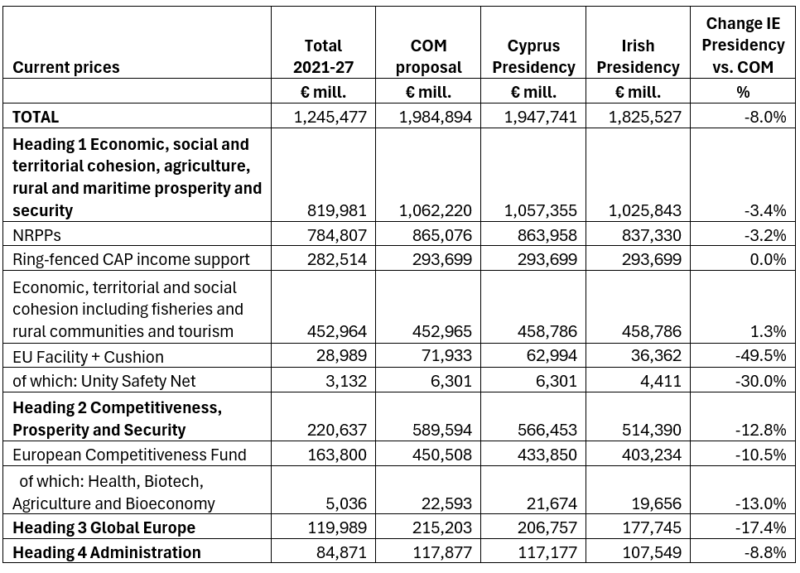
Source: As for Table 1.
Specific agricultural issues – degressivity and capping
The most significant changes modify the Commission proposal for the DABIS payment, in five ways:
- The permitted range for the planned average aid per hectare for area-based income support has been set at between €90 and €240 per hectare (para. 58). The square brackets in the Cyprus Presidency text have been removed, meaning that political agreement has been reached on these figures. The lowering of the lower bound (from €130 per ha in the Commission proposal) reflected demands from some Member States that wanted greater flexibility to be able to use their CAP income support allocation for other CAP interventions. There is a placeholder to address the concerns of Member States (read, Malta) whose payment per hectare lies outside this range in the 2021-2027 programming period.
- The Commission’s ambitious targeting proposal for DABIS has been completely hollowed out, and the paragraph itself remains in square brackets (para. 59), suggesting that the ‘D’ in DABIS still remains contested. Instead of degressivity starting at €20,000 with steps of 25%, 50% and 75%, and with capping at €100,000, the Irish Presidency draft suggests degressivity should start with a deduction of 15% for amounts between €100,000 and €125,000, a deduction of 25% for amounts between €125,000 and €150,000, and a deduction of 50% for amounts above €150,000. As a small concession to better targeting, the draft proposes that Member States may introduce additional points on a degressive scale below €100,000, but presumably the deduction rate would have to be less than or at most equal to 15%. Note that all of these specific figures, as well as the paragraph as a whole, remain in square brackets indicating that they are still subject to further change and that the notion of degressivity itself could still be dropped.
- The draft proposes that capping for large beneficiaries would be introduced at a figure of €300,000, and on a voluntary basis (with both the specific figure and the voluntary nature of capping in square brackets indicating further changes may occur) (para. 60). There is no reference to the deduction of labour costs.
- Before applying capping and degressivity, Member States may exclude higher area-based income support for young farmers (young farmer top-up) (para. 61). Interestingly, there are no square brackets here, suggesting that degressivity in some form would be introduced. This exclusion of payments to young farmers is left optional for Member States.
- Whereas the Cyprus Presidency draft recognised that the amounts resulting from degressivity and capping would remain part of the amount available for CAP income support, the Irish Presidency goes further in clarifying that these amounts would not require complementary national contributions when used for other CAP interventions.
Specific agricultural issues – national contributions or co-financing
The Irish Presidency draft advances on the Cyprus negobox draft in several ways.
- We have just noted that funds released through degressivity and capping of the DABIS payment can be applied to other CAP interventions without a requirement for national financing.
- The Union co-financing (national contribution) rates for the different regional categories are no longer in square brackets meaning political agreement has been reached on national contribution rates of 15% for less developed regions, 40% for transition regions and 60% for more developed regions as in the Commission proposal.
- A new concession is that Member States composed of a single region (of which there are five: Estonia, Cyprus, Latvia, Luxembourg and Malta) which have changed category compared to the 2021-2027 MFF from transition to more developed region may choose to apply a Union co-financing rate of 60% (that is, the lower national contribution rate of 40%).
- A Union co-financing rate of 100% is now proposed for certain interventions in POSEI regions, which should be financed from the unallocated part of the NRPP Fund of the relevant Member State, and a rate of 85% for other interventions.
- The Commission proposal for 100% Union financing of the DABIS payment, coupled income support, crop specific payment for cotton and support for small farmers is confirmed. This will also apply to the amounts up to two thirds of the amount available for the mid-term review if they are used to finance these CAP interventions.
- Otherwise, the maximum Union co-financing rate (minimum national contribution rate) is confirmed at 70% (30%) for other interventions financed from the ring-fenced CAP income support amount.
- Another significant concession is that CAP interventions related to LEADER, support for knowledge- sharing, territorial and local cooperation, and interventions in smaller Aegean islands, as well as financing from outside the minimum amount for CAP income support interventions, Member States may apply CAP co-financing rates or standard Union co-financing rates. This will benefit countries with transition or more developed regions where otherwise the relevant regional contribution rates (either 40% or 60%) would apply. These countries can now opt for the standard 30% contribution rate if they wish. This reflects concerns by some Member States that their regions are so fiscally constrained that they would not be able to afford the higher regional contribution rates proposed.
Other MFF issues relevant to agricultural stakeholders
Here are some other issues that are worth highlighting from an agricultural perspective.
- The general allocation key for the distribution of the overall NRPP pre-allocated amount in the MFF between Member States has been agreed exactly as the Commission proposed it (apart from the small additional payment to those States which received Cohesion Fund support in 2021-2027). I find it surprising that there has not been more political bargaining around this formula. Although the Commission figures show a small (1.5%) increase in current prices in the total pre-allocated amount under the general heading of the NRPP (essentially, the sum of the minimum CAP ring-fenced and fisheries amounts and the amount allocated to cohesion, fisheries and rural communities) between the 2021-2027 MFF and its 2028-2034 proposal, the general key which distributes this money between Member States leads to some redistribution of this overall amount. The extent of this redistribution is limited by a cap and safety net which means that no Member State’s allocation share is lower than 80% or higher than 105% of its 2021-2027 allocation share of relevant pre-allocated funds under shared management. Still, a potential fall of 20% in pre-allocated funding in current prices is quite significant. Yet there has been almost no debate about the appropriateness of this formula or its parameters. The relevant paragraphs in both the Cyprus and Irish Presidency negoboxes are included without square brackets. The significance from an agricultural perspective is that the gap between a country’s minimum ring-fenced CAP amount (including its potential increase from the Mercosur concession) and its NRPP Fund envelope determines the scope for further increases in a country’s CAP budget (the argument is spelled out in more detail in my previous post on this blog).
- The proposal to introduce an inflation adjustment for the MFF deflator of 2% is still in square brackets, so not yet agreed.
- The von der Leyen proposal to ring-fence 10% of the NRPP Fund envelope (excluding the ring-fenced amounts for CAP, fisheries and the Social Fund) to be dedicated to rural areas is now confirmed (square brackets on the 10% figure are removed). While the von der Leyen letter referred to investment in rural areas, there is no definition of what “dedicated to rural areas” might mean in practice. There is no explanation how his target will be monitored in the Presidency draft (I have previously argued in a previous post on this blog that monitoring this target will not be possible).
- We can also highlight the dogs that did not bark. There is no proposal for a minimum ring-fencing for young farmers, for agri-environment-climate actions, or for LEADER, though such minimum allocations can be introduced in the CAP Regulation without necessarily being mentioned in the MFF conclusions.
- The decision to hold back 25% of the NRPFF envelope as a flexibility amount for crisis interventions and the mid-term review has now been confirmed with square brackets removed. I always saw this as vulnerable to being reduced because it essentially freezes a significant share of a country’s NRPP envelope which cannot be programmed until mid-way through the programming period or later, introducing considerable uncertainty (although up to 10 percentage points of that amount is now available to be used for CAP interventions at the beginning of the period). Nonetheless, the figures have now been confirmed.
- A new sentence confirming that “[the Union’s] commitment to Ukraine is central to our overall ambitions” has been included in the opening paragraph. This is linked to the creation of a Ukraine Reserve of €100 billion in current prices over and above the MFF ceilings, the amount of which has not been altered under the Presidency drafts. I welcome this insertion by the Irish Presidency.
Conclusions
The Irish Presidency negobox is certainly not the last word in the difficult MFF negotiations. Not only does the disagreement between the Friends of Cohesion and the frugal states over the size and allocation of the budget continue. Very limited progress has been made on finding ways to finance an increased budget from new own resources, although the Irish Presidency draft includes some suggestions. No provision for rebates for net conributors has been included which may also be controversial. Nonetheless, some tentative conclusions can be drawn.
The Presidency draft continues the process of “splitting the difference” between the two factions by proposing an overall 8% cut in the MFF budget relative to the Commission proposal. From an agricultural perspective, the core funding (the minimum ring-fenced amount) has not been touched, nor has the overall size of the NRPP envelope been reduced (which influences the scope for adding to the minimum ring-fenced CAP amount). However, reductions are proposed both in the Unity Safety Net (intended as the crisis reserve for agricultural market disruptions) and in the allocation for agriculture and the bioeconomy in the European Competitiveness Fund.
The Commission’s proposal for greater targeting of area-based payments has, once again, been gutted. Recall that, under the current CAP Strategic Plans Regulation, Member States may introduce degressivity from €60,000 by up to 85%, and introduce a cap at €100,000, with the possibility to deduct labour costs before applying either degressivity or capping. This is voluntary for Member States and only a minority introduced either degressivity or capping or both. At the same time, there is a mandatory obligation on Member States to allocate at least 10% of their adjusted direct payments allocation to the redistributive payment for smaller farms.
The trade-off under the Irish Presidency draft is that, in return for making degressivity mandatory, without any reference to labour costs, the thresholds have been greatly increased and the deduction rates greatly decreased. Capping, meanwhile, might be implemented at a ceiling of €300,000 but could still remain voluntary. At the same time, while under the draft CAP Regulation Member States can differentiate their DABIS payment to allow redistribution towards smaller farms, there is no obligation on them to do this. Certainly, those who have advocated for greater targeting (including the Commission) have little to cheer about in this part of the of the draft negobox.
On the other hand, the concessions on national contribution rates will be welcomed by countries with transition or more developed regions as it will lower the burden on regional budgets when drawing down EU funds.
As noted, the Irish Presidency draft is only an intermediate step to concluding the MFF negotiations but it may not be too far from the final compromise. The weakness of the Friends of Cohesion group is that they need the agreement of the net contributors to the EU budget in the Frugals group to increase their transfers to the EU budget. To understand the likelihood of different outcomes, we need to understand the consequences of no agreement. Here, the rules are quite clear. If no new MFF is agreed by the end of the current MFF programming period, then the final year of the current MFF is simply rolled over. If you are a Friend of Cohesion and only interested in expenditure on agriculture and cohesion, this leaves you with the same outcome in budgetary terms as the Irish Presidency proposal (and it also avoids the governance changes such as the merging of the agriculture and cohesion funds that many of these countries are not enthusiastic about). From the perspective of the Frugals, no agreement means they fail to achieve any modernisation of the EU budget they so passionately desire, as well as any of the perceived benefits of the new governance structure. In that bargaining game, it seems to me the outcome will be closer to the preferences of the Friends of Cohesion because they are favoured by the disagreement point or the payoff if negotiations break down completely.
This post was written by Alan Matthews.
Photo credit: Irish EU Presidency
